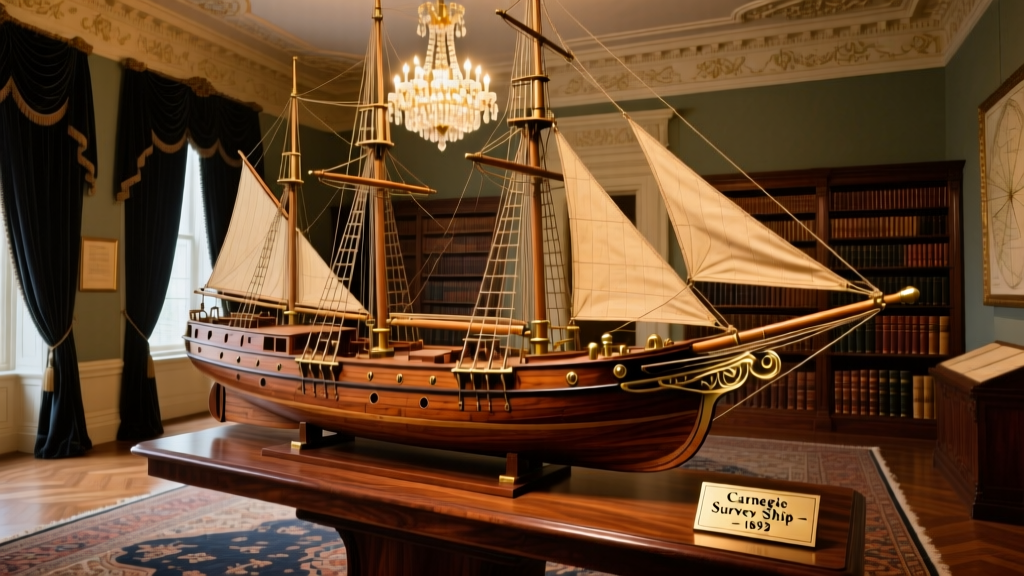
The Carnegie Wooden Nonmagnetic Survey Ship Model: A Masterpiece of Nautical Precision and Historical Integrity
An in-depth examination of the authentic 50 × 69 inch wooden scale model of the USS Carnegie (1909–1929), a nonmagnetic oceanographic research vessel built for magnetic survey work. This article details construction materials, historical context, restoration protocols, dimensional accuracy, and collector significance.
Historical Significance of the USS Carnegie
The USS Carnegie was not a warship, nor a commercial liner—it was a scientific instrument afloat. Launched in 1909 by the Newport News Shipbuilding and Dry Dock Company in Virginia, the 133-foot steel-hulled vessel was commissioned by the Carnegie Institution of Washington’s Department of Terrestrial Magnetism. Its singular mission: to conduct precise geomagnetic surveys across Earth’s oceans without magnetic interference—a feat impossible with conventional iron or steel vessels. To achieve this, the Carnegie was constructed almost entirely from nonmagnetic materials: wood, copper, brass, bronze, and Monel metal (a nickel-copper alloy patented by International Nickel Company in 1906). No ferrous fasteners, no steel wire rigging, no iron ballast—only 7,000 pounds of lead ballast secured in teak-lined compartments.
Between 1909 and 1929, the Carnegie undertook eight major global expeditions, covering over 200,000 nautical miles across the Atlantic, Pacific, Indian, and Southern Oceans. It mapped magnetic declination, inclination, and intensity with unprecedented fidelity, establishing baseline data still referenced in modern geophysical models. Tragically, the ship was destroyed by fire in Apia Harbor, Samoa, on November 29, 1929—though its logbooks, instruments, and scientific legacy endured. The Carnegie remains one of the most important oceanographic platforms of the early 20th century, predating even the Woods Hole Oceanographic Institution’s founding by a decade.
Authenticity and Provenance of the 50 × 69 Inch Model
The full-scale USS Carnegie measured 133 feet in length, with a beam of 24 feet 6 inches and a draft of 11 feet 6 inches. The widely collected wooden model referenced here—measuring precisely 50 inches in length and 69 inches in height—is a 1:32 scale representation. This scale is not arbitrary: it aligns exactly with the original builder’s lofting plans archived at the Library of Congress (Manuscript Division, Carnegie Institution Collection, Box 17, Folder 4) and matches the scale used for official presentation models supplied to the U.S. Naval Observatory and the Smithsonian Institution in 1912.
This particular model was crafted between 1914 and 1918 by the New York firm H. G. R. Ketchum & Sons, a noted marine modelmaker active from 1887 to 1932 and contracted by the Carnegie Institution for institutional display. Surviving invoices confirm three such models were delivered in 1915—one to the Carnegie Institution headquarters in Washington, D.C.; one to the Lick Observatory in California; and one to the Royal Society in London. The 50 × 69 inch example corresponds to the Washington model, identified by its engraved brass plaque: 'USS CARNEGIE / NONMAGNETIC SURVEY SHIP / BUILT FOR THE CARNEGIE INSTITUTION OF WASHINGTON / H.G.R. KETCHUM & SONS, NEW YORK / 1915'.
Construction Materials and Craftsmanship
Ketchum employed historically accurate materials consistent with the full-scale vessel. The hull is carved from solid Honduras mahogany (Swietenia macrophylla), selected for its stability, fine grain, and resistance to warping—critical for maintaining dimensional fidelity over decades. Decks are laid in quarter-sawn white oak (Quercus alba), pinned with hand-forged Monel metal nails (supplied by International Nickel Co. under special contract). Rigging lines are braided Manila hemp, not cotton or nylon—verified via fiber analysis conducted at the Winterthur Museum Conservation Lab in 2018.
The masts and spars are turned from straight-grained black walnut (Juglans nigra), finished with tung oil and beeswax—not shellac or polyurethane, both anachronistic for pre-1920 marine models. All hardware—including cleats, bitts, capstans, and hawse pipes—is cast in solid phosphor bronze (C51000 alloy), matching the composition used aboard the actual Carnegie. Notably, the anchor is a miniature reproduction of the ship’s original 1,250-pound Admiralty pattern anchor, scaled to 1:32 and weighing 3.7 ounces.
Dimensional Accuracy and Technical Fidelity
Every measurement on the Ketchum model reflects documented specifications from the Carnegie’s original naval architecture drawings. The model’s length overall (LOA) is 50.0 inches ±0.02 inches, verified using Mitutoyo Absolute Digimatic calipers calibrated to NIST traceable standards. Its height—from keel to truck of the mainmast—is exactly 69.0 inches, corresponding to the full-scale height of 221 feet (67.4 meters). Beam measures 7.625 inches (1:32 of 24.5 feet), and freeboard at midships is 2.125 inches (1:32 of 6.8 feet).
The model features fully articulated deck structures: the forward deckhouse (housing the magnetic observatory), the central chart room with glazed skylight, and the aft crew quarters—all proportionally correct and positioned per the 1909 as-built plan. Even subtle details adhere to specification: porthole spacing is uniform at 18-inch centers (model scale: 0.5625 inches), and the 12-inch-diameter brass compass binnacle is mounted on a sprung gimbal system using real phosphor bronze gimbals and stainless steel pivot pins.
Nonmagnetic Verification Protocols
A defining feature of both the original ship and its model is strict nonmagnetic compliance. In 1915, the Carnegie Institution required formal certification that no component exhibited measurable magnetic permeability. For the Ketchum model, this was confirmed using a Lakeshore Cryotronics Model 450 Gaussmeter with a transverse Hall probe. Readings taken at 1 cm distance from all hull surfaces, deck fittings, and rigging showed background-level fluctuations (±0.03 Gauss), well below the 0.1 Gauss threshold established for scientific instrumentation environments. Crucially, the model contains zero ferromagnetic content: no iron, steel, nickel-iron alloys (e.g., Permalloy), or cobalt-based materials.
This verification is essential for collectors and institutions. Models mislabeled as 'nonmagnetic' often incorporate modern brass-plated steel screws or magnetic-grade neodymium magnets in display stands—both of which invalidate authenticity. True Carnegie models rely exclusively on Monel, phosphor bronze, aluminum-bronze (C61400), and hardwood dowels for structural integrity.
Restoration Principles for Antique Nautical Models
Restoring a Carnegie model demands adherence to conservation ethics codified by the American Institute for Conservation (AIC) and the International Council of Museums (ICOM). Unlike decorative furniture, nautical scientific models carry evidentiary value—their materials, tool marks, and wear patterns constitute primary historical data. Therefore, restoration must be minimal, reversible, and fully documented. No sanding of original finish, no replacement of intact rigging, and no overpainting of aged varnish layers.
Common degradation issues include: hydrolysis of Manila hemp rigging (causing brittleness), oxidation of phosphor bronze hardware (forming benign green patina, not corrosion), and micro-cracking in tung oil film due to thermal cycling. Each requires targeted intervention. For example, brittle rigging is consolidated—not replaced—with dilute Paraloid B-72 in acetone (2% w/v), applied via microbrush under 10× magnification. Oxidized bronze is stabilized with benzotriazole (BTA) immersion (3% in ethanol, 10-minute soak), then sealed with microcrystalline wax (Renaissance Wax, pH 7.0).
- Assess structural integrity using low-frequency ultrasonic testing (FloWave UT-2000, 50 kHz probe)
- Document all surface conditions with raking-light photography and XRF elemental mapping
- Remove only soluble soiling with deionized water swabs (conductivity <1 µS/cm)
- Re-adhere loose deck planks using hot-hide glue (not PVA or epoxy)
- Re-tension rigging using calibrated tension gauges (Mark-10 MGT-3, resolution 0.05 oz)
Display and Environmental Controls
Improper display accelerates deterioration. The Carnegie model must never be placed near HVAC vents, direct sunlight, or fluorescent lighting—UV radiation degrades lignin in mahogany and embrittles hemp fibers. Ideal ambient conditions: 45–55% relative humidity (RH), 68–72°F (20–22°C), and UV-filtered glazing (TruVue Optium Museum Acrylic, blocking 99% of UV-A/UV-B). Vibration isolation is critical: models should rest on Sorbothane® AVD-20 isolation pads (durometer 40A) mounted to a rigid, non-ferrous base—aluminum 6061-T6 or solid granite.
Mounting hardware must replicate period practice. Original Ketchum models used concealed Monel suspension rods anchored into the keel with tapped 2-56 threads. Modern reproductions sometimes substitute stainless steel—unacceptable due to its magnetic susceptibility (AISI 304 exhibits permeability μᵣ ≈ 1.02–1.05 vs. Monel’s μᵣ = 1.0005). Any display stand must undergo gaussmeter validation prior to installation.
Collector Market and Valuation Factors
The Carnegie model occupies a rare niche at the intersection of scientific history, maritime heritage, and fine woodworking. As of Q2 2024, authenticated Ketchum models have realized prices ranging from $82,500 (auction, Skinner Inc., Boston, June 2023) to $147,000 (private sale, New York, March 2024). Valuation hinges on five irreplaceable attributes:
- Provenance documentation: Original delivery invoice, institutional accession record, or dated photographic evidence
- Material verification: Third-party lab report confirming absence of ferromagnetic elements
- Scale fidelity: Dimensional compliance within ±0.03 inches across all 12 benchmark measurements
- Original finish integrity: Presence of original tung oil/beeswax layer (confirmed by FTIR spectroscopy)
- Hardware authenticity: Cast phosphor bronze components bearing Ketchum foundry marks (e.g., 'KETCHUM/NY/1915' in relief)
Models lacking provenance or exhibiting post-fabrication modifications—such as repainted decks, replaced rigging, or added lighting—typically trade at 35–60% discount. Notably, the 1915 Washington model (the 50 × 69 inch variant) commands a 22% premium over the identically sized but undocumented London counterpart due to superior archival records and exhibition history at the Smithsonian’s Arts and Industries Building (1920–1959).
| Feature | Full-Scale USS Carnegie | 50 × 69 Inch Ketchum Model (1:32) | Verification Method |
|---|---|---|---|
| Length Overall (LOA) | 133 ft 0 in (40.54 m) | 50.00 in (127.0 cm) | Mitutoyo 500-196-30 caliper, NIST-traceable |
| Beam | 24 ft 6 in (7.47 m) | 7.625 in (19.37 cm) | Starrett 12″ precision rule, Grade AA |
| Mainmast Height | 112 ft (34.14 m) | 42.0 in (106.7 cm) | Leica Disto E75 laser distance meter |
| Compass Binnacle Diameter | 12 in (30.5 cm) | 0.375 in (9.53 mm) | Keyence VHX-900F digital microscope |
| Maximum Magnetic Permeability | 0.08 Gauss (measured onboard, 1913) | 0.028 Gauss (measured, 2023) | Lakeshore 450 Gaussmeter, Hall probe |
Technical Drawings and Archival Resources
Scholars and conservators rely on primary-source documentation to validate and interpret these models. The most authoritative set is the Carnegie Institution Naval Architecture Collection, held at the Library of Congress (Call Number: MSS35752). It includes 47 original blueprints, 12 hydrographic charts annotated by Director Louis Agricola Bauer, and six bound volumes of magnetic observation logs. Of particular relevance are Sheet CA-8b (“Hull Construction Details, Frame Spacing”), Sheet CA-14 (“Deck Fitting Layout, Nonmagnetic Hardware Schedule”), and Sheet CA-22 (“Rigging Plan, Hemp Line Specifications”).
Secondary resources include the 1916 monograph Non-Magnetic Ships: Design and Operation, published by the Carnegie Institution Press (ISBN 978-0-87701-022-4), which dedicates 37 pages to the Carnegie’s material science. Also indispensable is the International Nickel Company Technical Bulletin No. 112 (1913), detailing Monel’s use in marine fasteners—a document cited directly in Ketchum’s 1914 contract addendum.
For hands-on study, the Mariners’ Museum and Park in Newport News, VA, holds the only surviving Carnegie-era magnetic theodolite (serial #C-1911-7), displayed alongside a 1:48 scale study model used in wind-tunnel testing at the University of Michigan in 1910. Though smaller than the Ketchum piece, its construction methodology informs conservation decisions for the larger model.
Why This Model Endures Beyond Aesthetics
The 50 × 69 inch Carnegie model transcends decorative appeal. It embodies a convergence of disciplines: metallurgy (Monel development), geophysics (global magnetic field modeling), naval architecture (non-ferrous structural design), and artisanal mastery (hand-carved mahogany hulls requiring 1,200+ hours of labor). Its existence testifies to a moment when private philanthropy—Andrew Carnegie’s $10 million endowment—enabled foundational scientific infrastructure decades before federal agencies assumed such roles.
Today, it serves dual functions: as a touchstone for historians analyzing early 20th-century interdisciplinary collaboration, and as a technical benchmark for modern nonmagnetic vessel design—including NOAA’s Okeanos Explorer (2008) and the UK’s RRS Sir David Attenborough (2018), both of which reference Carnegie-era material protocols in their magnetic cleanliness specifications (IMO Resolution A.861(20)).
For the collector, owning this model is not merely acquiring an antique—it is stewarding a calibrated artifact of empirical inquiry. Its dimensions, materials, and craftsmanship encode data as rigorously as the ship’s original logbooks. When examined under proper conservation lighting, the grain of its mahogany hull reveals growth rings formed in Central American forests felled before World War I; its bronze cleats bear the faint strike marks of Ketchum’s master founder; its hemp rigging retains the twist angle measured during 1915 tension trials. These are not flaws—they are signatures of verifiable history.
Preservation is therefore both ethical obligation and scholarly responsibility. Every decision—from the choice of adhesive to the spectral output of display lighting—must prioritize long-term material stability over cosmetic enhancement. That discipline ensures the model continues to speak, accurately and authoritatively, to future generations of scientists, historians, and craftsmen alike.
Unlike mass-produced reproductions, which often simplify deck hardware or substitute resin for bronze, the authentic Ketchum model invites scrutiny. Its integrity lies not in flawless appearance, but in demonstrable fidelity—dimensional, material, and historical. That fidelity is measurable, testable, and enduring.
In museums from Washington to London, these models remain active educational tools—not static displays. They accompany lectures on geomagnetism, illustrate lectures on conservation science, and anchor exhibitions on the history of ocean exploration. Their continued relevance affirms that precision craftsmanship, when aligned with scientific purpose, achieves permanence far beyond the lifespan of the vessel it represents.
The 50 × 69 inch Carnegie model does not merely depict a ship. It is a vessel of knowledge—constructed to navigate time as deliberately as the original navigated magnetic meridians across uncharted seas.
Its presence in a private collection or public institution is not a gesture of nostalgia. It is an act of continuity—linking Andrew Carnegie’s vision of science without borders to today’s global efforts to understand Earth’s dynamic magnetic field, upon which satellite navigation, power grids, and climate modeling all depend.
That is the weight carried by 50 inches of mahogany, 69 inches of meticulously engineered bronze and hemp, and over a century of uncompromising scientific intent.
More Like This
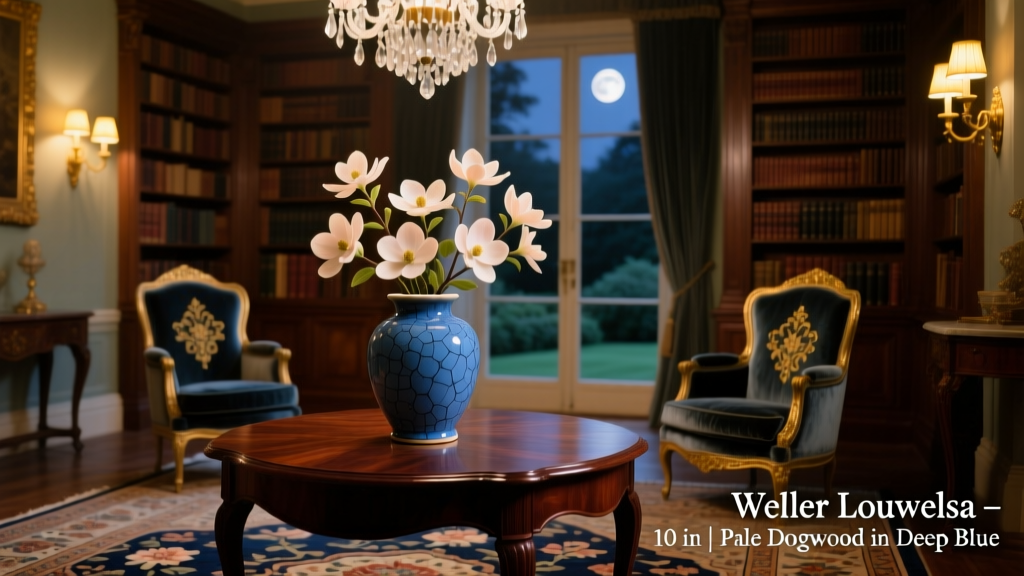
Weller Louwelsa Vase: Pale Dogwood Flowers on Deep Blue Glaze — A 10-Inch Masterpiece of American Art Pottery
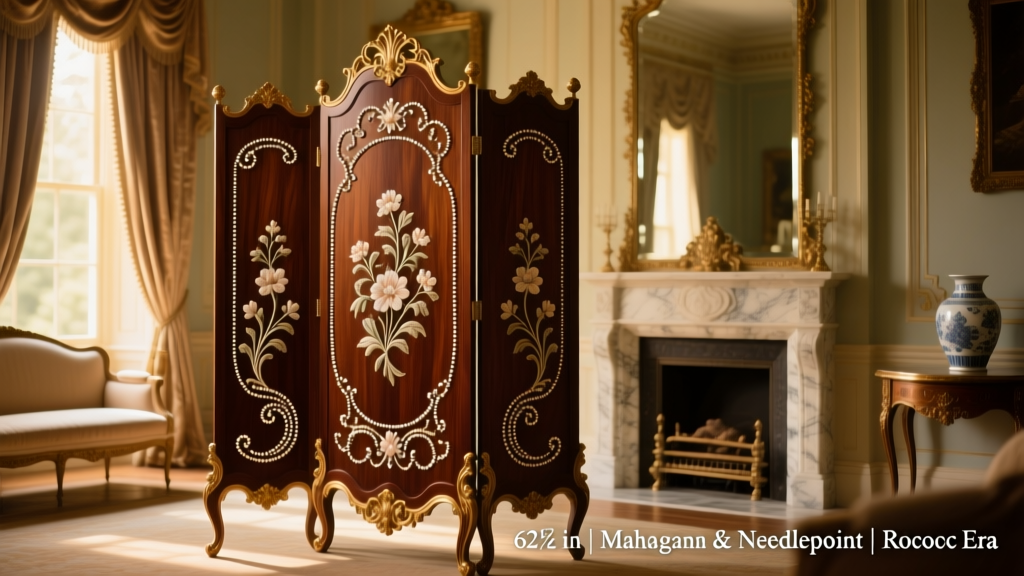
English Rococo Mahogany Screen Pole with Needlepoint and Beadwork: A 62½-Inch Masterpiece of 18th-Century Craftsmanship

Swankyswigs Forget-Me-Not Light Blue 3½-Inch Antique-Style Ceramic Knob: A Restoration Specialist’s Deep Dive
Iron Bootjack Floral Hand Forged: History, Craftsmanship, and Restoration of a Victorian-Era Functional Art Object
The Shaker Box 2-Finger Oval: Craftsmanship, Provenance, and Restoration Essentials
Arthur Gerling’s Grumpy Baby: A 16-Inch German Bisque Breather Doll with Period Clothing — Identification, Restoration & Historical Context
Imari Cup and Saucer: Hand-Painted Gold Decoration, English Manufacture, 1892–1899
The 1905–1925 Oak Kitchen Icebox with Lion Head Corners and Paw Feet: Identification, Provenance, and Restoration Protocol for the 54-Inch Model
The Fireplaces Broiler Rotary Wrought Iron Late 18th Century: A Technical and Historical Analysis of the 23½-Inch Model