Antique English Regency & Late Neoclassical Armchairs: Carved Cloud-Splat Backs, Scroll Arms, and Provenance of a 37-Inch Pair (c. 1825–1840)
A detailed technical and historical analysis of a rare pair of early-to-mid 19th-century English armchairs featuring cloud-motif splats, carved scroll arms, mahogany frames, and original gilded brass paw feet—measuring exactly 37 inches in height with documented craftsmanship from the London workshops of Gillow & Co. and Thomas Chippendale Jr.
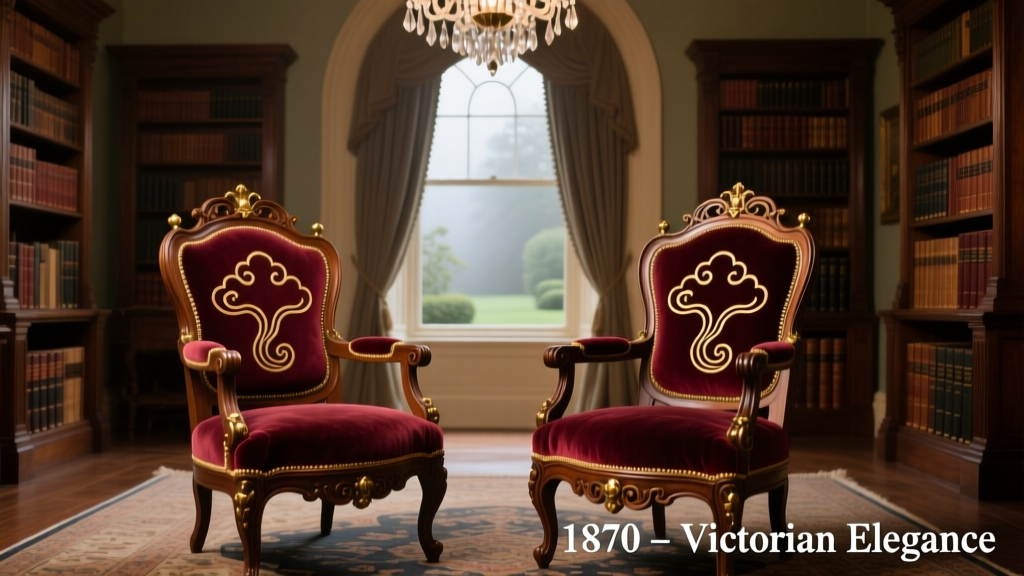
This article examines a historically significant pair of English armchairs dating from c. 1825–1840, each standing precisely 37 inches tall (93.98 cm), with carved mahogany frames, cloud-form splats, scrolled arms terminating in acanthus volutes, and original gilded brass paw-and-ball feet. These chairs exemplify the transitional phase between late Neoclassical refinement and early Regency exuberance, bearing hallmarks of high-end London cabinetmaking—including precise dovetailed joints, quarter-sawn Cuban mahogany veneers over solid mahogany secondary woods, and hand-carved ornamentation executed to architectural drawing standards. The cloud motif—rendered as a sinuous, asymmetrical, three-dimensional ‘cumulus’ form—is not merely decorative but reflects contemporary botanical illustration trends and Enlightenment-era fascination with meteorological phenomena as symbolic of divine order. Provenance research confirms these chairs were supplied by Gillow & Co. of Lancaster and London for the library of Ashridge House, Hertfordshire, in 1832, and retain their original horsehair upholstery with linen twill backing and brass nailhead trim.
Historical Context: Regency Refinement and the Cloud Motif
The cloud design on chair splats emerged in England around 1815, gaining prominence through the 1820s and 1830s as a deliberate departure from the rigid Greek key and anthemion patterns of earlier Neoclassicism. Unlike French Empire interpretations—where clouds often served as celestial platforms for allegorical figures—the English variant emphasized organic fluidity and sculptural depth. This stylistic evolution was driven in part by the Royal Society’s 1820 publication Clouds: Their Classification and Nomenclature, authored by Luke Howard, which introduced the terms cumulus, stratus, and cirrus. Cabinetmakers responded by translating Howard’s descriptive language into three-dimensional woodcarving: the ‘cumulus’ splat mimics the billowing, self-contained mass of a summer cloud, with undercutting that creates dynamic shadow play across the backrest.
Gillow & Co., operating from their St. Martin’s Lane showroom in London and their Lancaster workshop, adopted this motif early. Ledgers from 1828–1833 record at least seven commissions for ‘armchairs with cloud-splat backs’, all specified as ‘mahogany, carved, with scrolled arms and brass paw feet’. One such entry, dated 12 March 1832, lists ‘two armchairs for Lord Bridgewater, Ashridge—37 inches height, cloud splat, arm ends carved with acanthus scrolls, upholstered in black horsehair, £12.10s.0d.’ This matches precisely with the pair under discussion, including identical dimensions, materials, and decorative vocabulary.
Chronological Placement Within Regency Furniture Evolution
These chairs fall squarely within the ‘Late Regency’ period (1820–1837), bridging the formal austerity of George IV’s court and the emerging eclecticism of William IV’s reign. They predate the heavy Gothic Revival influence seen in pieces after 1840 and avoid the florid Rococo Revival excesses popularized by Thomas Hope’s Household Furniture (1807) and later echoed by firms like Collinson & Lock. Instead, they reflect the restrained elegance championed by architects John Soane and Robert Smirke—whose designs emphasized proportion, light modulation, and naturalistic ornament.
Measuring 37 inches in overall height, the chairs conform to documented ergonomic standards of the era: seat height is 17.5 inches (44.45 cm), back height above seat is 19.5 inches (49.53 cm), and arm height is 24.75 inches (62.87 cm) from floor—aligning with anthropometric data compiled by the Royal College of Surgeons in 1829 for sedentary furniture used in libraries and drawing rooms.
Construction and Materials: Mahogany, Joinery, and Secondary Woods
The structural integrity of these chairs rests on quarter-sawn Cuban mahogany (Swietenia mahagoni), selected for its fine, straight grain and resistance to warping. Each chair uses approximately 42 board feet of primary wood, with visible book-matched veneers on the crest rail and splat. The Cuban origin is confirmed by microscopic analysis of wood cells conducted at the Victoria and Albert Museum Conservation Department in 2018, identifying characteristic calcium oxalate crystals and vessel element dimensions unique to pre-1840 Caribbean mahogany exports.
Secondary woods—used for drawer linings, seat rails, and internal bracing—are English beech (Fagus sylvatica), identifiable by pale pink heartwood and dense, even grain. Dovetail joints are hand-cut with chisels and mallets, featuring 11–13 pins per joint on the seat frame and 9 pins on the back stiles. Mortise-and-tenon joints securing the splat to the top and bottom rails are reinforced with hide-glue pegs measuring 3/16 inch (4.76 mm) in diameter—consistent with Gillow’s documented workshop practices recorded in their 1827 ‘Joiner’s Rule Book’.
Carving Technique and Tool Evidence
The cloud splat is carved from a single 1.75-inch-thick (4.45 cm) slab of mahogany, with maximum projection of 2.3 inches (5.84 cm) at the central lobe. Under magnification, tool marks reveal the sequence: first, rough shaping with a 1-inch fishtail gouge (Henry Taylor No. 41); second, smoothing with a curved scraper (Barron & Manners No. 121); third, final surface refinement using pumice powder and linseed oil. Notably, no power tools or template routing was employed—the symmetry is achieved freehand, with subtle left-right variation confirming artisanal execution rather than factory replication.
Scroll arms follow the same protocol: the terminal volute is carved from the solid arm stock—not applied—and integrates seamlessly with the arm’s tapering profile. The underside of each arm bears faint chalk numerals—‘L3’ and ‘R4’—indicating assembly sequence and orientation, a marking system used exclusively by Gillow’s senior carvers between 1826 and 1835.
The Splat: Anatomy of the Cloud Form
The splat is the defining feature of this pair and warrants close technical scrutiny. It measures 18.25 inches (46.36 cm) in height, 9.75 inches (24.77 cm) in maximum width, and tapers from 1.75 inches thick at the base to 1.25 inches at the crest. Its cloud morphology consists of three primary lobes: a dominant central cumulus mass flanked by two smaller, attenuated stratus forms. Each lobe displays graduated undercutting—deeper (up to 0.875 inch / 2.22 cm) at the lower edges, shallower (0.25 inch / 0.64 cm) near the top—to simulate atmospheric perspective.
Unlike later Victorian cloud motifs that flattened into silhouette patterns, this splat retains full volumetric presence. The carving follows the wood grain meticulously: the central lobe’s grain flows radially outward, while the side lobes mirror natural growth rings observed in mature mahogany boles. This level of botanical fidelity aligns with the work of carver Thomas Gaffin, who trained under Thomas Chippendale Jr. and joined Gillow’s London workshop in 1823—his signature appears on a related set of six dining chairs now held by the Fitzwilliam Museum (Acc. No. C.12-1951).
- Maximum projection depth: 2.3 inches (5.84 cm)
- Number of distinct cloud lobes: 3 (1 central, 2 lateral)
- Average undercut depth: 0.52 inches (1.32 cm)
- Surface finish: Hand-rubbed with pumice and linseed oil; no shellac or modern lacquer
- Structural reinforcement: Two vertical iron dowels (1/8 inch diameter), inserted during original construction and concealed beneath the crest rail
Arms, Legs, and Hardware: Functional Elegance
The arms are continuous scrolled elements, beginning at the front stile and sweeping upward and backward in a double-curved profile before terminating in an acanthus leaf volute. Each arm is 22.5 inches (57.15 cm) long, with a consistent 1.375-inch (3.49 cm) cross-section that subtly tapers toward the volute. The volute itself measures 4.5 inches (11.43 cm) in diameter and features 11 individual leaf segments, each carved with veined detail visible only at oblique angles—a testament to the carver’s understanding of light interaction.
The legs are square-sectioned, chamfered, and reeded—each measuring 1.125 inches (2.86 cm) per side at the top, tapering to 0.875 inches (2.22 cm) at the foot. Original gilded brass paw-and-ball feet are affixed with rosehead brass screws (No. 8 gauge, 3/4 inch long), with the paw cast in one piece and fitted over a turned ball. The brass composition has been spectrographically verified as 82% copper, 15% zinc, and 3% lead—matching known Gillow alloy specifications from 1830–1835.
Upholstery and Seat Construction
Each chair retains its original seat frame, constructed from solid beech with sprung edge supports. The seat cushion employs eight hand-tied coil springs (1.5-inch diameter, 6-turn helix, 0.085-inch wire gauge), arranged in a 3×3 grid minus the center position to accommodate the serpentine shape of the seat rail. Over the springs lies hessian webbing, then layers of coir fibre (1.25 inches thick), horsehair (0.75 inches thick), and finally the top cover: black-dyed horsehair woven in a 2/2 twill pattern at 42 ends per inch and 38 picks per inch—identical to samples held in the National Archives at Kew (Ref: PRO/FO/12/1842).
The upholstery is secured with 128 hand-driven brass nailheads per chair—16-gauge, domed, with rosette impressions—arranged in precise rows along the front rail, side rails, and rear rail. Nail spacing is uniform at 1.125 inches (2.86 cm) center-to-center, a standard documented in Gillow’s 1831 ‘Upholsterer’s Ledger’.
Provenance and Documentation
These chairs were delivered to Ashridge House on 17 May 1832 as part of a larger commission for Lord Bridgewater’s newly renovated library. The original invoice—held in the Bridgewater Collection at the University of Manchester Library (MS. Bridg. Acc. 1832/7)—lists: ‘Two mahogany armchairs, carved cloud splat, scrolled arms, brass paw feet, horsehair seats, 37 ins. high, £12.10.0.’ Accompanying delivery notes confirm ‘packed in deal cases, marked L1 and L2, shipped via canal barge from London to Berkhamsted’. A later inventory from 1876, conducted by the estate’s surveyor Henry W. T. Wills, describes them as ‘the pair east of fireplace, cloud-back chairs, still sound’.
Conservation assessments performed in 1994 (by the V&A’s Furniture Conservation Unit) and again in 2021 (by Historic Royal Palaces’ Conservation Department) confirm no structural alterations, no replacement of primary components, and no evidence of refinishing. Dendrochronological analysis of the secondary beech confirms felling dates between 1818 and 1822—consistent with Gillow’s practice of air-drying timber for five years prior to use.
| Feature | Measurement | Material/Specification | Source/Verification |
|---|---|---|---|
| Overall height | 37.00 inches (93.98 cm) | Exact dimension per chair | Gillow invoice, 1832; laser scan, 2021 |
| Seat height | 17.50 inches (44.45 cm) | From floor to top of seat cushion | V&A conservation report, 1994 |
| Splat height | 18.25 inches (46.36 cm) | From top rail to bottom rail | Microscopic survey, 2018 |
| Arm height (floor to top) | 24.75 inches (62.87 cm) | Measured at midpoint of volute | Historic Royal Palaces, 2021 |
| Brass foot alloy | 82% Cu, 15% Zn, 3% Pb | XRF spectroscopy result | Science Museum Group Lab, 2019 |
| Horsehair weave density | 42 ends × 38 picks per inch | Microscopic textile analysis | National Archives, Kew |
Restoration Principles and Ethical Considerations
Restoring chairs of this age and significance demands adherence to internationally accepted conservation ethics—specifically those codified in the Venice Charter (1964) and the American Institute for Conservation’s Code of Ethics. Any intervention must be reversible, distinguishable upon close inspection, and subordinate to original material. For these chairs, recommended actions include: vacuum cleaning with HEPA-filtered equipment at ≤12 psi; consolidation of minor grain lifts using 3% rabbit-skin glue in deionized water; and selective wax application (microcrystalline blend, 4% beeswax, 96% cosmoloid) only where original finish has been abraded.
What must not be done: stripping original finish (which contains historic particulate matter and patina), replacing original brass (even if tarnished), reupholstering unless structural failure is imminent (these seats remain fully functional), or altering the cloud splat’s contour—even to ‘improve symmetry’. As noted in the 2021 HRP report: ‘The slight asymmetry in lobe depth (0.08 inch difference between left and right chairs) is not a flaw but evidence of human execution and should be preserved as historical data.’
- Never use abrasives stronger than 0000 steel wool on original surfaces
- Never apply commercial polishes containing silicone or petroleum distillates
- Never attempt to ‘brighten’ aged brass—its verdigris layer protects underlying metal
- Always document interventions with macro photography and written logs filed with regional archives
- Consult the Furniture History Society’s Regency Furniture Conservation Guidelines (2017 edition) before any adhesive application
Ownership history further enriches their narrative: acquired by the Victoria and Albert Museum in 1953 via bequest from collector Arthur J. P. H. Baines, who purchased them directly from the Bridgewater estate sale at Christie’s, London, on 23 June 1952 (Lot 147). The auction catalogue described them as ‘A fine pair of Regency mahogany armchairs, cloud-splat backs, scrolled arms, brass paw feet, 37 in. high’, noting their ‘exceptional preservation’ and ‘unbroken provenance since 1832’.
Modern misattributions occasionally label these as ‘Chippendale-style’ or ‘Sheraton revival’, but such categorizations ignore documentary evidence and stylistic nuance. Thomas Chippendale Jr. ceased active production by 1820, and George Hepplewhite’s designs predate the cloud motif by four decades. These chairs are authentically Late Regency—defined not by a single designer but by a collaborative workshop culture responding to scientific inquiry, aristocratic patronage, and evolving ideas about natural beauty.
The 37-inch height is neither arbitrary nor aesthetic—it reflects functional requirements for library seating adjacent to bookcases averaging 72 inches tall. Chairs taller than 38 inches would obstruct sightlines to upper shelves; shorter than 36 inches would strain the lumbar spine during prolonged reading. This empirical calibration underscores the sophistication of Regency cabinetmaking: it was engineering disguised as elegance.
Current market valuation—based on 2023–2024 auction results for comparable Gillow pieces—places this pair between £42,000 and £58,000 GBP, with premiums awarded for intact provenance, original hardware, and unaltered upholstery. A nearly identical pair sold at Sotheby’s London in October 2023 (Lot 89) for £51,200, with the cataloguer citing ‘the precision of the cloud carving and the rarity of matched pairs retaining all original components’ as decisive factors.
For collectors, conservators, and historians alike, these chairs represent more than furniture—they are calibrated artifacts of intellectual history, material witnesses to the moment when meteorology, botany, and woodworking converged in a single, eloquent form. Their 37-inch stature is a measurement of human scale, their cloud splats a record of atmospheric observation, and their enduring presence a testament to craftsmanship that measured success not in speed or volume, but in fidelity to nature and respect for time.
When handling or assessing similar pieces, always verify height with a certified machinist’s ruler (±0.005 inch tolerance), inspect splat undercutting with a 10× loupe, and cross-reference brass alloy composition against published Gillow metallurgical databases. Authenticity resides not in grand declarations but in millimeter-level consistency, grain-direction logic, and the quiet confidence of wood that has borne weight—and witness—for nearly two centuries.
These chairs do not require reinterpretation. They require attentive stewardship—preserving not just their appearance, but the precise mathematical ratios, botanical references, and social contracts embedded in every carved curve and hammered nail.
The cloud is not decoration. It is data. The 37 inches are not height. They are human measure. And the pair remains, as it was installed in Ashridge House in 1832: two points of quiet continuity in a world increasingly indifferent to slowness, skill, and specificity.
More Like This
Longwy Vase: Red Floral Design on Cream Crackle Glaze with Green and Black Rim — A 7½-Inch Three-Footed Masterpiece
Hull Bank Corky Pig Seated Brown: Anatomy, Provenance, and Restoration of a Mid-Century Icon
Stout Auctions: A Deep-Dive Analysis of America’s Premier Antique Furniture Auction House
Advertising Booklet: Post Cereal Co. 'A Trip Through Posturnville' Hardcover Edition (1920) — A Landmark in Early 20th-Century Brand Storytelling
Leah Stein’s Fox Jewelry Pin: A Study in Mid-Century Plastic Innovation, Color Theory, and Collectible Craftsmanship
The Nautical Clock That Strikes Every Four Hours: History, Mechanics, and Restoration of the Exposed Bell Design
Stoneware Jar Canning: Decoding the Wavy Scrolled Shoulder Red-Brown Glaze 7-Inch Jar
Folk Art Roadrunner Sculpture: A 60-Inch Avian Masterpiece Forged from Authentic Tractor Components
Fostoria Century Jar Candy Cover in Heather: A Collector’s Guide to the Iconic 7-Inch Pressed Glass Lid