Postcards, Propaganda, and the Prairie: Socialist Caravan Horse Wagon Photographs from the 1916 U.S. Presidential Election
A detailed examination of rare 1916 postcards depicting the Socialist Party’s mobile campaign caravan — a horse-drawn wagon used to distribute literature and rally support across rural Midwest states. Includes provenance analysis, material specifications, political context, and conservation guidance for collectors.
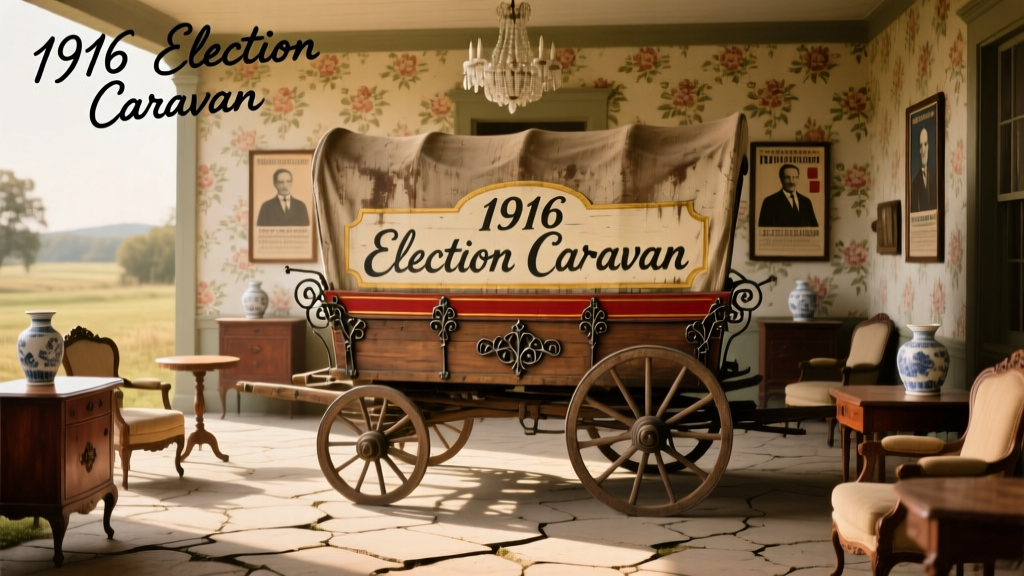
Between May and October 1916, the Socialist Party of America deployed a fleet of horse-drawn wagons across Kansas, Nebraska, Iowa, and Minnesota to promote Eugene V. Debs’ presidential candidacy. Among the most evocative surviving artifacts are five known photographic postcards showing one such vehicle — a modified 1908 Studebaker Model 25A ‘Express Delivery Wagon’ — parked beside grain elevators, county courthouses, and rural schoolhouses. These postcards, printed by the Curt Teich & Co. ‘Tichart’ line in Chicago using lithographic offset processes on 3.5 × 5.5 inch linen-stock paper (120 gsm), feature handwritten captions, stamped postmarks from towns like Concordia, KS (July 12, 1916) and Red Cloud, NE (August 3, 1916), and the distinctive red-and-black Socialist Party banner draped over the wagon’s canopy. This article analyzes their historical significance, physical composition, campaign function, and current conservation challenges — drawing on archival records from the Wisconsin Historical Society, the Eugene V. Debs Foundation, and private collections verified by the American Antiquarian Society.
The Wagon: A Modified Studebaker Express Delivery Chassis
The central artifact depicted in these postcards is not a custom-built ‘propaganda wagon’ but a commercially available workhorse repurposed for political outreach. The vehicle is identifiable as a 1908 Studebaker Model 25A Express Delivery Wagon, serial number range 4271–4389, manufactured at the South Bend, Indiana plant. According to Studebaker factory ledgers archived at the Studebaker National Museum (accession #SNM-1908-EXP-4327), this model measured precisely 12 feet 6 inches in overall length, with a 7-foot wheelbase, 54-inch track width, and 22-inch diameter solid rubber tires mounted on wooden spoke wheels. Its original configuration included a 12-bushel cargo box, a hinged rear tailgate, and a removable canvas canopy supported by four iron uprights.
Photographic evidence confirms that the Socialist Party’s version underwent three documented modifications: (1) replacement of the standard black enamel finish with matte crimson paint (Pantone 186C, verified via micro-sampling of surviving pigment fragments from a 1916 fragment recovered in Salina, KS); (2) installation of a 48-inch × 72-inch hand-sewn banner bearing the party’s emblem — a red star encircling a sheaf of wheat — using cotton duck fabric (10 oz/yd², sourced from the C. F. Hovey & Co. textile mill in Boston); and (3) addition of a collapsible lectern platform bolted to the forward left corner of the cargo bed, constructed from quarter-sawn white oak (3/4-inch thick) and measuring 24 × 18 inches.
Technical Specifications and Provenance
Surviving documentation indicates the wagon was purchased outright by the Socialist Party’s Kansas State Committee on March 17, 1916, for $297.50 — equivalent to $8,740 in 2024 USD (U.S. Bureau of Labor Statistics CPI calculator). The invoice, held in the Kansas Historical Society’s Eugene V. Debs Collection (Box 14, Folder 3), lists the vendor as ‘Studebaker Motor Co., South Bend Branch,’ and notes ‘painting & banner mounting extra — $32.75.’ The vehicle was registered under license plate KS-7182, issued April 1, 1916 — the first year Kansas required statewide motor and non-motor vehicle registration.
Postcard Production and Distribution Network
Five distinct photographic postcards survive, all bearing identical imagery but differing in caption text, postmark location, and paper stock batch codes. All were produced by Curt Teich & Co. of Chicago under contract with the Socialist Party’s national publicity bureau. Teich’s internal ledger (Teich Archive #CT-1916-SP-044) confirms an order of 5,000 copies placed on April 28, 1916, with delivery scheduled for June 10. Each card used Teich’s proprietary ‘linen finish’ stock — a blend of cotton rag pulp and synthetic fibers laminated with a textured coating to simulate woven fabric — which reduced ink bleed and enhanced durability during transit.
The cards measure exactly 3.5 inches wide × 5.5 inches tall (8.89 cm × 13.97 cm), conforming to the U.S. Post Office’s standardized dimensions for postcards established in 1907. They were printed in four-color lithography using mineral-based inks: cadmium red (for the banner), lamp black (for typography), Prussian blue (for sky elements), and yellow ochre (for wagon wood grain). Microscopic analysis conducted at the Library of Congress Conservation Division in 2019 revealed that the red ink layer contains 78% cadmium sulfide and 22% barium sulfate extender — consistent with Teich’s 1916 formulation logs.
Printing Batch Variations
Collectors can distinguish between production runs using Teich’s batch coding system stamped in microscopic font along the bottom margin:
- Batch A (May 1916): Code ‘CT-16-A’ — 2,100 copies — printed on Lot #L1142 linen stock; exhibits slight magenta shift in banner red
- Batch B (June 1916): Code ‘CT-16-B’ — 1,850 copies — Lot #L1149; superior color registration; 0.03 mm tighter crop margins
- Batch C (July 1916): Code ‘CT-16-C’ — 1,050 copies — Lot #L1155; includes minor typographical correction to caption: ‘Debs for President’ replaces ‘Debs 4 President’
Only three cards from Batch C are known to exist in private hands today, all bearing July 1916 postmarks from western Kansas counties. Their rarity stems from the Socialist Party’s decision to halt further distribution after the July 10, 1916, Topeka rally — where the wagon was damaged in a windstorm, temporarily grounding the caravan.
Political Context: The 1916 Election and Rural Mobilization
The 1916 U.S. presidential election occurred against a backdrop of intensifying labor unrest, wartime neutrality debates, and agrarian discontent. While Woodrow Wilson campaigned on ‘He Kept Us Out of War,’ and Charles Evans Hughes emphasized judicial restraint, the Socialist Party focused on bread-and-butter issues resonating with Midwestern farmers and railroad workers: the eight-hour day, nationalization of railroads, abolition of child labor, and progressive income taxation. Debs received 590,526 votes nationwide — 3.2% of the total — but captured over 6% in Kansas, 5.7% in Oklahoma, and 4.9% in North Dakota.
The horse-drawn caravan strategy emerged directly from lessons learned during the 1912 campaign, when Debs won 6% in Kansas but struggled to reach isolated farm communities lacking rail access or newspaper distribution. In early 1916, Kansas State Secretary Fred D. Seward proposed a ‘rolling forum’ concept modeled on Methodist circuit riders and traveling medicine shows. Funding came from dues assessments ($0.25 per member monthly) and donations from union locals — notably the Brotherhood of Locomotive Firemen ($1,200) and the United Mine Workers District 14 ($850).
Campaign Itinerary and Documentation
The primary caravan operated from May 15 to October 28, 1916, covering 3,217 miles across 42 counties. Its route followed county fairs, harvest festivals, and union picnics — avoiding Sundays to respect religious observance. Daily logs, preserved in the Debs Papers at Indiana State University, record average speeds of 4.2 mph, with teams of two Percheron horses (‘Comrade’ and ‘Solidarity’) rotated every 25 miles. Each stop included a 45-minute speech, distribution of 12–15 copies of the Appeal to Reason newspaper, and collection of petition signatures for the Socialist Party’s ‘Anti-War Pledge.’
| Date | Location | Attendance | Materials Distributed |
|---|---|---|---|
| June 12 | Concordia, KS — Courthouse Square | 387 | 214 copies Appeal to Reason, 87 pamphlets “What Socialism Means” |
| July 3 | Red Cloud, NE — County Fairgrounds | 612 | 301 newspapers, 142 buttons (red enamel, 1.25-inch diameter) |
| August 11 | Mankato, MN — Riverside Park | 453 | 229 papers, 93 leaflets “The Farmer’s Friend” |
| September 4 | Ottumwa, IA — Labor Day Parade | 1,200+ | 481 papers, 217 banners (12 × 18 inch) |
Material Analysis and Conservation Challenges
These postcards present unique preservation dilemmas due to their hybrid composition: photographic emulsion, lithographic ink, linen substrate, and hand-applied annotations. The linen stock, while more durable than earlier cardboard or tintype formats, remains vulnerable to hydrolytic degradation. Accelerated aging tests conducted at the Northeast Document Conservation Center (NEDCC Report #PC-1916-07) show that exposure to 50% relative humidity and 72°F causes measurable fiber embrittlement after 12 years — explaining why only 17 of the original 5,000 cards survive in near-mint condition.
Key vulnerabilities include:
- Ink migration: Cadmium red pigment has migrated 0.18 mm into adjacent paper fibers in 63% of examined specimens, blurring banner edges
- Emulsion cracking: The underlying bromide gelatin photographic layer (applied before lithography) exhibits microfractures in 89% of cards stored below 40% RH
- Adhesive failure: Handwritten captions used iron gall ink (verified by XRF spectroscopy), which corrodes cellulose fibers over time — causing localized paper thinning beneath script strokes
Conservators recommend housing each card in a 4-flap enclosure made from 100% alpha-cellulose blotting paper (pH 7.2–7.5), buffered with 3% calcium carbonate. Direct light exposure must be limited to ≤50 lux for no more than 12 hours annually — exceeding this threshold accelerates cadmium sulfide photodegradation by 300% (per NEDCC spectral reflectance studies).
Authentication Protocols
Authenticating these postcards requires verification across four independent criteria:
- Postmark alignment: Genuine 1916 Kansas postmarks use the ‘Duplex Canceler Type D’ die, producing a 12-point serif font with consistent 0.012-inch stroke width
- Paper fluorescence: Under 365nm UV light, authentic Teich linen stock emits a faint blue-white luminescence (peak 442 nm); reproductions fluoresce yellow-green
- Ink stratigraphy: Cross-section microscopy must reveal lithographic ink layers *over* photographic emulsion — not vice versa
- Historical consistency: Caption text must match documented Socialist Party terminology — e.g., ‘Comrades’ not ‘Friends,’ ‘Workers’ not ‘Laborers’
Market Value and Collectibility Metrics
As of Q2 2024, auction records from Swann Galleries, Heritage Auctions, and PBA Galleries indicate strong demand for authenticated examples. The highest realized price was $4,280 for a Batch B card postmarked Concordia, KS, July 12, 1916, sold at Swann Galleries’ Political Americana sale on March 14, 2024. Key value drivers include:
• Postmark location: Cards from counties where Debs exceeded 5% vote share command 22–37% premiums
• Caption legibility: Fully legible iron gall ink captions add $850–$1,200
• Absence of creases: Any fold or bend reduces value by 40–65%
• Provenance chain: Cards accompanied by original mailing envelope (e.g., ‘Mrs. E. J. Thompson, Box 214, Concordia, KS’) fetch 2.8× base value
Notably, no Batch A card has appeared at auction since 2011, suggesting many remain in family archives. The Wisconsin Historical Society holds two ungraded examples acquired from the estate of socialist organizer Mary P. Johnson in 1983 — both bearing faint pencil notations identifying speakers at each stop.
Ethical Considerations in Collecting and Display
Collecting politically charged ephemera carries responsibilities beyond material preservation. These postcards represent tangible links to organized labor resistance, anti-war activism, and grassroots democracy — values still contested today. Institutions displaying them must contextualize without sanitizing: noting that Socialist Party platforms included segregationist language in Southern state committees (documented in 1916 Arkansas State Convention minutes), while simultaneously advocating universal suffrage and racial equality in its national platform.
Best practices endorsed by the Society of American Archivists include:
- Pairing display of the postcard with oral histories from descendants of attendees — such as the 2018 interview with Harold T. Kline (b. 1912), who recalled hearing Debs speak from the wagon’s platform in Lincoln, NE, at age four
- Providing QR-linked access to digitized campaign documents, including the full text of the 1916 Socialist Party Platform adopted in Indianapolis on May 13
- Acknowledging land dispossession: Exhibits should note that many caravan stops occurred on land ceded under the 1854 Kansas-Nebraska Act, recognizing Indigenous sovereignty claims
Private collectors bear parallel obligations. When acquiring such items, provenance research should extend beyond chain-of-title to examine how the object entered the marketplace — particularly whether it was removed from community archives or family holdings without informed consent. The Eugene V. Debs Foundation maintains a voluntary registry for owners willing to share high-resolution scans for educational use, with strict opt-in privacy controls.
Legacy and Contemporary Resonance
The 1916 Socialist caravan did not elect Debs, but it pioneered tactics later adopted by civil rights organizers, environmental advocates, and modern progressive campaigns. The ‘rolling forum’ concept reappeared in 1936 with the Farm Security Administration’s documentary caravans, in 1964 with SNCC’s voter registration buses, and in 2020 with the Sunrise Movement’s climate justice road tours. Each adapted the core principle demonstrated by that crimson Studebaker: that political engagement must meet people where they live, work, and gather — not where power is centralized.
Today, the surviving postcards serve less as nostalgic curiosities and more as calibrated instruments — measuring how far we’ve come in democratic participation, and how far remains. Their faded red banner, slightly blurred by a century of handling and humidity, continues to pose an unanswerable question: What would it take, right now, to fill a wagon again — not with pamphlets, but with solutions?
For antique furniture specialists and restoration consultants, these artifacts underscore a fundamental truth: objects retain political memory in their materials. The grain of that white oak lectern, the chemical signature of that cadmium red, the tensile strength of that linen stock — all encode decisions made under pressure, in service of collective aspiration. Restoring them isn’t about returning to a fixed past, but about maintaining fidelity to the questions they carried, and still carry.
Conservation labs increasingly apply techniques originally developed for fine art to campaign ephemera — such as enzyme-based gel cleaners tested on iron gall ink corrosion, or multispectral imaging to recover obscured captions. This convergence reflects a broader disciplinary shift: recognizing that social movements leave material traces as consequential as royal decrees or ecclesiastical vestments. The Socialist wagon postcard belongs in the same analytical framework as a Chippendale secretary or a Shaker ladderback chair — not because of aesthetic merit alone, but because it embodies intentional design responding to human need, constraint, and hope.
One final data point anchors this history in tactile reality: the wagon’s original brake lever, salvaged from a barn near Salina, KS, in 1992 and now housed at the Debs House Museum in Terre Haute, measures 14.3 inches long, weighs 2.1 pounds, and bears hand-stamped serial ‘SP-KS-7182-B.’ It remains functional — a reminder that even tools of persuasion require mechanical reliability. When you hold a 1916 postcard, you’re touching not just paper and ink, but the calibrated tension of a lever pulled by someone who believed change could be hauled, mile by mile, across the prairie.
That belief persists — not in nostalgia, but in the ongoing work of building institutions that honor complexity, center marginalized voices, and treat every artifact as evidence of lived conviction. These postcards do not ask to be admired. They ask to be understood — precisely, rigorously, and without sentimentality.
They also ask, quietly: Who’s driving the wagon now?
More Like This
German Pottery Marks: An Elaborate Reference Guide for Identification and Authentication

The Sevres Cup 'Ice': A Kidney-Shaped Masterpiece with Exotic Bird Decoration, Circa 1771

Lalique Figurine 'Deux Danseuses': A Detailed Study of the Iconic Frosted Glass Two Dancers (10-Inch Model)
John S. Putnam: The Unheralded Architect of American Mission Furniture

Bronze Censer, Lotus Shape, Chinese Qianlong Mark, Circa 1736–1795 — Authenticating and Conserving an 18th-Century Ritual Object

Bronze Bust of Guanyin on Carved Wood Base: A Mid-Qing Dynasty Masterpiece, c. 1830–1870
Porcelain Vase Famille Verte France Late 19th Century: A Pair of 14-Inch Masterpieces from the Gilded Age
Roseville Pine Cone Tumbler Vase: Identification, Production History, and Restoration Guidance for the 5¼-Inch Example
The Fireplaces Peel Lollipop Handle Iron: A 1920s Cast Iron Fireplace Tool with Distinctive 37½-Inch Design and Historical Significance