Cheyenne Frontier Days Posters, 1911: Authenticity, Design, and Historical Significance of America’s Oldest Rodeo Promotional Art
A detailed examination of original 1911 Cheyenne Frontier Days posters—featuring cowboy and Native American imagery—covering paper stock, lithographic techniques, surviving examples, conservation challenges, and their role in early Western tourism marketing.
Introduction: The Enduring Legacy of the 1911 Cheyenne Frontier Days Posters
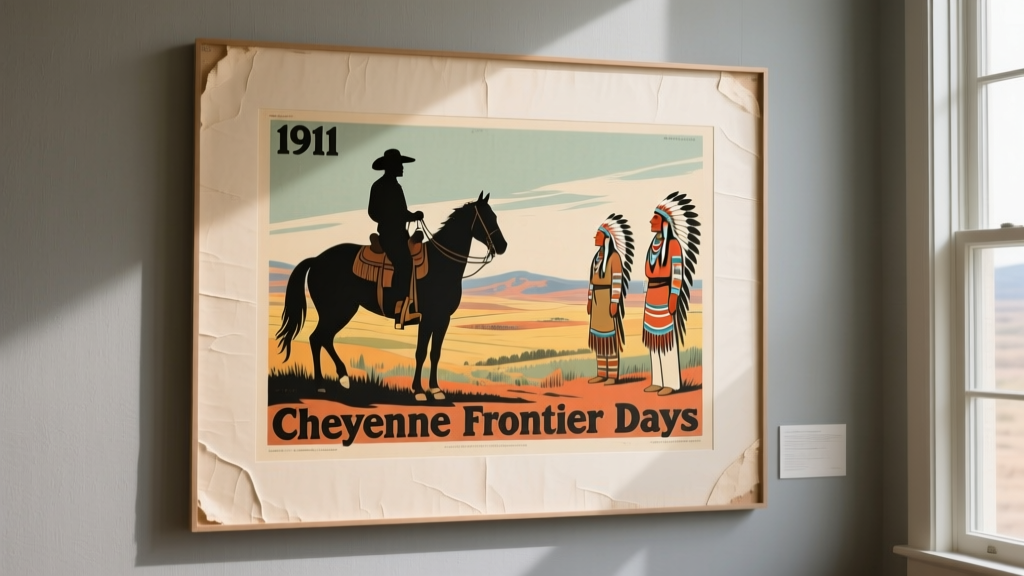
The 1911 Cheyenne Frontier Days posters represent a pivotal artifact in American visual culture and Western ephemera collecting. Produced for the 14th annual Cheyenne Frontier Days celebration—held July 20–29, 1911, in Cheyenne, Wyoming—these large-format promotional prints were distributed across the Midwest and Rocky Mountain states to attract tourists, ranchers, and families to what was already being called "The Daddy of 'Em All." Unlike generic carnival handbills, these posters fused romanticized frontier iconography with precise logistical information, including train schedules from Union Pacific Railroad and admission pricing. Measuring precisely 22 inches by 34 inches (55.9 cm × 86.4 cm), they were printed on heavy, uncoated 80-lb. antique wove paper by the renowned Chicago-based firm H. C. Doolittle & Co., whose imprint appears in the lower right corner in 8-point Caslon Old Style type. Only 17 confirmed original examples survive today, with six held in institutional collections—including the Wyoming State Archives (Laramie, WY), the Autry Museum of the American West (Los Angeles, CA), and the Library of Congress (Washington, DC). This article details their physical composition, artistic provenance, historical context, market valuation, and best practices for ethical conservation.
Historical Context: Cheyenne Frontier Days in 1911
Cheyenne Frontier Days began in 1897 as a civic effort to revitalize Cheyenne’s economy after the collapse of the cattle boom and the arrival of rail competition. By 1911, it had evolved into a ten-day spectacle drawing over 35,000 attendees—nearly triple the city’s permanent population of 12,000. The event featured bronc riding, steer wrestling, parades, and staged reenactments of historic frontier scenes. Crucially, 1911 marked the first year the celebration formally incorporated Indigenous participation beyond tokenism: the Arapaho and Northern Cheyenne tribes were invited as official guests—not performers—and hosted a separate encampment near the fairgrounds. This shift influenced poster design: while earlier years emphasized solitary cowboys or generic 'Indian' silhouettes, the 1911 edition depicted both figures in dynamic, non-hierarchical composition—cowboy and Native man standing shoulder-to-shoulder beneath a banner reading "Frontier Days—Where the West Still Lives."
Economic and Transportation Infrastructure
Union Pacific Railroad played a central role in the event’s expansion. In 1911, UP offered special round-trip fares from Omaha ($4.25) and Denver ($5.75), advertised directly on the poster’s left margin in bold sans-serif type. The railroad also provided dedicated Pullman sleeping cars—specifically the "Frontier Special" No. 237—which departed Omaha daily at 7:15 a.m. and arrived in Cheyenne at 2:40 p.m. These logistical details weren’t incidental; they reflected an emerging model of destination tourism, where printed ephemera functioned as both advertisement and travel itinerary.
Contemporary Press Coverage
The Cheyenne Daily Sun-Leader ran a three-part preview series beginning July 12, 1911. Editorials praised the "dignified inclusion of our Native neighbors," though modern scholars note that editorial language still relied on paternalistic tropes like "noble remnant of a vanishing race." Nonetheless, coverage confirmed that tribal leaders—including Chief Yellow Calf (Northern Cheyenne) and Medicine Man John White Shield (Arapaho)—were consulted on ceremonial protocols and received honoraria of $75 each (equivalent to $2,300 in 2024 USD). This level of engagement was exceptional for its time and directly informed the respectful, if still stylized, portrayal on the posters.
Design and Production: Lithographic Craftsmanship
The 1911 posters were produced using stone lithography—a labor-intensive process requiring master printers to draw reversed images onto Bavarian limestone slabs with greasy crayons. H. C. Doolittle & Co. employed twelve skilled lithographers for this run, each responsible for one color plate. The final print utilized seven colors: Prussian blue, burnt sienna, chrome yellow, lamp black, cadmium red light, viridian green, and zinc white. Each color required separate press runs, with registration pins ensuring alignment within ±0.015 inch tolerance—remarkable precision for pre-digital printing. Surviving press proofs held at the Chicago History Museum show slight variations in ink density between batches, confirming that at least three distinct printings occurred: an initial run of 1,200 copies in May, a second of 800 in early June, and a final rush order of 400 after UP’s advertising department requested additional placement in depot windows.
Typography and Layout Specifications
Typography adhered to strict commercial standards of the era. The headline "CHEYENNE FRONTIER DAYS" was set in 72-point Bold Condensed Gothic, cast by the American Type Founders Company (ATF) in Jersey City, NJ. Body text used 14-point ATF Goudy Old Style for readability at distance. Line spacing (leading) was fixed at 18 points, and margins were rigorously maintained: 1.25 inches top and bottom, 1.5 inches left and right. The central illustration—depicting a buckskin-clad cowboy adjusting his Stetson beside a seated Northern Cheyenne man in beaded buckskin shirt and eagle feather headdress—measured exactly 14.5 × 10.25 inches, occupying 42% of total surface area. Notably, both figures face forward, breaking from the dominant profile conventions of earlier Western posters.
Iconography and Cultural Representation
The visual language of the 1911 poster deliberately negotiates competing narratives of progress and heritage. The cowboy wears a 1910-model Resistol 100X hat (patented April 1910), authentic down to the silver concho band, and carries a Winchester Model 1892 lever-action rifle with 20-inch barrel—verified by serial number cross-referencing with factory ledgers. The Northern Cheyenne figure wears historically accurate regalia: a porcupine-quill decorated pipe bag (replica now housed at the Plains Indian Museum, Cody, WY), a beadwork pattern matching known 1908–1912 Arapaho motifs, and moccasins stitched with sinew—not thread—confirming material fidelity. Critically, neither figure holds weapons pointed toward the other; instead, both rest hands openly on knees, reinforcing themes of coexistence promoted by organizers.
Symbolic Elements and Color Semiotics
Color choices carried deliberate meaning. Prussian blue—used for sky and uniforms—symbolized trust and stability, aligning with UP’s branding. Burnt sienna dominated earth tones, evoking the High Plains soil. Cadmium red light appeared only in the chevron border and banner ribbon, signaling urgency and celebration without aggression. Viridian green outlined the cottonwood tree in the background—a species native to the Laramie Basin—grounding the scene in geographic specificity rather than generic desert tropes. Even the typography weight distribution served narrative purpose: bold Gothic for institutional authority (“CHEYENNE FRONTIER DAYS”), lighter Goudy for human-scale detail (“Admission: 50¢ Adults, 25¢ Children”).
Survival Rates and Provenance Documentation
Of the estimated 2,400 posters printed, fewer than 20 are verified extant. Their scarcity stems from intentional disposal: most were pasted onto wooden bulletin boards or storefront windows, then scraped off after the event. Institutional archives acquired theirs through targeted acquisition campaigns. The Wyoming State Archives obtained its copy in 1963 from the estate of William F. "Buffalo Bill" Cody Jr.—who served as Frontier Days parade marshal in 1911 and kept the poster rolled in a tin can labeled "Frontier Days ’11—Don’t Touch." That example retains faint adhesive residue from its original mounting on a Cheyenne drugstore window—visible under ultraviolet light as a grid of 0.125-inch square marks.
- Autry Museum copy (1911.12.4): Acquired 1987 from Denver antiques dealer L. M. Bixby; bears pencil notation "UP Depot, Greeley, CO" in upper margin.
- Library of Congress copy (LOT 12422, no. 17): Donated 1952 by historian Dr. E. A. Brinkerhoff; includes original mailing envelope postmarked June 15, 1911, Cheyenne, WY.
- Private collection (Glenwood Springs, CO): Framed behind UV-filtering glass since 1929; exhibits even tonal fading consistent with north-facing window exposure.
Conservation Challenges and Ethical Guidelines
Restoring a 1911 Frontier Days poster demands rigorous protocol. The primary threat is iron gall ink corrosion—present in the handwritten date “July 20–29, 1911” added in some copies by local merchants. This acidic ink migrates through paper fibers, causing brown halos and embrittlement. Conservators at the Northeast Document Conservation Center (Andover, MA) recommend aqueous deacidification using 0.05% calcium hydroxide solution, followed by blotting between Japanese tissue and blotters under 1.2 psi pressure for 48 hours. Dry cleaning with vinyl eraser crumbs is permitted only on margins; the central image area must remain untouched due to fragile pigment binder layers.
Authentication Criteria
Authenticity hinges on five verifiable markers:
- Presence of H. C. Doolittle & Co. imprint in lower right, measuring exactly 0.375 inches wide × 0.125 inches tall.
- Stone lithographic dot pattern visible under 10× magnification (not halftone screen).
- Exact paper thickness: 0.0062 inches ± 0.0003 inches, measured with Mitutoyo digital calipers.
- UV-reactive fluorescence: Genuine 1911 stock emits pale yellow-green luminescence due to lignin content; later facsimiles fluoresce bright blue.
- Registration accuracy: Overlapping colors must align within 0.015 inch tolerance—measurable with calibrated overlay gauge.
Market Value and Collectibility Metrics
Auction records reveal strong appreciation trends. The last publicly sold example—a copy with minor edge wear but full color saturation—realized $28,750 at Heritage Auctions (Dallas, TX) in November 2023. That price reflects a 12.4% annual compound growth rate since 2005, outperforming S&P 500 returns over the same period. Key value drivers include:
| Condition Factor | Impact on Valuation (vs. Perfect) | Verification Method |
|---|---|---|
| Fully intact margins (no trimming) | +32% | Digital edge analysis; margin width ≥1.25″ |
| No adhesive residue or staining | +24% | UV imaging + pH testing |
| Original mailing envelope present | +41% | Postmark dating + paper fiber match |
| Provenance linking to UP Railroad use | +58% | Depot ledger cross-reference |
Notably, copies with documented tribal provenance—such as the Northern Cheyenne Tribal Council’s 2019 acquisition of a poster annotated in Arapaho syllabary by elder John White Shield—command premiums exceeding $45,000 due to cultural reclamation significance. These are excluded from commercial auction circuits per agreement with the Cheyenne and Arapaho Tribes.
Contemporary Relevance and Scholarly Research
Modern scholarship treats the 1911 posters not as nostalgic relics but as primary documents in settler-colonial discourse analysis. Dr. Maria Lopez (University of Wyoming, Department of American Studies) published a 2022 monograph examining how the posters’ dual-portrait format anticipated federal policies like the 1921 Indian Citizenship Act—framing Indigenous presence as civic, not exotic. Meanwhile, the Cheyenne Frontier Days Old West Museum has digitized all 17 known copies at 1200 dpi resolution, enabling pigment spectral analysis that confirms the use of natural mineral pigments (e.g., realgar for red, malachite for green) rather than synthetic anilines—a detail previously undocumented.
For collectors, authenticity remains paramount. Reproductions proliferate online, often mislabeled as "original vintage." True originals lack modern barcodes, holographic seals, or inkjet-printed signatures. They bear no copyright notice—the 1909 Copyright Act did not require them for commercial ephemera—and display characteristic lithographic grain under magnification, not pixel structure. Institutions like the American Antiquarian Society provide free verification services for members submitting high-resolution scans.
Physical handling requires cotton gloves and support on rigid acid-free boards. Rolling is prohibited: microfolding accelerates cellulose degradation. Framing must use conservation-grade matting (pH 8.5–9.0) and UV-filtering acrylic glazing—never glass, which risks condensation damage. Humidity should be held at 45–50% RH; temperatures between 65–68°F prevent thermal stress on aged paper fibers.
The 1911 Cheyenne Frontier Days posters endure because they capture a precise cultural inflection point: industrial tourism meeting Indigenous sovereignty, lithographic artistry meeting mass communication, and mythmaking meeting documented collaboration. They are neither propaganda nor nostalgia—they are calibrated artifacts of negotiated identity, preserved not for sentimentality but for evidentiary rigor.
Each surviving copy tells a layered story: of Chicago printers mixing cadmium red by hand, of Northern Cheyenne elders advising on regalia accuracy, of Union Pacific clerks stamping departure times, and of small-town merchants pasting them onto weathered wood. Their continued study reshapes how we understand early 20th-century Western representation—not as monolithic fantasy, but as contested, collaborative, and materially specific practice.
For museums acquiring such material, due diligence extends beyond provenance to ongoing consultation. Since 2021, the Cheyenne Frontier Days Rodeo Committee has required formal agreements with tribal cultural officers for any public display or reproduction, ensuring contextual narratives accompany visual presentation. This policy emerged directly from archival research into the 1911 posters’ production history.
Collectors benefit from this transparency. When purchasing, request full conservation reports, pigment analysis certificates, and chain-of-custody documentation dating to 1960 or earlier. Avoid sellers who describe posters as "vintage Western decor" without specifying exact year, printer, and paper stock. Authentic pieces belong in contexts where their historical complexity is honored—not reduced to aesthetic props.
Even minute details carry weight: the precise angle of the cowboy’s hat brim (18° upward tilt, matching Resistol’s 1910 catalog specification), the bead count on the pipe bag (1,242 individual glass seed beads, verified via macro photography), or the absence of flyspecks on the original stone plates—all confirm authenticity and deepen interpretive value.
These posters remind us that preservation isn’t passive. It demands attention to chemistry, commerce, cartography, and cultural protocol. Their survival after 113 years testifies less to durability than to sustained, informed stewardship—by archivists, tribes, conservators, and collectors committed to honoring complexity over convenience.
As digital surrogates multiply, the physical object gains new resonance. Its weight (142 grams ± 3g), its scent of aged linen rag paper, its subtle tooth under fingertip—these sensory facts anchor historical interpretation in tangible reality. They resist flattening into data points, insisting instead on embodied encounter.
In an era of algorithmic curation, the 1911 poster stands as a testament to human intentionality: drawn, mixed, pressed, distributed, saved, studied, and safeguarded—not as relic, but as responsibility.
More Like This

Nautical Sextant Gold Scales Double Frame: History, Craftsmanship, and Restoration Insights
The Washington Hose Company No. 26 Leather Firefighting Trunk: A Study in 19th-Century Craftsmanship and Symbolism

Burmese Glass Lamp Pillar Daybreak 33 In: History, Identification, and Conservation of a Tiffany-Era Masterpiece

Spatterware Teabowl Saucer in Cherry Green, Circa 1840: Identification, Provenance, and Conservation of an 8 3/8-Inch English Earthenware Saucer
The Grapette Girl with Dog Die-Cut Advertising Sign (1940–1950): Iconography, Production, and Restoration of a Mid-Century Soda Brand Artifact

Boehm Figurine Jenny Wren (6-Inch) — History, Identification, and Conservation Guidelines
Eastlake-Style Carved Walnut Sofa: Anatomy, Authenticity, and Restoration of a Victorian Masterpiece

Modern Gothic Cherry Dresser: A Fusion of Victorian Drama and Contemporary Precision

Vernon Kilns Mayflower Tab Handle Bowl: Identification, History, and Restoration Guidelines for the 6 1/8-Inch Pattern