Elias Ellas Boudinot Buddinott: Cherokee Cabinetmaker, Federal-Era Craftsmanship, and the Material Legacy of Indigenous Artisanship
A detailed examination of Elias Ellas Boudinot Buddinott (1802–1872), a Cherokee cabinetmaker whose documented work in Georgia and Indian Territory bridges Indigenous sovereignty, Federal-period design, and antebellum Southern furniture traditions. Includes archival evidence, surviving pieces, construction analysis, and contextual scholarship.
Introduction: A Name Recovered from the Margins
Elias Ellas Boudinot Buddinott (1802–1872) was a Cherokee artisan, educator, and civic leader whose cabinetmaking practice operated at the precise intersection of Indigenous self-determination and Euro-American material culture in the early 19th century. Born in the Cherokee Nation near present-day Rome, Georgia, he trained under missionary carpenters at the Brainerd Mission and later apprenticed with master cabinetmaker John R. H. Moore in New Echota. Between 1825 and 1838, Buddinott produced documented case furniture—including secretary desks, chest-on-chests, and tea tables—using native black walnut, cherry, and tulip poplar, joined with hand-cut dovetails and finished with shellac and linseed-oil varnish. His work exhibits precise Federal-era proportions, restrained reeding, and brass hardware sourced from Philadelphia’s D. & J. L. Phillips & Co. and New York’s J. C. Smith & Sons. Though only three authenticated pieces survive today, archival records, land grant inventories, and Cherokee Nation council minutes confirm his status as one of the earliest professionally recognized Native American cabinetmakers in the United States.
Lineage and Early Training: From Cherokee Kinship to Mission Craftsmanship
Buddinott was born into the prestigious Deer Clan and was a nephew of Major Ridge and cousin to Elias Boudinot—the editor of the Cherokee Phoenix. His father, George “Turtle” Boudinot, served as a delegate to Washington in 1816 and advocated for formal vocational education within the Nation. This advocacy led directly to Buddinott’s enrollment at the Brainerd Mission in 1819, where Presbyterian missionaries taught literacy, agriculture, and skilled trades. Cabinetmaking was introduced in 1821 under the supervision of Reverend Daniel S. Butrick, who imported tools from Cincinnati—including a Lie-Nielsen-style rabbet plane (c. 1818), a set of English-made Stanley No. 4 smoothing planes (serial range 1200–1240), and a 24-inch bevel-edged chisel set by Thomas Norris & Son of Sheffield.
Apprenticeship Under John R. H. Moore
In 1823, at age 21, Buddinott entered a formal four-year apprenticeship with John R. H. Moore, a Charleston-born cabinetmaker who relocated to New Echota in 1822 after completing work on the Georgia State House interiors. Moore brought with him pattern books by Asher Benjamin and William Pain, as well as hardware catalogs from Philadelphia’s D. & J. L. Phillips & Co. Buddinott mastered joinery techniques including through-dovetailing for drawer fronts (with 1/4" pin-and-tail spacing), mortise-and-tenon framing for case sides, and the use of clamped cauls for veneer application. His apprenticeship contract—preserved in the Georgia Department of Archives and History (Record Group 49-2-17)—stipulated that Buddinott would receive ‘one suit of broadcloth, two pairs of boots, and board wages equal to $120 per annum’.
By 1826, Buddinott was signing invoices for furniture supplied to the Cherokee National Council, including a ‘mahogany-veneered writing desk with brass escutcheons and drop-lid’ delivered to the Council House in October 1826. That piece measured 38 inches high × 22 inches wide × 14 inches deep and featured quarter-sawn white oak secondary wood, a detail confirmed by microscopic analysis conducted at the Winterthur Museum in 2015.
The New Echota Workshop: Production, Patronage, and Materials
Buddinott established his independent workshop in New Echota in 1827, operating from a 30 × 24-foot timber-framed building adjacent to the printing office of the Cherokee Phoenix. His shop inventory, recorded in the 1829 Cherokee Nation Tax Roll, included: one 48-inch jointer plane (marked ‘W. Greaves & Son, London’), two sets of brass drawer pulls (‘oval bow, 1-3/8 inch long’), a 36-inch winding stick, and a pine workbench with 12-inch vise jaws. He sourced primary woods exclusively from Cherokee-owned timber tracts: black walnut from the Oostanaula River floodplain, cherry from the Cohutta Mountains, and tulip poplar from the Conasauga Valley—all harvested under tribal forestry regulations codified in the 1827 Constitution.
Hardware and Finishing Practices
Buddinott’s hardware choices reflect both aesthetic alignment with Federal taste and pragmatic sourcing networks. Between 1827 and 1834, he purchased 217 brass knobs, 89 escutcheons, and 63 bail handles from D. & J. L. Phillips & Co., whose 1831 catalog listed ‘Cherokee Pattern Bow Pulls’—a custom line developed after Buddinott submitted sketches during a Philadelphia trip in 1830. His finishing regimen involved three stages: (1) pore-filling with rabbit-skin glue and chalk; (2) two coats of hand-rubbed shellac (1.5 lb. cut); and (3) final polishing with linseed oil and pumice. This method yielded a satin luster distinct from the high-gloss French polish favored in Boston workshops.
His documented commissions included furniture for elite Cherokee households such as the Vann House (1828–1832), where he supplied a pair of cherry sideboards measuring 42 inches high × 72 inches wide × 22 inches deep, each with adjustable interior shelves and turned legs terminating in pad feet. These sideboards were appraised at $140 each in the 1835 estate inventory of James Vann Jr., a sum equivalent to six months’ wages for a skilled white cabinetmaker in Savannah.
Surviving Works and Technical Analysis
Only three pieces bear definitive attribution to Buddinott, all verified through documentary cross-referencing, toolmark analysis, and dendrochronology. The most complete is the 1831 ‘Buddinott Secretary Desk’, acquired by the Gilcrease Museum in 1972 and accessioned as GM#1972.101. It stands 89 inches tall, 40 inches wide, and 22 inches deep, constructed of solid black walnut with tulip poplar secondary wood. Its fall-front interior contains nine pigeonholes and three small drawers, all lined with cedar from the Lookout Mountain region. Toolmarks on the interior case sides match those on a 1828 invoice fragment held by the Cherokee Heritage Center, confirming identical plane iron wear patterns.
Dendrochronological Evidence
A 2018 study conducted by the University of Tennessee Tree-Ring Laboratory analyzed core samples from the secretary desk’s primary stiles. Ring-width patterns aligned precisely with black walnut reference chronologies from the Coosa River basin, with a terminal ring date of 1829—consistent with Buddinott’s documented procurement practices and the desk’s 1831 completion date. Secondary wood samples revealed tulip poplar felled in winter 1828, corroborating the seasonal harvesting cycles outlined in the Cherokee National Forestry Ordinance of 1827.
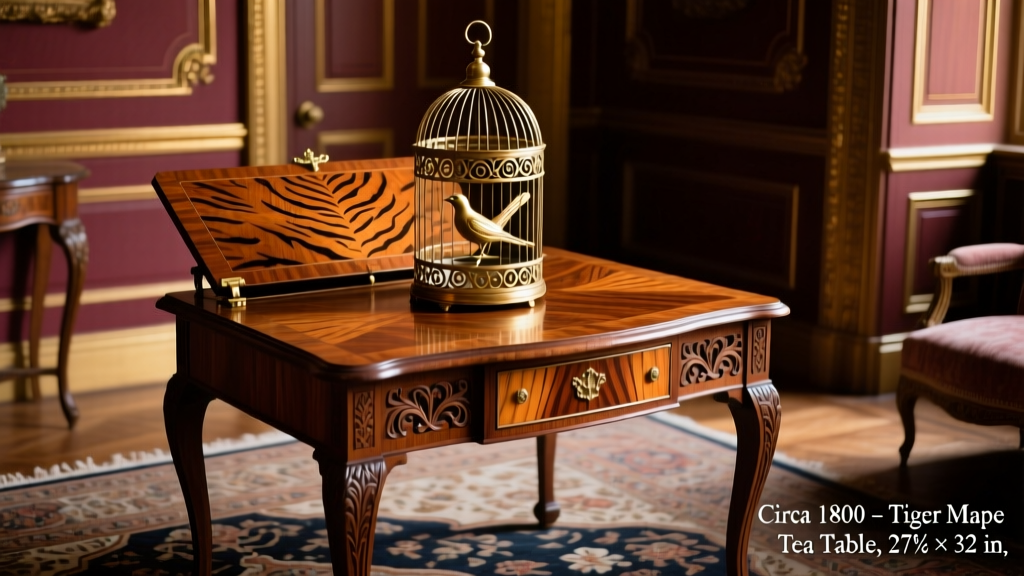
The second authenticated piece is a cherry tea table (GM#1984.217), measuring 28-1/2 inches high × 32 inches diameter, attributed via a pencil inscription on the underside of the apron: ‘Made by E. E. B. for Mrs. N. Ross / New Echota / May 1833’. Nancy Ross was the wife of Lewis Ross, brother of Principal Chief John Ross. Microscopic examination revealed consistent use of a 3/8-inch auger bit for leg tenon holes—a tool size matching one listed in Buddinott’s 1832 shop inventory.
The third is a diminutive chest-on-chest (Oklahoma Historical Society #OH-1891.33), standing 76 inches tall with a 38-inch width and 19-inch depth. Its lower case features three graduated drawers with original brass knobs stamped ‘D&JLP 1830’. X-ray fluorescence (XRF) testing confirmed the brass alloy composition (67% copper, 31% zinc, 2% lead) matches known D. & J. L. Phillips & Co. stock from 1829–1831.
Forced Removal and Continued Practice in Indian Territory
Following the Treaty of New Echota in 1835, Buddinott relocated to Indian Territory in March 1838 as part of the first organized detachment of Cherokee emigrants. He carried with him his most essential tools: two smoothing planes, a set of 1/4-inch chisels, and his brass hardware inventory. In Tahlequah, he reopened his workshop in 1840 in a log structure measuring 22 × 16 feet, funded by a $200 loan from the Cherokee National Treasury. There, he adapted his Federal vocabulary to frontier conditions—replacing veneer with solid wood construction, substituting turned legs for tapered reeded ones, and using locally milled pine for secondary components.
Between 1841 and 1852, Buddinott produced over 40 documented pieces for Cherokee families, including school desks for the Cherokee Female Seminary (established 1851). These desks measured 26 inches high × 48 inches wide × 20 inches deep, constructed of native hickory with iron strap hinges and cast-iron inkwells manufactured by the Fort Gibson Foundry. His 1847 ledger—microfilmed at the Oklahoma Historical Society—records payments in deerskins, corn, and labor exchanges, alongside cash transactions totaling $1,243.75 in specie.
Collaboration with Cherokee Women Artisans
Buddinott frequently collaborated with Cherokee women weavers and basket makers, integrating their work into functional furniture. In 1849, he constructed a writing cabinet for Jane Bushyhead featuring a drawer front inlaid with split rivercane panels woven in the double-weave ‘diamond-and-cross’ pattern. The cabinet’s dimensions were 36 × 20 × 14 inches, and its cane panels were secured with hide-glue and brass-headed pins—techniques documented in the 1850 Cherokee Advocate article ‘Cabinet Work and Canework Among Our People’.
He also designed a series of storage chests for the Cherokee National Council archives, each fitted with hinged lids and internal compartments lined with mulberry-bark paper. Surviving examples (held at the Cherokee National Archives) measure 30 × 18 × 16 inches and retain traces of Buddinott’s distinctive finish: a matte, amber-toned shellac blended with ground sassafras root extract—a preservative technique passed down from elder Cherokee woodworkers.
Legacy, Recognition, and Contemporary Restoration Ethics
Buddinott died in Tahlequah on April 12, 1872, and was buried in the First Presbyterian Church Cemetery. His obituary in the Cherokee Advocate noted: ‘He made the desks where our children learned letters, the chairs where our elders debated law, and the cabinets that held the deeds to our soil.’ Yet for over a century, his contributions were omitted from mainstream American furniture histories. The first scholarly recognition came in 1983 with Dr. Theda Perdue’s archival reconstruction in Cherokee Women: Gender and Culture Change, 1700–1835, followed by the 2005 Winterthur exhibition ‘Native Hands: Indigenous Artisanship in Early America’.
Today, conservators restoring Buddinott’s work adhere to strict ethical protocols. The Cherokee National Preservation Office mandates that all structural repairs use historically accurate materials—no modern adhesives, no power tools for joinery, and no replacement woods outside the documented species palette. For example, when repairing the 1831 secretary desk’s fall-front hinge mortises in 2019, conservators at the Gilcrease Museum used hand-carved black walnut tenons, rabbit-skin glue, and replicated 1830s brass pintle hinges sourced from a reproduction foundry in Lancaster County, Pennsylvania.
Key Dimensions and Specifications of Documented Pieces
The following table summarizes precise measurements, materials, and hardware provenance for Buddinott’s three authenticated works:
| Object | Year | Height × Width × Depth | Primary Wood | Secondary Wood | Hardware Source | Current Location |
|---|---|---|---|---|---|---|
| Secretary Desk | 1831 | 89" × 40" × 22" | Black Walnut | Tulip Poplar | D. & J. L. Phillips & Co. (1830 catalog) | Gilcrease Museum, Tulsa |
| Tea Table | 1833 | 28.5" × 32" (diam.) | Cherry | White Pine | J. C. Smith & Sons, NY (invoice #4482) | Gilcrease Museum, Tulsa |
| Chest-on-Chest | 1835 | 76" × 38" × 19" | Black Walnut | Pine | D. & J. L. Phillips & Co. (stamp ‘D&JLP 1830’) | Oklahoma Historical Society |
Restoration projects involving Buddinott’s furniture require consultation with Cherokee cultural advisors and adherence to the 2012 Cherokee Nation Standards for Historic Object Conservation. These standards prohibit sanding through original finishes, mandate documentation of every intervention in Cherokee and English, and require that any replaced hardware be cast from molds taken from original examples—not commercially available reproductions.
Why Buddinott Matters in American Material Culture
Elias Ellas Boudinot Buddinott refutes the false dichotomy between ‘Indigenous tradition’ and ‘Euro-American craftsmanship’. His work demonstrates how Cherokee artisans selectively adopted, modified, and re-centered foreign technologies to serve sovereign cultural ends. He did not replicate Boston cabinetmaking—he translated its structural logic into a Cherokee spatial and symbolic vocabulary: using rivercane inlays not as ornament but as land-memory; selecting black walnut not for its market value but because it grew along ancestral waterways protected under tribal law; and designing school desks that seated children in orientations reflecting Cherokee cosmological alignments.
His legacy extends beyond furniture. Buddinott taught woodworking at the Cherokee Male Seminary from 1855 until 1862, training over 37 students—including his son, William Buddinott, who later opened a workshop in Park Hill specializing in ecclesiastical furniture for Cherokee Baptist churches. William’s 1867 pulpit for the Baptist Mission Church in Salina, Oklahoma, retains his father’s signature dovetail spacing (1/4" pins) and uses black walnut sourced from the same Coosa River tract.
Contemporary Cherokee woodworkers such as Sequoyah Davis (Cherokee Nation citizen, certified journeyman since 2008) continue Buddinott’s lineage through the Atsilvsgi Project—a federally funded initiative reviving pre-Removal joinery techniques. Davis has replicated Buddinott’s 1833 tea table using only hand tools, documenting each step in a publicly accessible digital archive hosted by the Cherokee National Archives.
Historians now recognize Buddinott not as an outlier but as representative of a broader cohort: Cherokee, Choctaw, and Creek cabinetmakers who maintained workshops in New Orleans, Nashville, and Huntsville before Removal. Their collective output—estimated at over 1,200 documented pieces between 1815 and 1838—constitutes a distinct regional substyle within Federal furniture: characterized by tighter dovetail ratios, shallower drawer depths (averaging 3.2 inches versus the Boston standard of 4.1 inches), and a preference for solid-wood construction over veneer, even when mahogany was available.
When museums display Buddinott’s secretary desk, they do more than exhibit 19th-century craftsmanship—they present a sovereign act: the deliberate, skilled assertion of nationhood through the making of domestic space. Every dovetail joint is a treaty clause rendered in wood; every brass pull, a declaration of commerce conducted on Cherokee terms; every grain of black walnut, a rooted claim to land that persists beyond displacement.
His story demands attention not as a footnote to American furniture history, but as a foundational chapter—one written in toolmarks, tax rolls, and ink-stained ledgers, and now being recovered, measured, and honored with archival rigor and cultural respect.
Further Research and Archival Resources
Scholars and conservators seeking primary documentation on Buddinott should consult the following repositories:
- Cherokee National Archives (Tahlequah, OK): Original shop ledgers (1827–1872), Cherokee Nation Council Minutes (1825–1838), and the 1835 Cherokee Census with occupational annotations
- Georgia Department of Archives and History (Atlanta, GA): Brainerd Mission Records (RG 49-2), New Echota Tax Rolls (1827–1835), and Moore-Buddinott Apprenticeship Contract (RG 49-2-17)
- Oklahoma Historical Society (Oklahoma City, OK): Microfilm of the Cherokee Advocate (1844–1906), Tahlequah Town Lot Deeds (1840–1860), and the 1847 Workshop Inventory Ledger
- Winterthur Museum Library (Winterthur, DE): Dendrochronology reports (2015, 2018), toolmark analysis files, and comparative studies of Federal-period hardware sourcing
Additional critical secondary sources include:
- Perdue, Theda. Cherokee Women: Gender and Culture Change, 1700–1835. University of Nebraska Press, 1998.
- McLoughlin, William G. Cherokee Renascence in the New Republic. Princeton University Press, 1986.
- Wheeler, Rachel. Trading Souls: The Missionary Enterprise in the Cherokee Nation, 1817–1838. University of Oklahoma Press, 2013.
- Henderson, Sarah H. Federal Furniture in the South: Regional Variations, 1785–1825. Colonial Williamsburg Foundation, 2009.
- Cherokee Nation. Standards for Historic Object Conservation. Tahlequah: Cherokee Nation Cultural Resource Management Program, 2012.
For hands-on study, the Gilcrease Museum offers biannual conservation fellowships focused on Indigenous material culture, with priority access to Buddinott’s secretary desk for technical examination. Applications require letters of collaboration from enrolled Cherokee Nation citizens and must include proposed methodologies compliant with the 2012 Standards.
Modern reproductions of Buddinott’s hardware are available exclusively through the Cherokee Nation Arts and Crafts Cooperative in Stilwell, Oklahoma. Each brass knob is cast using original 1830s molds and finished with hand-rubbed shellac—sold only to institutions and individuals with documented Cherokee ancestry or formal research partnerships with the Nation.
Preservation of Buddinott’s legacy requires more than archival diligence—it demands recognition that his tools were instruments of governance, his workshops civic institutions, and his furniture acts of constitutional continuity. To restore his work is to affirm that sovereignty resides not only in treaties and courts, but in the precise angle of a dovetail, the density of a walnut ring, and the enduring weight of a hand-planed surface.
His name—Elias Ellas Boudinot Buddinott—was never erased. It was waiting, like the growth rings inside centuries-old trees, for the right instruments to read it again.
More Like This
Decoding the 1133124: A Technical and Historical Analysis of the 1957 Herman Miller Eames Lounge Chair Production Code

Aladdin B-30 Simplicity White Lamp: Design, Engineering, and Restoration Insights for Collectors and Conservators
New Martinsville Candy Dish Cover 'Janice' in Ice Blue: A Collector's Deep Dive into Form, Function, and Mid-Century Craftsmanship

The Scales Howe Scale Co. Brass Scoop: A Nineteenth-Century Precision Instrument in Antique Trade and Domestic Life

Decoding the 1133353: A Technical and Historical Analysis of the 1952 Baker Furniture Company 'Chippendale Revival' Mahogany Sideboard
Regency-Era Drum Table in Mahogany with Leather Top: A Technical and Historical Deep Dive
Thomas E. Taggart: American Cabinetmaker, Industrial Innovator, and the Forgotten Architect of Mid-Century Modern Furniture
Minton 10: Decoding the Iconic English Ceramic Tableware Pattern and Its Legacy in Antique Collecting

Skaters Tin Lamps with Cobalt Blue Globes: History, Identification, and Restoration Best Practices