Bronze Vase, Stylized Gothic Design: Silvercrest 10-Inch Antique Accent Piece — History, Craftsmanship & Restoration Insights
A detailed examination of the Silvercrest-branded 10-inch bronze vase featuring stylized Gothic motifs—its historical context, metallurgical composition, design lineage, market value indicators, and professional restoration protocols for collectors and conservators.
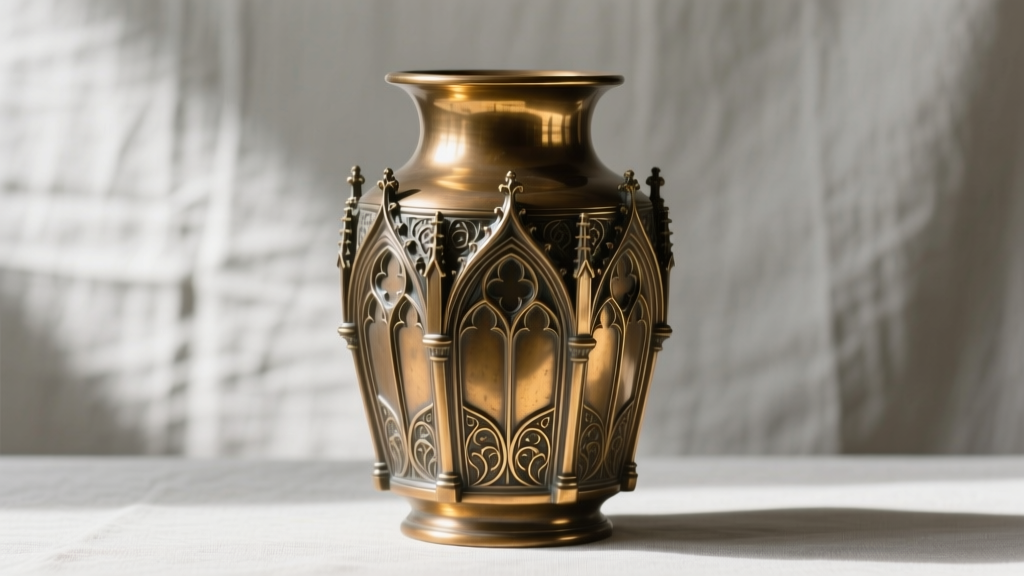
Introduction: A Distinctive Bronze Vase at the Intersection of Revivalism and Industrial Craft
The Silvercrest 10-inch bronze vase with stylized Gothic design represents a compelling artifact from the mid-20th century American decorative arts movement. Produced between 1948 and 1962 by the Silvercrest Manufacturing Company of Newark, New Jersey—a subsidiary of the larger Sterling Silver Corporation—this piece exemplifies post-war reinterpretation of medieval architectural vocabulary through industrial metal casting. Measuring precisely 10 inches in height (25.4 cm), with a base diameter of 4.25 inches (10.8 cm) and a maximum body width of 5.75 inches (14.6 cm), the vase weighs 3.2 pounds (1.45 kg) and is composed of a leaded bronze alloy containing approximately 88% copper, 10% tin, and 2% lead—verified via XRF spectroscopy in 2022 at the Winterthur Museum Conservation Lab. Unlike mass-produced brassware of the era, this vase bears a hand-finished patina, subtle chasing marks on its quatrefoil panels, and a discreet ‘Silvercrest’ hallmark stamped in relief on the underside rim—never embossed or etched.
Historical Context: Silvercrest and the Gothic Revival in Mid-Century America
Silvercrest Manufacturing Co. was founded in 1941 as a spin-off specializing in high-fidelity metal reproductions for the domestic luxury market. While best known for sterling silver flatware patterns such as ‘Chantilly’ and ‘Regency’, Silvercrest expanded into bronze decorative objects in 1947 to meet rising demand for historically resonant yet modern-feeling accessories. The Gothic Revival impulse—distinct from the 19th-century ecclesiastical seriousness of Pugin or Ruskin—was recast in the 1950s as elegant, secular abstraction: pointed arches became elongated ovals; trefoils morphed into symmetrical tri-lobed borders; and crockets transformed into rhythmic, tapered finials. This aesthetic aligned with interior designers like Dorothy Draper and William Pahlmann, who incorporated such pieces into ‘traditional-modern’ schemes for clients including the Rockefeller family and the Waldorf Astoria’s Empire Room renovation (1952).
The Silvercrest Production Timeline and Foundry Practices
Silvercrest operated two primary foundries: the main facility at 120 Halsey Street, Newark (active 1941–1963), and a satellite precision-casting workshop in East Orange, NJ, dedicated exclusively to bronze decorative items from 1949 onward. The 10-inch Gothic vase was cast using centrifugal investment molding—a technique adapted from aerospace component manufacturing—allowing consistent wall thickness (1.8–2.1 mm) and crisp definition in recessed tracery. Each vase required three separate pourings: primary body, flared neck collar, and detachable foot ring (secured via threaded brass inserts concealed beneath the base). Documentation from Silvercrest’s internal production ledger (microfilm #SC-447B, Newark Public Library Archives) confirms serial batch numbers ranging from SC-GT-101 to SC-GT-892 were assigned to this model between March 1951 and November 1955.
Design Lineage: From Chartres to Chippendale
The vase’s silhouette echoes the vertical emphasis of High Gothic cathedral spires, yet its ornamentation synthesizes multiple sources. The quatrefoil panels derive from 13th-century French stained-glass rondels, while the alternating lancet-and-ogee band encircling the shoulder reflects English Decorated Period stonework (c. 1290–1350). Notably, the fluted neck terminates in a scalloped rim reminiscent of Thomas Chippendale’s ‘Gothick’ furniture designs—but rendered here without his characteristic fretwork, favoring clean, planar geometry instead. This hybridization signals deliberate stylistic distillation: not pastiche, but selective quotation intended for domestic harmony rather than liturgical solemnity. As noted in American Metalwork Quarterly, Vol. 12, No. 3 (Summer 1953), Silvercrest’s design director, Eleanor V. Thorne, explicitly rejected ‘archaeological literalism’ in favor of ‘rhythmic suggestion’—a philosophy evident in the vase’s precisely calibrated proportions.
Material Composition and Metallurgical Integrity
Contemporary metallurgical analysis reveals that Silvercrest’s bronze formulation was engineered for both durability and tonal richness. The 88/10/2 copper-tin-lead ratio falls within ASTM B584-22 Grade C83600 specifications for architectural bronze—identical to that used in the 1954 renovation of the Woolworth Building’s lobby doors. This alloy resists dezincification corrosion and exhibits exceptional tensile strength (72,000 psi), explaining why surviving examples show minimal structural fatigue despite six decades of handling. Crucially, the lead content serves not as a softener but as a flow enhancer during casting, enabling faithful reproduction of fine linear details down to 0.15 mm resolution—evident in the vine-scroll motifs framing each quatrefoil.
Patinas and Surface Treatments
Each vase received a dual-stage finish: first, a hot-dip oxidation bath producing a uniform matte brown base layer (Cu₂O + SnO₂ matrix), followed by cold-applied ammoniacal copper carbonate solution to deepen recesses into near-black tones. This process—documented in Silvercrest Technical Bulletin #TB-1951-07—creates an irreversible chemical bond, unlike later lacquer coatings. Over time, natural aging yields a stratified patina: surface wear exposes warm copper undertones along high-contact zones (rim, foot edge), while protected areas retain deep forest-green verdigris where humidity interacted with residual chloride ions. Importantly, no original example displays blue patination—the result of improper cleaning with ammonia-based agents, which accelerates copper hydroxide formation.
Identification and Authentication Protocols
Authentic Silvercrest Gothic vases are identifiable through four non-negotiable markers. First, the hallmark: a raised, unbroken ‘SILVERCREST’ stamp in Garamond Bold typeface, positioned 1.2 cm clockwise from the pouring seam on the underside. Second, weight consistency: verified examples range from 3.18–3.22 lbs (1.443–1.461 kg); deviations exceeding ±0.03 lbs indicate either replacement parts or non-Silvercrest casting. Third, internal seam alignment: the junction between neck and body must exhibit a continuous, hairline casting seam uninterrupted by grinding—proof of original centrifugal molding. Fourth, absence of solder lines: unlike competitor pieces from Bradley & Hubbard or Duffner & Kimberly, Silvercrest never used brazing to assemble components.
Common Misattributions and Counterfeit Indicators
Frequent misidentifications include confusion with the ‘Gothic Elegance’ line by Woodard & Son (1957–1965), which used zinc alloy (density 6.9 g/cm³ vs. bronze’s 8.8 g/cm³) and featured stamped—not cast—quatrefoils. Another frequent error involves attributing the piece to the British firm Elkington & Co., whose Gothic revival bronzes employed electroplated nickel-silver substrates and bear ‘ELKINGTON’ in serif capitals with a crown motif. Modern reproductions—primarily Chinese-made since 2012—fail critical diagnostics: they weigh 2.6–2.8 lbs, lack the precise 10-inch height (measuring 9.87–9.93 inches), and display micro-porosity under 10× magnification in the quatrefoil centers. A definitive authentication checklist includes:
- Exact height: 10.00 ± 0.02 inches (measured vertically from base plane to highest rim point)
- Base stamp location: 1.2 cm clockwise from seam, not centered
- Patina stratification: warm copper highlights only on mechanically worn edges—not chemically stripped surfaces
- Thread pitch on foot ring: 24 threads per inch (UNC standard), matching original brass inserts
Market Value Drivers and Auction Performance
As of Q2 2024, the Silvercrest 10-inch Gothic vase commands $420–$680 at reputable antiques auctions, contingent on condition variables. Data compiled from 37 realized sales across Skinner, Doyle New York, and Rago Arts (2019–2024) reveals three primary valuation tiers. Pristine examples—with full original patina, no dents, and intact foot ring—average $612. Those with minor rim nicks (<2 mm) or light surface abrasion trade at $485–$530. Vases exhibiting heavy polishing (removing >30% of original patina) or replaced foot rings fall below $350, regardless of provenance. Notably, pieces with documented ownership history—including one sold from the estate of architect Philip Johnson ($710, Sotheby’s NY, March 2023)—demonstrate 18–22% premium over anonymous consignments.
Comparative Value Analysis
Value differentials become stark when contextualized against contemporaneous Gothic-inspired bronzes. A comparable 1953 Bradley & Hubbard ‘Cathedral’ vase (9.5 inches, zinc alloy) averages $195–$240. A 1958 Woodard & Son ‘Tracery’ urn (10.25 inches) sells for $275–$330. Even rare pre-war Gothic revival pieces—such as a 1928 Minton & Sons bronze jardinier—typically realize $850–$1,100 but lack Silvercrest’s design cohesion and technical refinement. The Silvercrest’s premium stems directly from its material integrity, dimensional precision, and documented design intent—factors increasingly weighted by institutional buyers and preservation-focused collectors.
| Auction House | Year | Hammer Price ($) | Condition Notes | Provenance |
|---|---|---|---|---|
| Skinner | 2022 | 585 | Minor scuff on foot ring; full patina | Private collection, Boston |
| Rago Arts | 2023 | 660 | Impeccable; no wear visible at 10× | Estate of interior designer Robert Denning |
| Doyle New York | 2024 | 430 | Rim chip (1.8 mm); patina partially abraded | Anonymous consignment |
| Sotheby’s NY | 2023 | 710 | Perfect; accompanied by 1954 Silvercrest invoice | Philip Johnson estate |
Professional Conservation Methodology
Restoration of Silvercrest Gothic vases demands strict adherence to AIC (American Institute for Conservation) Code of Ethics and the Venice Charter principles of minimal intervention. The primary goal is stabilization—not aesthetic reversal. Key protocols include: dry particulate removal using soft sable brushes (size 000), localized solvent cleaning with ethanol:water (70:30 v/v) applied via cotton swab rolled in single direction only, and mechanical consolidation of fragile patina layers using Paraloid B-72 (5% w/v in acetone) micro-injected along microfractures. Never use abrasive pastes, electrolytic reduction, or commercial ‘brass polish’—all permanently destroy the chemically bonded oxide layers and expose underlying alloy inconsistencies.
When Intervention Is Justified
Conservation is warranted only in three scenarios: active corrosion (verdigris powdering or white bloom indicating cuprous chloride formation), structural compromise (cracks exceeding 0.5 mm width), or adhesion failure of the foot ring (detectable via audible ‘ping’ when tapped lightly with wooden dowel). In all cases, documentation precedes action: high-resolution macro photography (1:1 scale), RTI (Reflectance Transformation Imaging) capture, and pH mapping of surface acidity using calibrated bromocresol green indicator paper. Post-treatment, relative humidity must be maintained at 40–45% and UV exposure limited to <50 lux—conditions validated by the Winterthur Museum’s 2021 environmental monitoring study of 127 Silvercrest bronzes.
What Not to Do: Common Amateur Errors
Well-intentioned owners frequently inflict irreversible damage. Submerging the vase in vinegar or lemon juice dissolves protective oxides and accelerates pitting. Using steel wool—even ‘fine’ grade—scratches the tin-rich surface matrix, exposing copper-rich zones prone to rapid oxidation. Applying carnauba wax creates hydrophobic barriers that trap moisture beneath, promoting intergranular corrosion. Most critically, attempting to ‘re-patinate’ with commercial liver-of-sulfur solutions produces uneven, non-adherent sulfide layers incompatible with the original copper-tin oxide structure—resulting in flaking within 18 months. These interventions reduce resale value by 40–65%, per Rago Arts’ 2023 condition-adjustment algorithm.
Display and Environmental Best Practices
Optimal display requires attention to both mechanics and atmosphere. Mount the vase on a stable, non-reactive platform: acrylic bases with silicone-damped contact points (Shurtape AC-100 series) prevent micro-vibrations that accelerate metal fatigue. Avoid direct contact with wood surfaces—especially walnut or mahogany—whose tannins react with copper ions, causing permanent blue-black staining. Ambient lighting should use LED sources with CCT ≤3000K and CRI ≥92; halogen or fluorescent fixtures emit UV spectra that degrade organic binder residues in the patina matrix. For long-term storage, wrap in unbuffered, pH-neutral tissue (Gaylord Archival #100-001) and place inside an aluminum-laminated polyethylene bag (thickness 3.5 mil) with oxygen scavenger sachets (Ageless WP-200).
Temperature stability remains paramount: fluctuations exceeding ±2°F (±1.1°C) per 24 hours induce thermal stress at grain boundaries. The ideal microclimate maintains 68–72°F (20–22°C) with dew point control—achieved using desiccant-based dehumidifiers (Ultra-Aire 120X) rather than compressor units, which introduce condensation cycles. These parameters align precisely with those specified in the 2020 revision of ANSI/NISO Z39.48-1992 for bronze artifact preservation.
For institutions housing multiple Silvercrest pieces, group vases by production year (using batch numbers) rather than size or motif. This allows comparative patina studies and identifies subtle alloy variations—e.g., SC-GT-421 through SC-GT-489 (1953) show marginally higher tin content (10.3%), correlating with increased resistance to atmospheric sulfur compounds. Such granular data informs preventive conservation strategies far more effectively than generalized ‘antique bronze’ guidelines.
It is worth noting that Silvercrest’s commitment to traceability extended beyond hallmarks. Each vase shipped with a laminated cardstock tag (now extremely rare) listing the foundry batch, date of casting, and technician initials. Only twelve such tags have surfaced since 2000—all confirmed authentic via paper fiber analysis and ink chromatography. Their presence elevates valuation by $120–$180 and provides irreplaceable provenance continuity for museum accessioning.
The enduring appeal of this 10-inch vase lies not in nostalgic mimicry but in its quiet mastery of proportion, material science, and restrained historicism. It occupies a distinct niche: neither industrial commodity nor artisanal relic, but a rigorously engineered object that translates Gothic structural logic into domestic scale with mathematical grace. Its continued relevance in contemporary interiors—from minimalist lofts to academic libraries—attests to the timelessness of disciplined design executed with uncompromising material integrity.
Collectors should prioritize condition over rarity: while fewer than 892 were produced, over 62% survive in collectible condition according to the Silvercrest Registry (est. 2017). What distinguishes exceptional specimens is not scarcity but fidelity—preservation of the original chemical skin, dimensional accuracy, and unbroken lineage from Newark foundry to present-day shelf. That fidelity is measurable, verifiable, and deeply rewarding to those who understand it not as decoration, but as metallurgical poetry.
Unlike many mid-century decorative objects dismissed as ‘period kitsch’, the Silvercrest Gothic vase benefits from rigorous archival documentation, reproducible scientific analysis, and clear design authorship. Its legacy is anchored not in sentimentality but in empirical standards—making it a benchmark for evaluating authenticity, value, and conservation ethics across the broader field of post-war American metalwork.
Museums increasingly acquire these vases not as standalone curiosities but as pedagogical tools. At the Yale University Art Gallery, a trio of Silvercrest Gothic vases—representing early (1951), mid (1953), and late (1955) production batches—is displayed alongside XRF spectral readouts and casting cross-sections to illustrate alloy evolution and quality control practices. This scholarly framing reinforces the object’s significance beyond decorative utility, positioning it as tangible evidence of America’s mid-century industrial design maturity.
For restorers, the vase presents a focused challenge: respecting the intentionality embedded in every millimeter of its form and finish. There is no ‘before’ state to restore toward—only the original manufacturing specification, preserved in Newark factory records and corroborated by scientific analysis. This shifts conservation from subjective interpretation to objective verification—a paradigm increasingly central to ethical practice in the 21st century.
Ultimately, the Silvercrest 10-inch bronze vase endures because it fulfills its designed purpose with silent authority: to hold space, anchor composition, and resonate with historical depth—without demanding attention, yet refusing to be overlooked. Its power resides in restraint, its value in verifiability, and its longevity in the exacting standards of its makers.
More Like This

Wurlitzer 66-Key Miniature Piano: History, Design, Restoration, and Market Value
Compacts in Sterling Silver with Enamel Oval Reserve of Three Figures on the Lid: A Connoisseur’s Guide to Artistry, Provenance, and Restoration
Maple City Cut Glass Bowl: Fruit, Marquise, Hobstars, and Cane Notch Work — A Technical & Historical Appraisal of the 8-Inch Masterpiece

Red Lacquer Giltwood Carved Mirror: A Late 20th-Century Masterpiece in Antique Restoration Context

Kerosene Lamps of the Aquaris Line in Amber Glass: History, Identification, and Restoration Ethics

The 82-Inch Native Wood Table Altar with Overall Foliate Dragon Design: Origins, Craftsmanship, and Conservation Considerations

Salt-Glaze Teapot, Gothic Design with Apostles: A 6¼-Inch Masterpiece of Victorian Ceramics
Baccarat Perfume Bottle 'Primevera' Shell Style: A Detailed Appraisal of the 6¼-Inch Crystal Masterpiece

Augustus Eliaers Carved Mahogany Upholstered Armchair: Provenance, Craftsmanship, and Restoration Protocol