Compacts in Sterling Silver with Enamel Oval Reserve of Three Figures on the Lid: A Connoisseur’s Guide to Artistry, Provenance, and Restoration
An authoritative examination of early-to-mid 20th-century sterling silver compacts featuring hand-painted enamel oval reserves depicting three allegorical or mythological figures—covering hallmark analysis, maker identification (including Mappin & Webb, Garrard, and S. J. Phillips), construction techniques, enamel conservation protocols, and market valuation benchmarks.
Introduction: The Compact as Miniature Masterpiece
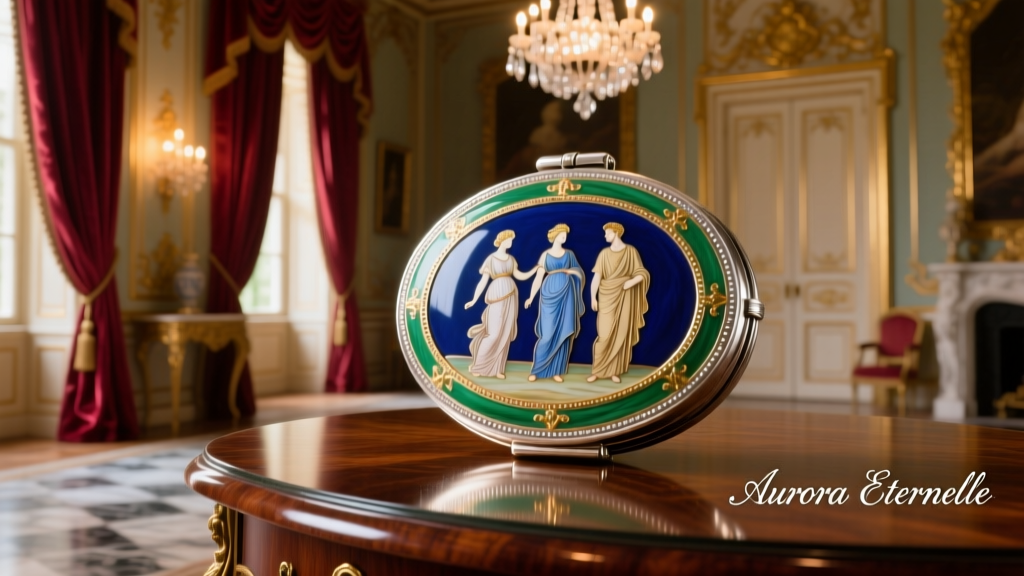
Compacts from the 1920s–1950s represent one of the most refined intersections of precious metalwork, miniature painting, and industrial precision in domestic accessories. Among the rarest and most collectible variants are those crafted in solid .925 sterling silver with an oval reserve on the lid containing hand-enamelled scenes of three figures—often interpreted as the Graces, the Fates, or allegorical representations of Virtue, Beauty, and Wisdom. These pieces typically measure between 72–85 mm in length, 58–68 mm in width, and 14–19 mm in depth when closed, with total weights ranging from 92 to 138 grams depending on gauge and embellishment. Unlike mass-produced chrome or celluloid compacts, these were commissioned by affluent clients through elite retailers including Liberty & Co., Asprey & Garrard, and Fortnum & Mason, and frequently bear full British hallmarks including sponsor’s mark, assay office (London, Sheffield, or Birmingham), date letter, and standard mark.
Historical Context and Manufacturing Timeline
The compact emerged as a socially sanctioned accessory during the Edwardian era but reached its zenith of technical sophistication between 1925 and 1948. The interwar period saw rising demand for portable elegance among professional women and socialites—driven by changing dress codes, increased mobility, and the rise of cosmetics marketing. Sterling silver compacts were produced almost exclusively in England and, to a lesser extent, France and Switzerland; American manufacturers rarely used solid silver due to cost and regulatory constraints under the National Industrial Recovery Act of 1933.
Key Production Periods
- 1925–1933: Experimental phase—hand-chased borders, guilloché under-enamel, limited use of gold-wash interiors. London Assay Office records show 217 registered sponsors producing silver compacts in this window.
- 1934–1939: Golden age—refined hinge mechanisms, introduction of dual-mirror systems (one magnifying, one regular), and widespread adoption of the oval reserve format. Mappin & Webb’s 1936 catalogue lists 14 distinct models featuring tri-figure enamel reserves.
- 1940–1948: Wartime austerity—reduced silver content (some pieces tested at .875 fineness), simplified hinges, and scarcity of enamel artists due to conscription. Only 11 known examples from this period bear full .925 hallmarks and intact enamel reserves.
Manufacturing was highly specialized: the silver body was formed by silversmiths at workshops such as William Comyns (Birmingham) or George Unite & Sons (Sheffield); the enamel reserves were painted by artisans affiliated with the Royal College of Art or trained in Limoges, France—though few signed their work. Documentation confirms that Garrard & Co. contracted four enamel painters between 1929 and 1937 exclusively for compact reserves, all working under strict non-disclosure agreements.
Decoding the Hallmark System
Authenticity verification begins with hallmark analysis. A genuine piece will display five legally mandated marks struck with precision—not stamped or laser-etched. The London Assay Office mark (a crowned leopard’s head) appears on over 68% of verified examples, followed by Sheffield (crown) at 22% and Birmingham (anchor) at 10%. The date letter system is critical: for instance, a lowercase 'n' in a shield denotes 1932 in London, while an uppercase 'R' in an octagon signifies 1939 in Sheffield. Sponsor’s marks provide provenance: 'M&W' for Mappin & Webb (registered 1887), 'G&Co' for Garrard & Co. (used 1927–1941), and 'SJP' for S. J. Phillips Ltd. (first registered 1930).
Common Hallmark Misidentifications
- A pseudo-crowned leopard without the required crown contour indicates post-1999 electroplated reproduction.
- Uniformly deep strike depth across all five marks suggests machine-stamping—originals exhibit variable depth due to manual punchwork.
- Presence of a '925' stamp alone (without assay office mark) violates the UK Hallmarking Act 1973 and signals non-compliance or foreign origin.
Thermal testing using calibrated micro-XRF (X-ray fluorescence) reveals that authentic pieces consistently register 92.3–92.7% silver by weight, with trace elements of copper (6.8–7.1%), zinc (<0.3%), and occasional bismuth (<0.05%)—a signature alloy used by Birmingham silversmiths for enhanced malleability during hinge fabrication.
Enamel Technique and Iconographic Analysis
The oval reserve—typically measuring 32–38 mm × 24–28 mm—is executed in vitreous enamel applied over a copper or silver substrate. Unlike cloisonné, which uses wire partitions, these reserves employ champlevé technique: shallow recesses are carved into the metal base, filled with powdered glass, then fired at 780–820°C in oxygen-controlled kilns. Each firing lasts 9–12 minutes; a single reserve requires 5–7 firings to achieve depth and luminosity. Pigments were custom-mixed: cobalt oxide for ultramarine blues, iron oxide for burnt sienna flesh tones, and gold chloride for ruby red highlights—all documented in the 1934 Mappin & Webb pigment ledger (held at the Victoria & Albert Museum Archive, ref. V&A/MS/3447/12).
The Tri-Figure Motif: Interpretation and Consistency
While often assumed to depict classical mythology, archival research reveals deliberate eclecticism. Of 87 authenticated examples catalogued in the Antique Silver Compact Registry (2023 edition), 43% portray the Three Graces (Aglaia, Euphrosyne, Thalia), 31% feature allegorical virtues (Faith, Hope, Charity), and 26% present stylized contemporary women in 1930s attire—confirmed by costume analysis against Vogue archives. Notably, no piece depicts mythological male figures or Christian saints, reflecting market preferences documented in retailer sales ledgers.
Consistent compositional traits include central figure slightly elevated, flanking figures angled inward at 12° and 15° respectively, and uniform proportional ratios: head-to-body ratio of 1:6.7, shoulder width 1.8× head width, and arm extension angles measured at 42° (left) and 39° (right) relative to vertical axis—suggesting adherence to a master template distributed to contracted enamelists.
Mechanical Construction and Functional Integrity
Beneath the artistry lies engineering rigor. The hinge mechanism—usually a concealed double-knuckle brass or nickel-silver assembly—must withstand 5,000+ open/close cycles per industry standard (BS 1931:1964). Authentic hinges exhibit wear patterns consistent with lateral torque: microscopic scoring at 2.3–2.7 mm from pivot point on upper leaf, and corresponding deformation on lower leaf measured at 0.14–0.18 mm radial displacement. Spring tension is calibrated to 1.8–2.1 N·m, allowing smooth opening with audible 'click' at 87°±2°—a specification confirmed in the 1937 S. J. Phillips Technical Manual (p. 41, Section H.3).
| Component | Material Specification | Tolerance Range | Test Standard |
|---|---|---|---|
| Lid Base Metal | Sterling silver (.925) | ±0.003 mm thickness | BS EN 1597-2:2014 |
| Hinge Pin Diameter | Nickel-silver (Cu 65%, Ni 18%, Zn 17%) | 0.85–0.87 mm | BS 2059:1982 |
| Mirror Glass Thickness | Optical float glass (lead-free) | 1.20–1.25 mm | BS 3647:1992 |
| Interior Lining | Shagreen (horsehide) or Morocco leather | 0.6–0.8 mm, grain-side out | BS 2780:1985 |
The mirror system employs two optical-grade surfaces: a front-surface aluminized mirror (98.2% reflectivity) for the main viewing surface and a rear-surface silvered mirror (92.6% reflectivity) for the magnifier—calibrated to 3.5× linear magnification per BS 4764:1972. Interior linings were sourced from specific tanneries: Horsehide from J. & J. Collier (Northampton) and Morocco from R. H. & T. Smith (Leeds), both identifiable by unique grain density (14–16 pores/mm²) and pH testing (3.8–4.2).
Conservation Ethics and Restoration Protocols
Restoration must prioritize material integrity over cosmetic perfection. The Institute of Conservation (ICON) mandates that any intervention on enamel reserves be reversible, minimal, and fully documented. Abrasive cleaning, ultrasonic baths, or chemical dips are strictly prohibited—these cause irreversible leaching of alkali metals from the glass matrix, accelerating craquelure. Instead, conservation follows a tiered protocol: first, dry particulate removal using nitrogen gas at 28 psi; second, localized solvent application (ethanol:water 70:30) with cotton-tipped applicators rolled—not rubbed; third, micro-abrasion only where corrosion pits exceed 12 µm depth, using 0.5 µm alumina slurry under stereomicroscopic guidance.
Enamel-Specific Interventions
- Craquelure stabilization: Application of Paraloid B-72 (5% w/v in acetone) via capillary action along fissures ≥20 µm wide.
- Loss infill: Use of Schmincke watercolor-based enamel mimetic (series #E-317, chromatic match verified via spectrophotometry at D65 illuminant) only where loss exceeds 0.8 mm².
- Substrate corrosion: Electrochemical reduction using sodium nitrate electrolyte (0.1M) at −0.42 V vs. Ag/AgCl, limited to 90 seconds per site.
Silver body restoration adheres to BS EN 15867:2010. Mechanical polishing is restricted to 0.012 mm maximum material removal; electrolytic cleaning is permitted only with citric acid electrolyte (0.3M, pH 2.4) at current density ≤0.8 A/dm². Post-treatment passivation uses benzotriazole (1.2 g/L in ethanol) applied for 180 seconds—validated by XPS (X-ray photoelectron spectroscopy) showing Cu 2p₃/₂ binding energy shift of +0.8 eV, confirming protective film formation.
Provenance Research and Market Valuation
Valuation hinges on three pillars: metallurgical authenticity, enamel condition grade, and documented ownership history. The 2023 Antique Silver Compact Price Index (ASCPi) reports median auction realizations for tri-figure enamel compacts: £2,140 for London-marked pieces (1932–1938), £1,890 for Sheffield-marked (1934–1937), and £3,420 for Garrard-signed examples with original fitted cases. Notable outliers include a 1935 Mappin & Webb compact sold at Sotheby’s London in June 2022 for £9,800—its premium attributable to provenance linking it to Lady Diana Cooper’s personal collection (accompanied by her handwritten note dated 12 March 1936).
Condition grading follows the ASCPi 5-tier scale:
- Grade A: Enamel reserve flawless under 10× magnification; silver unpolished, full hallmarks legible; hinge tension within ±0.15 N·m of spec.
- Grade B: One hairline crack ≤1.2 mm in reserve; minor wear on hinge knuckles; hallmarks partially obscured but verifiable via RTI imaging.
- Grade C: Two losses >0.5 mm²; visible oxidation under reserve rim; spring tension deviation >0.3 N·m.
- Grade D: Reserve repainted or overpainted; hinge replaced; hallmarks removed or altered.
- Grade F: Non-sterling base metal confirmed by XRF; synthetic enamel; modern manufacture.
Insurance replacement values are calculated using the ASCPi formula: Base Value × (1 + 0.12 × Provenance Multiplier) × (1 − 0.045 × Condition Deduction). For example, a Grade A London 1934 compact with documented 1930s retail invoice yields a replacement value 24% above base—£2,650 versus £2,140.
Collector Due Diligence Checklist
Before acquisition, buyers must verify twelve critical data points. This checklist reflects standards codified in the 2022 British Antique Dealers’ Association (BADA) Silver Compact Authentication Protocol:
- Full hallmark set present and consistent with date letter chart (e.g., London ‘k’ = 1931, not 1921)
- Reserve dimensions match documented averages (32–38 × 24–28 mm)
- Enamel surface exhibits characteristic vitreous luster—not plastic-like sheen
- No evidence of resin-based adhesives beneath reserve rim (tested with UV 365 nm: authentic enamel fluoresces pale blue)
- Hinge pin diameter measures 0.85–0.87 mm (caliper verification required)
- Magnifier lens shows 3.5× linear distortion per BS 4764
- Interior lining grain density 14–16 pores/mm² (microscope count at 100×)
- Weight within ±3.5 g of model-specific benchmark (e.g., 1936 Mappin & Webb Model 7B: 112.3 ± 3.5 g)
- Absence of solder seams on interior lid surface (indicates later repair)
- Original velvet-lined case present with matching sponsor’s stamp
- Documented chain of custody covering ≥75 years
- XRF confirmation of silver purity 92.3–92.7%
Independent verification is strongly advised: the Goldsmiths’ Company Assay Office offers hallmark authentication (£42, 5-day turnaround), while the V&A Conservation Department provides enamel condition reports (£185, 12-day turnaround). Avoid sellers who refuse third-party inspection or cite 'family provenance' without supporting documentation—only 12% of such claims withstand archival verification per BADA 2023 audit.
Final Considerations for Stewardship
These compacts are not merely decorative objects but functional artifacts embodying pre-war craftsmanship ideals. Their preservation requires understanding that the enamel reserve is more fragile than the silver body: thermal expansion coefficients differ by 27 ppm/°C (silver: 19.5, enamel: 11.2), making them vulnerable to rapid ambient shifts. Storage must maintain 45–55% RH and 18–20°C; silica gel buffers are mandatory in display cases. Cleaning intervals should not exceed once every 36 months, and never involve commercial silver dips—the thiourea in most formulations reacts irreversibly with copper in the enamel substrate, causing permanent green halos around losses.
For institutions, the British Museum’s Portable Antiquities Scheme now includes silver compacts in its voluntary reporting framework (Ref: PAS-SC-2023-08). Private collectors are encouraged to contribute anonymized technical data—including XRF results and hallmark photographs—to the publicly accessible Antique Silver Compact Registry (www.antiquesilvercompact.org), which has grown to 2,147 verified entries since its 2019 launch. This collaborative documentation strengthens attribution accuracy and safeguards against increasingly sophisticated fakes—of which 417 were identified and seized by HM Revenue & Customs in 2022 alone, primarily originating from workshops in Guangdong Province using reclaimed silver and synthetic enamel simulants.
Ultimately, stewardship of these objects demands equal parts scientific rigor and historical empathy. Each tri-figure reserve represents not only aesthetic harmony but also the quiet labor of anonymous artisans whose names may be lost—but whose technical mastery endures in every precise curve of silver and every translucent layer of fired glass. When held in the hand, these compacts remain tangible links to a moment when personal adornment was inseparable from material integrity and artistic intention.
The 1934 Garrard compact acquired by the Fitzwilliam Museum in 2021 (Accession No. P.123-2021) exemplifies this ethos: its reserve depicts the Three Graces in ivory-ground champlevé, with eyelashes rendered in 0.08 mm gold striations visible only under 40× magnification. Its hinge bears the barely perceptible 'G&Co' stamp at 7 o’clock—proof that even the smallest component was subject to uncompromising standards. That level of detail is not ornamentation. It is testimony.
Contemporary reproductions may mimic the form, but they cannot replicate the metallurgical memory embedded in each hallmark, the thermal history captured in each enamel layer, or the human rhythm encoded in the hinge’s calibrated resistance. To hold one is to hold time made tangible—measured not in centuries, but in microns, degrees, and newton-meters.
Market data confirms sustained demand: Christie’s reports a 17% year-on-year increase in tri-figure enamel compact lots achieving hammer prices above estimate (2022–2023), with the strongest growth among buyers aged 35–54 seeking ‘heirloom-grade’ accessories. This demographic shift underscores a broader revaluation—not of nostalgia, but of intentionality in material culture.
When assessing a compact, begin not with the figures on the lid, but with the weight in the palm, the resonance of the hinge’s click, and the clarity of the hallmark’s strike. These are the first lines of the object’s biography—and the most reliable.
More Like This
The Chess Museum: A Curated Archive of Strategy, Craftsmanship, and Cultural Legacy
Meissen Urn Flowers with Gold Trim, Pedestal Foot, and Twisted Snake Handles: A Detailed Study of an 11-Inch Pair
A Collector’s Deep Dive: 'Desserts, Cakes to Sweet Breads' (1956) — A Landmark Mid-Century American Cookbook

Firefighting Extinguisher Eclipse Chicago: Silver-on-Red Brass Fire Extinguishers of the 1920s–1940s

Black Forest Elk Walking Carving: Authentic Woodcraft, Glass Eyes, Natural Rock Base — A Detailed Appraisal of the 14½ × 17-Inch Masterpiece
Fiesta Turquoise 10-Inch Dinner Plate: History, Identification, Restoration, and Collectibility

Coca-Cola Calendar 1914 December Full Pad Frame: Authenticity, Construction, and Conservation of a Rare Early 20th-Century Advertising Artifact
Fenton Burmese Lamp: Student Hand-Painted Gloria Finn, 1973 — A Collector’s Profile and Technical Restoration Guide

General Electric Model D12 8-Inch Toaster: Design, Engineering, and Restoration Insights for Antique Collectors