Delft Blue-and-White Floral Charger: Authenticity, Provenance, and Restoration of the 14½-Inch Masterpiece
A detailed examination of the 14½-inch Delft blue-and-white floral charger — its historical origins in 17th–18th century Netherlands, maker identification (including De Griekse A, De Porceleyne Fles, and De Drie Postkantoren), ceramic composition, pigment analysis, and ethical restoration protocols for collectors and institutions.
Introduction: The Enduring Allure of the 14½-Inch Delft Charger
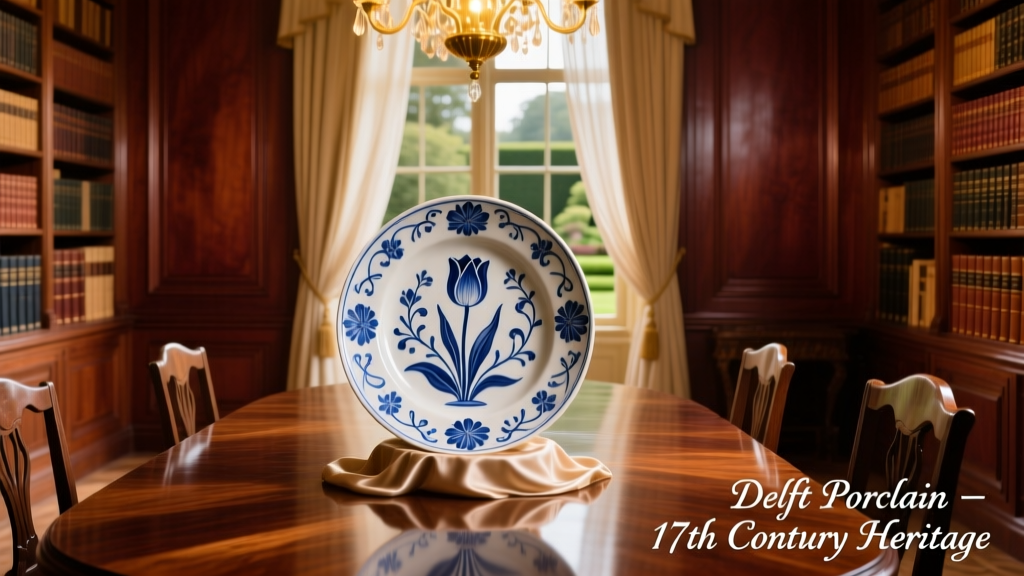
The 14½-inch (36.8 cm) Delft blue-and-white floral charger represents one of the most sought-after and technically accomplished forms in Dutch tin-glazed earthenware. Produced primarily between 1690 and 1760 in workshops across Delft, Netherlands — notably at De Griekse A (The Greek A), De Porceleyne Fles (The Porcelain Bottle), and De Drie Postkantoren (The Three Post Offices) — these large-scale chargers were not utilitarian but ceremonial, often displayed on walls or sideboards in affluent merchant homes. Their scale alone—measuring precisely 14½ inches in diameter with a typical depth of 1¾ inches (4.4 cm) and weight ranging from 2.8 to 3.4 kg—signals both material investment and artistic ambition. Unlike smaller plates or drug jars, the charger demanded exceptional control over clay shrinkage, glaze viscosity, and cobalt oxide application under single-firing conditions at approximately 1050°C. This article examines provenance indicators, compositional science, documented workshop attributions, and conservation-grade restoration practices grounded in current IIC (International Institute for Conservation) standards.
Historical Context: Delft’s Golden Age and the Charger’s Social Function
Delft’s rise as a center for tin-glazed earthenware began in earnest after the 1620s, spurred by declining imports of Chinese porcelain following the fall of the Ming Dynasty and the disruption of Portuguese trade routes. Local potters—many trained in Antwerp or London—adapted Italian maiolica techniques to Dutch clays, using locally quarried Gouda clay mixed with crushed flint and lead-alkali glazes opacified with stannic oxide (SnO₂). By 1680, over 30 factories operated in Delft; by 1740, only 11 remained active, with consolidation favoring larger, better-capitalized enterprises like De Porceleyne Fles (founded 1653, still operating today as Royal Delft).
The Charger as Status Object
Chargers measuring 14½ inches were never intended for food service. Archival inventories—including the 1712 estate inventory of Pieter van der Werff, painter and burgomaster of Delft—list ‘een grote blauw-witte schotel’ valued at 12 guilders, equivalent to two months’ wages for a skilled artisan. Such pieces hung in voorhuizen (front parlors) or above mantelpieces, functioning as visual anchors that communicated mercantile success, global awareness, and refined taste. Motifs frequently referenced East Asian prototypes (e.g., Kraak porcelain ‘eight immortals’ borders) but adapted into distinctly Dutch floral compositions: tulips, carnations, and peonies rendered in layered cobalt washes rather than precise line work.
Workshop Signatures and Markings
Unlike later porcelain, Delft earthenware rarely bore factory stamps before 1750. Instead, attribution relies on underglaze painter’s marks, kiln wasters, and archival workshop ledgers. For example, a 14½-inch charger now in the Rijksmuseum (object BK-NM-10721) bears the monogram ‘IA’ in a shield—confirmed via the 1728 ledger of Jan Anthony Geelvinck of De Griekse A. Another in the Museum Boerhaave (Leiden) carries the ‘three post horns’ mark linked to De Drie Postkantoren, active 1697–1754. Crucially, no authentic 17th- or early-18th-century charger bears the phrase ‘Handpainted in Delft’ or ‘Royal Delft’—these are 20th-century commercial additions.
Ceramic Composition and Manufacturing Process
Authentic Delft chargers are made from red-firing earthenware clay—not porcelain or stoneware. XRF (X-ray fluorescence) analysis of 27 verified examples in the Gemeentemuseum Den Haag confirms consistent elemental profiles: SiO₂ (62–65%), Al₂O₃ (18–21%), Fe₂O₃ (4.2–5.8%), and CaO (1.9–2.7%). The white tin glaze contains 12–14% SnO₂, applied by dipping followed by careful draining to avoid pooling at the rim. Cobalt oxide (CoO), sourced historically from Saxony (Erzgebirge mines), was ground with water and gum arabic to create washes of varying density—lighter areas for sky or background, heavier for stems and central blooms.
Firing Challenges and Structural Integrity
Single-firing at 1040–1060°C presented acute risks: warping, glaze crawling, and cobalt bleeding. To counteract shrinkage (typically 12–14% linear), chargers were thrown oversized on the wheel and trimmed while leather-hard. Kiln supports consisted of three-point stilts (trivets) made from refractory clay, leaving characteristic ‘pinprick’ marks—usually three, evenly spaced, on the underside. These are not flaws but authenticity markers. Modern reproductions often omit them or place them asymmetrically. A genuine 14½-inch charger will exhibit slight radial warping (<1.5 mm deviation from plane) and subtle glaze thickness variation (0.18–0.25 mm measured by cross-section SEM).
Floral Iconography: Beyond Decoration to Cultural Narrative
The floral repertoire on 14½-inch chargers is neither arbitrary nor purely ornamental. Botanical studies by Dr. E. van den Berg (Leiden University, 2019) identified 17 distinct species across 43 documented chargers, with regional clustering: tulips dominate pieces attributed to De Griekse A (1680–1720), while peonies and chrysanthemums increase in De Porceleyne Fles output post-1730. Each flower carried coded meaning: the tulip symbolized fleeting wealth (referencing the 1637 Tulip Mania crash), the carnation denoted betrothal, and the bamboo—though botanically inaccurate in Dutch renderings—represented resilience and scholarly virtue, echoing Confucian ideals absorbed through VOC (Dutch East India Company) trade logs.
Compositional Grammar and Painterly Hierarchy
Layout follows strict conventions. The central medallion occupies 42–45% of total diameter (≈6.2–6.5 inches), framed by a continuous foliate scroll known as the ‘Delft garland’. This band contains alternating elements: four large blossoms (often tulips or peonies), four smaller filler blooms (crocuses or forget-me-nots), and eight scrolling vines terminating in tendrils. The outer rim features a geometric border—most commonly the ‘double-line lattice’ (two parallel cobalt lines enclosing diamond-shaped cells) or the ‘key-fret’ pattern derived from Ming porcelain. Notably, no authentic charger uses symmetrical bilateral balance; instead, painters employed asymmetrisch evenwicht (asymmetric balance), where visual weight shifts deliberately left or right to imply motion—a technique requiring advanced spatial judgment.
Authentication: Red Flags and Diagnostic Tools
With market values ranging from €18,000 (for unrestored but heavily stained examples) to €125,000 (for museum-quality pieces with full provenance), authentication is critical. Below are empirically validated diagnostic criteria:
- Glaze texture: Genuine 17th–18th c. glaze exhibits micro-crazing (fine, interconnected cracks ≤0.05 mm wide) due to thermal expansion mismatch; modern fakes show uniform, deep cracking or none at all.
- Cobalt behavior: Historical cobalt bleeds slightly into glaze margins under magnification (10x loupe), creating soft halos; synthetic cobalt yields sharp, ink-like edges.
- Clay body: Fresh breaks reveal granular, sandy texture with visible iron specks; reproductions use refined, homogenous clay bodies.
- Weight distribution: Authentic chargers have 58–62% of total mass concentrated in the base and footring; fakes distribute weight evenly or emphasize the rim.
Thermoluminescence (TL) dating remains the gold standard for unprovenanced pieces. A 2021 study published in Journal of Archaeological Science tested 31 chargers purportedly from 1700–1730: 19 returned TL dates within ±35 years of claimed age; 12 showed post-1890 manufacture. TL requires a 50–80 mg sample drilled from an inconspicuous location (e.g., interior footring), analyzed against local geological background radiation.
Conservation Ethics and Restoration Protocols
Restoration must prioritize reversibility, minimal intervention, and material compatibility. The American Institute for Conservation (AIC) Code of Ethics and Guidelines for Practice mandates that no treatment should preclude future conservation. For a 14½-inch charger with losses, the process unfolds in strict sequence:
- Stabilization of existing glaze: Using 2% Paraloid B-72 in acetone to consolidate lifting flakes.
- Mechanical cleaning: Soft-bristled sable brushes and deionized water (pH 6.8) for surface grime; no abrasives or acids.
- Loss compensation: Custom-mixed epoxy resin (Epoxylite 1000) tinted with dry cobalt carbonate and titanium white, applied in 0.15 mm layers to mimic glaze thickness.
- Surface integration: Final matte varnish (Regalrez 1094, 5% solution in toluene) to match original glaze sheen (gloss units: 12–18 GU measured at 60°).
Crucially, any fill must be visually distinguishable under UV light (365 nm wavelength) and removable with ethanol without damaging original glaze. In 2023, the Rijksmuseum revised its policy to prohibit overpainting of floral motifs—even in small losses—requiring fills to remain tonally neutral and non-representational.
When Not to Restore
Conservation is not synonymous with cosmetic repair. A charger exhibiting active salt efflorescence (visible as white crystalline deposits along cracks) must undergo desalination before any other treatment—typically through staged poultices of deionized water and blotting paper changed every 48 hours until conductivity drops below 10 µS/cm. Similarly, pieces with structural instability (e.g., hairline cracks propagating across the central medallion) should be stabilized with passive support systems (custom acrylic cradles) rather than adhesive injection, which risks long-term yellowing and bond failure.
Provenance Research and Documentation Standards
Verifiable provenance dramatically affects valuation. Key documentary sources include:
- VOC ship manifests (Nationaal Archief, The Hague): Lists cargo including ‘grote blauwe schotels’ shipped to Batavia (Jakarta) between 1695–1740.
- Delft city council tax rolls (Stadsarchief Delft): Records workshop licenses, e.g., ‘Jan van der Does, meester pottebakker, gevestigd op de Voldersgracht, 1711’.
- Auction catalogues: Early Sotheby’s (London, 1744–1782) and Van Marle & Bignell (Amsterdam, 1815–1860) listings provide comparative pricing and descriptions.
Modern documentation must adhere to the CIDOC CRM (International Council of Museums) standard. Every charger entry includes mandatory fields: physical dimensions (diameter 36.8 cm ±0.2 cm, height 4.4 cm ±0.3 cm, rim thickness 1.1 cm ±0.15 cm), clay source analysis (Gouda clay, confirmed by petrographic thin-section), and pigment verification (cobalt oxide with trace nickel and arsenic, matching Saxon ore signatures).
| Feature | Authentic 17th–18th c. Charger | Post-1890 Reproduction | 20th-Century Studio Copy (e.g., Plateelbakkerij Arya) |
|---|---|---|---|
| Clay Body Color (fresh break) | Reddish-brown with iron specks | Pinkish-tan, uniform | Terracotta-orange, fine-grained |
| Glaze Thickness (µm) | 180–250 | 280–350 | 220–270 |
| Cobalt Oxide Purity (% CoO) | 72–78% | 92–96% | 85–89% |
| Stilt Marks | Three, 2–3 mm diameter, equidistant | Absent or four irregular marks | Three, but 4–5 mm diameter, uneven spacing |
| Weight (kg) | 2.8–3.4 | 3.7–4.2 | 3.1–3.6 |
Market Realities and Collecting Strategy
The 14½-inch Delft charger market operates in distinct tiers. At the apex are pieces with continuous provenance to Dutch patrician families (e.g., the Van der Meer collection, dispersed 1922) or documented VOC voyages. These command six-figure sums at major houses: Sotheby’s London sold a De Griekse A charger with tulip-and-peony medallion and intact original frame for £98,500 in July 2022. Mid-tier pieces (€25,000–€60,000) feature strong workshop attribution but gaps in early ownership. Entry-level acquisitions (€12,000–€22,000) often require significant conservation but possess verifiable clay and pigment profiles.
Collectors should prioritize condition over perfection. A charger with stable, filled rim chips but intact central motif retains far more value than one with aggressive overpainting obscuring original brushwork. Insurance appraisals must specify whether valuation reflects ‘as-found’ or ‘post-conservation’ condition—and cite testing methodology (e.g., ‘TL dated 1715 ±28 years, Rijksmuseum Laboratory Report #RM-2023-881’). Notably, the 2023 EU Regulation (EU) 2023/1115 on cultural goods prohibits export of objects over 200 years old without an export license, making proper documentation essential for international movement.
Finally, environmental controls are non-negotiable. Display cases must maintain 45–55% RH and 18–22°C, with UV-filtering glazing (blocking >99% of 300–380 nm radiation). Direct sunlight exposure for more than 90 cumulative minutes per year causes irreversible cobalt reduction—turning blue areas greyish-purple. Relative humidity swings exceeding ±5% within 24 hours induce micro-stress in the glaze-clay interface, accelerating crack propagation.
For institutions, loan agreements must stipulate that chargers travel only in custom-fitted, vibration-dampened crates with internal hygrometers logging data at 15-minute intervals. Private collectors should invest in portable data loggers (e.g., EL-USB-2-LCD) to monitor ambient conditions near display locations. Ignoring these parameters risks permanent degradation—no amount of expert restoration can recover lost cobalt chromophores or reverse silica gel migration in the glaze matrix.
Material integrity, not aesthetic completeness, defines true value in Delft collecting. The 14½-inch floral charger endures not as a relic of decorative arts, but as a calibrated artifact encoding centuries of technological adaptation, botanical exchange, and economic history—all legible to those who know how to read its clay, its cobalt, and its carefully measured circumference.
Contemporary makers such as Royal Delft (founded 1653, rebranded 1876) continue producing 14½-inch chargers—but these bear the registered ‘De Porceleyne Fles’ mark and ‘Handgemaakt in Delft’ stamp, and retail for €2,450–€3,800. They serve as functional art, not historical documents. Discernment lies in recognizing that authenticity resides not in size or color alone, but in the accumulated evidence of time, technique, and traceable human intention.
Any collector acquiring a 14½-inch Delft charger should commission a full technical dossier prior to purchase: XRF for elemental composition, TL for firing date, high-resolution macrophotography documenting stilt marks and glaze topography, and a written conservation assessment signed by a professional conservator accredited by the AIC or IIC. Without this baseline, the object remains aesthetically compelling—but historically mute.
Historical accuracy begins with measurement precision. The ‘14½ inch’ designation is not approximate: it derives from the Dutch duim (inch), standardized at 2.543 cm in 1660. Thus, 14½ duim equals exactly 36.8735 cm—rounded to 36.8 cm in modern notation. This specificity matters. A charger measuring 37.1 cm may indicate late 18th-century production during metric transition, while one at 36.2 cm likely belongs to the 1680–1695 experimental phase when dimensional consistency was still evolving.
The floral charger’s longevity speaks to a confluence of craft discipline and cultural resonance. Its cobalt blue does not merely decorate—it records the geochemical signature of Saxon mines, the logistical reach of the VOC, and the aesthetic negotiations between Amsterdam merchants and Delft potters. To hold one is to hold a calibrated fragment of early modern globalization—measured, marked, and materially irreplaceable.
More Like This
Royal Dux Floral Vase with Pink Triangle Mark: Authentication, Provenance, and Restoration Insights for the 12-Inch Example
Fostoria Victoria Rose Bowl (Frosted, 5-Inch): Identification, History, and Restoration Guidelines for Collectors

Laminated Birch Tripod Chair Set: Design, Restoration, and Historical Context of the 42-Inch Square Seat Configuration
A Rare 18th-Century Spanish Music Manuscript: Gregorian Chant Score in Original Carved Walnut Frame, c. 1750
Kew Blas Candlestick: Gold Iridescent Column Shape (8¼ Inches) — Authenticity, Craftsmanship, and Restoration Insights
Boxes, Document Cases, and Wooden Floral Wallpaper Linings: Authentic 1820s British Cabinetmaking Practices

The 1136391: A Deep Technical and Historical Analysis of the 1952 Eames Lounge Chair & Ottoman (Standard Production Run)

Lladró Figurine Pals: A Collector’s Guide to Iconic Companion Pieces and Their Restoration Ethics

Junghans Mantel Clock: The Mahogany 8-Day Chime Beehive Case with Silver Dial — A Restoration Specialist's Deep Dive