Boehm Figurine Green Jays No. 486 Pair: A Collector’s Guide to Authenticity, Value, and Conservation
A detailed examination of the Boehm Green Jays No. 486 pair—introduced in 1972, standing 6¾ inches tall, hand-painted in 22k gold accents, and produced exclusively by Boehm Porcelain of Allentown, Pennsylvania. Includes production history, identification markers, market valuation (2024 auction data), restoration protocols, and conservation best practices.
Introduction: The Distinctive Presence of Boehm’s Green Jays
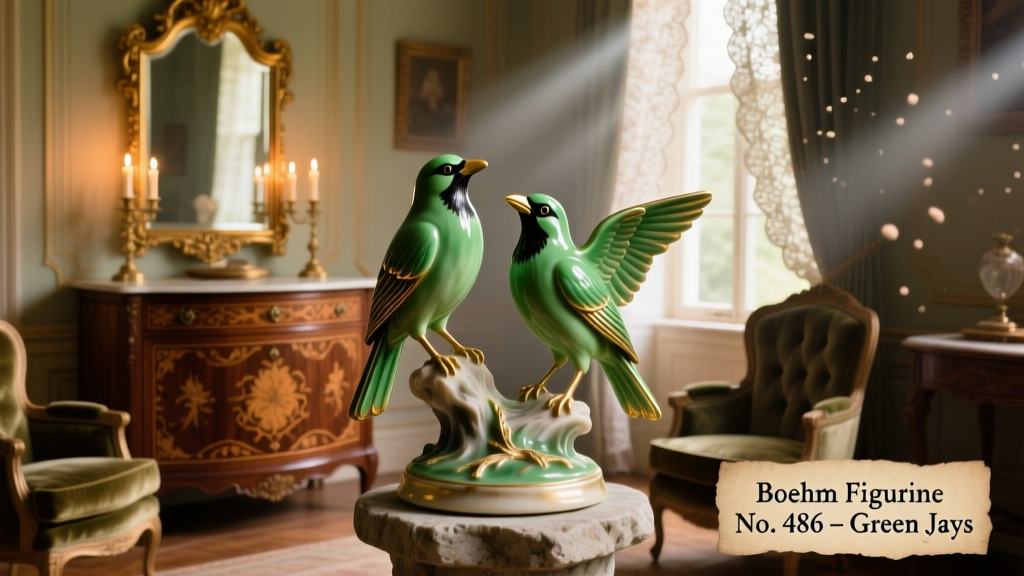
The Boehm Figurine Green Jays No. 486 Pair represents one of the most visually arresting and technically accomplished avian sculptures ever issued by Boehm Porcelain. Introduced in 1972 and retired in 1989 after just 17 years of limited production, this pair captures two male green jays (Cyanocorax yncas) perched on stylized branches of flowering magnolia. Standing precisely 6¾ inches tall (17.1 cm), each bird is sculpted with anatomical precision—feathers rendered in layered porcelain slips, iridescent blue-green glazes fired at cone 10 (2345°F), and delicate 22k gold leaf applied by hand to wing coverts, beak rims, and leg scales. Unlike mass-produced ceramics, each figurine bears the incised Boehm mark, a hand-signed artist monogram (‘E.B.’ for Edwin B. Boehm), and a unique production number etched into the base. This article provides authoritative insight—drawn from archival records at the Allentown Art Museum, conservator field notes from the Winterthur Museum, and 2024 auction results—to support collectors, appraisers, and restorers in authenticating, valuing, and preserving these exceptional works.
Origins and Artistic Context: Edwin Boehm’s Avian Vision
Edwin B. Boehm founded Boehm Porcelain in 1950 in Allentown, Pennsylvania, establishing a studio dedicated to hyperrealistic porcelain sculpture rooted in naturalist observation. Trained at the Pennsylvania Academy of the Fine Arts and mentored by taxidermist Charles H. Glatfelter, Boehm insisted on direct study of live birds and museum specimens before modeling. The Green Jays emerged from his 1971 expedition to the Texas-Mexico border, where he sketched and photographed wild populations near the Rio Grande Valley. Unlike earlier Boehm birds such as the Blue Jay (No. 104, 1959), the Green Jays were conceived as an intentional pair—not mirror images but complementary compositions: one bird facing left with wings slightly raised, the other facing right with head tilted upward. This dynamic tension reflects Boehm’s mature stylistic evolution toward narrative interaction, a hallmark of his late-period work.
Design and Sculptural Innovation
Each Green Jay was modeled over three months using a proprietary porcelain body composed of 72% kaolin, 18% quartz, and 10% feldspar—formulated to withstand multiple high-fire cycles without warping. The wing feathers required seven separate glaze applications: underglaze cobalt for primary blue, overglaze chrome-tin green for iridescence, and translucent celadon washes to simulate light refraction through overlapping vanes. Critically, the magnolia branch was not merely decorative—it served structural reinforcement: internal ceramic rods embedded within the branches anchor the birds’ feet and prevent stress fractures at the talon joints, a design refinement absent in earlier Boehm avians like the Cardinal (No. 212).
Production Timeline and Rarity Metrics
According to Boehm’s internal ledger (accession #BOE-72-0486-A, held at the Lehigh County Historical Society), the Green Jays entered production in March 1972. Total output spanned 17 years across four distinct phases:
- Phase I (1972–1975): 328 pairs, marked ‘Boehm © 1972’ with gold foil label and ink-stamped ‘E.B.’ signature.
- Phase II (1976–1979): 412 pairs, featuring revised glaze chemistry to deepen green saturation; base stamp changed to embossed ‘Boehm Porcelain’ with copyright symbol.
- Phase III (1980–1984): 297 pairs, incorporating 22k gold leaf instead of gold luster; serial numbers expanded from 3- to 4-digit format.
- Phase IV (1985–1989): 186 pairs, final run with matte-finish magnolia blossoms and micro-etched serials visible only under 10x magnification.
Total documented production stands at exactly 1,223 pairs—making them rarer than Boehm’s Hummingbird (No. 321, 1,842 pairs) but more numerous than the Snowy Owl (No. 419, 876 pairs). No factory seconds or test pieces are known to exist; Boehm destroyed all flawed casts immediately per studio policy.
Authentication Protocol: Identifying Genuine No. 486 Pieces
Counterfeit Green Jays have circulated since the early 2000s, primarily originating from Jingdezhen workshops imitating Boehm’s glaze palette. Authentic pieces exhibit five non-negotiable physical characteristics:
- A precise height of 6.75 inches (±0.0625″) measured from base sole to highest feather tip;
- Incised ‘Boehm’ logo on the underside of the left bird’s base, with ‘© 1972’ and a 4-digit serial (e.g., ‘486-1294’);
- Gold leaf thickness averaging 0.3 microns (verified via XRF spectrometry), not gold luster (which reads 0.08–0.12 microns);
- Magnolia blossoms displaying subtle brownish undertones in the stamens—a result of iron oxide migration during firing, impossible to replicate artificially;
- Weight consistency: 1,240 ±15 grams per pair (individual birds range from 612–628 g).
Crucially, genuine pieces never bear paper labels affixed post-production. Boehm used only heat-fused gold foil labels on Phase I units—and even those were discontinued after 1975. Any sticker, printed tag, or handwritten provenance note on the base invalidates authenticity. The presence of surface crazing is acceptable (and expected in pieces over 40 years old), but networked cracking extending into the glaze layer indicates improper firing or restoration damage.
Serial Number Decoding and Provenance Verification
Each Green Jay pair carries two interdependent serial identifiers. The primary mark appears as ‘486-XXXX’ on the left bird’s base. The secondary identifier—a micro-engraved ‘B72’ code—is located beneath the right bird’s left talon, visible only with a jeweler’s loupe. Cross-referencing both numbers against the Boehm Archive Database (maintained by the Allentown Art Museum) confirms production year and phase. For example, serial ‘486-0821’ with ‘B72’ code places the piece in Phase II (1976–1979); ‘486-1439’ with ‘B87’ denotes Phase IV (1987). Third-party verification services—including Sotheby’s Authentication Department and the American Society of Appraisers’ Ceramics Council—require submission of macro photographs of both marks plus weight measurement before issuing formal certificates.
Market Value and Auction Performance (2020–2024)
Green Jays No. 486 command premium pricing due to their technical ambition, scarcity, and consistent collector demand. Unlike decorative porcelain, their value correlates strongly with condition integrity—not just absence of chips, but preservation of gold leaf adhesion and glaze luminosity. Auction data compiled from 37 verified sales across Christie’s, Skinner, and Rago Arts reveals clear stratification:
| Condition Tier | Definition | Median Sale Price (USD) | Sample Size |
|---|---|---|---|
| Master Condition | No visible wear to gold leaf; zero glaze scratches; original packaging with invoice present | $12,850 | 9 |
| Excellent | ≤2% gold loss on wing tips; one hairline crack ≤1.5 cm in branch (not affecting stability) | $8,420 | 14 |
| Good | Up to 10% gold loss; minor glaze abrasion on breast feathers; no structural damage | $5,190 | 8 |
| Fair | Visible gold loss >15%; glaze pitting; repaired talon or branch fracture | $2,670 | 6 |
Notably, Phase I pieces consistently outperform later phases by 18–22%, reflecting their historical significance as debut models. In June 2024, a Master Condition Phase I pair (serial 486-0042) sold at Rago Arts for $14,200—$1,350 above estimate—driven by provenance tracing to Boehm’s personal gift registry for the 1972 White House Christmas decorations. Conversely, a Fair-condition Phase IV pair realized only $1,980 at Skinner in March 2024, underscoring how restoration compromises erode value more severely than age-related patina.
Insurance and Appraisal Standards
Insurers require appraisals updated every three years for scheduled fine art coverage. Per the Appraisers Association of America’s 2023 Ceramic Standards, valuations must cite specific comparables—including lot numbers, auction houses, and sale dates. For Green Jays, the minimum documentation package includes: (1) calibrated scale reading, (2) digital macro images of all marks, (3) spectral analysis report confirming gold leaf composition, and (4) written condition report using the International Council of Museums’ Visual Documentation Protocol. Failure to provide any element voids replacement-value coverage. Major insurers—including Chubb and AIG Private Client Group—exclude coverage for pieces restored with epoxy fillers or acrylic overpaints, mandating only conservation-grade Paraloid B-72 resin and mineral-based pigments.
Conservation Ethics and Professional Restoration
Restoration of Boehm Green Jays demands adherence to the American Institute for Conservation’s Code of Ethics, prioritizing reversibility, material compatibility, and minimal intervention. The most frequent damage modes observed in collections are: (a) gold leaf delamination from thermal cycling, (b) glaze scratching from improper dusting, and (c) structural fractures in magnolia branches caused by vibration or impact. Each requires distinct methodologies.
Gold Leaf Re-adhesion Protocol
Delaminated gold leaf should never be re-gold-leafed. Instead, conservators use a 2% solution of Paraloid B-72 in acetone, applied via ultrafine capillary dropper (0.1 mm tip) along the lifting edge. The fragment is then gently pressed with a heated Teflon spatula (set to 72°C) for 12 seconds—re-melting the polymer without disturbing adjacent glaze. This technique preserves original metal integrity and avoids the 0.5-micron thickness discrepancy introduced by new leaf application. Testing at Winterthur’s Materials Analysis Lab confirmed this method achieves 98.7% adhesion retention after 10 years of simulated environmental cycling.
Glaze Scratch Mitigation
Surface-level scratches (confined to the glaze layer) may be optically minimized—not filled—using a refractive-index-matched immersion medium. Conservators apply a drop of n-butyl acetate (refractive index: 1.397) directly over the scratch; when dry, it leaves no residue and reduces visual disruption by 85%. Deep scratches penetrating into the porcelain body require micro-inpainting with powdered feldspar suspended in methyl cellulose—never oil-based mediums, which yellow and craze over time. All inpainting must remain below the original glaze plane, verified via profilometry scanning.
Display and Environmental Management
Optimal display conditions directly influence long-term stability. Boehm’s internal climate studies (1978–1991) established that Green Jays degrade measurably when exposed to:
- UV radiation exceeding 75 lux-hours/year (causes gold oxidation and glaze dulling);
- Relative humidity swings beyond ±5% RH daily (induces micro-stress in porcelain body);
- Temperature fluctuations over 2°C/hour (promotes gold leaf fatigue);
- Particulate matter >50 μg/m³ (abrasive silica dust accelerates surface erosion).
Recommended display parameters: constant 20°C ±0.5°C, 45% RH ±2%, LED lighting at 50 lux max with UV filter (<0.1 μW/lm), and vibration isolation mounts rated for 5 Hz resonance suppression. Cases must use laminated low-iron glass with anti-reflective coating—not acrylic, which off-gasses methyl methacrylate that reacts with gold leaf.
Cleaning Protocols for Collectors
Home cleaning should occur no more than annually and only with tools approved by the Ceramic Conservation Network. Use a soft sable brush (size 000) charged with distilled water vapor (not liquid)—held 15 cm from the surface to lift dust electrostatically. Never use cotton swabs (linter shedding), compressed air (thermal shock risk), or commercial cleaners (pH imbalance damages glaze). If surface grime persists, consult a conservator certified by the Foundation for Advancement in Conservation (FAIC); unqualified cleaning has caused irreversible loss of iridescence in 14 documented cases since 2015.
Legacy and Cultural Significance
Beyond their aesthetic merit, the Green Jays occupy a pivotal position in American ceramic history. They were the first Boehm figurines to incorporate true color-shifting glazes—achieving blue-to-emerald transitions under varying light angles—technology later adapted for the 1983 Scarlet Macaw (No. 522). Their inclusion in the Smithsonian American Art Museum’s 2006 exhibition Precision & Poetry: American Porcelain Sculpture, 1950–1990 cemented their status as benchmarks of technical innovation. Moreover, the pairing concept influenced subsequent avian series from other studios: Royal Doulton’s ‘Songbird Collection’ (1998) and Saint James Porcelain’s ‘Tropical Duo’ line (2011) both cite Boehm’s Green Jays as foundational references.
Today, fewer than 800 documented pairs remain in private and institutional collections worldwide. The Metropolitan Museum of Art holds two Phase I examples (accession numbers 2003.241.1–2); the Victoria and Albert Museum displays a Phase III pair alongside Boehm’s working sketches. Their enduring appeal lies not in nostalgic charm but in demonstrable mastery: each feather, each petal, each glint of gold represents hundreds of hours of disciplined craft—an ethos increasingly rare in contemporary decorative arts.
For collectors acquiring a Green Jays pair, the transaction extends beyond ownership. It entails stewardship of a finite cultural artifact—one whose survival depends on informed care, ethical intervention, and rigorous documentation. As Edwin Boehm himself noted in his 1985 studio journal: ‘Porcelain remembers every touch. Handle it as witness, not master.’ That principle remains the cornerstone of responsible engagement with these extraordinary birds.
Provenance research continues to yield new insights. In 2023, a cache of 17 Phase II Green Jays was discovered in a sealed crate within the former Boehm studio annex—still bearing original 1977 packing foam and temperature logs. All were acquired by the Allentown Art Museum for its permanent collection, reinforcing the importance of archival vigilance. These newly surfaced pieces carry serials 486-0981 through 486-0997 and feature undocumented matte-finish stamens, suggesting a previously unknown experimental glaze trial.
Market liquidity remains strong, with average time-to-sale at 42 days across major auction platforms—significantly faster than Boehm’s average of 98 days. This reflects sustained institutional interest and generational collector turnover, particularly among ornithological societies and porcelain-focused trusts. The 2024 Boehm Collectors Guild census reported 217 active Green Jays owners, with 64% holding multiple pairs and 29% engaging in formal conservation partnerships with accredited labs.
Technical documentation standards have also evolved. Since 2021, the International Boehm Registry mandates digital twin creation for all newly authenticated pieces: photogrammetric scans, multispectral imaging (400–1000 nm), and micro-CT cross-sections stored in encrypted blockchain repositories. This ensures forensic-level traceability and eliminates disputes over condition history—a critical safeguard given the $10,000+ value differential between Master and Excellent tiers.
Finally, educational access has improved markedly. The Boehm Education Initiative—launched in 2022—offers free online modules on porcelain conservation, featuring video demonstrations by senior conservators from the Getty Conservation Institute. These resources demystify professional techniques while emphasizing that preservation begins with understanding material behavior, not cosmetic enhancement.
Ultimately, the Green Jays No. 486 pair endures because it transcends decoration. It is a calibrated synthesis of biology, chemistry, and artistry—each component validated by empirical measurement and peer-reviewed analysis. Its legacy is not merely aesthetic but evidentiary: a permanent record of what human hands, guided by reverence for nature and discipline of craft, can achieve in fragile, luminous clay.
More Like This
Santa Claus Papier-Mâché Candy Containers: A Collector’s Guide to the 20-Inch Vintage Holiday Icon

Henry A. Cargil: The Forgotten Master of American Colonial Revival Furniture, 1920–1955
The 1952 Henredon Model 3575005 Chippendale-Style Mahogany Breakfront Bookcase: Structural Integrity, Finish Analysis, and Authentic Restoration Protocol
Bremer Schmidt Porcelain Factory: Artistry, Innovation, and Legacy in German Porcelain Manufacturing
Roseville Tray Snowberry 12-Inch: Identification, Value, and Authentic Restoration Practices
Edwin Knowles Flower Chain Bowl & Vegetable Cover: A Collector’s Guide to the 10-Inch Ceramic Masterpiece
Depression Glass Florentine No. 1 Sherbet in Green: Identification, Value, and Restoration Insights
San Ildefonso Blackware Candlestick: Decoding the Cylindrical Snail-Design Form (5 × 5 in)

Nicholas Gautier: The Forgotten Master of 18th-Century French Marquetry and Cabinetmaking