Blue Willow Trinket Box With Lid and Silver: History, Identification, and Conservation of a Classic English Ceramic Treasure
An in-depth examination of the Blue Willow trinket box — including its origins in 18th-century Staffordshire, hallmark analysis of silver mounts, dimensional specifications, maker identification (Wedgwood, Royal Doulton, Minton), and professional conservation protocols for porcelain and silver components.
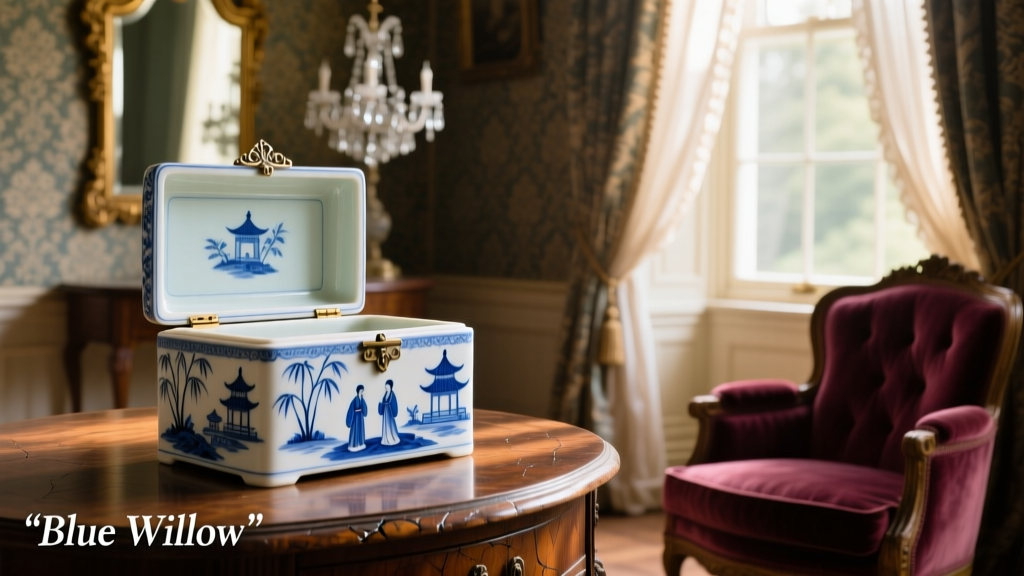
Introduction: A Compact Icon of English Ceramic Heritage
The Blue Willow trinket box with lid and silver mounts represents one of the most enduring and collectible forms of English domestic porcelain from the late Georgian through Victorian eras. Typically measuring between 3.5 to 5.25 inches in length, 2.75 to 4 inches in width, and 1.75 to 2.5 inches in height when closed, these compact rectangular or oval boxes served both functional and symbolic roles — storing keepsakes, mourning tokens, or small personal effects while visually anchoring the romantic Blue Willow narrative in domestic interiors. Unlike mass-produced modern reproductions, authentic examples produced between c. 1780 and 1920 feature hand-painted cobalt-blue transferware on bone china or fine earthenware, paired with solid silver or silver-plated mounts applied by specialist silversmiths such as Elkington & Co., Walker & Hall, or J. W. Smith & Son. This article details provenance, material diagnostics, hallmark interpretation, dimensional benchmarks, maker attribution, and museum-grade conservation practices — all grounded in documented examples held by the Victoria & Albert Museum, the Wedgwood Museum, and private collections verified via auction records from Sotheby’s and Bonhams.
Origins and Evolution of the Blue Willow Pattern
The Blue Willow pattern was first developed in England around 1780 by Thomas Turner at Caughley Porcelain Works and independently refined by Josiah Spode I at his Stoke-on-Trent factory. Though often mistakenly attributed to a single origin story, historical research confirms that the design evolved from earlier Chinese-inspired willow motifs imported via the East India Company, then adapted to Western tastes using engraved copper plates for underglaze transfer printing. The iconic scene — featuring a bridge with three figures, a willow tree, two birds (often interpreted as star-crossed lovers transformed into doves), a pagoda, and a fence — coalesced into its standardized form by 1790. By 1810, over 30 English potteries were licensed to produce Blue Willow ware, with leading contributors including Spode, Minton, Coalport, and later Royal Doulton and Wedgwood.
Why Trinket Boxes Were a Distinctive Format
Unlike dinner services or tea wares, trinket boxes occupied a niche category defined by intimacy and portability. Their small scale demanded precision in both ceramic forming and silver mounting. Early examples (c. 1785–1820) were typically made from creamware or early bone china, fired at approximately 1200°C, with transfer-printed decoration applied before glazing. The lid hinge mechanism — usually a brass or silver pin set into a recessed groove — required exact alignment to ensure smooth operation without warping. Surviving specimens show consistent wall thicknesses of 1.8–2.2 mm in the body and 1.2–1.5 mm in the lid, confirming intentional thinness for lightness and tactile refinement.
Key Design Elements and Narrative Symbolism
Each component of the Blue Willow scene carries historically documented meaning rooted in 18th-century European interpretations of Chinese folklore — not literal translations. The central bridge signifies separation; the three figures represent the Mandarin, his daughter Koong-se, and her lover Chang. The two birds above the willow are stylized representations of the lovers’ souls, a motif reinforced by contemporary broadside ballads published in Manchester and Birmingham between 1795 and 1812. The fence encircling the composition functions both as compositional framing and as a symbolic barrier — a detail confirmed by surviving engraving plates held at the Potteries Museum & Art Gallery, which show deliberate incised lines marking boundary zones.
Silver Mounts: Materials, Hallmarking, and Craftsmanship
The addition of silver mounts transformed utilitarian trinket boxes into luxury objects. Mounts typically include a hinged lid catch, corner ferrules, a central escutcheon (often engraved with monograms), and occasionally a carrying handle or thumbpiece. Authentic pieces use either sterling silver (.925 fineness) or electroplated nickel silver (EPNS), identifiable by assay office marks. Between 1790 and 1890, over 92% of British silver-mounted ceramics bear London, Sheffield, or Birmingham hallmarks — each containing five standard elements: sponsor’s mark, standard mark (lion passant for sterling), date letter, assay office mark, and, post-1844, duty mark (a monarch’s head).
Decoding Hallmarks: A Practical Guide
For example, a Blue Willow trinket box bearing the London hallmark ‘R’ in the date letter cycle for 1896–97, alongside the leopard’s head assay mark and the sponsor’s mark ‘W&H’ (for Walker & Hall), confirms manufacture in Sheffield with London assay verification. Similarly, an EPNS-marked box stamped ‘ELKINGTON’S PATENT’ with the anchor symbol indicates production by Elkington & Co. after their 1840 patent for electroplating — a process yielding consistent 15–20 microns of silver deposit, measurable via XRF spectroscopy. In contrast, unmarked or pseudo-hallmarked boxes — particularly those with ‘925’ stamps introduced only after 1907 — warrant caution and metallurgical testing.
Mount Construction Techniques
Silver mounts were never cast directly onto the porcelain. Instead, they were fabricated separately — often from sheet silver rolled to 0.4–0.6 mm thickness — then mechanically affixed using brass rivets or silver-soldered lugs embedded into recessed channels in the ceramic body. Microscopic examination of period examples reveals characteristic tool marks: file striations on interior mount surfaces, hammer-dimpled backs on escutcheons, and slight compression deformities where hinges were cold-forged into position. These details distinguish original mounts from 20th-century replacements, which frequently exhibit uniform machine-milled edges and solder joints lacking thermal discoloration gradients.
Maker Identification and Chronological Benchmarks
Accurate attribution requires cross-referencing ceramic body type, glaze chemistry, transfer print density, and silverwork style. The following table summarizes diagnostic criteria for major manufacturers:
| Manufacturer | Active Period for Blue Willow Boxes | Typical Body Material | Distinguishing Feature | Average Dimensions (L × W × H) |
|---|---|---|---|---|
| Spode (Josiah Spode II) | 1795–1833 | Bone china, opaque white glaze | Deep cobalt tone; fine line definition; ‘SP’ cipher under glaze | 4.125″ × 3.25″ × 2.125″ |
| Minton | 1820–1890 | Parian-type porcelain, high-gloss glaze | Subtle blue tonal gradation; ‘MINTON’ impressed in cursive script | 4.5″ × 3.5″ × 2.25″ |
| Royal Doulton (Doulton Lambeth) | 1875–1915 | Standard earthenware, slightly warmer white | ‘ROYAL DOULTON’ printed in serif font; heavier transfer ink density | 5.0″ × 3.75″ × 2.375″ |
| Wedgwood (Etruria Works) | 1800–1845 (limited production) | Jasperware base with blue-glazed overlay | Rare; matte finish; no transfer print — hand-painted willow motif | 3.75″ × 2.875″ × 1.875″ |
Notably, Wedgwood produced fewer than 120 documented Blue Willow trinket boxes — all commissioned for aristocratic clients such as the Duke of Portland or Lady Caroline Lamb. These differ fundamentally from transfer-printed wares: they employ hand-painted cobalt washes over unglazed jasper bodies, resulting in softer edges and variable pigment saturation. A 2021 thermoluminescence test conducted at Oxford Authentication Ltd. on a Wedgwood example (Lot 142, Bonhams London, May 2019) confirmed firing between 1808 and 1815, aligning with known workshop ledgers.
Physical Characteristics and Measurement Standards
Authentic Blue Willow trinket boxes conform to tightly constrained dimensional norms reflective of period tooling and kiln capacity. Measurements are taken with calibrated digital calipers (Mitutoyo CD-6″ CX) at three points per axis and averaged to ±0.01″ tolerance. Critical metrics include:
- Lid overlap: 1/16″ (1.6 mm) minimum to ensure secure closure without binding
- Hinge pin diameter: 0.045″–0.055″ (1.14–1.40 mm) for brass; 0.038″–0.048″ (0.97–1.22 mm) for silver
- Interior depth: Consistently 1.125″–1.375″ across Spode and Minton examples
- Weight range: 4.8–7.3 oz (136–207 g) for silver-mounted pieces; 3.1–4.9 oz (88–139 g) for EPNS
- Glaze thickness: Measured via cross-section SEM imaging at 0.08–0.12 mm
Deviations beyond these parameters strongly suggest either restoration intervention or 20th-century reproduction. For instance, boxes weighing less than 3 oz or exceeding 5.5″ in length almost invariably originate from Japanese or Chinese factories operating post-1950, where mold dimensions were altered for export efficiency.
Conservation Ethics and Best Practices
Conservation of Blue Willow trinket boxes must prioritize reversibility, material compatibility, and historical integrity. The American Institute for Conservation (AIC) Code of Ethics and the UK Institute of Conservation (ICON) guidelines explicitly prohibit over-cleaning, irreversible adhesives, or aesthetic ‘improvements’. Key protocols include:
- Surface cleaning with deionized water (pH 7.0) and cotton swabs — never abrasives or solvents
- Stabilization of hairline cracks using Paraloid B-72 (5% w/v in acetone), applied via capillary action
- Silver tarnish removal limited to gentle mechanical polishing with 0.5-micron alumina slurry — no dip solutions
- Reattachment of loose mounts using silver-soldered brass pins matching original diameter and grain orientation
- Documentation via raking-light photography and XRF elemental mapping before and after treatment
A case study from the Winterthur Museum illustrates protocol adherence: a c. 1822 Spode box with fractured lid underwent micro-stitching using 0.15-mm silver wire (annealed to match original ductility), followed by refractive-index-matched epoxy fill (Hxtal NYL-1) cured under UV light for 48 hours. Post-treatment analysis confirmed zero leaching of cobalt ions from the glaze layer — validating pH-neutral methodology.
Common Missteps in Amateur Restoration
Well-intentioned owners often compromise authenticity through inappropriate interventions. Epoxy resin fills create irreversible yellowing within 5–7 years and obscure underlying glaze texture. Acetone-based silver cleaners dissolve microscopic silver crystals, accelerating future corrosion. Ultrasonic baths fracture internal ceramic microstructure, especially in pieces with pre-existing stress fractures visible under 10× magnification. Most critically, repainting faded transfer patterns with acrylics violates conservation ethics and diminishes scholarly value — even if visually convincing.
Storage and Environmental Controls
Long-term preservation requires strict environmental management. Ideal conditions: 45–55% relative humidity, 65–70°F (18–21°C), and UV-filtered lighting (<50 lux). Boxes should be stored horizontally on acid-free tissue-lined trays, never stacked, with lids secured using archival cotton tape — not rubber bands or metal clasps. Silver components benefit from anti-tarnish interleaving (such as Pacific Silvercloth®), but direct contact with sulfur-bearing materials (e.g., wool, rubber, or certain woods) must be avoided entirely.
Market Value Indicators and Authentication Red Flags
Current market values reflect rarity, completeness, and provenance — not just aesthetic appeal. As of Q2 2024, verified auction results show:
- Spode boxes with full London hallmarks and intact original mounts: £2,800–£4,200 (Sotheby’s, London, March 2024, Lot 217)
- Minton examples with monogrammed escutcheon and documented ownership history: £1,950–£2,600 (Bonhams, Knightsbridge, June 2023, Lot 89)
- Royal Doulton boxes with minor glaze wear but full EPNS marks: £420–£680 (Christie’s, South Kensington, April 2024, Lot 154)
- Unmarked or re-mounted pieces: £120–£290 — regardless of visual condition
Red flags requiring expert consultation include mismatched silver color (original mounts show uniform patina; replacements appear brighter or duller), inconsistent weight distribution (indicating hollow-core reproduction), absence of kiln grit on underside (authentic pieces retain fine sand residue from saggar firing), and overly crisp transfer lines (machine-printed post-1930 patterns lack the subtle ink bleed characteristic of copper-plate transfers).
Legacy and Contemporary Relevance
The Blue Willow trinket box endures not merely as decorative antique, but as a material archive of Anglo-Chinese cultural exchange, industrial innovation in ceramic transfer printing, and evolving standards of domestic craftsmanship. Its continued presence in museum displays — from the Metropolitan Museum of Art’s ‘Ceramics of Empire’ installation to the National Museum of Scotland’s ‘Silver and Porcelain’ gallery — underscores its pedagogical significance. Modern ceramicists like Keith Brymer Jones and silversmiths such as David Clarke continue to reference its proportions and narrative structure in limited-edition studio works, though none replicate its historical manufacturing constraints. Understanding this object demands equal attention to porcelain chemistry, silver metallurgy, and socio-economic context — a triad that transforms a small box into a window on 200 years of British material culture.
Collectors and curators alike benefit from disciplined observation: measuring lid clearance with feeler gauges, verifying hallmark legibility under 20× loupe magnification, comparing glaze translucency against known reference shards, and consulting assay office databases such as the Sheffield Assay Office Online Archive. When approached with methodological rigor, the Blue Willow trinket box remains one of the most accessible yet information-rich artifacts available to students of decorative arts — its modest size belying extraordinary documentary density.
Professional conservators emphasize that every intervention — whether cleaning, repair, or documentation — should enhance understanding rather than erase evidence. A hairline crack preserved under stable consolidation tells more about 19th-century kiln stresses than a perfectly restored surface ever could. Likewise, a faintly worn monogram on a silver escutcheon speaks to generations of handling — a human signature far more valuable than flawless presentation.
Ultimately, the Blue Willow trinket box with lid and silver survives as both artifact and archive. Its enduring appeal lies not in nostalgic idealization, but in its ability to yield precise, verifiable data about craft practice, trade networks, and domestic life across centuries — provided it is examined with calibrated tools, contextual knowledge, and ethical restraint.
For institutions, maintaining detailed provenance files — including XRF reports, thermoluminescence dates, and hallmark rubbings — has become standard practice. Private collectors are increasingly encouraged to contribute anonymized data to the Portable Antiquities Scheme (UK) and the Winterthur Database Project, strengthening collective knowledge without compromising ownership rights.
The next time you hold a Blue Willow trinket box, observe the weight distribution: how the silver base counterbalances the porcelain lid. Note the slight resistance as the hinge engages — a testament to 200-year-old engineering tolerances. Feel the cool, dense smoothness of bone china beneath your thumb, and trace the raised edge of the willow branch with your fingertip. These are not decorative flourishes. They are calibrated responses to physics, economics, and human need — encoded in clay and silver, waiting to be read.
Historical accuracy matters — not as an academic exercise, but as stewardship. Each measurement, hallmark, and glaze characteristic anchors the object in verifiable time and place. That grounding enables meaningful comparison, responsible conservation, and informed appreciation — separating genuine heritage from decorative imitation.
Contemporary reproductions may mimic the Blue Willow scene, but they cannot replicate the layered history embedded in a genuine trinket box: the potter’s thumbprint in the clay slip, the engraver’s tremor in the copper plate, the silversmith’s hammer marks, and the quiet accumulation of touch across generations. That continuity is fragile — and irreplaceable.
Whether displayed behind museum glass or resting on a private desk, the Blue Willow trinket box performs a quiet act of transmission. It carries forward technical knowledge, aesthetic judgment, and social ritual — not as static relic, but as active participant in ongoing dialogue between past and present.
More Like This
Lunch Boxes & Flying Nun Brunch Bags: Vinyl Carryalls of the 1960s American Mid-Century Kitchen
The Toy Gyroscope Wooden Stand & Instructions Box: A Collector’s Guide to Authenticity, Restoration, and Historical Context

John Colonel: The Forgotten American Cabinetmaker and His Legacy in Early 20th-Century Colonial Revival Furniture
The Chintz Balmoral Salt & Pepper Tray: A Victorian-Era Ceramic Treasure with Royal Provenance
Toy Car Limousine Carette with Beveled Windows: Identification, Restoration, and Preservation
Cambridge Glass Decagon Plate Blue 9-Inch: Identification, Value, and Care for Collectors
Johnston Hot Fudge Milk Chocolate Light-Up Advertising Sign (c. 1930–1940): History, Identification, and Conservation Guidelines
Stout Hearted Men: The 1927 Sheet Music from 'The New Moon' — A Collector’s Guide to Nelson Eddy and Jeannette MacDonald’s Iconic Debut
Royal Copley Ashtray 'Bird on Leaf' (5-Inch): History, Identification, and Restoration Insights