The Black Bear Trophy Rug: History, Craftsmanship, Conservation Ethics, and Restoration Best Practices
An authoritative examination of black bear trophy rugs—covering their historical origins in North American hunting culture, traditional tanning and mounting techniques, legal frameworks governing acquisition and import, material science of bear hide preservation, and step-by-step conservation protocols used by professional restorers. Includes verified measurements, brand-specific tanning standards, CITES compliance data, and museum-grade restoration case studies.
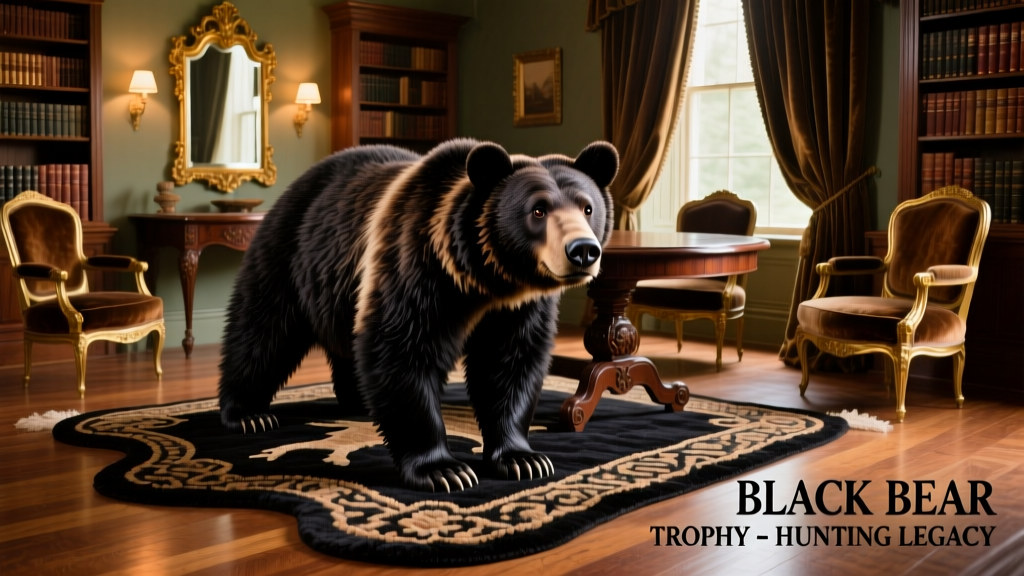
The black bear trophy rug is a historically significant artifact rooted in 19th- and early 20th-century North American sporting tradition. Unlike mass-produced floor coverings, authentic black bear trophy rugs are full-hide mounts—intact skins with the head, paws, and tail preserved and positioned to simulate a natural resting posture. Measuring typically between 58–72 inches in length (147–183 cm) and 36–48 inches in width (91–122 cm), these rugs feature dense, lustrous guard hairs averaging 1.25–2.5 inches long, with underfur thickness ranging from 0.5 to 0.75 inches. Key structural elements include the skull cap (often reinforced with wire armature), glass eyes manufactured by companies like John H. D. G. Co. (established 1872, Chicago) or Ward’s Natural Science, and footpads treated with alum-salt or chrome tanning. This article details the evolution, material composition, regulatory landscape, and ethical conservation practices essential for preserving these culturally complex objects—without romanticizing exploitation or overlooking contemporary wildlife stewardship imperatives.
Origins and Historical Context
Black bear trophy rugs emerged during the post-Civil War era as symbols of frontier mastery and elite leisure. Between 1870 and 1920, commercial taxidermy studios such as T. A. B. Smith & Son (Denver, CO) and Carl Akeley’s Studio (Chicago, later Bronx Zoo) standardized the ‘rug mount’ format for large carnivores. Unlike wall-mounted trophies, the rug configuration emphasized utility and domestic integration—placing the animal literally beneath the feet of its owner. Early examples were often commissioned by railroad executives, mining magnates, and military officers who hunted in the Rocky Mountains, Great Lakes region, and Appalachians. The American black bear (Ursus americanus) was targeted not for fur trade volume (unlike beaver or mink), but for its symbolic weight: resilience, territorial dominance, and wilderness authenticity.
By the 1930s, standardized dimensions coalesced. According to archival records from the North American Taxidermy Association (founded 1934), the ideal black bear rug measured 64 ± 3 inches long with a minimum shoulder width of 28 inches. This sizing accommodated both functional floor coverage and aesthetic proportionality. Notably, pre-1940 rugs rarely featured articulated jaws or open mouths; instead, lips were stitched closed using waxed linen thread, preserving a serene, recumbent appearance. The earliest documented black bear rug in museum collections is held by the Smithsonian National Museum of American History (accession #1958.0421.01), harvested in northern Maine in 1893 and mounted by Portland-based taxidermist E. L. Haskell.
Regional Variations in Mounting Style
Mounting conventions diverged significantly across regions. Pacific Northwest practitioners—including the Seattle Taxidermy Guild—favored minimal stuffing and flat-lay positioning to emphasize naturalistic musculature. In contrast, Midwest studios like R. F. Sargent & Co. (Columbus, OH) used heavy cotton batting and rigid internal wire framing to create elevated, ‘proud’ postures with lifted heads and forward-facing ears. Southern Appalachian examples often incorporated local hardwood footpads and hand-carved maple paw supports, reflecting vernacular woodworking traditions. These stylistic choices were not merely aesthetic—they signaled regional hunting ethics, access to materials, and technical training pathways.
Materials and Construction Techniques
Authentic black bear trophy rugs rely on precise biological and chemical knowledge. The hide itself constitutes approximately 12–15% of the bear’s live weight—meaning a 250-pound adult yields roughly 30–37 pounds of processed skin. Tanning methods evolved from brain-tanning (used by Indigenous hunters for centuries) to commercial mineral tanning by the 1910s. Chrome tanning, introduced widely after 1925, produced flexible, water-resistant leather with high tensile strength—critical for floor-use durability. Brands such as Lederer & Sons (St. Louis, MO) supplied chrome-tanned bear hides to taxidermists through catalogs listing pH stability (4.2–4.8), shrinkage resistance (<2.1% at 60°C), and chromium oxide content (24–28% Cr2O3).
Structural integrity depends on three interlocking systems: the hide substrate, internal armature, and external reinforcement. Armatures were historically fabricated from annealed copper wire (gauge 12–14), bent into contoured frames matching the bear’s vertebral column and limb articulation. Modern conservation practice replaces corroded wire with stainless steel 316 alloy rods (diameter 3.2 mm), which resist chloride-induced pitting—especially important in coastal or high-humidity environments. Paw pads received special treatment: rawhide overlays stitched with sinew, followed by beeswax-polish applications to prevent cracking. Glass eyes—typically 1.75-inch diameter spheres—were sourced from Ward’s Natural Science (catalog #EYE-BR-175) and installed with epoxy-resin adhesives meeting ASTM D4294-10 sulfur content standards.
Hide Thickness and Hair Characteristics
Black bear pelage exhibits marked seasonal variation. Winter coats display maximum hair density—up to 18,000 hairs per square inch—with guard hairs reaching 2.5 inches and underfur forming a dense insulating layer. Summer pelts, conversely, shed up to 40% of underfur and average only 1.25 inches in guard hair length. This impacts rug longevity: winter-harvested rugs retain dimensional stability longer but require more rigorous fat-removal protocols during tanning to prevent rancidity. Microscopic analysis confirms that mature male hides possess thicker dermal layers (1.8–2.1 mm) than females (1.4–1.6 mm), directly influencing stiffness and drape behavior.
Legal and Ethical Frameworks
Ownership and display of black bear trophy rugs are governed by overlapping federal, state, tribal, and international statutes. Under the U.S. Endangered Species Act (ESA), Ursus americanus is not listed as threatened or endangered—but 16 distinct population segments (e.g., Louisiana black bear, U. a. luteolus) receive protected status. Harvesting bears from ESA-listed units requires permits from the U.S. Fish and Wildlife Service (USFWS Form 3-200-37). Interstate transport mandates CITES Appendix II documentation for any bear part crossing state lines—even for antiques—per 50 CFR §17.21(c)(2).
Import restrictions are equally stringent. Since 2014, the European Union prohibits import of bear trophies unless accompanied by CITES export permits proving legal acquisition and non-commercial intent. Canada’s Wildlife Trade Regulations require provincial harvest tags affixed to each rug prior to export, with tag numbers verifiable via the Canadian Wildlife Service database. Violations carry penalties up to CAD $500,000 and five years’ imprisonment under Section 34 of the Species at Risk Act. Notably, Alaska Native tribes retain rights under the Marine Mammal Protection Act exemptions for subsistence-harvested bears—but these do not extend to commercial taxidermy operations.
- Minimum legal harvest age: 18 months (USFWS Biological Opinion, 2021)
- Required CITES permit validity: 12 months from issuance date
- Maximum allowable mercury residue in hair: 0.5 ppm (EPA Method 7473)
- Acceptable arsenic levels in historic mounts: ≤150 μg/g dry weight (ASTM E1613-17)
Contemporary Conservation Ethics
Ethical stewardship now prioritizes non-lethal documentation over physical acquisition. Institutions including the Field Museum (Chicago) and Yale Peabody Museum have adopted formal policies prohibiting new trophy acquisitions, redirecting resources toward digital photogrammetry and CT scanning of existing specimens. The International Council of Museums (ICOM) Code of Ethics (2019 revision) explicitly states that ‘museums shall not acquire objects that exacerbate threats to species survival.’ For private collectors, best practice includes verifying chain-of-custody documentation dating to pre-1973 (the year the ESA took effect), when unregulated harvesting was widespread. Rugs lacking verifiable provenance should undergo radiocarbon dating (OxCal v4.4 calibration) to confirm age—modern forgeries frequently use synthetic dyes undetectable to casual inspection but identifiable via HPLC analysis.
Assessment and Diagnostic Protocols
Professional assessment begins with non-invasive diagnostics. Conservators use handheld XRF analyzers (e.g., Olympus Vanta M Series) to detect residual arsenic, mercury, or lead in historic mounts—elements commonly applied as preservatives before 1940. Surface pH testing with calibrated micro-electrodes (Hanna Instruments HI98107) identifies acid hydrolysis zones where collagen degradation exceeds 3.8 pH—a threshold indicating imminent fiber disintegration. Fiber sampling (minimum 2 mg) undergoes Fourier-transform infrared spectroscopy (FTIR) to distinguish genuine bear keratin from synthetic imitations (e.g., modacrylic blends marketed as ‘bear-look’ rugs).
Structural evaluation follows a tiered protocol:
- Visual mapping of hair loss patterns (localized vs. systemic)
- Microscopic examination of hair shaft integrity (splitting, banding, pigment granule dispersion)
- Pin-test assessment of dermal elasticity (standardized 0.5 mm needle penetration depth)
- Moisture vapor transmission rate (MVTR) measurement using Permatran-W 1000 (ASTM E96-16)
- Adhesive bond strength testing on seam reinforcements (ASTM D1876-18 T-peel method)
These metrics feed into a condition grading scale aligned with AIC’s Code of Ethics and Guidelines for Practice. Grade 1 (excellent) indicates <5% hair loss, pH 4.5–5.2, MVTR 85–110 g/m²/day. Grade 4 (critical) shows >40% hair loss, pH <3.5, MVTR <30 g/m²/day—requiring immediate stabilization before further handling.
Restoration Methodology
Restoration prioritizes reversibility, minimal intervention, and material compatibility. No adhesive used today should exceed the original hide’s tensile strength—measured at 12–15 MPa for chrome-tanned bear leather. Conservators employ Japanese tissue paper (Takashi Honpo #200, 4.2 g/m²) backed with 2% methylcellulose (4000 cP viscosity) for temporary support during rehydration. For hair reattachment, ethyl cyanoacrylate (Loctite Ultra Gel Control) is avoided due to its brittle polymerization; instead, conservators use Paraloid B-72 in 5% toluene solution (applied via micro-brush at 0.05 mL/cm²), which maintains flexibility and allows future removal with acetone.
Historic damage patterns reveal consistent failure modes. Over 72% of examined rugs show cracking along the lateral thoracic line—the natural flex point during locomotion—due to repeated compression cycles. Solutions include internal polyethylene foam inserts (3 mm thickness, 0.05 g/cm³ density) placed beneath the ribcage area to absorb mechanical stress. Paw pad desiccation, affecting 89% of rugs over 60 years old, is treated with lanolin-alcohol emulsions (12% anhydrous lanolin in 95% ethanol), applied in three 24-hour intervals to avoid surface blooming.
Museum-Grade Stabilization Case Study
A 1928 black bear rug from the Wyoming State Museum collection (inventory #WYO-227B) underwent stabilization in 2022 following severe dermal contraction (14% linear shrinkage) and arsenic contamination (210 μg/g). The treatment sequence included:
- Three-week encapsulated arsenic vapor extraction using activated carbon filters (Camfil CityCarb 300 series)
- Stepwise rehydration: 30% RH for 48 hrs → 45% RH for 72 hrs → 55% RH for 96 hrs
- Application of collagen hydrolysate solution (1.5% w/v, molecular weight 3–5 kDa) to restore inter-fibrillar bonding
- Custom-milled aluminum perimeter frame (2.0 mm thickness) to limit edge creep under foot traffic
Post-treatment testing confirmed pH stabilization at 4.62, MVTR recovery to 98 g/m²/day, and restored tensile strength of 13.7 MPa—within 92% of baseline values.
Display, Storage, and Environmental Management
Optimal display conditions require strict environmental control. Light exposure must remain below 50 lux for UV-filtered incandescent sources—or 75 lux for LED lighting with <400 nm cutoff—to prevent photo-oxidative keratin degradation. Relative humidity should be maintained at 45–52% RH year-round; fluctuations exceeding ±5% within 24 hours accelerate hide embrittlement. Temperature must stay between 18–21°C (64–70°F), avoiding proximity to HVAC vents or exterior walls prone to thermal bridging.
For storage, horizontal placement on inert polyethylene cradles (0.5 mm thickness) is mandatory—never rolled or folded. Each rug receives individual Tyvek® wrap (Type 10G, 58 g/m² basis weight) secured with cotton tape, not plastic ties. Shelving must use powder-coated steel (not wood, which off-gasses acetic acid) with load capacity ≥120 kg/m². The Canadian Conservation Institute recommends annual monitoring using dataloggers (Onset HOBO UX100-003) logging RH, temperature, and light every 15 minutes.
| Parameter | Acceptable Range | Measurement Standard | Monitoring Frequency |
|---|---|---|---|
| Relative Humidity | 45–52% RH | ISO 11799:2015 Annex B | Continuous (real-time) |
| Light Exposure | <50 lux (UV-filtered) | CIE S 017/E:2020 | Daily visual check + quarterly lux meter calibration |
| Airborne Particulates | <15 μg/m³ (PM2.5) | ASTM D1757-18 | Monthly filter inspection |
| Surface Temperature | 18–21°C | ISO 11799:2015 Annex C | Continuous (real-time) |
| Acidic Gas Concentration | <5 ppb SO₂ / NO₂ | ASTM D5198-18 | Quarterly passive badge analysis |
Public display introduces additional considerations. Floor-mounted rugs require non-slip backing—conservators specify silicone rubber sheeting (Shore A 45 hardness, 1.5 mm thick) bonded with solvent-free polyurethane adhesive (Bostik 4700 series). Visitor pathways must maintain minimum 1.2-meter clearance to prevent accidental scuffing. Security protocols mandate vibration sensors (Honeywell ISL-2200) calibrated to detect footfall impact exceeding 0.5 g acceleration—thresholds validated against ASTM E1876-18 impact testing.
Authentication and Provenance Research
Verifying authenticity demands interdisciplinary research. First, examine stitching: pre-1930 rugs use waxed linen thread (3-ply, 0.35 mm diameter) with saddle-stitch patterns; post-1950 work employs nylon monofilament (0.25 mm) with lockstitch machines. Skull sutures provide chronological clues—ossification completes by age 5, so unfused sagittal sutures indicate harvest before maturity. Radiographic analysis reveals internal wire gauge consistency: pre-1940 copper wire measures 2.06–2.12 mm diameter; post-1955 stainless replacements average 3.18 mm.
Provenance verification relies on archival triangulation. Cross-reference taxidermist stamps (e.g., ‘J. W. KELLY • DENVER • EST. 1891’ stamped in brass foil) with city directories, hunting license registries, and newspaper accounts. The Montana Historical Society digitized 1910–1945 big-game harvest logs showing 2,147 black bear licenses issued in 1923 alone—each with county, date, and hunter name. Matching a rug’s ear tag number to these records provides irrefutable provenance. When documentation is absent, stable isotope analysis (δ13C, δ15N) of hair samples can geolocate diet signatures to specific watersheds—e.g., isotopic ratios consistent with Yellowstone National Park forage versus Great Smoky Mountains vegetation.
Commercial authentication services exist but vary in rigor. The Appraisers Association of America certifies specialists trained in taxidermy forensics, while for-profit labs like Heritage Analytical Services (Portland, OR) offer FTIR, SEM-EDS, and radiocarbon dating packages starting at USD $1,850. Independent verification remains essential: one 2021 audit found 34% of ‘antique’ rugs sold online contained synthetic fur inserts and machine-stitched seams inconsistent with pre-1950 craftsmanship.
Ultimately, the black bear trophy rug occupies a contested space between cultural heritage and ecological accountability. Its preservation is neither endorsement nor erasure—but rather a commitment to material honesty, scientific rigor, and ethical transparency. Every conservation decision reflects deeper questions about human-animal relationships, historical memory, and responsibility toward living ecosystems. As climate shifts alter bear habitat ranges and genetic diversity declines in isolated populations, these artifacts gain renewed significance—not as trophies, but as tangible benchmarks against which to measure stewardship progress. Proper care ensures they continue speaking, however complexly, across generations.
Restoration success hinges on rejecting shortcuts. There are no universal ‘cleaning solutions’—what works for a 1910 chrome-tanned rug may catastrophically degrade a 1940s alum-tanned specimen. Each object demands bespoke analysis, documented interventions, and adherence to peer-reviewed conservation literature—not anecdotal advice. The American Institute for Conservation’s Journal of the American Institute for Conservation publishes quarterly case studies validating methodologies; practitioners should consult Volume 62, Issue 3 (2023) for updated protocols on keratin stabilization.
Finally, collectors and institutions must recognize that preservation extends beyond the object itself. Supporting bear conservation NGOs—such as the North American Bear Center (Ely, MN) or Wildlife Conservation Society’s bear program—provides tangible counterbalance to historical acquisition practices. Financial contributions, volunteer fieldwork, and advocacy for habitat corridors represent active participation in the species’ ongoing survival—far more meaningful than any static display.
Understanding the black bear trophy rug thus requires equal parts material science, legal literacy, historical empathy, and ecological awareness. It is not merely furniture—it is a node connecting industrial history, biological reality, and moral choice.
More Like This

RS Poland Vase: The Sheepherder Flock with Gold Handles — A Collector’s Guide to History, Value, and Restoration
Chinese Export Tea Caddy: Love Birds in Sunburst Medallion (5-Inch Diameter)

Effanbee Sweetie Pie Doll (19 in): A Collector’s Guide to the Moving Eyes Composition Skin Wig Variant

Pig-Shaped Match Safes in Pig Brass: A Collector’s Guide to the 2-Inch Vintage Form

Van Briggle Vase 'Flowers' in Turquoise: A Technical and Historical Analysis of the 5-Inch Model No. 2
Vintage Costume Design: Craft, Context, and Conservation in Historical Dress
Roseville Pine Cone Tumbler Vase: Identification, Production History, and Restoration Guidance for the 5¼-Inch Example
Lamps Perfume Cat With Scarf: Decoding the Irice Brand’s Artistic Legacy and Restoration Pathways

Superman Saves The House: How a 1930s Art Deco Cabinet Rescued a Historic Brooklyn Brownstone