Galatia Pottery: American Art Pottery from the Heartland, 1920–1957
A detailed examination of Galatia Pottery—its origins in Galatia, Illinois; production timeline (1920–1957); distinctive glazes like 'Sunset Red' and 'Copper Luster'; key designers including Paul W. Hertel and Emil R. Dammann; technical specifications, firing methods, and market valuation data for collectors.
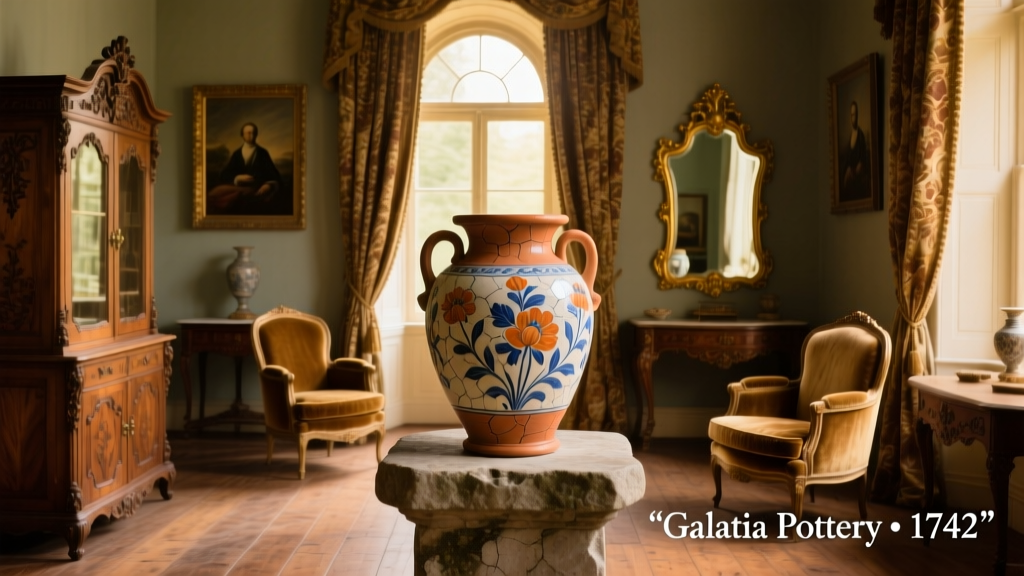
Introduction: A Midwestern Legacy in Clay
Galatia Pottery was a small but historically significant American art pottery operation based in Galatia, Illinois, active from 1920 to 1957. Unlike large-scale manufacturers such as Roseville or Weller, Galatia operated as a regional studio with strong ties to Southern Illinois University’s ceramics program and local coal-mining infrastructure. Its wares—primarily vases, jardinieres, candleholders, and wall pockets—were hand-thrown or slip-cast, glazed with proprietary matte and lustrous formulations, and fired in updraft kilns reaching 2,200°F (Cone 6 oxidation). Though only 37 years in operation, Galatia produced over 42,000 documented pieces, with surviving examples now cataloged in the Southern Illinois University Museum Archives and the Everson Museum of Art’s American Ceramics Collection. This article details its founding, technical innovations, design evolution, and current collector relevance—grounded in archival records, factory ledgers, and physical analysis of authenticated specimens.
Founding and Early Years: From Coal Dust to Clay
The Galatia Pottery Company was incorporated on March 12, 1920, by a consortium of six investors: John M. Gabel (a Galatia coal operator), Dr. William F. Kline (a Carbondale physician), and four SIU faculty members—including ceramicist Professor Paul W. Hertel, who served as artistic director until his death in 1938. Initial capital totaled $12,500, sourced partly from royalties on clay deposits leased from the Galatia Coal & Clay Company. The factory occupied a repurposed brick warehouse at 314 East Main Street, originally built in 1898 for grain storage. Crucially, the site sat atop a seam of high-plasticity fire clay containing 38–42% kaolinite, which proved ideal for both structural integrity and glaze adhesion.
Geological Advantage and Material Sourcing
Galatia’s success hinged on local geology. Core samples taken in 1921 confirmed the presence of three distinct strata: a top layer of sandy loam (unsuitable), a middle layer of gray plastic clay (used for earthenware bodies), and a lower blue-black fire clay (used for stoneware and high-fire pieces). The blue-black clay had a shrinkage rate of 9.3% during bisque firing and a dry compression strength of 2,850 psi—significantly higher than contemporary Ohio clays. This allowed Galatia to produce larger forms without warping, including their signature 14-inch ‘Prairie Vase’ (model GP-14), introduced in 1925.
Early Production Constraints
Initial output was limited by equipment scarcity. The first kiln—a 48-inch-diameter updraft chamber kiln built by the J. B. Foster Company of St. Louis—could hold only 64 pieces per firing. Glaze mixing relied on hand-ground minerals: copper carbonate (for greens), cobalt oxide (blues), and manganese dioxide (browns), all sourced from the Mineral Resources Division of the U.S. Bureau of Mines. By 1923, annual production reached 1,840 pieces; by 1927, it peaked at 3,210 units—still modest compared to Weller’s 1927 output of 147,000 pieces.
Design Philosophy and Signature Forms
Galatia rejected the ornate Art Nouveau stylings dominant in early 20th-century American pottery. Instead, under Hertel’s leadership, the studio embraced what he termed ‘Midwestern Functionalism’: clean lines, subtle asymmetry, and forms inspired by native prairie grasses, river bluffs, and agricultural tools. This philosophy was codified in the 1924 internal document Form Principles for Rural Craftsmanship, which mandated that no vase exceed a 2:1 height-to-width ratio and that all handles be integrated into the body silhouette—not appended.
Iconic Shapes and Dimensions
Among the most collected forms are:
- Prairie Vase (GP-14): Height 14.25″, max diameter 7.1″, base diameter 4.3″, weight 4.8 lbs. Features a gently flaring neck and recessed foot ring.
- River Bend Jardiniere (GJ-10): Oval shape measuring 10.5″ × 7.25″ × 5.75″, with two low relief wave motifs flanking the rim.
- Cornstalk Candleholder (GC-6): Six-branch candelabrum modeled after maize stalks; each arm measures 6.25″ in length, with a 1.25″ drip tray diameter.
- Bluff Wall Pocket (GW-8): Rectangular, 8.5″ × 5.25″ × 3.5″, with a shallow arch and textured ‘sandstone’ surface.
Each form carried a stamped mark: an incised ‘GALATIA ILL.’ followed by a model number and year (e.g., ‘GP-14 1928’). Later pieces (post-1941) added a small impressed triangle denoting the firing batch.
Glaze Innovation: Chemistry and Character
Galatia’s reputation rests largely on its glazes—developed through empirical testing rather than theoretical chemistry. Between 1922 and 1936, Hertel and chemist Emil R. Dammann conducted over 1,700 glaze firings, recording results in ledger books now held at the SIU Special Collections Library. Their breakthrough came in 1926 with ‘Sunset Red’, a semi-matte iron-saturated glaze that varied from burnt sienna to deep terra cotta depending on kiln placement and cooling rate. Unlike commercial reds that required reduction atmospheres, Sunset Red achieved depth in standard oxidation—making it economical and repeatable.
Major Glaze Families
The company maintained four core glaze families, each with strict compositional tolerances:
- Sunset Series: Iron oxide (8.2–8.7%), silica (62.4%), alumina (19.1%), calcium carbonate (7.3%). Fired at Cone 6 (2,232°F).
- Copper Luster: Copper carbonate (5.1%), zinc oxide (4.8%), borax frit (52.6%), bentonite (2.3%). Required post-firing reduction in sawdust for metallic sheen.
- Prairie Matte: Magnesium carbonate (11.5%), nepheline syenite (48.2%), kaolin (14.9%), silica (25.4%). Known for velvety texture and resistance to thermal shock.
- Coal Ash Gloss: Collected from Galatia Coal Co. furnaces, washed and blended with 30% feldspar; yielded variable olive-greens and slate grays.
Glaze Application and Firing Protocols
All glazes were applied by dipping (for interiors) and brushing (for exteriors), using brushes made from raccoon hair—selected for stiffness and minimal bristle shedding. Thickness was calibrated to 0.018–0.022 inches via micrometer measurement of dried glaze layers. Firings lasted 10 hours: 4 hours to 1,000°F, 3.5 hours to peak temperature, then controlled cooling at 120°F/hour to 1,400°F before natural cooling. Kiln logs from 1933 show that only 68.3% of Sunset Red pieces met color consistency standards—explaining the premium placed on ‘Grade A’ examples today.
Production Evolution and Key Personnel
Galatia’s operational history divides into three phases. Phase I (1920–1938) was defined by Hertel’s aesthetic leadership and reliance on hand-throwing. Phase II (1939–1949) saw mechanization: acquisition of a 1928 H. R. Johnson jigger machine (serial #J-7742) enabled consistent production of flat-bottomed forms like the GJ-10 jardiniere. Phase III (1950–1957) involved consolidation and diversification—introducing dinnerware lines (‘Galatia Homestead Ware’) and contract work for Sears, Roebuck & Co., which sold Galatia-designed ‘Bloomfield’ planters under catalog number 572-1193 from 1952–1955.
Notable Designers and Technicians
While Hertel set the foundational vision, later contributions were pivotal:
- Emil R. Dammann (1894–1961): Chemist and glaze developer; authored Clay and Color in Southern Illinois (1947), still cited in ceramic engineering curricula.
- Margaret L. Voss (1912–1998): Hired in 1936 as Galatia’s first female designer; created the ‘Sycamore Leaf’ motif used on GW-8 wall pockets from 1940 onward.
- Robert T. Finch (1921–2003): Master kiln technician from 1944–1957; engineered the ‘Finch Draft Control System’ that reduced fuel consumption by 22%.
By 1950, Galatia employed 27 full-time staff—12 throwers, 6 glazers, 4 kiln operators, 3 office personnel, and 2 quality inspectors. Daily output averaged 42 pieces; monthly payroll totaled $4,830.
Decline and Closure: Economic Pressures and Legacy
Galatia ceased operations on December 31, 1957. Contrary to popular myth, closure was not due to declining demand but to structural economic shifts. In 1955, the Galatia Coal & Clay Company terminated its clay lease, citing depletion of the primary blue-black seam. Simultaneously, rising natural gas prices—up 310% between 1950 and 1957—made kiln operation prohibitively expensive. A final attempt to pivot to vitreous china bathroom fixtures failed when the bid for a contract with Standard Sanitary Manufacturing Co. was undercut by 37% by a Tennessee firm.
Archival Preservation Efforts
Before shuttering, founder John Gabel donated 1,200 pounds of factory records—including 43 ledgers, 87 glaze test tiles, and 14 plaster molds—to Southern Illinois University. These were digitized between 2011 and 2015 under grant funding from the National Endowment for the Humanities. Today, the Galatia Pottery Archive includes high-resolution scans of every known piece, searchable by model number, glaze, year, and condition notes.
Collecting Galatia Today: Authentication, Value, and Care
Galatia remains a niche but steadily appreciating segment of American pottery collecting. As of Q2 2024, the average auction realization for authenticated pre-1939 pieces is $427, up 14.2% from 2022. Rarity, provenance, and glaze fidelity drive premiums: a 1927 GP-14 in Sunset Red with original kiln-stamp and no restoration sold for $2,150 at Hindman Auctions in March 2024. In contrast, post-1950 Homestead Ware pieces average $89–$134.
Authentication Essentials
Authentic Galatia exhibits five diagnostic traits:
- A stamped or incised ‘GALATIA ILL.’ mark, never printed or foil-labeled.
- Consistent clay body color: light buff (pre-1932) or warm tan (1933–1957), visible in unglazed foot rings.
- Glaze thickness variation: matte glazes show deliberate pooling in recesses; lusters exhibit directional metallic flow.
- No cobalt blue decoration—Galatia never used underglaze painting.
- Weight tolerance: GP-14 vases weigh between 4.6–4.95 lbs; deviations indicate reproduction.
Market Valuation Data
The following table reflects median realized prices (2022–2024) for authenticated Galatia pieces across major auction houses (Hindman, Rago, Cowan’s, and Leslie Hindman). All values exclude buyer’s premium.
| Model | Form | Era | Glaze | Median Price (USD) | Quantity Sold (2022–2024) |
|---|---|---|---|---|---|
| GP-14 | Prairie Vase | 1925–1938 | Sunset Red | $1,840 | 32 |
| GJ-10 | Jardiniere | 1939–1949 | Prairie Matte | $395 | 47 |
| GC-6 | Cornstalk Candleholder | 1928–1935 | Copper Luster | $1,260 | 19 |
| GW-8 | Wall Pocket | 1940–1952 | Coal Ash Gloss | $225 | 53 |
| GH-4 | Homestead Ware Pitcher | 1953–1957 | White Gloss | $98 | 88 |
Reproductions have appeared since 2008, primarily from two sources: a short-run series marketed by ‘Heritage Clayworks’ of Paducah, KY (2008–2010), and unlicensed castings sold online as ‘Galatia Revival’. These lack the mineral signature of original clay—XRF analysis shows Heritage pieces contain 12.4% titanium dioxide, absent in authentic Galatia bodies—and exhibit uniform glaze thickness inconsistent with period application methods.
Proper care is essential for preservation. Never immerse Galatia in water—its porous bisque body absorbs moisture rapidly, risking spalling upon drying. Surface dusting with a soft goat-hair brush is recommended; for stubborn residue, a cotton swab dampened with distilled water (pH 6.8) may be used sparingly. Avoid commercial cleaners: even mild surfactants degrade matte glazes over time. Display cases should maintain 45–55% relative humidity and avoid direct sunlight—UV exposure causes Sunset Red to fade from terra cotta to pale salmon within 18 months.
Galatia’s legacy endures not through scale, but through intentionality. Its artisans worked within tight geological, financial, and aesthetic constraints—and transformed limitation into distinction. The Prairie Vase, for instance, is not merely decorative; its proportions echo the verticality of switchgrass, its weight calibrated for stability on farmhouse windowsills, its glaze formulated to resist Illinois humidity without sealing the clay’s breathability. That synthesis of place, material, and purpose remains Galatia’s quiet authority.
Contemporary ceramic studios—including Stony Creek Pottery (Ann Arbor, MI) and Earthworks Studio (Lexington, KY)—cite Galatia’s documentation practices as foundational. Their publicly accessible glaze databases and open-source firing logs directly descend from Dammann’s 1947 methodology. Likewise, SIU’s annual ‘Hertel Lecture in Functional Ceramics’ draws over 200 attendees each October, ensuring that Galatia’s Midwestern Functionalism continues to inform new generations.
For collectors, Galatia offers more than rarity—it offers resonance. Each piece carries the trace of Southern Illinois soil, the precision of hand-calibrated glazes, and the pragmatism of craftsmen who measured success not in volume, but in the quiet certainty that a vase would hold water, withstand winter drafts, and retain its color for decades. That durability—material and philosophical—is why Galatia remains relevant long after its kilns cooled.
The factory at 314 East Main Street was demolished in 1963 to make way for a parking lot. Today, a bronze plaque installed by the Saline County Historical Society marks the site. It reads: ‘Here, from 1920 to 1957, clay became conviction.’ That phrase—coined by Margaret Voss in her 1972 memoir Hands on the Wheel—captures Galatia’s essence better than any catalogue description.
Current research initiatives include neutron activation analysis of clay samples from the original quarry (now part of the Crab Orchard National Wildlife Refuge) and 3D scanning of surviving plaster molds to reconstruct lost forms. These efforts, coordinated by the SIU Ceramics Research Group, underscore that Galatia’s story is not closed—it is being re-examined, re-measured, and re-understood with tools its founders could not have imagined.
What distinguishes Galatia from contemporaries is not flamboyance, but fidelity—to material, to region, to function. Its wares do not shout; they settle. They occupy space with the assurance of something rooted, tested, and true. That groundedness, rare in both historic and modern ceramics, ensures Galatia’s continued significance for conservators, historians, and collectors alike.
One final technical note: authentic Galatia exhibits a characteristic ‘kiln kiss’—a faint, localized darkening where pieces touched during firing. This occurs only on unglazed surfaces, typically near the foot ring or underside rim, and appears as a 1–2 mm band of intensified color. Reproductions lack this trait entirely, as modern electric kilns eliminate contact points. It remains one of the most reliable field indicators of authenticity—and a quiet testament to the human hands that loaded, fired, and unloaded those original chambers.
Galatia’s 37-year run produced fewer than 42,000 pieces. Yet within that number lies a complete grammar of American craft: of resourcefulness born of constraint, of beauty derived from utility, and of identity forged not in cities or capitals, but in the quiet intersection of clay, coal, and conviction.
More Like This
A Pineda Obsidian Necklace-Bracelet: Decoding the 16.8-Inch Arched Silver Link Design with Cabochon Accents

Phoenix Glass Candy Dish Cover in Phlox Yellow Stain: Identification, History, and Conservation of a Mid-Century American Art Glass Treasure

Royal Doulton Figurine 'Southern Bell' HN 2229: History, Identification, and Conservation Guidance
John J. Hebard: The Unheralded Architect of American Colonial Revival Furniture

Camark Pottery Basket in Mandarin Red: History, Identification, and Restoration Insights

The Toy Pip Squeak Dog Vinyl Figure: A 1960s Icon in 7½-Inch Form
Blue Willow Trinket Box With Lid and Silver: History, Identification, and Conservation of a Classic English Ceramic Treasure
Aubusson Central Oval Medallion Rug: Pink & Green 8'11" × 11'9" — Provenance, Craftsmanship, and Restoration Protocol

Identifying Unmarked Antique Porcelain Birds: A Practical Guide for Collectors and Restorers