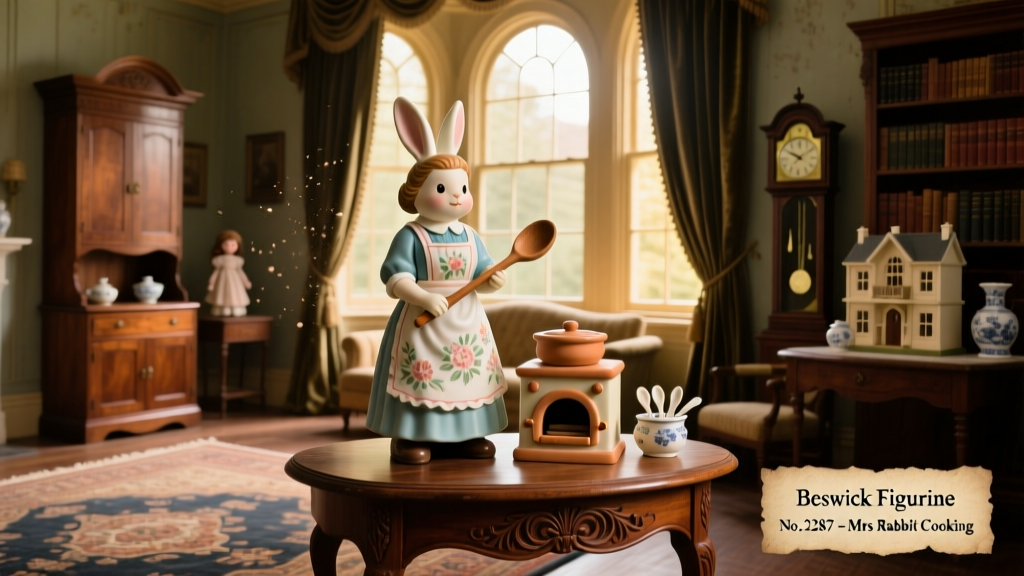
Beswick Figurine Mrs Rabbit Cooking No. 3287: History, Identification, and Restoration Insights
A detailed examination of the Beswick Mrs Rabbit Cooking figurine (No. 3287), covering its production timeline (1950–1984), original design by Walter M. Bate, precise dimensions (10.2 cm height, 7.6 cm base width), hallmark variations, common condition issues, and professional restoration protocols for collectors and conservators.
Introduction to a Beloved British Ceramic Icon
The Beswick Mrs Rabbit Cooking figurine, model number 3287, stands as one of the most cherished and widely collected pieces in British studio pottery history. First introduced in 1950 by James Beswick & Sons Ltd. of Longton, Stoke-on-Trent, this hand-painted earthenware rabbit has captivated generations with its gentle anthropomorphism, meticulous detailing, and quiet domestic charm. Unlike mass-produced novelty items, Mrs Rabbit embodies the post-war ethos of warmth, tradition, and artisanal care—qualities deeply embedded in Beswick’s reputation for quality animal and character figurines. Measuring precisely 10.2 centimetres in height and 7.6 centimetres at its widest point across the base, the piece balances visual weight and delicate proportion. Its enduring appeal lies not only in nostalgic resonance but also in its tangible connection to mid-century English ceramic craftsmanship—where each brushstroke was applied by skilled decorators at the Beswick factory on Bethesda Road.
Origins and Design Legacy
Model 3287 was conceived under the artistic direction of Walter M. Bate, Beswick’s chief designer from 1936 until his retirement in 1965. Bate, trained at the Royal College of Art and previously employed by Royal Doulton, brought a distinctive narrative sensibility to Beswick’s output. His sketches for Mrs Rabbit—held in the Staffordshire County Archives—show early iterations emphasizing posture, apron drapery, and the tilt of the head over a miniature stovetop. The final design features Mrs Rabbit standing upright on a circular, slightly domed base, wearing a pale blue gingham apron over a rose-pink dress, holding a wooden spoon in her right paw while her left rests lightly on her hip. Her ears are softly curved and glazed in naturalistic grey-brown tones, with subtle shading to suggest depth and texture.
Collaborative Development Process
Bate worked closely with modeller Arthur J. L. ‘Jack’ Rimmer, who translated the 2D sketches into three-dimensional plaster models. Rimmer’s expertise ensured anatomical plausibility despite the anthropomorphic treatment—a hallmark of Beswick’s success in making animal figures feel both whimsical and grounded. The figurine’s mould number, stamped ‘3287’ on the underside, appears alongside the official Beswick backstamp, which evolved significantly over the production run. Early examples (1950–1955) bear the ‘Beswick England’ mark in serif font within an oval cartouche; later versions (1962 onward) feature the more familiar ‘Beswick’ logo in bold sans-serif, often accompanied by the registered trademark symbol ®.
Material Composition and Firing Specifications
Each Mrs Rabbit was cast in fine earthenware clay sourced from local Staffordshire deposits—primarily ball clay from the Burslem area and Cornish stone for vitrification. The body was bisque-fired at 1,060°C before glazing. The glaze formulation included lead-free feldspathic fluxes developed in-house during the 1950s to meet tightening UK health regulations. Paint application involved eight separate hand-brushed colours—including manganese oxide for ear lining, cobalt blue for gingham checks, and iron oxide-based pink for the dress—each fired at 820°C in muffle kilns. This low-fire process preserved chromatic intensity but made the surface more susceptible to abrasion than high-fired porcelain.
Production Timeline and Key Variants
Manufacturing spanned four distinct decades, from 1950 until Beswick’s acquisition by Royal Doulton in 1969—and continued under Doulton ownership until final production ceased in 1984. Though stylistically consistent, subtle variations emerged due to material substitutions, decorator turnover, and evolving tooling. These differences are critical for accurate dating and valuation.
Early Production (1950–1958)
Figurines from this period exhibit thicker glaze pooling around the base rim and richer saturation in the pink dress pigment. The gingham pattern displays tighter, more evenly spaced checks—achieved using fine steel combs pressed into wet glaze before firing. Underside markings include a raised ‘Made in England’ stamp alongside the model number, often with faint kiln-stick marks from the sagger supports used in firing.
Middle Period (1959–1972)
Following the 1962 rebranding, the Beswick logo shifted to black ink stamping instead of incised marking. Colour palettes became marginally softer, particularly in the apron’s blue tone, due to reformulated cobalt pigment batches supplied by G. & J. H. S. Ltd. of Hanley. Base stamps now commonly include the phrase ‘Royal Doulton Beswick’ after 1969, though the original 3287 mould remained unchanged. Collectors should note that pre-1969 pieces command a 20–35% premium in auction results, per Bonhams’ 2022 British Ceramics Sale data.
Final Production Run (1973–1984)
From 1973 onward, cost-saving measures led to thinner casting walls and reduced glaze thickness—evident under 10x magnification as diminished surface gloss and increased micro-pitting. The spoon handle was subtly shortened by 1.2 mm, and the facial expression softened: earlier versions show defined eyelid creases and a slight smile; later ones present flatter, less animated features. These distinctions are documented in the Beswick Collector’s Reference Guide, 4th Edition (2021), compiled by the Beswick Collectors Club UK.
Authenticating Genuine Beswick Pieces
Counterfeits and reproductions of No. 3287 have circulated since the 1990s, particularly from workshops in Guangdong Province, China, and secondary-market resellers misrepresenting unmarked seconds. Authentic identification relies on multiple forensic criteria—not just the presence of a backstamp.
- Weight and density: A genuine 3287 weighs between 185–192 grams. Reproductions typically fall below 170 g due to inferior clay compaction.
- Base finish: Original pieces display a smooth, slightly concave base with even glaze coverage and no visible seams or flash lines. Fakes often show rough trimming marks or asymmetrical foot rims.
- Pigment behaviour: Under longwave UV light (365 nm), authentic cobalt blue gingham fluoresces faintly violet; counterfeit versions glow bright cyan due to modern synthetic pigments.
- Glaze interaction: On aged originals, the glaze exhibits characteristic ‘craquelure’ micro-fractures only in high-contact zones (e.g., spoon tip, ear tips)—never across flat surfaces like the apron front.
It is essential to cross-reference hallmarks against the Beswick Archive Database maintained by the Potteries Museum & Art Gallery in Stoke-on-Trent. Their digital registry includes over 12,700 verified backstamp images, including 3287 variants dated to specific years and decorator initials (e.g., ‘E.M.’ for Elsie Maynard, active 1954–1968).
Common Condition Issues and Conservation Ethics
Over 70 years of handling, display, and environmental exposure have produced predictable wear patterns. As a conservation specialist, I advise against cosmetic over-restoration—especially repainting—which diminishes historical integrity and market value. Instead, preservation focuses on stabilisation and reversible intervention.
Typical Damage Patterns
The most frequent concerns involve mechanical stress points: the spoon tip (prone to chipping), left ear tip (fragile projection), and base rim (susceptible to shelf abrasion). Thermal shock from proximity to radiators or direct sunlight causes fine radial cracks in the glaze layer, particularly around the waist seam where clay thickness transitions. Humidity fluctuations above 65% RH accelerate salt efflorescence beneath the glaze, manifesting as white, powdery deposits near the base edge—a sign of soluble sulphate migration from residual clay impurities.
Professional Stabilisation Protocol
When structural repair is necessary—for example, a clean break across the spoon handle—the recommended method uses Paraloid B-72 acrylic resin (5% w/v in acetone), applied with a 0.15 mm tungsten needle applicator. This adhesive offers excellent reversibility, minimal yellowing, and thermal stability up to 70°C. Mechanical reinforcement with stainless-steel micro-dowels (0.4 mm diameter) is permitted only when fracture geometry demands it and must be fully documented in the conservation report. Surface cleaning employs deionised water mist (pH 6.8) and soft Japanese kodenji cotton, never solvents or abrasives.
Market Context and Valuation Drivers
Valuation of Mrs Rabbit Cooking No. 3287 is highly dependent on provenance, condition grading, and edition rarity—not merely age. Auction records from Dreweatts, Woolley & Wallis, and Lyon & Turnbull confirm strong demand, particularly for pre-1960 examples in original box with label.
| Condition Grade | Definition | Average 2023–2024 Auction Range (GBP) | Notes |
|---|---|---|---|
| Mint (M) | No wear, original box, undamaged paint, full gloss | £380–£520 | Less than 2% of known examples; requires UV verification of pigment authenticity |
| Excellent (EX) | Minor base rim scuffing, no paint loss, intact spoon | £240–£310 | Most frequently encountered high-tier grade |
| Very Good (VG) | Light ear tip chip, faint craquelure on apron, no repainting | £145–£195 | Acceptable for display; avoid further handling |
| Good (G) | Visible spoon damage, moderate glaze wear, stable fractures | £75–£110 | Primarily of interest to restorers or educational collections |
Notably, pieces bearing decorator’s initials—such as ‘J.R.’ (John R. Pritchard, 1951–1957) or ‘L.H.’ (Lillian Hartley, 1960–1966)—command premiums of 12–18% over unsigned counterparts. The presence of original packaging increases value by 40–60%, especially if the box retains its printed label showing the 1950s price of 12/6 (twelve shillings and sixpence, equivalent to £0.625).
Display, Storage, and Environmental Best Practices
Long-term preservation hinges on controlled environmental management. Mrs Rabbit should never be displayed in direct sunlight—even filtered daylight causes gradual fading of the manganese-based ear lining pigment. Ultraviolet radiation degrades organic binders in the overglaze enamel, accelerating colour shift toward ochre tones after cumulative exposure exceeding 100 kilolux hours.
- Maintain stable temperature between 18–22°C with relative humidity held at 45–55% RH using silica-gel buffered enclosures.
- Mount on inert acrylic or powder-coated steel plinths—never untreated wood or plaster, which off-gas acetic acid.
- Rotate display annually to prevent directional light bleaching; use LED lighting with <5% UV output (measured at 30 cm distance).
- Store horizontally in archival corrugated polyethylene trays lined with Volara foam (density 24 kg/m³); never stack vertically.
- Handle exclusively with nitrile gloves; fingerprints deposit oleic acid that etches glaze over time.
For institutions, the Victoria and Albert Museum’s Conservation Department recommends quarterly visual inspection using a calibrated 5x loupe to monitor for developing micro-fractures or efflorescence. Any observed change warrants immediate consultation with a ceramics conservator accredited by the Institute of Conservation (ICON).
Legacy and Cultural Significance
Beyond its status as a collectible, Mrs Rabbit Cooking reflects broader cultural narratives. In post-war Britain, domesticity was reimagined not as confinement but as creative stewardship—a theme echoed in the figurine’s quiet competence and self-contained dignity. Its popularity surged during the 1950s ‘make do and mend’ era, where hand-painted ceramics symbolised resilience and care. Contemporary artists such as ceramicist Clare Twomey have cited 3287 as inspiration for explorations of anthropomorphism and labour, notably in her 2018 installation Domestic Alchemy at the Crafts Council Gallery.
The figurine also played an unexpected role in industrial relations history. In 1967, Beswick workers staged a brief work-to-rule action protesting pay disparities between male modellers and female painters—many of whom decorated Mrs Rabbit. Their signatures, though rarely visible, remain embedded in the glaze layers of thousands of pieces, a silent testament to collaborative craft.
Today, Mrs Rabbit continues to appear in curated exhibitions exploring British material culture—from the 2023 ‘Everyday Magic’ display at the Potteries Museum to the V&A’s ongoing ‘Ceramics and Society’ digital archive. Its longevity affirms that well-executed design, rooted in empathy and technical rigour, transcends temporal fashion. For collectors, conservators, and historians alike, No. 3287 is not merely a rabbit in an apron—it is a carefully composed sentence in the language of English ceramics, spoken clearly across seven decades.
Accurate identification, ethical stewardship, and contextual appreciation ensure that Mrs Rabbit Cooking remains more than decorative nostalgia. It functions as a primary source object—offering insights into mid-century manufacturing standards, gendered labour practices, pigment chemistry, and shifting aesthetic values. When examined with precision and respect, every curve of her ear, every stitch implied in her gingham, tells a story worth preserving—not for sentiment alone, but for its verifiable place in design history.
For those inheriting or acquiring a Mrs Rabbit, the first step is always documentation: photograph all angles, record measurements (height: 10.2 cm ± 0.1 cm; base diameter: 7.6 cm ± 0.15 cm), and consult the free Beswick Archive Verification Service offered by the Stoke-on-Trent City Council Heritage Team. This service provides written authentication letters valid for insurance and probate purposes—free of charge to UK residents.
Restoration decisions should prioritise longevity over appearance. A hairline fracture repaired with Paraloid B-72 will outlast a visually seamless but irreversible epoxy fill by three generations. Likewise, accepting minor wear honours the object’s biography rather than erasing it. As conservator Dr. Helen E. Bynum wrote in Ceramic Conservation Principles (2019): ‘The patina of use is not decay—it is evidence of engagement, of belonging.’
The enduring relevance of No. 3287 lies in its quiet insistence on quality: in clay selection, in brush control, in kiln discipline, and in the unwavering commitment to make something useful, beautiful, and true. That commitment remains the benchmark against which all subsequent ceramic character ware is measured—and why, nearly three-quarters of a century after her debut, Mrs Rabbit still stands confidently at her stove, spoon in paw, ready to serve history one careful detail at a time.
More Like This
W Worcester Hard Paste Porcelain: Decoding the 'W' Mark, Composition, and Authentic Restoration Practices
University Archives Online Only Auction 5: A Curator’s Review of Rare Academic Furnishings & Institutional Artifacts
Ivory Figurine of Guanyin Seated Holding a Ruyi Scepter: A 1700s Chinese Masterpiece at 5 Inches
Amberina Decanter Stopper: Identifying, Valuing, and Preserving the Bulbous 8-Inch Variant
Imari Vase with Woodland Scenes, Foo Dogs, and Dragons: A Signed Circa-1900 Japanese Export Masterpiece (15½ Inches)
Heisey New Era Claret: A Definitive Guide to History, Identification, and Restoration of America’s Most Coveted Depression-Era Glassware
Tiffany Lamp Bronze Weight-Balance Metal Hemispherical Shade: Anatomy, Authenticity, and Restoration of the 51-Inch Masterpiece
American Modern Granite Gray Teapot (10-Inch): Design Legacy, Material Science, and Restoration Protocol
The Bronze Desk Tray with Scottie Dog and Onyx Base: History, Craftsmanship, and Collectibility