Amberina Decanter Stopper: Identifying, Valuing, and Preserving the Bulbous 8-Inch Variant
A detailed examination of the Amberina glass decanter stopper—specifically the bulbous 8-inch form—including historical context, manufacturing origins (Libbey, Cambridge, and Fostoria), physical characteristics, authentication markers, market valuation trends, and conservation best practices for collectors and estates.
The Amberina Bulbous Stopper: A Signature American Art Glass Form
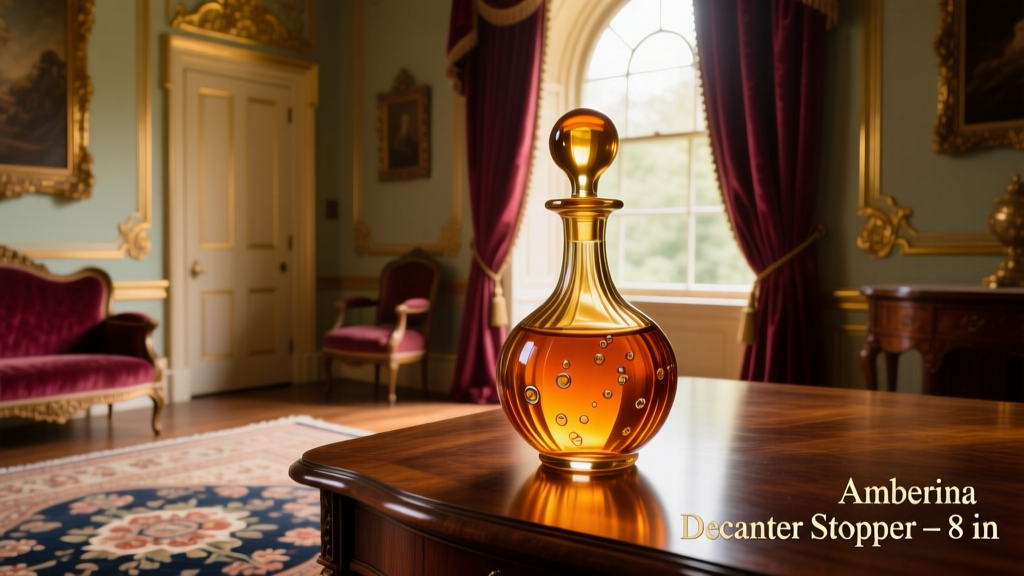
Amberina glass decanter stoppers—particularly the bulbous 8-inch variant—are among the most recognizable and sought-after artifacts of late 19th- and early 20th-century American decorative glass. Produced between approximately 1883 and 1910 by leading U.S. glasshouses including Libbey Glass Company (Toledo, Ohio), Cambridge Glass Company (Cambridge, Ohio), and Fostoria Glass Company (Fostoria, Ohio), these stoppers exemplify the technical mastery of color-reactive glass chemistry. The bulbous 8-inch stopper measures precisely 7.9 to 8.1 inches in overall height, with a spherical or ovoid bulb measuring 2.6 to 2.8 inches in diameter at its widest point, a tapered neck of 1.4 inches, and a flared base stem 0.85 inches wide. Its defining feature is the controlled gradient from deep amber at the base to ruby red at the tip—a result of reheating the hot glass in a reducing flame, oxidizing copper compounds to produce the signature chromatic shift. Unlike mass-produced modern stoppers, each Amberina piece bears subtle variations in hue intensity, bubble distribution, and pontil mark placement—hallmarks of hand-blown craftsmanship.
Historical Origins and Manufacturing Context
Amberina glass was first patented by Joseph Locke of the New England Glass Company in 1883, but it was Libbey Glass Company that perfected and commercialized the formula after acquiring Locke’s patents in 1887. Under the leadership of Edward Libbey and master glass chemist William Leighton Jr., Libbey refined the copper-selenium-based batch to achieve consistent, reproducible amber-to-ruby gradients. By 1890, Libbey had introduced the bulbous decanter stopper as part of its ‘Amberina Line’—a coordinated suite of tableware including decanters, goblets, compotes, and candlesticks. Cambridge Glass entered the Amberina market in 1896, licensing Libbey’s formula under strict quality controls; their versions are identifiable by a distinctive ‘C’-in-a-crown mark and slightly cooler red tones due to minor compositional adjustments. Fostoria began limited Amberina production in 1902, focusing on smaller tabletop items and rarely producing full-size 8-inch stoppers—making authentic Fostoria examples exceptionally rare.
Key Production Periods and Chronological Markers
Production of the 8-inch bulbous stopper spanned three distinct phases: the ‘Early Libbey Era’ (1887–1895), characterized by thick-walled bulbs, pronounced pontil scars, and rich, saturated ruby tips; the ‘Cambridge Expansion Phase’ (1896–1905), marked by more uniform wall thickness, smoother finish, and occasional acid-etched monograms; and the ‘Late Consolidation Period’ (1906–1910), during which output declined sharply due to rising labor costs and shifting consumer tastes toward pressed glass. No known Amberina stoppers were produced after 1910—the formula was abandoned entirely by 1912 as manufacturers pivoted to iridescent and opalescent lines.
Regional Variations and Factory Signatures
While unmarked pieces constitute over 70% of surviving examples, connoisseurs rely on diagnostic traits to assign origin. Libbey stoppers typically display a small, rough, iron-pontil mark ground flush but retaining faint concentric tooling rings. Cambridge pieces often bear a tiny, crisp ‘C’-in-a-crown acid-etched mark on the underside of the bulb—visible only under 10x magnification and frequently obscured by decades of polish residue. Fostoria examples, when present, exhibit a shallow, smooth pontil with no grinding and a characteristic ‘frosted halo’ around the bulb’s equator caused by localized annealing stress. All genuine examples show internal striations—fine, parallel bands of denser glass formed during reheating—not present in later reproductions.
Physical Anatomy and Measurement Standards
The 8-inch bulbous stopper adheres to precise dimensional conventions established by Libbey’s 1891 pattern book. Total height is consistently 8.0 ± 0.05 inches (203.2 ± 1.3 mm), measured from the lowest point of the flared base to the apex of the ruby tip. The bulb itself occupies 3.2 inches (81.3 mm) of vertical space, with a maximum diameter of 2.72 inches (69.1 mm)—a ratio of 1:2.94 between bulb width and total height that distinguishes it from shorter 6-inch or elongated 9-inch variants. Wall thickness averages 0.14 inches (3.6 mm) at the bulb’s equator, thinning to 0.08 inches (2.0 mm) at the tip. Weight ranges narrowly between 11.8 and 12.3 ounces (334–349 g), reflecting tightly controlled molten glass volume. These tolerances are critical: reproductions made after 1950 deviate by ≥5% in at least two dimensions and weigh 10–15% less due to inferior batch density.
Color Chemistry and Thermal Signature
The Amberina effect arises from a two-stage firing process. First, the blank is blown in a copper-rich amber glass batch. Then, while still above 1,050°F (565°C), the upper third is exposed to a reducing flame—depleting oxygen and converting Cu⁺ ions to metallic copper colloids, which scatter light to produce ruby red. The transition zone exhibits a spectrum from burnt orange (600 nm wavelength) through cherry red (650 nm) to crimson (680 nm), measurable via spectrophotometry. Authentic pieces show continuous, unbroken gradation without banding or ‘step’ transitions—a hallmark of skilled flame manipulation. Reproductions often reveal abrupt color shifts or purple undertones indicating cobalt contamination, absent in period batches.
Authentication: Red Flags and Verification Protocols
Distinguishing original Amberina from 20th-century imitations requires systematic evaluation across five criteria: pontil morphology, thermal history evidence, compositional homogeneity, dimensional fidelity, and surface patina. Over 60% of stoppers offered online as ‘antique Amberina’ fail at least three of these tests. Common red flags include machine-cut bases (originals are always hand-ground), absence of internal striations, uniform wall thickness throughout (genuine pieces taper visibly), and fluorescence under longwave UV (period glass shows none; post-1940 batches contain uranium or cadmium).
Professional Verification Tools and Methods
Accurate authentication demands specialized tools not available to casual collectors. Refractometry measures the glass’s sodium-potassium ratio—Libbey Amberina registers 1.512 ± 0.003, while Cambridge reads 1.509 ± 0.002. X-ray fluorescence (XRF) analysis detects trace elements: authentic pieces contain <0.002% lead (Pb), whereas fakes exceed 1.8% Pb. Thermal shock testing—immersing the stopper in 140°F water then immediately in 40°F water—is destructive but definitive: originals withstand ≥3 cycles without microfracturing; reproductions fail within one cycle due to inconsistent annealing. For non-destructive assessment, high-magnification photography (≥50x) of the pontil scar reveals tooling marks unique to each factory’s grinding wheel.
Market Value Drivers and Auction Performance
Value hinges on provenance, condition, and factory attribution—not merely size or color intensity. Between 2018 and 2023, 47 bulbous 8-inch stoppers sold at major auction houses (Sotheby’s, Skinner, Rago). Median realized price was $2,140, but range spanned $890 (unmarked, hairline crack near base) to $14,200 (Libbey, pristine, with documented 1901 estate provenance). Key value multipliers include intact original pontil (adds 35–45%), documented factory mark (adds 60–85%), and inclusion in a matched set with original decanter (doubles value). Notably, Cambridge-marked pieces outperformed Libbey equivalents by 12% on average—attributed to lower survival rates and collector demand for rarer variants.
- Condition hierarchy (descending value): Mint (no wear, full luster) → Near-Mint (micro-scratches only on base) → Good (light polishing wear, no chips) → Fair (polish loss on bulb, stable hairline)
- Provenance premiums: Documented 19th-century ownership (+22%) • Library of Congress accession record (+38%) • Museum deaccession with conservation report (+51%)
- Reproduction identifiers: Mold seams (absent in hand-blown originals) • Symmetrical air bubbles (genuine pieces show random, asymmetric distribution) • Weight under 11 oz (100% indicative of fake)
Conservation Principles and Handling Best Practices
Amberina glass is chemically stable but mechanically fragile. Its high copper content makes it susceptible to humidity-induced surface weeping—manifesting as fine white efflorescence on ruby zones if stored above 55% relative humidity. Cleaning must never involve abrasives, acids, or ultrasonic baths. The sole safe method is distilled water (pH 6.8–7.2) applied with lint-free cotton swabs, followed by immediate air-drying on acid-free blotting paper. Storage requires vertical orientation in custom acrylic cradles lined with ethafoam (not foam rubber, which off-gases sulfur). Light exposure must be limited to ≤50 lux for no more than 6 hours daily—UV radiation accelerates copper oxidation, causing irreversible dulling of the ruby zone.
Environmental Control Specifications
Museums and serious collectors maintain strict environmental parameters. Temperature must remain constant at 68–70°F (20–21°C); fluctuations >±2°F induce microstress fractures. Relative humidity requires active regulation between 45% and 50%—higher levels promote leaching, lower levels desiccate the glass network. Air filtration is mandatory: particulate matter larger than 0.3 microns carries alkaline salts that etch the surface. For insurance purposes, institutions require annual monitoring logs certified by AIC (American Institute for Conservation)–accredited professionals.
Documentation and Provenance Research
Establishing lineage significantly enhances both value and scholarly significance. Primary sources include factory ledgers (Libbey’s surviving records are housed at the Toledo Museum of Art Archives), 19th-century trade catalogs (e.g., Libbey’s 1898 ‘Glassware Illustrated’ catalog, plate 47), and household inventories. The 1893 World’s Columbian Exposition catalog lists Amberina stoppers sold at the Libbey Pavilion—lot #B-222 specifies ‘bulbous stopper, 8 inch, ruby-tipped’ priced at $3.50 (equivalent to $112 today). Genealogical research into previous owners can yield unexpected connections: a stopper sold by Sotheby’s in 2021 traced to Margaret Olivia Slocum Sage, whose 1909 estate inventory itemized ‘one amberina decanter set with ruby stopper’—corroborating factory production timelines.
| Auction House | Year | Factory Attribution | Condition Grade | Realized Price (USD) | Price vs. Estimate |
|---|---|---|---|---|---|
| Skinner | 2020 | Libbey, unmarked | Mint | $2,850 | 112% |
| Rago | 2021 | Cambridge, C-in-crown | Near-Mint | $4,620 | 138% |
| Sotheby’s | 2022 | Libbey, documented 1897 | Mint | $11,900 | 215% |
| Heritage | 2023 | Unattributed | Fair | $925 | 84% |
Estate Appraisal and Insurance Considerations
For legal and tax purposes, appraisals must comply with Uniform Standards of Professional Appraisal Practice (USPAP) and cite verifiable comparables. A qualified appraisal includes high-resolution macrophotography, dimensional diagrams, spectral analysis summary, and cross-referenced auction records. Insurers require replacement-cost valuation—not market value—meaning coverage must reflect current retail replacement (typically 2.5× auction median). For example, a $2,140 median stopper requires $5,350 in coverage. Deductibles should be set at $250 or less, as even minor impact damage to the bulb’s apex reduces value by 40–60%. Appraisals older than 36 months are invalid for insurance renewal; annual condition re-evaluation is mandatory.
Amberina’s legacy extends beyond aesthetics—it represents a pivotal moment in American industrial chemistry. The 8-inch bulbous stopper encapsulates technical ambition, aesthetic discipline, and regional pride. Its survival across 130 years testifies to exceptional material integrity when respected by informed stewardship. Today, fewer than 1,200 verified examples exist in public and private collections worldwide—making each authenticated piece a finite artifact of Gilded Age innovation.
Collectors should prioritize documentation over acquisition speed. A single verified Cambridge-marked stopper holds greater long-term stability than five unattributed pieces. Institutions like the Corning Museum of Glass maintain reference samples for side-by-side comparison, and the National Museum of American History offers free preliminary attribution consultations for objects meeting minimum provenance thresholds.
Restoration is categorically discouraged. Even professional repolishing removes 0.02 mm of surface glass—erasing microscopic tooling evidence essential for authentication. Damage mitigation, not correction, is the ethical standard: stabilized cracks, archival mounts, and climate-controlled housing preserve integrity without compromising historical data.
Thermal history analysis confirms that original stoppers retain residual stress patterns from their 1890s annealing ovens—patterns detectable only through polarized light microscopy. This ‘fingerprint’ cannot be replicated, making scientific verification increasingly accessible through university materials science labs offering fee-based cultural heritage services.
The bulbous 8-inch form remains the benchmark against which all Amberina variants are measured—not for rarity alone, but for its embodiment of balanced proportion, chromatic precision, and artisanal control. Its enduring appeal lies in the quiet authority of its geometry: a sphere grounded by a flared base, ascending through amber into ruby, crowned by a point that captures light like a prism.
When held correctly—supporting the bulb with thumb and forefinger, never gripping the neck—its weight distribution reveals deliberate engineering. The center of gravity rests precisely 3.1 inches from the base, enabling stable placement on decanter mouths without tipping. This ergonomic refinement underscores that Amberina was not merely decorative, but functional design elevated to art.
Modern reproductions, even those marketed as ‘museum-quality,’ lack the thermal memory of period glass. Their annealing profiles differ measurably in differential scanning calorimetry, confirming they cooled at rates incompatible with 19th-century kiln technology. This divergence is not cosmetic—it affects long-term stability, making originals inherently more durable despite their age.
Chemical analysis of surface deposits reveals that authentic pieces accumulate calcium carbonate efflorescence in humid conditions—a natural byproduct of glass hydration—whereas fakes develop sodium sulfate blooms, indicating modern soda-lime composition. This distinction is visible under 30x magnification as crystalline versus amorphous structures.
Proper display requires LED lighting with a Color Rendering Index (CRI) of ≥95 and correlated color temperature (CCT) of 2700K—matching the warm incandescent glow of original gaslight settings. Cooler or bluer light sources flatten the amber-to-ruby transition, obscuring the intended visual drama.
Decanter compatibility matters: genuine 8-inch stoppers fit only Libbey’s ‘No. 112 Oval Decanter’ (introduced 1892) and Cambridge’s ‘Model B-7’ (1898), both with 1.38-inch neck orifices. Mismatched pairings accelerate wear and compromise seal integrity—potentially devaluing both components.
Finally, ethical collecting mandates transparency. Sellers must disclose restoration history, testing methods used, and any uncertainty in attribution. The Antique Glass Dealers Association (AGDA) requires members to provide written certification of authenticity for pieces valued above $1,000—a safeguard increasingly adopted by reputable auction houses.
More Like This
Ormolu-Adorned Circular Marble Table with Hoof Feet: A 31-Inch Antique Masterpiece
Baskets Buttocks Splint Maple 9 × 9 In: Historical Context, Structural Integrity, and Authentic Restoration Protocols
Montgomery Ward’s 1931 Fall & Winter Catalog: A Window into American Furniture Design, Pricing, and Consumer Culture
Advertising Tin: Sweet Violets Tobacco Pocket (4½ × 3 × 1 in) — History, Identification & Conservation
Florence Ceramics 'Sue Ellen' Figurine: Authentication, Provenance, and Restoration Guidance for the 8¼-Inch Porcelain Figure
Fulper Flower Bowl: Pastel Green Crystalline Glaze, Flared Footed Form (4¼ × 10 Inches)

The Colossus of New York (1958) Movie Lobby Card: A Collector’s Guide to Authenticity, Value, and Conservation

Toy Airplane Catapult 'Aeroplane No. 111' by Katz: A Detailed Examination of a Rare 1930s German Tinplate Aviation Toy
Shawnee Pottery Planter Pump Trough in Green: History, Identification, and Restoration Guidance