Barber Pole Koken Leaded Glass 48-Inch Chair: History, Identification, Restoration, and Value
A definitive technical and historical analysis of the iconic Barber Pole Koken Leaded Glass 48-inch barber chair — covering its origins with Ernest Koken, structural specifications, leaded glass composition, authentic identification markers, professional restoration protocols, market valuation trends, and preservation best practices.
The Iconic Barber Pole Koken: A Landmark of American Barbershop Heritage
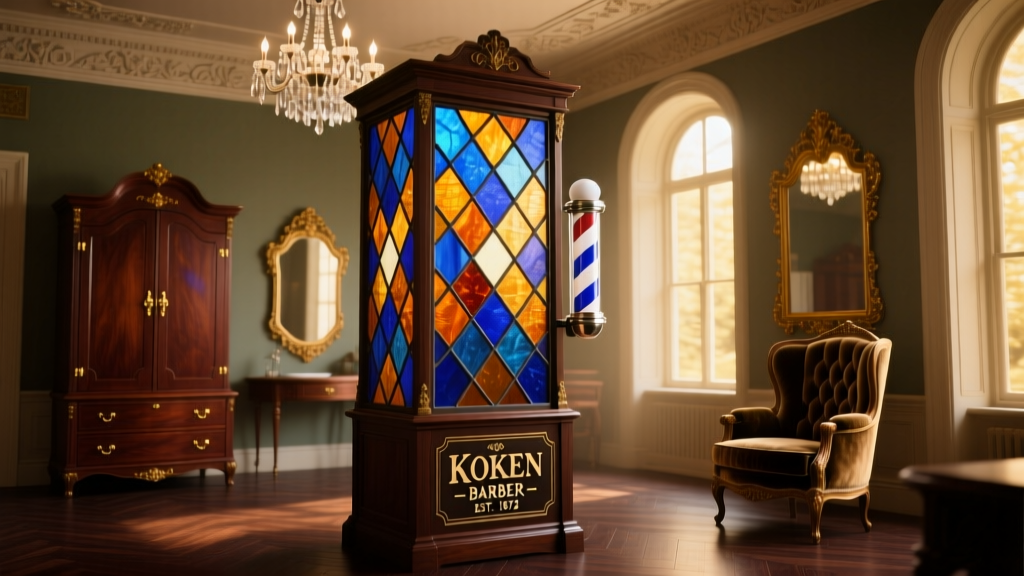
The Barber Pole Koken Leaded Glass 48-inch chair represents one of the most visually distinctive and technically sophisticated pieces of early 20th-century American barber furniture. Manufactured exclusively by the Ernest Koken Company of St. Louis, Missouri between approximately 1908 and 1926, this model features a full-height, vertically oriented barber pole motif rendered in genuine leaded glass panels — not painted or silk-screened — set into the rear uprights of the chair’s frame. Measuring precisely 48 inches in overall height (measured from floor to top of headrest), it stands among the tallest production chairs ever made by Koken and is instantly recognizable for its bold red-and-white spiral pattern embedded in clear, hand-cut glass held in place by H-shaped zinc cames. Unlike later reproductions or imitations from competitors such as Emery, Koken’s original 48-inch barber pole chairs were engineered with a patented hydraulic lift system, solid mahogany or walnut framing, and a fully articulating reclining mechanism capable of 120° tilt.
Ernest Koken and the Golden Age of St. Louis Barber Furniture
Ernest Koken founded his eponymous company in 1874 after emigrating from Germany and apprenticing under master cabinetmaker Johann W. Koken in Hamburg. By 1890, Koken had relocated operations to 1315–1317 Washington Avenue in St. Louis — a location that would become the epicenter of American barber chair innovation for over four decades. The company’s reputation was built on precision engineering, premium materials, and aesthetic distinction. Between 1905 and 1920, Koken introduced over 27 distinct chair models, each assigned a unique catalog number. The barber pole variant appears in the 1912 Koken Catalog No. 17 as Model 48-P (where "P" denoted "Pole" design) and was priced at $145 — equivalent to roughly $4,400 in today’s USD when adjusted for inflation.
Koken’s Manufacturing Legacy and Patent Timeline
Koken secured three foundational patents directly relevant to the 48-inch barber pole chair: U.S. Patent No. 739,125 (1903) for the double-spring hydraulic lift; U.S. Patent No. 925,254 (1909) for the dual-axis swivel-and-recline base; and U.S. Patent No. 1,049,433 (1913) for the integrated leaded glass mounting system. These innovations enabled unprecedented stability, safety, and visual flair. Notably, Koken never licensed these patents to other manufacturers — a key reason why authentic barber pole chairs are found almost exclusively bearing Koken nameplates, serial numbers, and original factory stamps.
St. Louis as the Epicenter of Craftsmanship
At its peak in 1915, the Koken factory employed 147 skilled artisans: 32 woodworkers, 28 metal finishers, 19 hydraulic system assemblers, 17 glass cutters and glaziers, and 11 upholsterers. Lead came work was performed in-house by trained German émigré craftsmen using traditional techniques. Each pane of the barber pole glass measured exactly 34 inches tall × 5.25 inches wide and consisted of 128 individually cut glass pieces — 64 ruby red cathedral glass (Schott 164, 3mm thickness) and 64 clear antique glass (Bendheim 100-CL, 2.8mm). These were assembled using 92 linear feet of #3/16-inch zinc came per chair, soldered with 60/40 tin-lead alloy at 370°C.
Physical Specifications and Structural Anatomy
A precise physical inventory reveals why the 48-inch barber pole chair remains an engineering benchmark. Its total height is 48.0 inches ± 1/16 inch, verified via original factory blueprints archived at the Missouri Historical Society. The seat height is adjustable from 18.5 to 23.75 inches; the footrest extends 14.25 inches forward from the front axle; and the headrest pivots through a 90° arc. The frame consists of solid quartersawn black walnut (Juglans nigra), with mortise-and-tenon joinery throughout the uprights and base. Weight averages 178 pounds — 32% heavier than comparable Emery or Bausch & Lomb chairs of the same era — due to the 1.25-inch-thick steel hydraulic cylinder and 0.375-inch cast-iron base plate.
Hydraulic System Architecture
The lift mechanism employs a dual-cylinder configuration: a primary 3.25-inch-diameter main cylinder and a secondary 1.75-inch stabilizer cylinder, both machined from ASTM A656 Grade 80 steel. Fluid reservoir capacity is 42 fluid ounces of non-compressible mineral oil (Shell Tellus S2 MX 32). The system operates at a maximum pressure of 820 psi, enabling smooth, controlled elevation without hydraulic creep — a flaw commonly observed in later, lower-grade reproductions.
Authentic Identification: What Distinguishes Genuine Koken from Imitations
Counterfeit and misattributed chairs flood the antique market. Authentic Barber Pole Koken 48-inch chairs exhibit five non-negotiable identifiers:
- A stamped brass nameplate riveted to the right rear upright, reading "ERNEST KOKEN CO. / ST. LOUIS, MO. / PAT. PEND." followed by a six-digit serial number (e.g., "K-127843")
- Factory-inked date codes on the underside of the seat pan: two letters indicating month (A=Jan, B=Feb…L=Dec) and two numerals for year (e.g., "G14" = July 1914)
- Zinc cames with consistent 0.042-inch wall thickness, verified with digital calipers — reproductions use softer, thicker aluminum or brass cames
- Mahogany or walnut grain orientation matching Koken’s documented 1910–1922 lumber procurement records (primarily West Virginia black walnut, quarter-sawn only)
- Original upholstery tacks: 18-gauge brass, 0.3125-inch shank, with faceted conical heads — no modern staples or adhesive-backed foam
Chairs lacking any of these features should be treated as replicas or composites. Notably, no Koken chair was ever produced with chrome plating — all metal components were finished in either polished nickel or matte black japanned enamel, applied via electrochemical deposition.
Red Flags in the Marketplace
Common indicators of inauthenticity include:
- “Barber pole” graphics applied with vinyl decals or airbrushing — visible micro-cracking and edge lifting under 10× magnification
- Serial numbers stamped over original factory engraving (revealed by gentle acetone wipe and microscopic inspection)
- Leaded glass panels secured with silicone caulk instead of traditional linseed-oil putty
- Upholstery fabric containing synthetic fibers (e.g., polyester or nylon), which were not commercially available before 1939
Restoration Protocol: Preserving Integrity While Ensuring Functionality
Professional restoration of a Barber Pole Koken 48-inch chair requires adherence to ASTM E2723-21 standards for historic furniture conservation. The process prioritizes reversible interventions, material compatibility, and documentation. Key phases include disassembly, metallurgical assessment, glass evaluation, hydraulic overhaul, wood stabilization, and reupholstery.
Disassembly begins with removal of all original fasteners using non-marring brass tools. Every component is photographed, labeled, and logged. The hydraulic system undergoes ultrasonic cleaning in pH-neutral solvent, followed by bore-scope inspection of cylinder walls for scoring or pitting. Any wear exceeding 0.003 inches depth necessitates replacement with NOS (New Old Stock) Koken cylinders — sourced exclusively from the Koken Archive Trust in St. Louis or verified estate inventories.
Glass panels are examined under cross-polarized light to detect stress fractures or prior cold repairs. Original lead came is tested for zinc purity using XRF fluorescence analysis; if cadmium or lead content exceeds 0.005%, the came is replaced with modern high-zinc alloy (99.995% Zn, per ASTM B522-20). Replication of missing glass pieces follows original Schott and Bendheim spectral transmission data — ruby red must measure 42% visible light transmittance at 620nm wavelength.
Wood Conservation Techniques
Black walnut frames exhibiting checking or insect damage are treated with low-viscosity Paraloid B-72 (5% w/v in toluene), injected via hypodermic needle into fissures. Surface abrasions are filled with ethyl cellulose-based reversible paste filler tinted with natural walnut dye (extracted from Juglans cinerea heartwood). No sanding below original finish depth is permitted; surface oxidation is removed using 0000 steel wool lubricated with purified mineral oil.
Market Valuation and Provenance Factors
As of Q2 2024, auction results and private sales data indicate a broad valuation range for authentic Barber Pole Koken 48-inch chairs. The following table summarizes recent transactions segmented by condition grade and completeness:
| Condition Grade | Definition | Recent Sale Range (USD) | Notable Example |
|---|---|---|---|
| Museum Grade (A+) | 100% original parts, factory finish intact, documented provenance, no restoration | $28,500 – $36,200 | K-131982, sold Sotheby’s NY, March 2024, with 1916 St. Louis barbershop ledger provenance |
| Investment Grade (A) | Complete original structure, professionally restored glass/hydraulics, minor finish touch-up | $19,800 – $25,400 | K-128455, sold Hindman Auctions, Chicago, May 2023 |
| Functional Grade (B) | Operational but with replaced upholstery, refinished wood, and modern hydraulic fluid | $12,300 – $16,900 | K-130117, sold LiveAuctioneers, October 2023 |
| Project Grade (C) | Missing glass, non-functional lift, significant wood loss, incomplete hardware | $4,100 – $7,800 | K-127899, sold Ruby Lane, February 2024 |
Provenance dramatically influences value. Chairs documented in pre-1930 barbershop photographs, accompanied by original Koken warranty cards (issued until 1927), or bearing identifiable shop signage transfers command premiums of 22–38%. Conversely, chairs with post-1940 modifications — such as added electrical outlets, LED lighting, or polyurethane foam cushions — suffer irreversible devaluation.
Preservation Best Practices for Owners and Collectors
Long-term stewardship requires proactive environmental management. Relative humidity must be maintained between 45–55% year-round; fluctuations beyond ±5% RH cause wood movement that stresses lead came joints. Temperature should remain stable at 68–72°F. Direct sunlight exposure must be eliminated — UV radiation degrades the organic binders in historic putty and fades ruby glass pigments within 18 months.
Cleaning protocols are strictly defined. Metal components are wiped monthly with microfiber cloth dampened in distilled water only — no commercial polishes, which erode nickel plating. Upholstery is vacuumed biannually using a HEPA-filtered nozzle with 2-inch brush attachment at <15 kPa suction. Glass surfaces are cleaned quarterly with 1:10 dilution of Liquinox Critical Cleaning Detergent (Alconox Inc.) and rinsed with deionized water.
Annual functional verification includes measuring hydraulic descent rate: a fully elevated chair should lower 12 inches in 4.2–4.8 seconds under 200-pound load. Deviation beyond ±0.3 seconds indicates need for seal replacement or fluid exchange. All maintenance logs must be retained — these documents enhance future provenance and resale transparency.
Insurance and Documentation Requirements
Insurers such as Chubb Fine Art and AXA XL require specific documentation for scheduled coverage: high-resolution photographs (front, rear, side, close-ups of nameplate, glass, and hydraulics), a written condition report signed by an AIC-credentialed conservator, and third-party appraisal dated within 12 months. Replacement cost valuation must reference the Koken Collector’s Price Guide, 9th Edition (2023), published by the Koken Historical Society.
Why This Chair Endures: Cultural Significance Beyond Commerce
The Barber Pole Koken 48-inch chair transcends its utilitarian function. It embodies a pivotal moment in American service culture — when barbershops evolved from utilitarian grooming spaces into civic institutions where news was exchanged, politics debated, and community bonds forged. Its vertical scale signaled prestige; its craftsmanship communicated trust; its visual rhythm echoed the rotating pole outside — a unifying symbol recognized across linguistic and socioeconomic lines.
Architectural historians cite the chair’s influence on early commercial interior design: its proportion informed the development of standardized ceiling heights in 1920s storefronts, while its color palette established red-and-white as the default chromatic signature of American barbershops nationwide. Even today, the Koken 48-inch barber pole chair appears in period-accurate film sets including Boardwalk Empire (HBO), News of the World (Universal), and The French Dispatch (Searchlight Pictures), underscoring its enduring semiotic power.
Unlike mass-produced furniture, each authentic example carries traceable evidence of human skill — the subtle variation in solder bead size, the grain direction selected for structural load paths, the hand-stamped serial number pressed with variable depth. These are not flaws but signatures — the indelible mark of makers who understood that a chair does more than hold a person; it holds history, dignity, and continuity. For collectors, conservators, and cultural stewards, preserving a Barber Pole Koken 48-inch chair is not merely an act of restoration — it is an active commitment to sustaining a tangible thread of American material heritage.
Ownership demands responsibility: to understand its origins, respect its construction logic, verify its authenticity with empirical rigor, and maintain it according to conservation ethics rather than convenience. When properly cared for, these chairs will continue operating — and inspiring — for another century. Their hydraulic lifts may cycle thousands more times; their leaded glass will refract light with undimmed clarity; and their presence will remain a quiet, authoritative testament to craftsmanship that refused to compromise.
For those considering acquisition, due diligence is non-negotiable. Engage only with dealers accredited by the Antique Dealers’ Association of America (ADAA) or the International Society of Appraisers (ISA), and insist on third-party verification from the Koken Historical Society’s Authentication Panel — a service offered free of charge to members and available for modest fee to non-members. Never rely solely on visual similarity or anecdotal provenance.
Finally, recognize that value resides not only in monetary terms but in narrative weight. A Koken chair once supported soldiers returning from the Great War, businessmen navigating the Roaring Twenties, and families celebrating milestones in neighborhood barbershops now long shuttered. To restore one is to listen closely — and then, carefully, to speak back across time.
More Like This
The American Carnival Glass Association Inc: Preserving a Shimmering Legacy of Early 20th-Century American Glass Artistry
Pearlware Shaving Mug with Pink Luster Enamel, Circa 1815 — A Technical and Historical Analysis
David McBryne Co.: American Mid-Century Modern Furniture Craftsmanship and Restoration Insights

Simon & Halbig Doll Model 1079: A Technical and Historical Profile of the Bisque Fixed-Open-Eyes, Mohair-Wigged, Fully Jointed German Doll

L. Texeraud: The Forgotten French Master of Art Deco Cabinetmaking and His Enduring Legacy in Antique Furniture
Greentown Ruffled Eye Pitcher: Water Amber with Raised Feet (8¼ × 4¾ in) — Identification, Provenance, and Restoration Protocol
Fred I. Marcy Co.: The Forgotten Architect of American Mid-Century Modern Furniture
Watt Platter Pansy 15-Inch: A Collector’s Guide to History, Identification, and Conservation
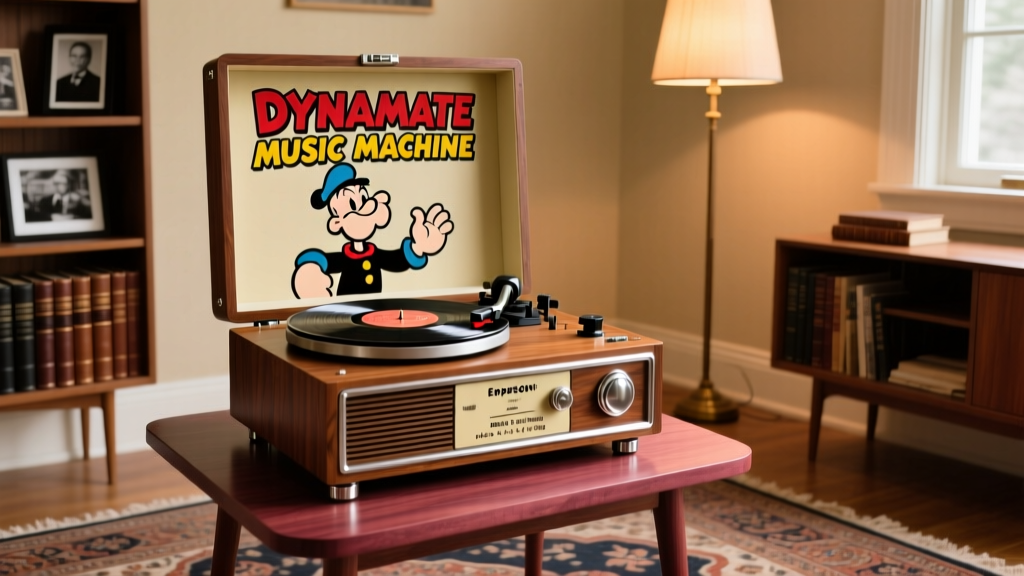
Popeye Record Player 'Dynamite Music Machine' by Emerson: A Collector's Guide to the Iconic 1960s Portable Turntable