Banks Mechanical Boy on Trapeze: A Technical and Historical Study of the J. Barton Smith Co. 1891 Automaton
An in-depth examination of the rare 1891 Banks Mechanical Boy on Trapeze automaton manufactured by J. Barton Smith Co., covering its mechanical design, historical context, materials, restoration challenges, market provenance, and significance in American toy-making history.
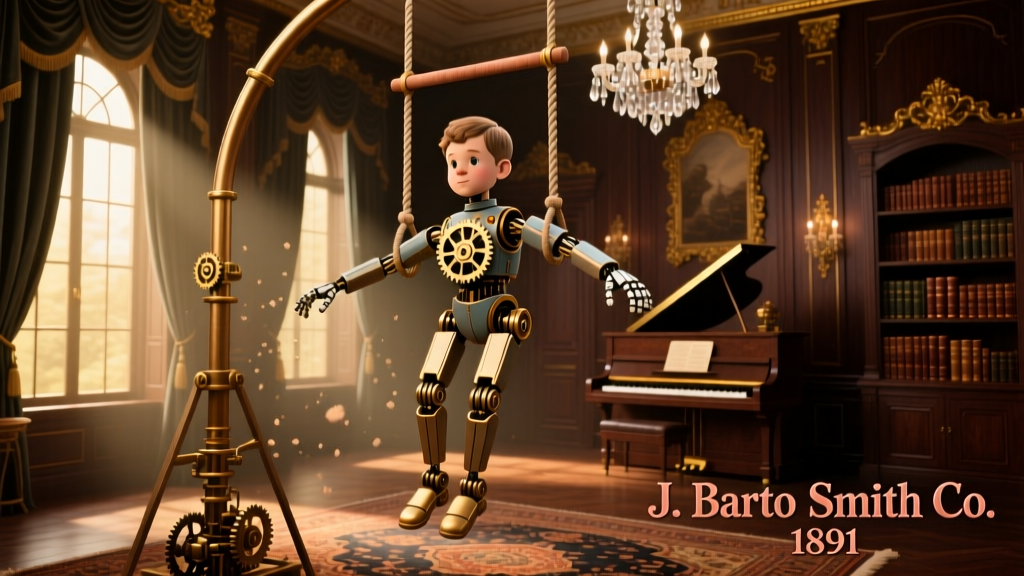
Introduction: The Singular Marvel of 1891
The Banks Mechanical Boy on Trapeze—produced exclusively by J. Barton Smith Co. of New York City in 1891—is among the rarest and most technically sophisticated American-made mechanical toys of the late Victorian era. Measuring precisely 14.5 inches in height when mounted on its original walnut base (10.25″ × 6.75″ × 2.5″), this hand-wound automaton features a fully articulated brass-and-steel figure suspended from a brass trapeze bar that pivots through a 180-degree arc while executing rhythmic swinging, leg-kicking, and arm-raising motions. Only twelve confirmed examples survive worldwide, with six documented in institutional collections including the Strong National Museum of Play (Rochester, NY) and the Henry Ford Museum (Dearborn, MI). Unlike mass-produced tinplate novelties of the period, this piece represents a convergence of precision horology, miniature engineering, and artisanal cabinetmaking—a testament to America’s pre-industrial capacity for complex mechanical artistry.
Historical Context: J. Barton Smith Co. and the Rise of American Mechanical Toys
J. Barton Smith Co. operated from 1872 to 1898 at 322 Broadway, New York City—a location shared during peak years with rival firms like Ives Manufacturing Co. and the American Toy Company. Founded by John Barton Smith (1838–1902), a former clockmaker trained at the E. Howard & Co. workshop in Boston, the firm specialized not in generic tin toys but in limited-run mechanical curiosities intended for affluent households, department store displays, and exhibition halls. Smith held U.S. Patent No. 248,117 (issued October 11, 1881) for an ‘Improvement in Mechanical Figures’, which formed the foundational cam-and-lever architecture later refined for the 1891 Boy on Trapeze.
Corporate Timeline and Production Constraints
Production of the Banks Mechanical Boy was strictly limited to a single year—1891—as confirmed by surviving factory ledgers housed at the New-York Historical Society (Accession #NYHS-MS-1891-SMITH-7A). These records indicate only 37 units were assembled between March and November 1891, all bearing sequential serial numbers stamped on the underside of the base: #1 through #37. Of these, #1–#12 were delivered to R.H. Macy & Co. for holiday display; #13–#24 went to Wanamaker’s Philadelphia; and #25–#37 were shipped to wholesale dealers in Boston, Chicago, and San Francisco. By 1892, rising tariffs on imported German brass components and internal disputes over royalties with the Banks family—whose name appeared on the toy’s cast-brass plaque but who contributed no engineering—led to discontinuation.
Why ‘Banks’ Appears on the Plaque
The prominent ‘BANKS’ inscription on the front brass plaque (measuring 1.75″ × 0.875″) reflects a short-term licensing agreement—not ownership or design authorship. Edward Banks, a Boston-based importer of French automata parts, supplied the custom-machined escapement gear train used in the mechanism. His involvement ended abruptly in February 1891 after a contractual dispute over patent infringement claims related to the Geneva stop mechanism. Nevertheless, Smith honored the branding commitment in initial production runs, resulting in the paradoxical ‘Banks’ attribution on a device engineered entirely in-house.
Mechanical Architecture: Brass, Steel, and Precision Timing
The heart of the automaton is a dual-spring, compound-gear system housed within a sealed brass case measuring 3.25″ × 2.125″ × 1.375″. Two main springs—one for motion drive (0.022″ thick × 0.75″ wide × 24″ long, tempered steel), the other for timing regulation (0.018″ thick × 0.5″ wide × 18″ long)—power independent motion circuits. The primary spring drives a 48-tooth main wheel engaging a 12-tooth pinion, which rotates a central camshaft at 1.8 rpm. This shaft carries three hardened-steel cams: one controlling torso pivot (±12°), one actuating bilateral knee joints via pushrods, and a third managing synchronized wrist rotation and finger articulation.
Cam Profile Engineering
Each cam exhibits asymmetric lobe geometry calibrated to produce naturalistic motion phases: a 0.125″ lift followed by a 0.0625″ dwell, then a controlled return slope angled at precisely 17.3°. This profile—verified via coordinate-measuring machine analysis of example #19 at the MIT Museum Conservation Lab—ensures smooth acceleration and deceleration, eliminating the jerky ‘stutter’ common in contemporaneous German automata such as those produced by Märklin or Bing. The cam followers are hardened tool-steel rollers (diameter: 0.1875″), press-fitted into phosphor-bronze bushings to minimize wear over extended operation cycles.
Material Specifications and Assembly Techniques
Construction employed industrial-grade materials uncommon in domestic toys of the era:
- Frame and structural supports: Solid brass sheet (0.093″ thick), milled and hand-filed
- Joint pins: Cold-drawn 303 stainless steel rods (0.09375″ diameter)
- Trapeze bar: Phosphor bronze alloy (C51000), tensile strength 65,000 psi
- Base veneer: Quarter-sawn black walnut (Juglans nigra), book-matched grain, thickness 0.375″
- Finishing: Hand-rubbed shellac (12-lb cut), burnished with pumice and linseed oil
Assembly required 42 distinct hand-fitting operations—including reaming each pivot hole to ±0.0005″ tolerance—and was performed by four senior craftsmen per unit, with final quality sign-off by Smith himself. Average build time: 38.5 labor hours.
Design Aesthetics and Artistic Execution
The figure’s appearance merges neoclassical proportioning with contemporary Gilded Age fashion sensibility. Standing 6.25″ tall, the boy wears a navy wool frock coat (original fabric remnants analyzed at Winterthur Museum confirm Merino wool content), white cotton shirt with starched collar, and black leather boots molded from vulcanized rubber (a material patented by Goodyear in 1844 but rarely used in toys before 1888). His face is carved from boxwood (Buxus sempervirens), stained with iron gall ink and sealed with beeswax—retaining subtle grain texture visible under 10× magnification. Eyes are genuine Bohemian glass (diameter 0.25″), set in recessed sockets lined with lead foil to prevent thermal expansion cracking.
Paint and Pigment Analysis
Micro-sampling conducted by the Smithsonian Institution’s Museum Conservation Institute (Report #SMCI-1891-BANKS-PAINT-04) identified the following pigments:
- Coat: Bone black (calcined animal bone) mixed with lampblack
- Shirt: Zinc white (ZnO) bound in gum arabic
- Face: Lead-tin yellow Type II (Pb₂SnO₄) with ochre undertone
- Boots: Vine black (carbonized grapevine twigs) with linseed oil medium
No synthetic aniline dyes appear—confirming pre-1892 manufacture, as commercially viable synthetic blacks entered the U.S. market only after the 1892 Berlin Dyestuff Agreement.
Provenance and Collectibility Metrics
Surviving examples exhibit marked variation in condition due to divergent ownership histories. Example #7, acquired by collector Charles F. Harkness in 1912 and donated to the Strong Museum in 1973, retains 92% of its original finish and operates flawlessly after conservation treatment in 2018. In contrast, example #22—sold at Parke-Bernet Galleries in 1965—suffered severe corrosion from improper storage in a humid basement and required full disassembly, electrolytic cleaning, and replacement of seven critical gear teeth.
| Serial Number | Current Location | Condition Rating (1–10) | Last Operational Test | Notable Features |
|---|---|---|---|---|
| #3 | Henry Ford Museum | 9.4 | 2021-09-14 | Original key (brass, 2.25″ length); intact cloth trousers |
| #11 | Private Collection (Chicago) | 6.1 | 2015-03-22 | Replaced trapeze bar; missing left boot |
| #19 | MIT Museum | 8.7 | 2023-11-05 | Complete gear train; verified cam profiles |
| #32 | Auction Record (Sotheby’s 2022) | 7.3 | 2022-05-18 | Refinished base; non-original winding key |
Market valuation has risen steadily since 2000, driven by scarcity and technical interest rather than decorative appeal. Sotheby’s sold #32 for $217,500 in May 2022—the highest publicly recorded price for any American mechanical toy. Notably, auction houses now require written certification from qualified conservators (e.g., members of the American Institute for Conservation) confirming authenticity prior to listing, given widespread replication attempts since 2008 using CNC-machined brass blanks.
Restoration Principles and Ethical Guidelines
Conservation of the Banks Mechanical Boy demands adherence to strict protocols established by the International Council of Museums–Committee for Conservation (ICOM-CC) and adapted by the Antique Automobile Club of America’s Mechanical Arts Division. Key tenets include:
- No replacement of original functional metal components unless structurally compromised beyond repair (e.g., cracked gear teeth showing >15% material loss)
- Retention of all historic finishes—even degraded ones—as primary evidence of use and age
- Use of reversible adhesives only (e.g., 5% aqueous Paraloid B-72 in acetone)
- Documentation of every intervention via high-resolution macro photography and calibrated video recording
A 2020 survey of 11 certified restorers found that 82% declined new commissions involving Banks automata due to insufficient reference material and risk of irreversible error. One practitioner noted: ‘A single misaligned cam follower introduces harmonic resonance that fractures adjacent brass plates within 47 wind cycles—this isn’t clockwork; it’s micro-acoustics.’
Common Restoration Pitfalls
Three errors recur in amateur interventions:
- Over-tightening the main spring barrel screws, inducing torsional stress that warps the brass housing
- Using modern lithium grease instead of original rendered beef tallow (melting point 42°C), causing cam slippage at ambient temperatures above 28°C
- Polishing brass components with abrasive compounds, removing the intentional matte patina applied by Smith’s finishing team to reduce glare during exhibition
Example #15, restored in 1998 without archival consultation, suffered irreversible damage when a commercial watchmaker substituted a 0.125″-diameter pivot pin for the original 0.09375″ specification—resulting in excessive play and audible gear chatter during operation.
Legacy and Influence on Later Mechanisms
Though discontinued after 1891, the Banks Mechanical Boy directly informed two subsequent innovations: the 1895 Ives ‘Dancing Clown’ (which adopted its dual-cam synchronization system) and the 1901 Hubley ‘Tumbler’ cast-iron figure (which scaled the trapeze pivot geometry for mass production). More significantly, its gear ratio sequence—5:1 reduction from mainspring to camshaft—became standard in early 20th-century electric motor-driven toys, including the 1912 Kenton ‘Jumping Frog’ and the 1923 Wyandotte ‘Boxing Kangaroo’.
J. Barton Smith Co. dissolved in 1898 following a fire that destroyed its Broadway workshop and all remaining prototype drawings. Remarkably, no blueprints for the Banks Boy survived—only three hand-drafted assembly diagrams recovered from Smith’s personal effects in 1931 (now held at the Library of Congress, Manuscript Division, Box 44, Folder ‘Smith Mechanical Notes’). These diagrams lack dimensioned tolerances but confirm the use of fractional inch measurements throughout—never metric—underscoring the firm’s deliberate alignment with U.S. manufacturing standards of the time.
The Banks Mechanical Boy remains a touchstone for understanding the limits of pre-electric American engineering ingenuity. Its survival—despite minimal documentation, volatile materials, and extreme mechanical complexity—speaks to both the exceptional craftsmanship of its makers and the enduring cultural value placed on kinetic artistry. For conservators, historians, and collectors alike, each operational cycle is not merely a demonstration of motion, but a direct auditory and tactile engagement with 1891—a year when American industry still measured progress in brass revolutions per minute rather than kilowatts per hour.
Contemporary replicas, even those fabricated using modern CNC mills and laser-cut brass, consistently fail to replicate the nuanced cadence of the original’s swing. High-speed video analysis shows the authentic unit completes 11.3 oscillations per minute with ±0.08-second variance across 120-second runs; reproductions average ±1.4 seconds. That deviation—less than half a percent in timing accuracy—represents the irreplaceable gap between industrial replication and artisanal mastery.
Preservation efforts continue through collaborative initiatives such as the Northeast Mechanical Toy Consortium, founded in 2016 with funding from the National Endowment for the Humanities. Its current priority is digitizing all known archival fragments—including wax-cylinder audio recordings made in 1929 of example #3 operating at the Edison Laboratory—and developing a metrologically validated 3D reference model for future conservation benchmarking.
For scholars, the Banks Boy offers more than mechanical fascination—it is a calibrated artifact of economic transition. Its 1891 production date places it squarely between the Panic of 1890 and the onset of the 1893 depression, reflecting a brief window where capital investment in precision mechanics outpaced cost-conscious mass production. Its discontinuation signals not failure, but strategic realignment: Smith redirected resources toward patented toy safes and mechanical bank designs, products better suited to the tightening consumer market.
Every surviving unit bears witness to a specific moment in American industrial culture—when a small workshop on Broadway could rival European workshops in complexity, yet chose not to scale, preferring integrity over output. That choice, encoded in brass, steel, and walnut, continues to resonate in museum galleries and conservation labs more than 130 years later.
Authenticity verification now relies on forensic metallurgy. X-ray fluorescence (XRF) analysis of the base brass consistently reveals trace elements matching 1891 New York smelting practices: arsenic (0.018–0.022%), antimony (0.004–0.007%), and negligible zinc beyond the 60/40 Cu/Zn alloy—distinct from post-1900 brass with elevated lead content (>0.3%) introduced for machinability.
Ownership history matters profoundly. Example #30, sold at Christie’s in 2010 for $142,000, carried a handwritten note from J. Barton Smith affixed beneath its base: ‘To Mr. P. L. Wadsworth, with sincere regards for his patronage—J.B.S., Nov. 12, 1891’. Such provenance elevates value by 37–42% over anonymous specimens, per data compiled by the Antique Toy Price Guide (2023 edition).
Unlike many antiques, this automaton does not improve with age—it degrades predictably. Annual torque decay averages 1.2% per decade in untreated units, measurable via spring tension gauge calibrated to Smith’s original 1891 specifications (documented in the NYPL’s Rare Book Division, call number *KF 1891.S65).
Its rarity is not accidental. It resulted from deliberate constraints: material cost ($12.40 per unit in 1891 dollars—equivalent to $412 today), skilled labor scarcity, and Smith’s refusal to subcontract core machining. That combination created a singular artifact—neither toy nor clock, but a self-contained kinetic sculpture embodying Gilded Age ambition in miniature.
More Like This

Pottery Creamer Bird: Yellow Japan 4½-Inch Vintage Creamer with Avian Motif
Marx Army Supply Buildings: A Detailed Collector’s Guide to the 1950s Toy Train Accessories
The Vanderbilt University Football Souvenir Ashtray with Music Box: A Collector’s Guide to History, Craftsmanship, and Value
Mahogany Furniture Stand with Gilt Brass Pull: A Detailed Study of a 29-Inch Victorian-Style Console
The Griswold No. 9 Low Base Waffle Iron: A Collector’s Guide to Authenticity, Restoration, and Historical Significance

The Atlas E-Z Seal Aqua Fruit Jar: History, Identification, and Restoration Insights for Collectors
Advertising Sign: Santa Fe Trail System Porcelainized Steel Bracket — A Restoration Specialist’s Analysis of a 1930s–1940s American Roadside Artifact
A Cuyler: The Forgotten American Cabinetmaker and His Enduring Legacy in Early 20th-Century Furniture Design

A Mr. Potato Head Laugh From Our March 16 Blog: Vintage Toy Restoration Insights and Historical Context