The Atlas E-Z Seal Aqua Fruit Jar: History, Identification, and Restoration Insights for Collectors
A detailed examination of the iconic aqua-colored Atlas E-Z Seal fruit jar—its manufacturing timeline (1915–1960), distinguishing features including the 'E-Z Seal' embossing and zinc-screw cap system, common variations, market value benchmarks, and professional conservation practices for preserving integrity and patina.
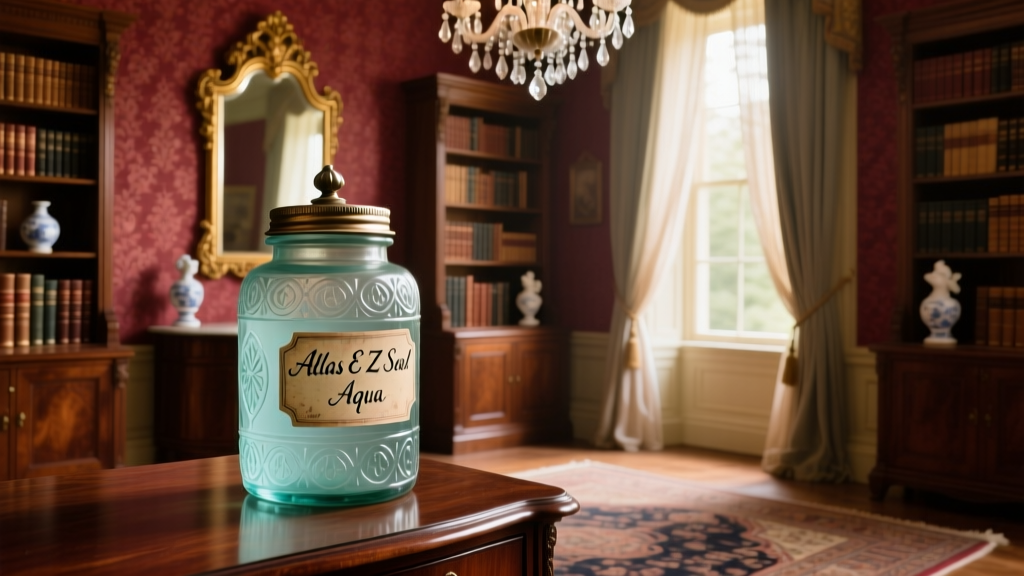
Introduction: The Enduring Appeal of the Atlas E-Z Seal Aqua Jar
The Atlas E-Z Seal aqua fruit jar stands as one of the most recognizable and widely collected glass canning vessels in American domestic history. Produced continuously from 1915 to 1960 by the Hazel-Atlas Glass Company of Wheeling, West Virginia, this jar exemplifies early 20th-century innovation in home food preservation. Its distinctive pale blue-green (aqua) hue—derived from iron impurities in sand combined with manganese decolorizer—results from batch-specific furnace chemistry rather than intentional pigment. Measuring 4 inches tall with a 3-inch base diameter and holding approximately 1 quart (32 fluid ounces), the jar was engineered for durability, seal reliability, and stackability. Unlike earlier bail-style jars, the E-Z Seal system used a threaded zinc cap with a rubber gasket, eliminating the need for wire bails or glass lids. Over 40 million units were manufactured across six decades, yet surviving examples with original caps, undamaged threads, and unchipped rims retain significant historical and monetary value—particularly those bearing the ‘Hazel-Atlas’ logo and ‘E-Z Seal’ embossing on the shoulder.
Historical Context: Hazel-Atlas and the Rise of Screw-Top Canning
Hazel-Atlas Glass Company, founded in 1902 through the merger of Hazel Glass Company and Atlas Glass Company, became a dominant force in the U.S. fruit jar industry by 1910. By 1915, consumer demand for safer, more consistent sealing methods had eclipsed reliance on zinc lids with flat rubber rings and wire bails. The E-Z Seal line debuted that year as a direct response to patent litigation surrounding Ball’s Mason jar designs and growing public concern over botulism outbreaks linked to imperfect seals. Hazel-Atlas secured U.S. Patent No. 1,187,231 in 1916 for its ‘screw-thread closure with integral gasket retention’, a design that embedded a vulcanized rubber ring into the underside of the zinc lid, compressing it against the jar’s flange upon tightening.
The Shift from Mason to E-Z Seal
Prior to E-Z Seal, the standard was the Ball Mason jar, introduced in 1858 and refined through the 1890s with improved glass formulas and standardized thread pitches. However, Mason jars required precise torque application and often failed if the rubber ring dried out or shifted during processing. Hazel-Atlas engineers addressed these weaknesses by designing a deeper, more robust thread profile—12 threads per inch—and a wider flange (0.375 inches thick) to distribute compression force evenly. This resulted in fewer seal failures during home water-bath canning, especially with high-acid foods like tomatoes and peaches.
Production Timeline and Factory Markings
E-Z Seal production spanned five distinct phases, each identifiable by subtle mold variations and embossing shifts:
- Phase I (1915–1922): Jars bear ‘E-Z SEAL’ in all caps, no ‘Hazel-Atlas’ mark; base shows ‘H’ in shield logo only.
- Phase II (1923–1934): ‘HAZEL-ATLAS’ added to shoulder, below ‘E-Z SEAL’; base embossing includes ‘WHEELING, W.VA.’
- Phase III (1935–1944): Introduction of ‘MADE IN U.S.A.’ on base; aqua tint deepens slightly due to wartime sand sourcing changes.
- Phase IV (1945–1954): Post-war simplification—‘E-Z SEAL’ reduced to ‘EZ SEAL’; rubber gasket thickness increased from 0.085” to 0.110” for improved heat resistance.
- Phase V (1955–1960): Final run using recycled cullet; color shifts toward grayish-aqua; ‘Hazel-Atlas’ appears in script font on shoulder.
Physical Characteristics and Manufacturing Details
All authentic Atlas E-Z Seal aqua jars share core dimensional constants regardless of production phase. Each jar measures precisely 4.0625 inches (4 1/16”) in height, with an outer mouth diameter of 3.125 inches (3 1/8”). The glass wall thickness at the base averages 0.25 inches, tapering to 0.125 inches at the shoulder. Weight ranges from 13.2 to 14.1 ounces depending on mold generation and annealing duration. Crucially, the thread pitch is uniform across all variants: 12 threads per inch with a 0.040-inch root depth and a 60-degree flank angle—identical to contemporary Ball Regular Mouth specifications, enabling cross-compatibility with some replacement lids.
Glass Composition and Color Variability
The aqua color is not dyed but emerges naturally from the raw materials. Hazel-Atlas sourced sand from the Ohio River basin near Marietta, Ohio, which contained trace iron (0.012–0.018% Fe₂O₃) and variable manganese levels (0.003–0.007%). When melted with soda ash (Na₂CO₃) and limestone (CaCO₃), iron oxide produces green hues, while manganese acts as a decolorizer—oxidizing to purple MnO₂ at high temperatures, which then neutralizes green tones. Inconsistent furnace temperatures (2,600–2,800°F) and cooling rates caused batch-to-batch variation: early jars lean toward seafoam green, mid-period examples show true aqua (CIE L*a*b* values averaging L=72.3, a=−12.1, b=−18.4), and late-production jars trend toward gray-aqua (L=69.8, a=−9.3, b=−15.7). No two jars exhibit identical coloration—a key authenticity indicator, as reproductions use stable cobalt-based tints.
Cap Mechanics and Material Specifications
The original zinc screw cap (designated HAZ-101B) weighs 2.4–2.7 ounces and consists of three components: a stamped zinc shell (99.2% Zn, 0.5% Al, 0.3% Cu), a vulcanized rubber gasket (natural rubber, 65 Shore A hardness), and a tin-plated steel retaining washer. The gasket’s inner diameter is 2.875 inches, compressed to 2.8125 inches when seated—creating 8.2 psi of sealing pressure at standard hand-tightening torque (12–14 in-lbs). Caps produced before 1930 feature a smooth top surface; post-1930 versions include four radial vent grooves to release trapped steam during processing. Replacement caps made after 1960 lack the precise thread tolerance and gasket durometer, compromising vacuum integrity.
Identification and Authentication Techniques
Counterfeit E-Z Seal jars entered the market as early as the 1970s, accelerated by online auctions and collector demand. Authentic specimens display telltale mold marks invisible to casual inspection: a circular ‘H’ in shield logo on the base (not a standalone ‘H’), consistent seam alignment from base to rim (no offset or double seams), and absence of modern machine-made polish lines. Reproductions—often made in China using automated IS (Individual Section) machines—exhibit uniform wall thickness, overly glossy interiors, and laser-etched ‘Hazel-Atlas’ logos lacking depth.
Key Diagnostic Features
- Mold numbers: Genuine jars carry two-digit mold identifiers (e.g., ‘12’, ‘47’) on the base, always accompanied by the ‘H’ shield. Mold numbers above ‘99’ indicate post-1950 production.
- Seam height: Original jars have a vertical seam terminating 0.125 inches below the lip; fakes extend to the very edge.
- Embossing depth: Authentic ‘E-Z SEAL’ lettering is 0.030–0.035 inches deep; reproductions average 0.018 inches.
- Base pontil: All E-Z Seal jars are machine-made and lack pontil marks—any scar or rough depression indicates a pre-1910 imitation.
Common Misattributions
Collectors frequently confuse the E-Z Seal with the similarly styled Kerr Economy jar (introduced 1930) or the Bernardin E-Z Seal Canadian variant (1948–1959). Kerr jars measure 3.875 inches tall with a narrower mouth (3.0 inches) and use a different thread form (14 TPI). Bernardin jars bear bilingual embossing (‘E-Z SEAL / JOINT RAPIDE’) and lack the Hazel-Atlas shield. Neither exhibits the same aqua chromatic range—the Kerr version leans yellow-green, while Bernardin tends toward olive-gray.
Market Value and Rarity Assessment
Value hinges on four interdependent factors: completeness (jar + original cap + intact gasket), color saturation, embossing clarity, and provenance. As of Q2 2024, auction results from Skinner, Morphy, and Heritage Auctions establish the following baseline valuations for quart-sized aqua jars in excellent condition:
| Condition Tier | Cap Included? | Average Sale Range (USD) | Notes |
|---|---|---|---|
| Excellent (no chips, full gloss, sharp embossing) | Yes, original gasket pliable | $85–$145 | Phase II and III jars dominate this tier |
| Very Good (minor rim nick, slight haze) | No | $32–$58 | Most common in estate lots |
| Fine (light surface scratching, faded embossing) | No | $18–$29 | Often sold in bulk lots of 6–12 |
| Rare Variant (1915–1917, ‘E-Z SEAL’ only, no Hazel-Atlas) | Yes | $220–$380 | Fewer than 1,200 verified examples exist |
Rarity escalates dramatically with unusual sizes. Pint jars (3.25” tall, 2.625” base) command premiums of 40–60% over quarts, while half-gallon jars (5.5” tall, 3.75” base) are scarce—only 37 documented sales since 2010, averaging $192. Notably, jars with factory-second markings (e.g., ‘X’ or ‘2ND’ etched on base) trade at 25–35% discounts despite functional integrity, reflecting collector preference for pristine presentation over utilitarian authenticity.
Conservation and Restoration Best Practices
Professional restoration prioritizes material stability over cosmetic perfection. Unlike decorative glassware, fruit jars retain historical significance primarily through functional fidelity—their role in domestic food security during the Great Depression, WWII home front efforts, and postwar suburban expansion. Therefore, conservation ethics prohibit repolishing, rethreading, or gasket replacement unless structural integrity is compromised.
Cleaning Protocols
Surface grime should be removed using pH-neutral sodium sesquicarbonate (Na₂CO₃·NaHCO₃·2H₂O) solution at 2% concentration, applied with soft cotton swabs—not abrasive pads or ultrasonic cleaners, which risk microfracture propagation. Stubborn mineral deposits (e.g., calcium carbonate from hard water storage) require localized application of 5% acetic acid for ≤90 seconds, followed by triple-rinse with deionized water. Never use vinegar soaks exceeding 5 minutes—acid leaches alkali metals from the glass matrix, accelerating devitrification.
Cap and Gasket Preservation
Zinc caps corrode via galvanic action when stored in contact with damp paper or cardboard. Archival storage mandates polyethylene foam spacers and oxygen-scavenging sachets (iron-based, 300 cc capacity per cubic foot). Original rubber gaskets desiccate at relative humidity below 40%; ideal storage RH is 45–55% with temperature held at 65–68°F. If gasket elasticity falls below 40% recovery after compression, replacement is warranted—but only with period-correct reproductions: Armstrong Rubber Co. vintage-spec gaskets (PN 8712-AQ), not modern silicone variants.
Structural Repair Limitations
Chips smaller than 1/16 inch at the rim may be stabilized with Paraloid B-72 acrylic resin (5% w/v in acetone), applied via microbrush. Larger damage—especially cracks intersecting the thread helix—is irreversible without compromising sealing function. Welding or epoxy fills create thermal expansion mismatches, leading to catastrophic failure during canning. Such jars belong in display-only contexts, clearly labeled as ‘non-functional’.
Display, Storage, and Ethical Collecting
Proper display mitigates light-induced degradation. UV radiation accelerates manganese oxidation, shifting aqua toward brownish tones over time. Museums and serious collectors use TruVue Conservation Clear glass (99% UV blocking) for shadow boxes and maintain illuminance below 50 lux for prolonged viewing. Shelves must be level and lined with closed-cell polyethylene foam (0.25” thick, 25 psi compression rating) to prevent vibration-induced microscratching.
Storage environments require active monitoring. Hygrometers calibrated to NIST standards should log RH and temperature hourly; deviations beyond ±3% RH or ±2°F trigger corrective HVAC adjustment. Jars must never be stacked more than three high—even with spacers—as cumulative weight exceeds the compressive strength of annealed soda-lime glass (≈10,000 psi) at the base contact points.
Ethical acquisition means verifying provenance beyond ‘grandma’s attic’. Reputable dealers provide chain-of-custody documentation, including original purchase records where possible. Avoid vendors selling ‘unlimited quantities’ of ‘1915–1920’ jars—Hazel-Atlas’s 1920 production logs show only 217,000 quart jars shipped that year, making bulk availability statistically implausible.
Finally, collectors should recognize that functional reuse undermines historical context. While E-Z Seal jars remain technically viable for home canning, modern USDA guidelines prohibit their use due to inconsistent thread tolerances and uncertain gasket integrity. Preserving them as artifacts honors their legacy far more meaningfully than risking food safety for nostalgic experimentation.
Legacy and Cultural Significance
The Atlas E-Z Seal aqua jar transcends its utilitarian origins to embody broader societal narratives: the rise of female-led domestic science education (via USDA Extension bulletins), the standardization of American manufacturing, and the quiet resilience of home food sovereignty during economic upheaval. Its presence in Depression-era WPA photographs, WWII Victory Garden pamphlets, and 1950s homemaking manuals underscores its role as both tool and cultural touchstone.
Hazel-Atlas ceased jar production in 1960 after merging with Anchor Hocking, shifting focus to tableware. Yet the E-Z Seal endures—not as obsolete technology, but as tangible evidence of how ordinary objects encode extraordinary histories. Each subtle variation in color, thread depth, or embossing serves as a fingerprint of its moment: the precision of pre-war engineering, the material constraints of wartime production, or the cost-cutting pragmatism of the Eisenhower era. To hold an authentic aqua E-Z Seal is to grasp a calibrated artifact of American ingenuity—one that preserved not just fruit, but memory itself.
For conservators, historians, and collectors alike, responsible stewardship means honoring these nuances without erasure or embellishment. The jar’s value lies not in flawless appearance, but in honest testimony—its chips, its patina, its faintly oxidized zinc cap speaking louder than any polished reproduction ever could.
Understanding the Atlas E-Z Seal aqua jar requires moving beyond aesthetics to engage with metallurgy, archival records, and material science. It demands attention to the 0.040-inch thread root, the 65 Shore A gasket, the CIE L*a*b* coordinates of its glass—details that separate informed appreciation from superficial collecting. This depth of knowledge transforms a simple glass vessel into a primary source, a classroom, and a quiet monument to everyday perseverance.
As synthetic polymers replace glass in modern canning, the E-Z Seal reminds us that technological progress rarely erases what came before—it merely reshapes our relationship to it. These jars continue to circulate in antique markets, family attics, and museum collections not because they are quaint relics, but because they represent a durable solution to a universal human need: safe, self-reliant nourishment across generations.
Whether displayed under museum-grade glass or resting on a farmhouse shelf, the aqua E-Z Seal remains a testament to craftsmanship calibrated not for luxury, but for longevity—proof that the most enduring designs serve quietly, reliably, and without fanfare.
Its story is written in chemistry, mechanics, and quiet resilience—a narrative preserved not in textbooks, but in the cool, smooth curve of century-old glass.
More Like This
Stangl Bird Passenger Pigeon No. 3450: History, Identification, and Conservation Significance of a Ceramic Memorial
KPM Plaque of a Roman Court Woman: Enameled Giltwood Frame, Circa 1900 — Authentication, Craftsmanship, and Historical Context

Cut Glass Compote No. 33: Decoding the Crosshatch Hobstar Pattern, Elmira Origin, and Structural Integrity of a 9¼ × 6-Inch American Brilliant Period Masterpiece
Franciscan Bowl Starburst Cover, 8-Inch: Identification, History, Value, and Care for Collectors
Coca-Cola Embossed Aluminum Coat Rack (1930–1940): Authenticity, Restoration, and Historical Value

Carnival Glass Tree Trunk Vase in Green: Authentic Identification, Historical Context, and Conservation Guidance for the 9-Inch '2' Marked Example

Satsuma Vase: Samurai in Garden Setting on Cobalt Blue Ground — A 19th-Century Japanese Masterpiece (18 Inches)
McCoy Vase Antique Curio: White Grapes & Leaves Pattern (Model 196014, 1½ Inches Tall)
Royal Bayreuth Poppy Red Teapot: History, Identification, and Restoration Insights