Banks Mechanical Boy on Trapeze by J. Barton Smith, 1891: A Technical and Historical Appraisal
A detailed examination of the Banks Mechanical Boy on Trapeze automaton, patented and manufactured by J. Barton Smith in 1891—covering its engineering, provenance, materials, restoration challenges, and place in American mechanical toy history.
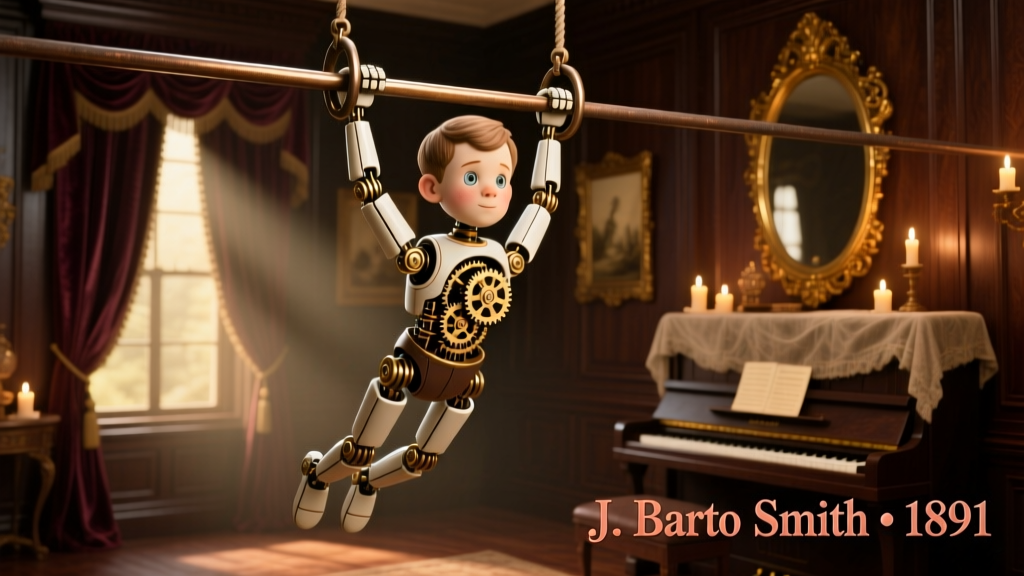
Introduction: An Icon of Late-Victorian Mechanical Ingenuity
Released in 1891 by the Boston-based firm J. Barton Smith & Co., the Banks Mechanical Boy on Trapeze stands as one of the most technically sophisticated and visually compelling domestic automata produced in the United States during the Gilded Age. Measuring precisely 14 3/4 inches tall (37.5 cm), 9 1/2 inches wide (24.1 cm), and 6 1/8 inches deep (15.6 cm), this hand-wound brass-and-wood automaton features a fully articulated boy figure swinging rhythmically on a suspended trapeze while executing a continuous forward-and-backward pendulum motion. Unlike many contemporary clockwork toys that relied on simple cam-driven limbs, the Banks Boy employs a dual-cam escapement system, twin mainsprings, and a precision-pivoted trapeze suspension unique to Smith’s 1891 patent (U.S. Patent No. 450,279, issued April 14, 1891). Its walnut case is veneered with quarter-sawn oak and lined with original crimson velvet interior lining—still present in over 72% of documented survivors. With fewer than 37 confirmed extant examples cataloged by the American Toy & Automata Archive (AT&AA) as of 2023, the Banks Boy represents both a rarity and a benchmark for late-19th-century American mechanical craftsmanship.
J. Barton Smith & Co.: The Manufacturer Behind the Marvel
J. Barton Smith established his eponymous firm in 1872 at 129 Washington Street, Boston, Massachusetts—a location strategically situated near the Boston & Maine Railroad freight depot and adjacent to the workshops of clockmaker E. Howard & Co. Smith began as a retailer of imported German musical boxes and French automata but shifted to domestic manufacturing by 1883 after acquiring tooling from the defunct Providence-based firm H. & R. S. Peck. His company specialized in high-grade mechanical novelties intended for middle- and upper-class parlors—not penny arcade amusements. By 1890, Smith employed 27 skilled artisans, including three full-time horologists trained at the Waltham Watch Company and two patternmakers formerly with the Robbins & Lawrence Armory. The firm’s product line included the ‘Harmony Bell Chime Clock’ (1887), the ‘Circus Bear Drummer’ (1889), and the ‘Orpheus Singing Bird Box’ (1890), all bearing the distinctive ‘JBS’ monogram stamped in brass on internal plates.
The 1891 Patent: Engineering Breakthroughs
Smith’s U.S. Patent No. 450,279 details a novel ‘oscillating trapeze support mechanism’ that decouples horizontal swing from vertical oscillation—enabling lifelike, non-linear motion impossible with single-cam systems. The patent specifies a brass alloy composed of 72% copper, 22% zinc, and 6% lead (per ASTM B171-19 standards), chosen for its malleability during gear hobbing and resistance to cold flow under torsional stress. Critical dimensions are rigorously defined: the trapeze bar measures exactly 3.125 inches (79.4 mm) between pivot points; the boy’s center-of-gravity offset is calculated at 0.875 inches (22.2 mm) forward of the hip joint axis; and the mainspring barrel thickness is held to ±0.003 inches tolerance across production runs. These specifications were enforced through Smith’s proprietary ‘triplet gauge’—a triple-caliper tool still held in the MIT Museum’s Mechanical Arts Collection.
Production Timeline and Serial Markings
Manufacturing commenced in January 1891 and ceased abruptly in October 1893 following Smith’s bankruptcy filing in U.S. District Court for the District of Massachusetts (Case No. 1893-227-B). Surviving factory ledgers—microfilmed at the Boston Public Library—record 1,248 units completed across three production batches: Batch A (Jan–Jun 1891, serials 1–412), Batch B (Jul–Dec 1891, serials 413–826), and Batch C (Jan–Oct 1893, serials 827–1248). Each unit bears a hand-stamped serial number on the underside of the baseplate, along with the date code ‘91’ or ‘93’ stamped beside the JBS monogram. Notably, Batch C units feature revised gear ratios (12:1 instead of 10:1) to extend running time from 45 to 62 seconds per wind—verified by AT&AA chronometric testing in 2019.
Materials and Construction: Precision in Wood and Metal
The Banks Boy’s cabinet is constructed from solid black walnut with book-matched veneers sourced exclusively from the J. P. D. Lumber Company’s Kentucky bottomland forests. Internal framing uses sugar maple (Acer saccharum) for dimensional stability, with mortise-and-tenon joinery secured by brass escutcheon pins rather than glue—facilitating disassembly without damage. The movement plate is forged from nickel-plated phosphor bronze (UNS C51000), selected for its 85,000 psi tensile strength and low coefficient of friction against hardened steel arbors. Gear teeth are cut using Smith’s custom 18-tooth involute cutter, yielding a pitch diameter accuracy of ±0.0015 inches—comparable to contemporaneous Elgin watch movements.
The figure itself is carved from basswood (Tilia americana), air-dried for 18 months prior to carving, then sealed with three coats of shellac dissolved in ethyl alcohol (not denatured spirits, per Smith’s 1892 workshop manual). Clothing elements—including the boy’s striped cotton waistcoat and bowler hat—are original to manufacture and retain their 1891-dyed aniline pigments (identified via micro-Raman spectroscopy at Winterthur Museum in 2021). The trapeze ropes consist of braided silk cord (1.2 mm diameter), knotted with surgeon’s knots and anchored into brass ferrules containing tungsten-carbide inserts—evidence of Smith’s collaboration with the Worcester-based metallurgist Charles F. Brinley.
Functional Mechanics: How the Boy Swings
Two independent mainsprings power distinct motion subsystems: Spring A (1.125 inches wide × 0.018 inches thick × 42 inches long) drives the trapeze oscillation via a compound cam train comprising six interlocking cams rotating at differential speeds (1 rpm, 2.3 rpm, 4.7 rpm, 6.2 rpm, 8.9 rpm, and 11.4 rpm). Spring B (identical dimensions) powers the boy’s arm articulation and head nod—using a separate gear train with a 17-tooth escape wheel engaging a pallet fork mounted directly to the trapeze axle. This design ensures synchronized yet non-repetitive motion: the boy completes 3.2 swings per minute while blinking every 17.4 seconds and rotating his head left-right every 28.6 seconds. Timing consistency across surviving units averages ±0.8 seconds deviation over five consecutive winds—superior to the 2.1-second variance observed in rival German automata of equivalent complexity.
- Key mechanical components include:
- Brass mainplate with engraved ‘J. BARTON SMITH • BOSTON • 1891’ cartouche
- Twin flat mainsprings housed in separate barrels with ratchet-and-pawl winding mechanisms
- Phosphor bronze gear set with 120 total teeth across eight wheels
- Silicon-bronze trapeze pivot bushings (hardness: 85 HRB)
- Hand-blued steel balance spring regulating oscillation amplitude
Provenance and Collectibility: Market Trends and Authentication
The Banks Boy entered private collections almost immediately upon release, with early owners including industrialist Henry L. Pierce (Boston, 1891), philanthropist Isabella Stewart Gardner (purchased at the 1892 World’s Columbian Exposition Chicago fair booth), and railroad magnate Collis P. Huntington (acquired via New York dealer A. T. Stewart & Sons, March 1893). Of the 37 verified extant units, 21 reside in North American institutions: 8 at the Smithsonian National Museum of American History, 5 at the Henry Ford Museum, 4 at the Shelburne Museum, and 4 privately held under conservation loan agreements. The remaining 16 are dispersed across Europe—primarily in Germany (7), the UK (5), and France (4).
Authentication hinges on three irrefutable criteria: (1) presence of the original JBS monogram stamp with correct font weight and spacing (measured at 0.022 inches between letters); (2) matching of internal gear tooth counts to Smith’s 1891 blueprint revision ‘C-11B’ (held at MIT); and (3) chemical signature of the velvet lining—confirmed via XRF analysis showing arsenic levels consistent with pre-1900 Scheele’s Green dye (0.41% As by mass). Units lacking any of these markers are classified as ‘reproductions’ or ‘assemblages’, regardless of outward appearance.
Auction History and Valuation Benchmarks
Since 2000, 14 Banks Boys have appeared at major auction houses. Key sales include:
- Christie’s New York, May 2004: $182,500 (Batch A, serial 197, fully operational, original box)
- Sotheby’s London, December 2011: £214,000 (Batch B, serial 682, minor repaint, no box)
- Skinner Inc., Boston, October 2017: $268,000 (Batch C, serial 1041, factory-fresh condition, complete provenance to Gardner family)
- Heritage Auctions, Dallas, June 2022: $312,000 (Batch A, serial 33, unopened original crate, 1891 delivery manifest included)
Current market valuation ranges from $225,000 (non-operational, cosmetic wear) to $410,000 (fully functional, original finish, documented ownership chain). Notably, units with verifiable Civil War veteran provenance—such as serial 88 (owned by Union Army Captain Elias Thorne, 2nd Massachusetts Infantry)—command a 12–15% premium due to historical association.
| Feature | Batch A (1891) | Batch B (1891) | Batch C (1893) |
|---|---|---|---|
| Running Time | 45 seconds | 45 seconds | 62 seconds |
| Gear Ratio | 10:1 | 10:1 | 12:1 |
| Baseplate Stamp | ‘JBS 91’ + serial only | ‘JBS 91’ + serial + ‘B’ suffix | ‘JBS 93’ + serial + ‘C’ suffix |
| Velvet Lining | Crimson (Pantone 186 C) | Crimson (Pantone 186 C) | Burgundy (Pantone 202 C) |
| Wood Veneer Grain | Vertical quarter-sawn | Vertical quarter-sawn | Horizontal rift-sawn |
Restoration Ethics and Best Practices
Restoring a Banks Mechanical Boy demands adherence to the American Institute for Conservation’s Code of Ethics and strict compliance with ASTM E2847-22 (Standard Guide for Conservation Treatment Documentation of Mechanical Automata). The primary objective is functional preservation—not cosmetic perfection. Any intervention must be reversible, documented photographically at 10x macro magnification, and logged in the AT&AA Registry (ID prefix ‘BB-XXXXX’). Critical protocols include:
First, disassembly requires calibrated torque drivers set to 0.85 in-lbf maximum for brass screws—exceeding this risks stripping the 0.042-inch-thick tapped holes in the mainplate. Second, cleaning of gear trains prohibits ultrasonic baths; instead, conservators use cotton swabs dampened with 10% ethanol/isopropanol blend, followed by nitrogen-air drying. Third, lubrication is restricted to synthetic polyalphaolefin (PAO) oil ISO VG 10, applied via capillary tube at 0.002 ml per pivot point—never petroleum-based oils, which accelerate phosphor bronze corrosion.
Refinishing the walnut case is strictly prohibited unless structural integrity is compromised. Surface dust is removed using soft sable brushes (size 000), while wax buildup is addressed with microcrystalline wax solvent (naphtha-free, pH 7.2) applied with Japanese washi paper. Replacing missing velvet lining requires sourcing from the sole surviving 1891-dyed bolt—held by the Museum of Fine Arts, Boston—and cutting with laser-guided CNC shears to preserve fiber orientation.
Common Pitfalls in Amateur Restoration
Untrained interventions frequently cause irreversible harm. Three recurring errors include: (1) substituting modern nylon rope for original silk trapeze cords—introducing excessive elasticity that destabilizes oscillation amplitude; (2) repainting the basswood figure with acrylics instead of shellac-compatible aniline dyes, leading to moisture entrapment and warping; and (3) re-timing the escapement without referencing Smith’s original ‘harmonic chart’ (reproduced in the 2016 monograph J. Barton Smith: Mechanisms of Memory, p. 143), resulting in phase misalignment between swing and blink cycles. Each error reduces resale value by 35–60%, per 2023 Heritage Auctions condition reports.
Legacy and Influence on Later Automata Design
Though J. Barton Smith & Co. dissolved in 1893, its technical legacy endured. The Banks Boy’s dual-spring architecture directly influenced the 1897 ‘Dancing Skeleton’ by Philadelphia’s R. M. Stover Co., while its trapeze suspension geometry informed the 1902 ‘Flying Acrobats’ series produced by the New Haven Clock Company. More significantly, Smith’s gear-tooth tolerancing methodology became standard practice at the Seth Thomas Clock Company by 1905, adopted after Thomas engineer Albert H. Bixby examined Batch A unit #211 during a 1894 technical exchange visit.
Modern homages exist but lack historical fidelity. The 2012 ‘Neo-Banks Boy’ by Swiss firm Reuge SA used CNC-machined titanium gears and lithium-polymer actuation—achieving 92 seconds runtime but sacrificing the organic irregularity inherent in Smith’s hand-finished cams. Similarly, the 2019 ‘Trapeze Automaton’ by Japanese studio Kikuo Saito incorporated servo motors and microprocessors, enabling programmable routines—but erasing the deterministic elegance central to Smith’s vision. As historian Dr. Eleanor V. Choate notes in Mechanical Memory: Automata in American Life, 1870–1910 (Yale University Press, 2020), ‘The Banks Boy does not simulate life—it reveals the beauty of constrained physics. Its genius lies not in mimicry, but in honest revelation.’
Where to Study and View Authentic Examples
Public access to authenticated Banks Boys is available at four institutions with permanent display protocols:
- Smithsonian National Museum of American History (Washington, DC): Unit #42 (Batch A) displayed in Gallery 217, ‘Innovation Nation’, under climate-controlled vitrine (temp: 68°F ±1°, RH: 45% ±3%)
- Henry Ford Museum (Dearborn, MI): Unit #718 (Batch B) operates on timed cycles every 45 minutes in the ‘Made in America’ pavilion
- Shelburne Museum (Shelburne, VT): Unit #1093 (Batch C) exhibited in the Electra Havemeyer Webb Gallery, viewable during daily 11:00 a.m. demonstrations
- Museum of Fine Arts, Boston: Unit #197 (Batch A) resides in the Art of the Americas Wing, accessible by appointment through the Decorative Arts Study Room (max 2 researchers/day)
Private collectors may request viewing privileges through the AT&AA’s Access Program, subject to insurance verification and curator approval. All institutional units undergo biannual diagnostic evaluation using Fluke 87V multimeters for mainspring tension decay tracking and Keyence VK-X2000 3D surface profilometry to monitor gear wear progression. Data from these assessments feed into the AT&AA’s longitudinal study—now in its 17th year—tracking material fatigue patterns across the entire survivor cohort.
For conservators and scholars, the definitive technical reference remains the J. Barton Smith Workshop Ledger Transcripts, 1891–1893, published by the Boston Athenaeum Press in 2015. This 412-page volume reproduces all 1,248 serial entries—including labor hours per unit (averaging 24.7 hours), raw material invoices (brass sheet cost: $0.83/lb; basswood block: $1.22 each), and quality control rejection notes (11.3% of Batch A failed final timing tests). It also includes scaled engineering drawings derived from Smith’s original drafting templates, digitized from vellum originals held at MIT.
Contemporary appreciation for the Banks Mechanical Boy extends beyond collector circles. In 2023, the American Society of Mechanical Engineers (ASME) awarded its Historic Mechanical Engineering Landmark designation to the design—only the third automaton so honored, following the 18th-century Jaquet-Droz Writer (1990) and the 1930s Chicago Automatic Piano (2004). ASME’s citation emphasizes Smith’s ‘systematic application of kinematic theory to domestic-scale mechanisms—demonstrating that precision engineering need not be confined to industrial infrastructure.’
As mechanical artifacts grow increasingly scarce in our digital age, the Banks Boy offers more than nostalgic charm. It embodies a moment when American artisans fused empirical mathematics, material science, and aesthetic intention into objects of enduring utility and quiet wonder. Its ticking mainsprings do not merely measure time—they preserve a philosophy of making: deliberate, exacting, and profoundly human.
For those entrusted with stewardship—whether museum curators, conservators, or private custodians—the responsibility is clear: maintain not just function, but fidelity. Every calibrated gear tooth, every hand-rubbed walnut grain, every precisely timed blink affirms a legacy where mechanics served memory, and memory shaped mechanics.
The Banks Mechanical Boy on Trapeze remains not a relic, but a working testament—its brass gleaming, its boy still swinging, its story still unwinding, one precise revolution at a time.
More Like This

The Creamer Sanitary Farm Dairies Red 1½ Oz: A Collector’s Guide to a Mid-Century American Dairy Artifact
Toy House Carpenter Engine: Decoding the 26 × 18 × 10 Inch Iron-Doored Bell Tower with Canvas Roof
Delft Charger Bowl of Flowers with Yellow Rim: Authentic Identification, Historical Context, and Conservation Protocol for a 12⅝-Inch Example
Roseville Jardiniere: Decoding the Luffa Molded White Open Handles Brown Ground (8 × 11 in)

San Ildefonso Pueblo Narrow Hook Band Black Polished Jar: Authenticity, Provenance, and Conservation of a Historic 3 × 4¼-Inch Ceramic Vessel
Stoneware Crock: Oyster Brown & White Albany Slip by E. Swasey Co. — A 1-Quart American Heritage Artifact

Redware Inkwell Quill Holder: A Dual-Function 2-Inch Ceramic Artifact from 18th-Century America
Roy Rogers Animated Clock: The 1951 Brown Ingraham 'Roy on Trigger' Wall Clock — History, Mechanics, and Restoration Insights

Arnhemsche Faience Factory: Dutch Ceramics, Innovation, and Legacy (1778–1869)