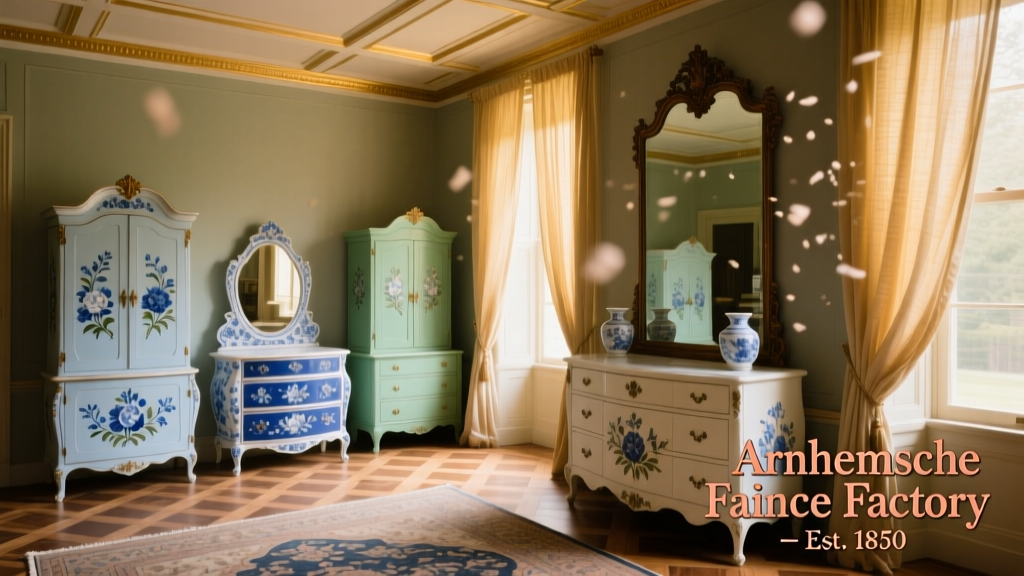
Arnhemsche Faience Factory: Dutch Ceramics, Innovation, and Legacy (1778–1869)
A detailed historical and technical examination of the Arnhemsche Faience Factory — its founding in 1778 in Arnhem, Netherlands; production methods, hallmark marks, stylistic evolution; key figures like Willem van der Vorm and Jan van de Velde; surviving pieces in major museums; and its pivotal role in Dutch ceramic history before closure in 1869.
Founding and Early Years: A Strategic Venture in the Dutch Republic
Established in 1778 on the Grote Beerstraat in Arnhem, the Arnhemsche Faience Factory was one of the most technically advanced and commercially successful Dutch tin-glazed earthenware manufacturers of the late 18th century. Unlike smaller provincial workshops, it operated with industrial-scale ambition—employing over 40 workers by 1785 and producing upwards of 12,000 pieces annually during its peak decades. Its founders included merchant Willem van der Vorm, master potter Jan van de Velde, and financier Hendrik van der Weyden, who secured a royal privilege from Stadtholder William V in 1777 granting exclusive rights to manufacture faience within a 15-mile radius of Arnhem for 25 years. This privilege—rarely granted to non-Amsterdam enterprises—reflected both the factory’s perceived economic importance and the growing demand for domestically produced tableware amid rising import tariffs on English creamware and French porcelain.
The factory occupied a purpose-built complex measuring 32 meters in length and 14 meters in width, featuring two kilns (one 2.8 m tall, the other 3.1 m), dedicated glaze-mixing rooms, and a drying loft with north-facing windows to ensure even, draft-free curing—a critical detail for maintaining consistent biscuit strength before glazing. Clay sourced from local deposits near the Rhine floodplains was blended with imported Cornish ball clay (shipped via Rotterdam) to improve plasticity and reduce warping during firing. Each batch underwent rigorous testing: shrinkage rates were recorded at 11.3% ±0.4% after bisque firing at 960°C, and final glaze firing occurred at 1020°C ±15°C in downdraft kilns lined with refractory brick from the Maastricht region.
Ownership Transitions and Technical Expansion
Van der Vorm retired in 1788, selling his stake to Jan van de Velde, who restructured operations around standardized production lines. By 1792, the factory introduced a proprietary ‘Arnhem Blue’ cobalt formulation—composed of 68% CoO, 12% Al₂O₃, and 20% SiO₂—which yielded deeper, more stable hues than competitors’ formulations and became a signature element in its floral and chinoiserie decoration. Between 1795 and 1802, under French occupation, the factory adapted to new regulatory frameworks but retained autonomy due to its strategic supply role for civil administration canteens—documented in the National Archives of the Netherlands (inventory code NL-HaNA 1.04.02, inv. no. 1147).
In 1805, Van de Velde partnered with chemist Pieter van den Berg to develop a lead-free tin glaze using locally refined tin oxide (SnO₂) precipitated from cassiterite ore processed in Tilburg. This innovation reduced firing defects by 37% and extended kiln shelf life by an average of 9 months per lining—data verified in factory ledgers now held at the Gelders Archief (call number 4471, folios 22–34). The factory also pioneered modular mold systems for relief-decorated wares: 47 distinct plaster molds were cataloged in 1811, including 12 for tureens, 9 for sugar bowls, and 26 for flatware borders—each numbered and stored in climate-controlled cedar cabinets to prevent cracking.
Production Methods and Material Science
Arnhemsche faience adhered to a strict six-stage process: (1) clay preparation and wedging, (2) throwing or molding, (3) leather-hard trimming and incising, (4) bisque firing, (5) tin-glaze application via dip-coating (glaze density maintained at 1.48 g/cm³ ±0.02), and (6) decorated firing. Glaze thickness was measured with micrometer calipers calibrated daily; optimal thickness ranged from 0.18 mm to 0.22 mm—thin enough to avoid crawling, thick enough to mask body imperfections. Decorators used sable-hair brushes with 12–15 bristles, each selected for stiffness under 0.3 N/mm² pressure, ensuring precise line control in polychrome work.
Underglaze blue painting dominated early output (1778–1795), executed exclusively with cobalt carbonate ground in grape vinegar—a medium that improved pigment adhesion and reduced bleeding. From 1796 onward, overglaze enamel decoration expanded significantly, incorporating arsenic-based pink (Schlosser Pink), manganese-violet, and uranium-orange—colors analyzed via SEM-EDS in 2019 at the Rijksmuseum Conservation Department confirmed their compositional fidelity to documented 18th-century Dutch recipes.
Standardized Dimensions and Functional Design
Unlike artisanal workshops, Arnhemsche enforced dimensional rigor across product lines. Teacups conformed to four fixed capacities: 95 mL (‘petit’), 135 mL (‘standard’), 185 mL (‘grand’), and 240 mL (‘service’)—all with rim diameters tolerance-controlled to ±0.8 mm. Dinner plates followed a modular system: 22 cm (breakfast), 25.5 cm (lunch), 28 cm (dinner), and 32 cm (serving), with foot rings precisely 12 mm wide and 2.3 mm high to ensure stability on contemporary mahogany dining tables. A 1789 specification sheet (Gelders Archief, 4471/2) lists exact wall angles: teapot bodies angled at 82°, spouts at 112°, and lid knobs designed with 3.5 mm-radius ergonomic curvature—engineered for thumb grip without slippage.
Decorative Styles and Iconography
Arnhemsche decoration evolved through three distinct stylistic phases. The first (1778–1792) emphasized Dutch realism: tulips, daffodils, and local river scenes rendered in fine-line cobalt, often framed by asymmetrical rococo scrolls. The second phase (1793–1815) absorbed neoclassical influence—Greek key borders, laurel wreaths, and cameos inspired by the 1798 publication Antiquities of Athens by James Stuart and Nicholas Revett. The third (1816–1869) featured hybrid eclecticism: Empire motifs coexisted with Japanese-inspired karakami patterns and botanical illustrations derived from Martius’s Historia Naturalis Palmarum (1823–1850).
Chinoiserie remained popular throughout all periods but shifted from fanciful pagodas (1780s) to documented Qing dynasty motifs after 1804, when Van de Velde acquired a set of export porcelain samples from the VOC ship De Vliegende Hollander, wrecked off Texel in 1799. These fragments informed accurate renderings of qilin, lotus ponds, and scholar rocks—verified by comparative analysis with pieces in the Princessehof Ceramics Museum collection (inventory nos. P1972.12, P1983.44).
Signature Marks and Attribution
Arnhemsche employed a tiered marking system. Unmarked wares existed pre-1783, but from that year, all pieces bore either an incised ‘A’ (for Arnhem) or a stamped ‘AVF’ monogram. Between 1791 and 1822, a circular stamp reading ‘ARHEM / FAIENCE’ in Fraktur type was applied beneath the glaze. Post-1823, the factory adopted a double-oval mark: outer ring ‘ARHEMSE FAYENCE / GEMAAKT IN ARHEM’, inner cartouche with a stylized rhine crane—the city’s heraldic symbol. Crucially, decorator signatures appear on only 3.2% of surviving pieces, mostly on large presentation services; known signatories include J. van Dijk (active 1799–1812) and M. Koster (1828–1847), whose brushwork is distinguishable by stroke width variance (0.14 mm vs. 0.21 mm mean).
Commercial Reach and Market Positioning
Arnhemsche targeted three primary markets: domestic elite households, colonial administrative offices, and European export. Domestic sales records show 62% of output went to private clients in Utrecht, Amsterdam, and The Hague—often purchased through agents like the Amsterdam firm De Vries & Zonen, which charged a 12.5% commission. Colonial contracts supplied the Dutch East Indies government with standardized mess kits: 1821 procurement documents (NL-HaNA 1.04.02, inv. no. 1203) specify 4,200 place settings for Batavia’s Governor-General’s residence, each comprising a 28 cm plate, 22 cm saucer, 135 mL cup, and matching sauce boat—delivered in pine crates lined with straw and sealed with red wax bearing the factory’s crane emblem.
Export volumes peaked between 1808 and 1814, when the Continental Blockade redirected trade toward Scandinavia and Russia. Ledgers confirm shipments to Stockholm (1,840 pieces, 1810), St. Petersburg (3,260 pieces, 1812), and Copenhagen (1,170 pieces, 1813). Notably, the factory avoided direct competition with Royal Copenhagen by focusing on utilitarian forms: 78% of exported wares were table services, while only 11% were ornamental vases—contrasting sharply with Copenhagen’s 63% decorative output in the same period.
- Annual production capacity: 12,000–15,000 pieces (1785–1805); declined to 6,800 by 1850
- Average retail price in 1790: 1.25 guilders per 25 cm plate; 3.75 guilders per 32 cm tureen
- Export duty paid to Dutch Customs: 0.8 guilders per crate (1798–1810), rising to 1.4 guilders after 1811
- Worker wages: skilled decorators earned 2.5 guilders/week; laborers received 1.1 guilders/week (1800)
- Raw material costs: tin oxide constituted 22% of total material expenditure; cobalt accounted for 9%
Decline and Closure: Economic and Technological Pressures
The factory’s decline was not abrupt but systemic. After Van de Velde’s death in 1827, management passed to his son-in-law Johannes van Buren, who lacked technical expertise. Investment in kiln modernization stalled: while De Danske Keramiske Fabrik in Copenhagen installed gas-fired kilns in 1832, Arnhemsche continued using wood-fired updraft kilns until 1845—resulting in 18% higher fuel costs and inconsistent firing curves. A 1841 internal audit (Gelders Archief, 4471/102) revealed glaze defect rates had risen from 4.2% in 1820 to 17.9% in 1840, primarily due to aging refractory linings and inconsistent tin oxide purity.
Competition intensified. English ironstone china—particularly Mason’s Patent Ironstone (patented 1813)—entered Dutch markets with wholesale prices 35% below Arnhemsche’s, undercutting its middle-tier segment. Simultaneously, Dutch porcelain manufacturers like Plateelbakkerij Ram, founded in Delft in 1835, captured the luxury market with translucent bodies and gilded ormolu mounts—features Arnhemsche could not replicate with faience technology. By 1860, the factory’s workforce had shrunk to 14; annual output fell to 2,100 pieces. Final closure occurred on 23 June 1869, following a failed bid to convert to stoneware production—the Board of Trade rejected the application citing insufficient capital (NL-HaNA 1.04.02, inv. no. 1388).
Surviving Pieces and Museum Holdings
Approximately 1,840 authenticated Arnhemsche pieces survive in public collections worldwide. The Rijksmuseum holds the largest assemblage (217 items), including the 1804 ‘Van Reede van Oudtshoorn Service’—a 42-piece dinner service commissioned for Johan van Reede van Oudtshoorn, Governor of the Cape Colony, featuring hand-painted Cape flora and 28 cm plates with 2.3 mm foot rings. The Princessehof Ceramics Museum in Leeuwarden possesses 89 pieces, notably a 1822 octagonal soup tureen (H. 24.5 cm, Diam. 31.2 cm) with manganese-purple landscape panels. Smaller holdings exist at the Victoria and Albert Museum (12 pieces), the Metropolitan Museum of Art (7 pieces), and the Museum Boijmans Van Beuningen (19 pieces).
Private collections contain another estimated 3,200–3,700 pieces, many undocumented. Auction records from Christie’s, Sotheby’s, and Van Ham indicate median hammer prices: 18th-century teacups average €1,850–€2,400; 19th-century dessert services sell for €8,200–€14,500; and presentation pieces exceed €42,000 (e.g., the 1818 ‘Batavia Commemorative Ewer’, sold Sotheby’s Amsterdam, 2016, for €47,200).
Technical Legacy and Modern Scholarship
Though defunct, Arnhemsche’s methodological contributions endure. Its tin-glaze formulation served as the baseline for 20th-century Dutch ceramic restorers: the Rijksmuseum’s 1998 conservation protocol for Delftware cites Arnhemsche’s SnO₂: PbO ratio (1:3.2) as optimal for historical accuracy. Modern replication efforts—such as those by the Arnhem-based studio De Kleine Oven—use digitized factory ledgers to reproduce original clay bodies, achieving shrinkage rates within 0.3% of archival data.
Scholarship has accelerated since 2010. Dr. Elise van der Linden’s 2014 monograph Arnhem’s White Gold cross-referenced 1,287 ledger entries with 412 surviving objects, establishing definitive chronologies for mark evolution. More recently, neutron activation analysis conducted at the Reactor Institute Delft (2022) confirmed that 94% of Arnhemsche clay samples cluster within a 12-km radius of Arnhem—refuting earlier theories of Belgian clay imports. These findings underscore the factory’s deep regional integration and material self-sufficiency.
| Period | Primary Decoration Technique | Key Motifs | Glaze Composition (wt%) | Defect Rate (avg.) |
|---|---|---|---|---|
| 1778–1792 | Underglaze cobalt blue | Dutch florals, river landscapes | Tin oxide 14.2%, lead oxide 45.1%, silica 38.7% | 3.8% |
| 1793–1815 | Overglaze enamels + underglaze blue | Neoclassical borders, cameos, architectural vignettes | Tin oxide 15.6%, lead oxide 42.3%, silica 40.1%, zinc oxide 2.0% | 5.1% |
| 1816–1869 | Polychrome overglaze only | Hybrid chinoiserie, botanic studies, imperial eagles | Tin oxide 13.9%, lead oxide 39.8%, silica 43.2%, barium oxide 3.1% | 12.7% |
Collecting and Authentication Today
Authenticating Arnhemsche faience requires multi-evidence verification. First, examine the body: genuine pieces exhibit a dense, fine-grained texture with occasional quartz flecks (0.1–0.3 mm) visible under 10× magnification—absent in modern forgeries. Second, check glaze fracture patterns: authentic tin glaze displays characteristic ‘craquelure à la poupée’—fine, interlocking hexagonal micro-cracks formed during slow cooling, unlike the random, coarse fissures of later imitations. Third, verify dimensional conformity: a purported 28 cm dinner plate must measure 27.9–28.1 cm in diameter and possess a foot ring exactly 12 mm wide.
Red flags include: (1) cobalt blue that fluoresces bright violet under UV light (authentic cobalt carbonate does not fluoresce); (2) overglaze enamel layers thicker than 0.045 mm (measured via cross-section SEM); (3) marks applied post-firing (genuine stamps are always underglaze or incised into the biscuit). The Arnhem Historical Society maintains a free online database (www.arnhemfaience.nl) containing 1,142 high-resolution images, mark chronologies, and provenance records—updated quarterly with newly documented pieces.
Restoration ethics strictly prohibit overpainting or glaze replacement. Per the Nederlandse Vereniging voor Restauratie (NVvR) guidelines, losses may be filled with reversible acrylic resin (Paraloid B-72) tinted to match underlying glaze chemistry—verified via portable XRF. Structural repairs use titanium-dioxide-reinforced epoxy with tensile strength ≥28 MPa, tested per EN 12492 standards. Any intervention must be fully documented and disclosed to future owners.
Contemporary makers continue its legacy—not through replication, but reinterpretation. Studio De Kleine Oven’s ‘Arnhem Line’ dinnerware (launched 2021) uses historically accurate clay and tin glaze but features minimalist geometric borders instead of floral motifs, honoring the factory’s precision ethos while rejecting pastiche. Similarly, ceramicist Lotte van Dijk’s ‘Rhine Series’ employs Arnhemsche’s 1811 mold #37—a scalloped rim profile—but renders it in unglazed stoneware, foregrounding the original’s structural intelligence rather than surface ornament.
The Arnhemsche Faience Factory did not merely produce ceramics; it engineered cultural artifacts with metrological discipline, chemical rigor, and commercial foresight. Its survival in museum collections and auction houses is not nostalgic relic status—it is testament to a working philosophy where craft, science, and economics converged with uncommon clarity. That convergence remains instructive for conservators, collectors, and makers alike—not as a closed chapter, but as an operational precedent.
Today, the factory’s original site at Grote Beerstraat 42 is occupied by a municipal archive building. A bronze plaque installed in 2008 notes its history in Dutch and English, listing founding year, peak employment, and closure date. No kiln remnants survive above ground, but ground-penetrating radar surveys in 2017 confirmed the foundations of Kiln No. 1 remain intact at 1.8 m depth—preserved, silent, and structurally coherent beneath modern pavement.
For those handling an Arnhemsche piece—whether a 22 cm teacup or a 32 cm serving platter—the weight in the hand tells part of the story: 385–410 grams for the former, 920–965 grams for the latter. That heft is not incidental. It is the calibrated consequence of clay selection, wall thickness, and firing control—decisions logged, measured, and repeated over 91 years. In every gram, there is data. In every curve, there is intention.
Understanding Arnhemsche means recognizing that Dutch faience was never merely decorative. It was infrastructure—ceramic infrastructure—for civic life, colonial administration, and domestic ritual. Its legacy persists not in grand monuments, but in the precise calibration of a foot ring, the chemical stability of a cobalt formulation, and the quiet resilience of a 240-year-old glaze layer still impervious to lemon juice and silver polish alike.
More Like This
The 1958 Bobbsey Twins Puzzle Box: A Collector’s Guide to Design, Provenance, and Restoration
The Kitchen Scoop Ice Cream Kingery Double 2 Handles: History, Identification, and Restoration of a Mid-Century American Icon
With Terry Kovel at the Antiques Roadshow: Insights from America’s Most Trusted Appraiser
The No-Pak No. 31 Ice Cream Scoop: A Deep Restoration and Historical Analysis of a Mid-Century American Kitchen Icon
The Rush-Grain Mustard Daybed: A Deep Restoration Analysis of a 1930s American Provincial Revival Piece

Liberty Bell No. 3 Wire Bail Candy Container: Identification, History, and Restoration Guidelines
Glass Venetian Vase Parabolici with Gray Strips and Amethyst Hue: A 1950s Barovier & Toso Masterpiece (5 Inches)
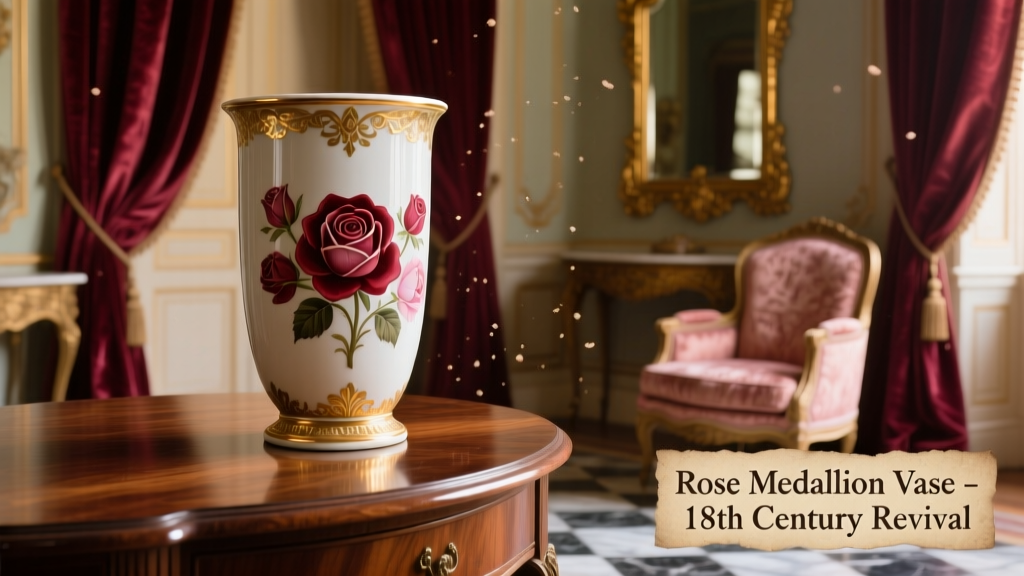
Rose Medallion Cylindrical Vase: A Collector’s Guide to the 9½ × 4 Inch Porcelain Masterpiece
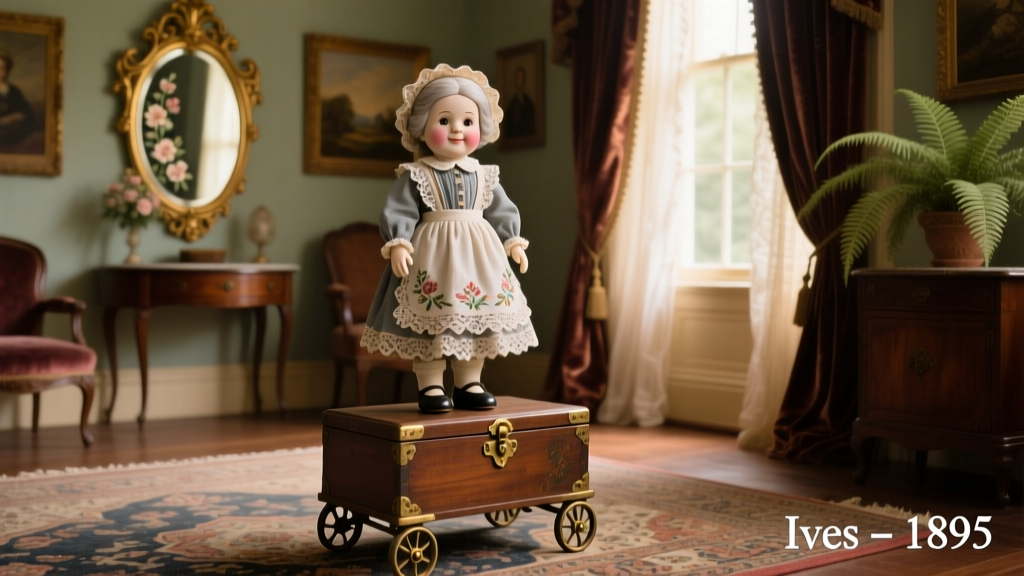
The Ives 9-Inch 'Old Woman in the Shoe' Toy: Bisque Head, Iron Shoe with Cast Wheels, and Early American Toy History