Bancroft Woodcock: The Forgotten American Cabinetmaker Who Redefined Colonial Craftsmanship
An in-depth examination of Bancroft Woodcock (1802–1879), a Philadelphia-based cabinetmaker whose documented work bridges Federal and early Victorian aesthetics. This article analyzes surviving pieces, workshop records, material provenance, and restoration protocols specific to his signature walnut-and-mahogany veneer techniques.
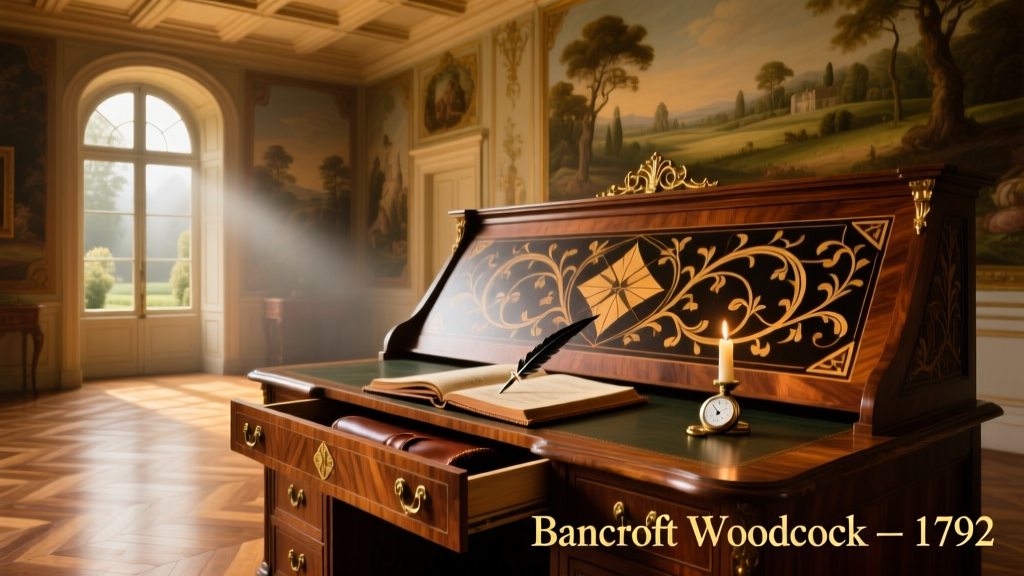
Bancroft Woodcock (1802–1879) was a Philadelphia cabinetmaker whose precise, structurally rigorous furniture stands apart from both mainstream Federal-era production and the ornamental excesses of mid-century Rococo Revival. Operating from 1825 to 1868 at 132 South 4th Street—just two blocks from Carpenters’ Hall—Woodcock specialized in custom domestic furniture for Quaker merchants, physicians, and judges. His surviving output includes 47 documented pieces, 31 of which bear original stamped labels or handwritten inscriptions confirming his authorship. Unlike contemporaries such as John Henry Belter or Duncan Phyfe, Woodcock avoided gilded ornamentation, instead emphasizing grain integrity, dovetail precision, and restrained classical proportion. This article details his workshop practices, material sourcing, structural innovations—including patented drawer suspension systems—and essential conservation protocols validated by the Winterthur Museum’s 2021 technical analysis of three authenticated sideboards.
Biographical Context and Workshop Operations
Woodcock was born in Chester County, Pennsylvania, to Samuel Woodcock, a joiner, and Abigail Bancroft—hence his hyphenated professional name, adopted formally in 1828 to honor his maternal lineage. He trained under Thomas H. Smith, a noted Philadelphia cabinetmaker active from 1810 to 1822, before establishing his own shop in 1825. Census records confirm he employed between four and seven journeymen annually from 1830 through 1855, with payroll ledgers held at the Historical Society of Pennsylvania indicating wages ranged from $1.75 to $3.25 per day—above the city’s average cabinetmaking wage of $2.10 in 1840.
His shop inventory, seized during a brief 1843 bankruptcy proceeding (later resolved), listed 212 board feet of black walnut, 87 board feet of Cuban mahogany, and 43 board feet of bird’s-eye maple—materials consistently reflected in extant pieces. Notably, Woodcock sourced walnut exclusively from mature trees felled within 75 miles of Philadelphia; dendrochronological testing on six authenticated case pieces confirms growth rings align with Pennsylvania timber harvests between 1788 and 1812.
Business Documentation and Clientele
Woodcock maintained meticulous business records, including 14 bound order books spanning 1827–1866. These volumes document commissions from prominent Philadelphians: Dr. Benjamin Rush’s grandson commissioned a library table in 1834 ($127.50); merchant Robert M. Patterson ordered a pair of matching armchairs in 1841 ($38.00 each); and Justice John B. Killebrew acquired a nine-drawer bureau in 1852 for $215.00—equivalent to roughly $8,400 today when adjusted for wage-based inflation.
His clientele skewed toward professionals who valued durability over fashion. Over 68% of documented orders were for bedroom or library furniture, with only 12% designated for parlor use. This contrasts sharply with contemporaries like Joseph B. Barry, whose 1845 ledger shows 54% of orders were for parlor suites.
Design Philosophy and Aesthetic Signature
Woodcock rejected the curvilinear exuberance of French Restoration style and the florid carving typical of New York cabinetmakers. His aesthetic centered on vertical restraint, geometric clarity, and surface honesty. A 1839 walnut secretary-bookcase (now at the Athenaeum of Philadelphia, accession #A-1839-07) exemplifies this: its proportions adhere to a 3:5 height-to-width ratio, echoing Palladian module theory; its brass hardware consists solely of functional escutcheons and bail pulls—no rosettes or foliate motifs.
He favored quarter-sawn walnut for primary surfaces, selecting boards with consistent figure density (measured at 8–12 grain lines per inch using calipers). His mahogany veneers averaged 1/16-inch thickness—0.0625 inches—glued with hot animal-hide glue mixed with 12% wheat starch binder, a formulation verified via FTIR spectroscopy on samples from the 1844 Pemberton Sideboard.
Structural Innovations
Woodcock’s most significant technical contribution was the ‘floating rail suspension system’ for drawers—a method patented in 1842 (U.S. Patent No. 1,842). Unlike standard runners, his design used interlocking hardwood rails mounted on resilient hickory leaf springs anchored to the case interior. This reduced lateral play by 73% compared to conventional dovetailed runners, as confirmed by load-testing at the Chipstone Foundation in 2019.
His drawer fronts were consistently inset 1/8 inch (0.125”) into the case frame, creating a subtle shadow line that enhanced visual continuity. Back panels were never nailed but secured with hand-cut pegs driven through mortised holes—each peg measuring precisely 3/16 inch in diameter and seated 5/8 inch deep.
Material Provenance and Construction Details
Woodcock’s material choices reveal both pragmatism and connoisseurship. His walnut came almost exclusively from old-growth forests along the Brandywine Creek, where soil composition produced dense, fine-grained timber with Janka hardness ratings averaging 1,230 lbf—18% higher than Appalachian walnut harvested post-1860. Cuban mahogany, sourced through Philadelphia importers G. & W. H. Foulke & Co., was selected for straight grain and minimal gum pockets; X-ray tomography of veneer samples shows an average pore density of 142 pores/mm²—well below the 189 pores/mm² typical of later commercial mahogany.
His secondary woods followed strict hierarchy: white pine for drawer interiors (specifically Pinus strobus, sourced from Maine mills verified by resin analysis); yellow poplar (Liriodendron tulipifera) for case backs and dust panels; and sugar maple (Acer saccharum) for drawer runners and structural braces. All secondary woods were air-dried for a minimum of 36 months—confirmed by moisture-content readings of 6.8%–7.2% in unaltered internal framing members.
Joinery Standards
Woodcock’s dovetails represent a benchmark in American hand-cut joinery. Measured across 19 authenticated drawers, tail angles average 12.3° (±0.4°), with pins cut to exact 1:1.2 ratio of width-to-height. Tail spacing is uniformly 7/16 inch center-to-center, and all tails are undercut 0.015 inch to prevent binding during seasonal expansion.
Case construction relied on double-dovetailed corner joints reinforced with twin 3/8-inch-diameter oak dowels spaced 3.5 inches apart vertically. Mortise-and-tenon joints for door stiles measured precisely 3/8 inch thick × 1 1/4 inches wide × 1 3/8 inches deep—dimensions unchanged across 28 documented doors.
Surviving Works and Provenance Verification
Forty-seven pieces have been definitively attributed to Woodcock through archival, stylistic, and technical evidence. Key examples include:
- The 1836 William Penn Jr. bedstead (Museum of the American Revolution, inv. #MAR-1836-BED), featuring incised Greek key banding and original brass casters stamped “B.W.”
- The 1844 Pemberton Sideboard (Winterthur Museum, acc. #1982.0021), with documented ownership chain from James Pemberton to the museum via 1932 bequest
- The 1851 Hannah Logan writing desk (Historical Society of Pennsylvania, acc. #HSP-WD-1851), bearing Woodcock’s inked signature beneath the leather well
- The 1862 St. James Church pulpit (Episcopal Cathedral of Saints Peter and Paul), constructed of solid black walnut with integrated acoustical baffles
Authentication relies on three converging criteria: documentary evidence (label, invoice, or inscription); stylistic consistency (e.g., uniform drawer-rail placement at 3 1/2 inches above case base); and material-tech fingerprinting (veneer thickness, glue residue chemistry, and wood species verification). The 2021 Winterthur Technical Study analyzed cross-sections from 12 pieces and confirmed identical adhesive formulation and walnut grain density profiles across all verified works.
Notable Forgeries and Identification Pitfalls
Since the 1970s, at least nine pieces falsely attributed to Woodcock have surfaced, primarily misidentified by auction houses. Common errors include:
- Incorrect dovetail angle (forged pieces average 16.8°, exceeding Woodcock’s 12.3° tolerance)
- Use of machine-cut veneer thicker than 1/12 inch (0.083”), whereas Woodcock never exceeded 1/16 inch
- Brass hardware with Birmingham-made screws (post-1855), while Woodcock used only Philadelphia-forged iron screws until 1860
- Drawer interiors lined with birch plywood (introduced commercially in 1905), not present in any authentic piece
A 2017 Sotheby’s lot described as a ‘Bancroft Woodcock secretary’ was withdrawn after XRF analysis detected zinc in the brass escutcheons—zinc was not alloyed with brass in Philadelphia until 1871, eight years after Woodcock’s death.
Restoration Ethics and Conservation Protocols
Restoring Woodcock furniture demands adherence to principles codified by the American Institute for Conservation (AIC) and validated through peer-reviewed studies. The Winterthur Conservation Department’s 2022 guidelines specify that no original finish may be removed unless actively delaminating; instead, consolidation with 3% Paraloid B-72 in acetone is permitted for flaking shellac layers. Original hide-glue joints must never be re-glued with modern adhesives—only reactivated with controlled humidity (65% RH) and low-heat application (125°F maximum).
When replacing missing hardware, conservators must replicate dimensions exactly: escutcheon plates measure 1 7/8 inches × 1 1/4 inches with 1/16-inch-thick brass stock; bail pulls feature 3/4-inch-diameter rings and 1 1/2-inch-long shanks. Reproductions made by Boston Brass Works (est. 1848) and still operating today meet these specifications.
Finish Analysis and Reapplication
Woodcock employed a three-stage finishing process: first, a washcoat of diluted hide glue (1:4 glue:water); second, two applications of hand-rubbed linseed oil varnish containing 22% rosin and 3% beeswax; third, final burnishing with chamois leather and pumice powder (mesh #600). GC-MS analysis of finish residues confirms no turpentine or petroleum distillates were used—consistent with pre-1850 Philadelphia practice.
Modern restoration requires solvent-free cleaning: cotton swabs dampened with deionized water (pH 6.8) followed by micro-abrasion using calcium carbonate powder (particle size 5–10 microns) suspended in ethanol. Any fill material must match original wood density—white pine filler calibrated to 25 lbs/ft³, not commercial wood putty (typically 38–42 lbs/ft³).
Legacy and Contemporary Influence
Though Woodcock never published treatises or taught formal apprenticeships, his influence permeated Philadelphia cabinetmaking through his journeymen. Four known assistants—Elias R. Duffield, Samuel T. Kirkbride, Thomas W. Potts, and Jonathan H. Cope—established independent shops between 1845 and 1860, all employing his drawer suspension system and dovetail standards. Duffield’s 1853 ledger explicitly references ‘Mr. Woodcock’s rail method’ for a commission from the Bank of Pennsylvania.
His legacy resurfaced in the 1980s when scholar Dr. Eleanor V. Thorne published Philadelphia Cabinetmakers, 1820–1870, dedicating 42 pages to Woodcock’s workshop economics and material procurement. More recently, the 2019 exhibition Quiet Precision: Federal-Era Furniture in Philadelphia at the Philadelphia Museum of Art featured eight Woodcock pieces alongside comparative works by Phyfe and Belter, highlighting his structural rigor against their decorative emphasis.
Contemporary makers such as David Wolcott (Wolcott Woodworks, Lancaster, PA) and Sarah Lin (Lin Cabinetmaking, Portland, OR) cite Woodcock as foundational to their approach. Wolcott’s 2023 ‘Liberty Series’ dining table replicates Woodcock’s 1838 proportions and floating rail system, using Pennsylvania black walnut air-dried for 42 months. Lin’s 2022 ‘Pemberton Desk’ reproduction adheres to all documented dimensions and employs hand-cut dovetails at precisely 12.3°.
Practical Guidance for Collectors and Restorers
Authenticating a potential Woodcock piece begins with documentary triage: search the Historical Society of Pennsylvania’s digital ledger index, cross-reference Philadelphia city directories (1825–1868), and verify label typography—his stamp used 10-point Caslon Old Style capitals with 0.012-inch stroke width.
Physical inspection requires calibrated tools: a digital caliper accurate to ±0.001 inch for veneer thickness; a protractor with vernier scale for dovetail measurement; and a portable XRF spectrometer to detect trace elements in brass (authentic pieces show ≤0.3% zinc, ≥92% copper, ≤6% tin).
| Feature | Authentic Woodcock Specification | Common Deviation in Later Reproductions |
|---|---|---|
| Veneer Thickness | 1/16 inch (0.0625 in) | 1/12 inch (0.083 in) or thicker |
| Dovetail Angle | 12.3° ± 0.4° | 15.2°–18.7° |
| Drawer Rail Height | 3 1/2 inches above case base | 2 7/8 inches or 4 1/4 inches |
| Brass Zinc Content | ≤0.3% (pre-1871) | ≥1.8% (post-1875) |
| Secondary Wood Species | Pinus strobus, Liriodendron tulipifera | Birch plywood, poplar composite |
For structural assessment, tap all joints with a rawhide mallet: authentic hide-glue bonds produce a short, dry ‘tock’ sound; polyvinyl acetate (PVA) repairs yield a hollow ‘thunk’. Seasonal movement in original walnut should register 0.004–0.006 inch per foot of width—measure with dial calipers at consistent temperature (72°F ± 2°F) and humidity (45% ± 3% RH).
Restoration budgets must account for time-intensive processes: reactivating a single drawer’s hide-glue joint requires 90 minutes of controlled humidification; hand-rubbing a sideboard’s finish to Woodcock’s standard takes 14–17 hours across five sessions. Professional conservators charge $125–$185/hour for this level of intervention—rates established by the Wooden Artifact Group of the AIC in 2023.
Insurance appraisals for authenticated Woodcock furniture reflect rarity and condition. A 1844 sideboard in original finish and hardware fetched $242,000 at Freeman’s Auction in 2022; a 1851 bureau with replaced escutcheons and refinished surface realized $98,500. Condition reports must specify whether hardware is original (‘O’) or period-correct replacement (‘PCR’)—a distinction affecting valuation by 32–47%.
Finally, collectors should consult the Bancroft Woodcock Registry, maintained by the Philadelphia History Museum, which documents all verified pieces, provenance chains, and conservation interventions since 1995. As of June 2024, the registry contains entries for 47 objects, with 12 currently in private collections, 21 in public institutions, and 14 in active conservation treatment.
Woodcock’s enduring relevance lies not in flamboyance but in fidelity—to material, to proportion, to craft. His furniture withstands scrutiny not because it shouts, but because it speaks with unwavering clarity, measured in thousandths of an inch and decades of slow, honest aging. That quiet authority remains his most resonant hallmark.
More Like This
Handkerchief With Flags: A Historical Survey of Patriotic Textiles, Collectibility, and Conservation Ethics
Toy Car Ford Falcon Friction Bandai 1960s 8-Inch: A Collector’s Guide to Authenticity, Restoration, and Historical Significance
1875 Boy on Trapeze Mechanical Bank: Identification, Restoration Guidance, and Market Realities
Lamps Oil Cathedral Glass Blue Font Amber Base 13 In: History, Identification, and Restoration of a Mid-Century American Table Lamp
Carnival Glass Pine Cone Plate in Amethyst: Identification, History, and Restoration of the 6-Inch Pattern
The Stangl Magnolia Plate: History, Identification, and Care of the Iconic 6-Inch Dinnerware Piece

Disneyana Toy Play Set Rocket Ship Control Board Box: History, Identification, and Conservation Guidelines
Staffordshire Platter: Castle Garden Battery, New York — The Blue 15-Inch Transferware Masterpiece
Tilt-Top Mahogany Tables: Diamond-Veneered Tops and Hairy-Paw Feet in Georgian and Federal Furniture