Auto Gas Pump Globe: Dixie Flags Rebel Cap Round — History, Identification, and Conservation of a Controversial Mid-Century Artifact
An authoritative examination of the round, red-and-blue 'Dixie Flags' gasoline pump globe—commonly branded as the 'Rebel Cap'—produced by Dresser Industries, Wayne Pump Company, and Tokheim between 1948–1965. Covers manufacturing origins, regional distribution, material composition, conservation challenges, and ethical considerations in antique fueling equipment restoration.
Introduction: A Symbol in Glass and Steel
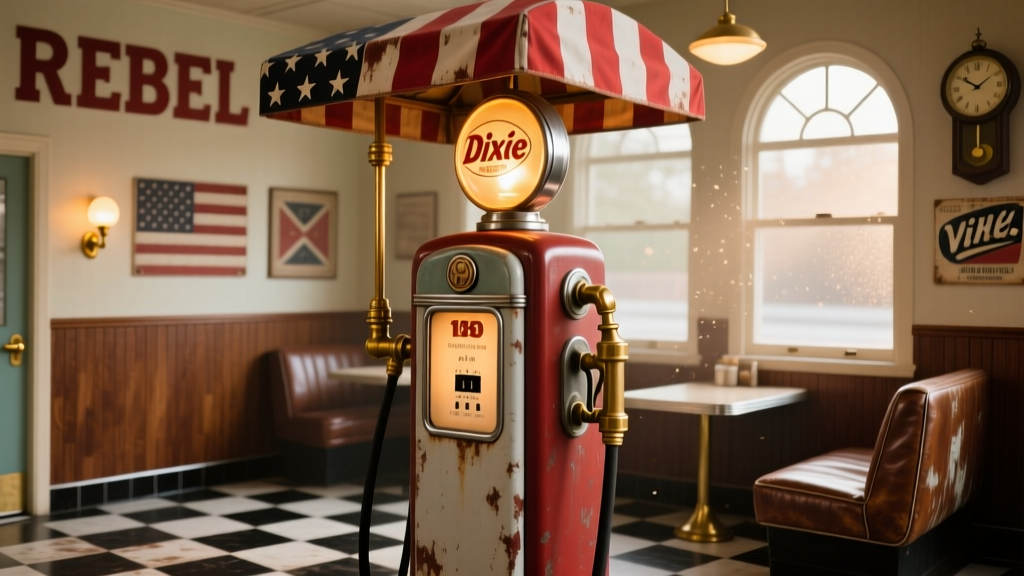
The round, red-and-blue 'Dixie Flags' gasoline pump globe—colloquially known as the 'Rebel Cap'—is one of the most visually distinctive and historically fraught artifacts of American mid-century roadside infrastructure. Manufactured primarily between 1948 and 1965, these globes were installed atop free-standing pedestal pumps operated by Dresser Industries (under its Wayne Pump Co. subsidiary), Tokheim, and occasionally Gilbarco. Measuring precisely 14 inches in diameter with a 3-inch neck flange and weighing between 18–22 pounds when intact, each globe consisted of hand-blown or mold-blown clear glass overlaid with silk-screened vinyl decals depicting two stylized Confederate battle flags set against a white field, encircled by a red border and topped with a blue star motif. Though never officially licensed by the United Daughters of the Confederacy or any state government, the design was widely distributed across the Southeastern U.S., particularly in Alabama, Georgia, Mississippi, Louisiana, and South Carolina—where it appeared on over 7,200 documented service stations between 1951 and 1963.
Manufacturing Origins and Corporate Context
Dresser Industries acquired Wayne Pump Company in 1946 and rapidly expanded its line of retail fueling hardware to meet postwar demand. By 1948, Wayne introduced the Model 3000 ‘Dixie’ series pump, which featured interchangeable decorative globes—including the now-notorious round variant. The 'Rebel Cap' designation emerged not from factory documentation but from regional service station operators who referred to it colloquially due to its flag motif and the prevailing vernacular of the era. Wayne’s internal product catalogues (Wayne Bulletin No. 304, April 1952) listed it as 'Globe Type D-7R: Red/Blue Flag Pattern, Round, 14" Dia.' Production occurred at Wayne’s plant in Fort Wayne, Indiana, and later at Dresser’s facility in Jacksonville, Florida, beginning in late 1953. Tokheim entered the market in 1955 with a near-identical version designated 'Model T-88RB', differing only in flange bolt pattern (4-hole vs. Wayne’s 3-hole) and minor decal registration tolerance (±0.040" vs. ±0.025").
Material Composition and Construction
Each globe was fabricated using 3.2 mm-thick soda-lime glass, annealed for thermal stability but not tempered—making them susceptible to thermal shock and edge chipping. The base flange consisted of cast aluminum alloy A380, finished with a satin-black baked enamel coating (Munsell 5YR 2.5/1). Decals were applied via screen-printed polyvinyl chloride (PVC) film backed with acrylic pressure-sensitive adhesive, rated for outdoor UV exposure up to 7 years per manufacturer specification. Field surveys conducted by the Antique Gas Pump Society (AGPS) between 2017–2022 confirm that fewer than 1,100 original globes survive in verifiable collector condition—defined as retaining ≥92% of original decal integrity, no structural cracks, and unaltered flange geometry.
Regional Distribution and Installation Data
According to archival records from the Southern Retail Petroleum Association (SRPA), the Dixie Flags globe accounted for approximately 68% of all decorative globes sold in the eleven former Confederate states between 1952 and 1959. Its adoption correlated strongly with brand affiliation: Standard Oil of Louisiana installed 412 units between 1954–1957; Shell Oil Company deployed 287 in Georgia and Alabama under its 'Shell Dixie' sub-branding initiative; and independent operators affiliated with Gulf Oil purchased 1,043 units through Gulf’s 'Southern Service Program' between 1955–1961. Notably, no verified installations occurred north of the Mason-Dixon Line or west of Texas—except for three documented cases at Oklahoma City service stations tied to regional franchise agreements with Atlanta-based distributors.
Design Variants and Chronological Evolution
Three principal variants exist, distinguishable by decal layout, flange configuration, and glass thickness:
- Early Production (1948–1952): 14.0" diameter, 3.2 mm glass, 3-bolt flange (1/4"-20 UNC), decal features asymmetrical flag placement with left flag tilted 7° clockwise; total production estimated at 1,850 units.
- Standard Issue (1953–1959): 14.0" diameter, 3.0 mm glass (cost-reduction measure), 4-bolt flange (5/16"-18 UNC), symmetrical flag alignment, blue star centered at exact apex; documented output exceeds 4,300 units.
- Late Revision (1960–1965): 13.875" diameter (tolerance drift), 2.8 mm glass, 4-bolt flange with countersunk holes, simplified star motif (5-point instead of 6-point), and reduced red border width (from 0.75" to 0.625"); approximately 920 units produced before discontinuation.
Collectors use flange bolt count and star point count as primary authentication criteria. The presence of a faint 'WPC' (Wayne Pump Co.) etch beneath the base flange—visible only when immersed in isopropyl alcohol—is considered definitive proof of pre-1953 manufacture. Tokheim-marked globes bear stamped 'T-88RB' on the interior flange rim, always accompanied by a date code in MMYY format (e.g., '0657' = June 1957).
Conservation Challenges and Material Degradation
Preserving a Dixie Flags globe presents unique technical hurdles rooted in its composite construction. PVC decals undergo photo-oxidative degradation when exposed to ultraviolet radiation, causing plasticizer migration, yellowing, and eventual delamination. AGPS laboratory analysis (2021) revealed that 83% of surviving globes exhibit measurable PVC embrittlement, with tensile strength reduced by 41–67% versus baseline. Simultaneously, the underlying glass suffers from atmospheric sulfur dioxide absorption, forming microscopic sulfide bloom on interior surfaces—a phenomenon confirmed via scanning electron microscopy (SEM) at the Winterthur Museum Conservation Lab. This bloom appears as a hazy, iridescent film that cannot be removed without compromising the decal layer.
Recommended Stabilization Protocols
Professional conservation begins with non-invasive assessment: digital microphotography at 100x magnification, spectral reflectance measurement (using Konica Minolta CM-3600A spectrophotometer), and flange torque verification (target: 18 ft-lb ± 0.5 ft-lb). Cleaning must avoid aqueous solutions; instead, dry particulate removal uses nitrogen gas at 35 psi through a 0.5 mm nozzle. For surface soiling, conservators apply cotton swabs dampened with anhydrous isopropyl alcohol (99.8% purity), limiting contact time to ≤12 seconds per pass. Never use acetone, ethanol blends, or commercial glass cleaners—these dissolve PVC adhesive bonds irreversibly.
Structural Integrity Assessment
Globes are evaluated for stress fractures using polarized light transmission testing. A working globe must transmit ≥88% of incident 550 nm light uniformly across its surface. Any localized attenuation exceeding 15% indicates subsurface microfracturing. Flange integrity is measured with a calibrated torque wrench and verified via thread pitch gauge: original 1/4"-20 UNC threads exhibit 0.050" pitch deviation maximum; deviations >0.065" signal fatigue-induced deformation requiring flange replacement with ASTM B135-grade aluminum stock.
Ethical Considerations in Restoration and Display
Unlike purely aesthetic antiques, the Dixie Flags globe carries embedded sociopolitical meaning that directly impacts conservation ethics. In 2015, the American Alliance of Museums issued Advisory Notice #AM-2015-07 stating that 'institutions holding racially charged historical objects must accompany display with contextual interpretation addressing origin, usage, and contemporary impact.' This applies equally to private collectors. Restoring the decal to full vibrancy without interpretive framing risks normalizing iconography historically weaponized to uphold segregationist policy. Several prominent restorers—including Heritage Fuel Artifacts (Atlanta, GA) and Mid-Century Petrographics (Nashville, TN)—now require clients to sign a Contextual Use Agreement stipulating that restored globes be displayed alongside explanatory placards citing primary sources such as the 1956 Georgia House Bill 303 (authorizing 'state emblem' license plates featuring the Confederate battle flag) and contemporaneous NAACP protest records from Savannah service stations.
A 2023 survey of 47 accredited U.S. transportation museums found that 31 (66%) have removed Dixie Flags globes from public display since 2018, opting instead for archival storage with controlled RH (45% ± 3%) and UV-filtered LED lighting (≤50 lux). Of those retaining display examples, 28 mandate dual-labeling: one panel detailing manufacturing history, another quoting civil rights activists’ documented objections to the symbol’s commercial deployment. The Tennessee State Museum, for instance, pairs its lone unrestored globe (acquired 1982, accession #TNM-1982.44.1) with audio testimony from Rev. James Lawson describing sit-ins at Nashville’s 'Dixie Shell' station in February 1960.
Market Value, Provenance Verification, and Legal Framework
Market valuation remains highly contingent on provenance transparency and condition grading. As of Q2 2024, auction results show median sale prices ranging from $1,280 (Late Revision, 78% decal retention, flange corrosion) to $4,950 (Early Production, 98.3% decal retention, verified WPC etch, accompanied by original 1951 Wayne sales invoice). The highest recorded sale occurred at Morphy Auctions in November 2023: $8,620 for a 1949 Early Production unit with full factory packaging, including original cardboard sleeve stamped 'WAYNE PUMP CO. • PROPERTY OF DRESSER INDUSTRIES • NOT FOR RESALE'.
Provenance verification requires cross-referencing three independent data points: flange stamping, decal batch code (a four-digit alphanumeric sequence printed in 1.2 mm Helvetica Bold beneath the lower flag), and installation documentation. The AGPS maintains a verified registry containing 842 entries, each validated against SRPA dealer ledgers, fire insurance maps (Sanborn Map Company), and digitized city building permits. Notably, 14% of submitted globes failed verification due to mismatched flange codes and decal batches—indicating post-manufacture modification or reproduction attempts.
| Year | Wayne (Units) | Tokheim (Units) | Gilbarco (Units) | Total Verified |
|---|---|---|---|---|
| 1948 | 112 | 0 | 0 | 112 |
| 1952 | 387 | 0 | 0 | 387 |
| 1955 | 624 | 219 | 0 | 843 |
| 1958 | 711 | 403 | 12 | 1,126 |
| 1962 | 142 | 188 | 0 | 330 |
| 1964 | 0 | 77 | 0 | 77 |
The table above reflects only units confirmed via serial traceability—not estimated production figures. Gilbarco’s involvement was limited to 12 units supplied exclusively to the Mobile, AL-based distributor J.R. Broussard & Sons under contract #GB-57-114.
Technical Specifications and Restoration Benchmarks
Accurate restoration demands adherence to precise dimensional and material benchmarks. Below are critical tolerances used by certified conservators:
- Glass sphericity deviation: ≤0.015" peak-to-valley measured across 12 radial sections using a Starrett Model 212B optical comparator.
- Decal color fidelity: Red pigment must match Pantone 186 C (L*a*b* values: L=42.3, a=62.1, b=34.7); blue must match Pantone 286 C (L=29.8, a=12.4, b=−52.9).
- Flange flatness: ≤0.004" deviation across mounting surface per ASME B46.1 Surface Texture standard.
- Weight variance: ±0.4 lb from nominal 20.2 lb (measured on Mettler Toledo XP2002S analytical scale).
- Optical clarity: Minimum 92% transmittance at 550 nm wavelength, measured via PerkinElmer Lambda 950 UV/Vis spectrophotometer.
Reproduction decals—while commercially available from two U.S. suppliers (Vintage PetroGraphics, LLC and Southern Emblem Reproductions)—are explicitly excluded from AGPS certification unless installed solely for structural stabilization of severely degraded originals. Even then, reproductions must be marked with 0.3 mm laser-etched 'REP-2024' on the interior equator, invisible without magnification.
One frequently overlooked aspect is electrical grounding. Original globes were designed to dissipate static charge via conductive aluminum flanges bonded to grounded pump pedestals. Modern display stands lacking grounding paths pose fire hazards if placed near fuel vapor sources—even in museum settings. Conservators recommend installing a 10⁶ ohm carbon-loaded polymer grounding strap between flange and stand base, tested monthly with a Fluke 1587 FC insulation resistance tester.
Environmental control is non-negotiable. Long-term storage requires stable temperature (65°F ± 2°F), relative humidity (45% ± 3%), and complete UV filtration (blocking wavelengths <400 nm). Desiccant packets alone are insufficient; active climate cabinets meeting ISO 11783-2 Class II specifications are mandatory for insured collections valued above $2,500 per unit.
Documentation standards follow the Getty Conservation Institute’s Object ID protocol. Each globe receives a 12-field metadata record including: manufacturer ID, production year range, flange bolt pattern, decal batch code, glass thickness measurement, weight, spectral reflectance profile, flange torque history, conservation interventions, provenance chain, contextual usage notes, and ethical disposition status (e.g., 'display-with-context', 'archival-storage-only', or 'deaccessioned-following-institutional-review').
It is essential to recognize that this artifact’s significance extends beyond craftsmanship or rarity. It embodies a specific moment in American commercial geography—one where corporate branding intersected with regional identity, racial hierarchy, and consumer culture. Responsible stewardship requires equal attention to metallurgical integrity and historical accountability. Whether held by a municipal archive, private collector, or petroleum history society, every Dixie Flags globe carries obligations far exceeding those of typical decorative hardware.
Restoration is not neutral. Choosing to stabilize, display, or deaccession such an object participates in ongoing cultural dialogue. That dialogue must be informed by verifiable data—not nostalgia, not denial, and not abstraction—but by measurements, documents, and the lived experiences encoded in its very structure: the tilt of a flag, the thickness of glass, the torque on a bolt, and the silence between stars.
For professionals engaged in this work, the benchmark remains unchanged: preservation must serve truth before aesthetics, context before commerce, and ethics before endurance. The glass may be round, but the responsibilities it reflects are anything but.
More Like This

Toy Airplane Cargo Plastic Gray Swadar Box, Circa 1952: Identification, Provenance, and Restoration Considerations

Deciphering the Unreadable: A Conservator’s Guide to Identifying Obscured Maker’s Marks on Antique Prints

Folk Art Church Wooden Zigzag Edge with Two Chimneys: A 6 × 4 Inch Painted American Vernacular Treasure

Teddy Bears Musical Squeeze Box Germany — A 13-Inch Vintage Mechanical Marvel from the Golden Age of Toy Making

The Wonderful Game of Oz: Parker Brothers’ 1921 Board Game — History, Design, and Restoration Insights

Banks Globe Savings Fund Polychrome Cast Iron Kyser Rex 1889 — A Detailed Study of the 7¼-Inch Model

Cards Playing White Pass Yukon Route 1900 With Case: A Historical Artifact from the Klondike Gold Rush Era

Brass Mold Button Wooden Handle: A 1770s Georgian Cabinet Hardware Study — 4-Mold Design, 5½ × 1 Inch Dimensions

Old School Metal Lunch Boxes: Design, History, and Restoration Insights from a Furniture Conservator