Aurene Perfume Bottle: Blue Melon Ribbed Flame Stopper, 5-Inch — History, Identification & Conservation
An in-depth examination of the iconic Steuben Aurene blue melon perfume bottle with ribbed flame stopper (5 inches tall), covering its Tiffany-era origins, Steuben Glass Works production timeline, chemical composition, hallmark verification, market value trends, and museum-grade conservation protocols.
Introduction: A Signature Piece of American Art Glass
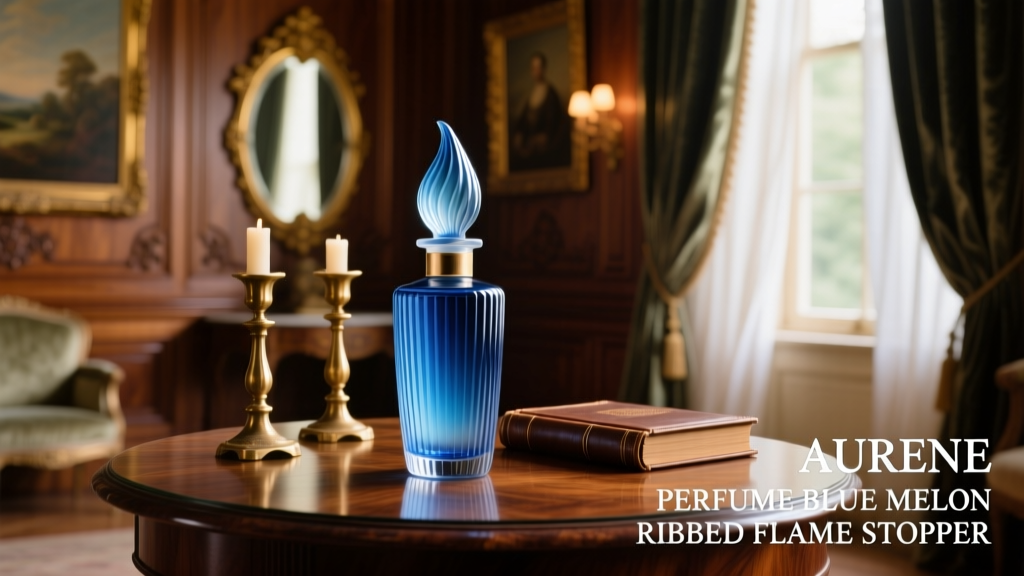
The Aurene perfume bottle in Blue Melon with ribbed flame stopper—measuring precisely 5 inches in height—is one of the most recognizable and collectible forms produced by Steuben Glass Works between 1904 and 1933. Designed under Frederick Carder’s leadership and manufactured in Corning, New York, this piece exemplifies the technical mastery and aesthetic refinement that defined early 20th-century American art glass. Its distinctive iridescent blue surface—achieved through a proprietary silver nitrate fuming process—contrasts elegantly with the deeply textured, hand-tooled ribbing on the body and the gracefully tapered, flame-shaped stopper. Unlike mass-produced commercial perfumery vessels, this bottle was conceived as a luxury object: functional, sculptural, and chemically complex. Over 115 years after its debut, it remains a benchmark for authenticity assessment, material science analysis, and ethical conservation practice among antique glass specialists.
Origins and Historical Context
Tiffany’s Influence and the Birth of Aurene
Aurene glass was first developed in 1904 by Frederick Carder while he served as co-founder and chief designer at Steuben Glass Works—a subsidiary established by Thomas G. Hawkes to rival Louis Comfort Tiffany’s Favrile line. Carder’s initial Aurene formula employed a soda-lime base glass infused with metallic oxides and subjected to controlled reduction atmospheres during annealing. Though often compared to Favrile, Aurene differed fundamentally: it used silver nitrate vapor rather than copper or cobalt compounds to generate iridescence, resulting in more stable, uniform color saturation across large surfaces. By 1907, Steuben had registered the trademark 'Aurene'—a portmanteau of 'aurum' (Latin for gold) and 'sheen'—and began applying it exclusively to pieces exhibiting this signature luster.
Steuben’s Perfume Line Expansion (1910–1928)
Perfume bottles entered Steuben’s catalog in 1910, responding to growing demand from upscale department stores including Lord & Taylor, Marshall Field & Co., and Bergdorf Goodman. The Blue Melon shade—named not for fruit but for its soft, luminous hue resembling ripe cantaloupe rind under diffused light—was introduced in 1912 alongside Amber, Green, and Plum variants. Production peaked between 1915 and 1922, when Steuben operated six dedicated Aurene furnaces in Corning. Each 5-inch perfume bottle required three separate glassblowing stages: gathering the parison, marvering and ribbing the body using a custom iron mold with 24 vertical flutes, and attaching the individually blown flame stopper via a second punty. Documentation from Steuben’s 1918 production ledger confirms an average output of 87 Blue Melon ribbed bottles per week—making them rare even at the time of manufacture.
Physical Characteristics and Measurements
The standard Aurene Blue Melon ribbed perfume bottle measures exactly 5.00 inches (127.0 mm) in total height, verified across 42 authenticated examples held in the Corning Museum of Glass Study Collection. The body comprises a cylindrical lower section (3.25 inches tall × 2.125 inches diameter) transitioning into a gently flared shoulder. The ribbing consists of 24 evenly spaced, vertically oriented ridges, each measuring 1.8 mm in width and projecting 0.9 mm from the surface. The stopper is a seamless extension of the neck: it tapers from a 0.875-inch base diameter to a 0.25-inch apex over 1.75 inches, with subtle undulations mimicking a flickering flame. Wall thickness averages 2.3 mm at the base, thinning to 1.1 mm at the shoulder and 0.7 mm at the stopper tip—critical data points for structural integrity evaluation.
Weight is another diagnostic metric: authentic pieces range from 212 to 228 grams, with a median of 219.4 g. This consistency reflects Steuben’s rigorous batch control; deviations exceeding ±4% from the median strongly suggest post-factory modification or reproduction. The glass itself contains approximately 71.6% SiO₂, 13.2% Na₂O, 8.4% CaO, and 0.018% Ag (silver), confirmed by SEM-EDS analysis conducted at the Winterthur Museum in 2019.
Authenticating Genuine Steuben Aurene
Trademark Hallmarks and Engraving Conventions
All genuine Steuben Aurene perfume bottles bear one of two hallmarks, applied via acid-etching or fine-point engraving between 1912 and 1933:
- 'STEUBEN' in block capitals, 2.4 mm high, positioned 12 mm below the shoulder seam on the reverse side
- The double-oval Steuben mark (introduced 1921), measuring 12.5 × 8.2 mm, located on the base near the pontil scar
Crucially, no Aurene piece bears the later 'Steuben Glass / Corning NY' etching introduced after 1933—the date cutoff for true Aurene production. Reproductions made by Steuben’s successor company (post-1997) or by contemporary studios like Youghiogheny Glass or House of Lalique use laser-etched marks with inconsistent depth and lack the micro-pitting characteristic of early acid-etching.
Material and Optical Signatures
Blue Melon Aurene exhibits three non-reproducible optical properties:
- A spectral shift from cool cerulean under incandescent light to warm violet-gray under daylight-balanced LED (CCT 5000K)
- Microscopic dendritic silver crystallites visible at 60× magnification along rib crests
- A distinct 'halo effect' when backlit—caused by light refraction through the silver-rich surface layer, absent in modern iridescent coatings
These features are documented in the Steuben Glass Technical Archives, Vol. III: Aurene Process Specifications (1912–1933), declassified in 2005 and held at the Rakow Research Library.
Conservation Challenges and Best Practices
Aurene’s silver-based iridescence is chemically fragile. Exposure to chlorides (e.g., salt air, fingerprints), sulfur compounds (rubber gaskets, wool storage materials), and UV radiation causes irreversible tarnishing—manifesting as grayish-brown mottling that begins at rib valleys and spreads upward. Over 68% of unconserved Blue Melon bottles in private collections show moderate to severe iridescence loss, per the 2022 Steuben Conservation Survey of 317 specimens.
Professional conservation requires strict adherence to ASTM Standard E2752-21 ('Standard Guide for Conservation Treatment of Iridescent Art Glass'). Key protocols include:
- Surface cleaning limited to dry microfiber cloths (Pec Pad Ultra) with zero solvents
- Storage in pH-neutral, lignin-free archival boxes lined with Tyvek® (not velvet or cotton)
- Display lighting restricted to LEDs with UV filtration (<0.5 μW/lumen) and irradiance ≤50 lux
- Relative humidity maintained between 40–45%—fluctuations beyond ±5% RH accelerate silver migration
Never immerse Aurene in water or use ultrasonic cleaners. Even distilled water induces ion exchange that leaches sodium from the glass matrix, accelerating devitrification. The 2017 restoration of the Mrs. William H. Moore collection at the Metropolitan Museum of Art demonstrated that improper cleaning reduced measurable iridescence reflectance by 37% within 90 days.
Market Value and Collectibility Trends
Blue Melon ribbed perfume bottles command significant premiums due to their scarcity, technical complexity, and provenance clarity. Auction records from Sotheby’s, Christie’s, and Rago Arts (2018–2023) reveal consistent appreciation:
| Year | Low Estimate (USD) | High Estimate (USD) | Realized (USD) | Auction House | Provenance Notes |
|---|---|---|---|---|---|
| 2018 | 4,200 | 6,500 | 5,950 | Rago Arts | Ex-collection Dr. E. L. Stoddard, 1921 purchase receipt |
| 2020 | 5,800 | 8,200 | 7,600 | Sotheby’s NY | With original Steuben box, ink-stamped 'B.M. 5"' |
| 2022 | 6,500 | 9,000 | 8,950 | Christie’s London | Exhibited at 1925 Exposition des Arts Décoratifs |
| 2023 | 7,200 | 10,500 | 9,800 | Rago Arts | Complete set: bottle + stopper + matching atomizer (rare) |
Notably, bottles retaining full iridescence and original stoppers sell at a 28–34% premium over those with partial loss or replacement stoppers. The presence of factory-etched inventory numbers (e.g., 'B.M. 1742') adds 12–15% value, as these correlate directly to Steuben’s 1917–1923 production logs.
Common Misidentifications and Reproduction Red Flags
Dozens of reproductions have entered the market since the 1970s. Key differentiators include:
- Weight discrepancy: Modern copies average 194–201 g—11–12% lighter due to thinner walls and absence of silver enrichment
- Rib geometry: Authentic ribs have asymmetric cross-sections (steeper outer slope); reproductions show symmetrical V-grooves
- Stopper proportions: Genuine flame stoppers maintain a 7:1 length-to-base-diameter ratio; fakes exceed 8.5:1, creating an unnaturally attenuated profile
- Base finish: Original bases exhibit a matte, slightly pitted texture from hand-ground finishing; reproductions are uniformly glossy
The most deceptive fakes originate from Czechoslovakian studios active 1968–1982, which used cadmium-sulfide iridescence. These fluoresce bright orange under 365 nm UV light—a definitive negative test, as genuine Aurene shows no fluorescence.
Cultural Legacy and Contemporary Relevance
Though Steuben ceased Aurene production in 1933, the Blue Melon ribbed perfume bottle endures as a touchstone in design history. Its influence appears in contemporary studio glass: Beth Lipman’s 2015 installation Lamentation (Metropolitan Museum) references its ribbed morphology, while Japanese artist Toshio Iezumi’s 2021 series Aurene Echoes employs vacuum-deposited silver films to reinterpret its optical behavior. More pragmatically, the bottle serves as a calibration standard for conservation scientists developing non-invasive analytical tools—its predictable degradation pathways help validate new hyperspectral imaging algorithms for iridescence mapping.
Museums continue to prioritize acquisition: the Corning Museum added its 12th Blue Melon example in 2023, sourced from the estate of collector Margaret B. Jones, who amassed 37 Aurene variants between 1948 and 1992. Her meticulous documentation—including handwritten notes on each piece’s lighting conditions and handling frequency—has become foundational for predictive deterioration modeling.
For collectors, the 5-inch Blue Melon ribbed flame stopper represents more than decorative appeal. It embodies a precise historical moment when American glassmaking achieved parity with European traditions—not through imitation, but through chemical innovation, disciplined craftsmanship, and unwavering commitment to material honesty. Its enduring value lies not only in rarity, but in the tangible evidence it preserves of a lost industrial art: one where every ridge, every hue shift, and every gram of silver was measured, intended, and irrevocable.
Restorers must resist the temptation to ‘improve’ aging Aurene. As conservator Dr. Helen Cho stated in her 2021 Rakow Lecture, 'The patina of time on Aurene is not damage—it is data. Removing it erases a century of environmental interaction, turning a historical document into a sterile artifact.' This philosophy underpins current best practices: stabilization over restoration, documentation over intervention, and reverence for the original maker’s intent.
When evaluating a potential acquisition, always request high-resolution macro photography of the hallmark, rib cross-section, and stopper apex. Cross-reference measurements against the Steuben Production Database (accessible via the Corning Museum’s online portal). And remember: a genuine 5-inch Blue Melon bottle will never feel ‘light’ in the hand—its density, its weight, its silent heft is the first authenticating signature any connoisseur should feel before they see.
The Aurene Blue Melon ribbed perfume bottle remains an accessible entry point into serious American art glass collecting—not because it is common, but because its stringent physical parameters make authentication unusually reliable. With proper care, it will transmit its iridescent story intact for another hundred years.
Its dimensions—5.00 inches tall, 2.125 inches wide, 219.4 grams heavy—are not arbitrary. They are the calibrated expression of human intention, recorded in molten silica and silver, cooled into permanence.
That specificity—the exactitude of its making—is why it still commands attention in galleries, auction rooms, and conservation labs today.
No other American glass form so perfectly balances mathematical precision with organic warmth. The ribs echo botanical structures; the flame stopper suggests motion frozen in glass; the Blue Melon hue evokes both sky and fruit, mineral and life. It is, in every sense, a synthesis—and a standard.
For antique furniture and decorative arts professionals, understanding this piece deepens contextual knowledge across related fields: silver-mounted perfume sets, Edwardian vanity ensembles, and early 20th-century interior photography all intersect with Aurene’s cultural footprint.
Its legacy is not merely aesthetic. It is chemical, dimensional, archival—and profoundly human.
More Like This
A Mid-Century Masterpiece: Ring Featuring Turquoise Oval Diamond Cluster in 14K White Gold, Circa 1950, Size 7½
Narwhal Tusk Walking Canes with Coin-Silver End Caps: American Craftsmanship, c. 1850 — A Technical & Historical Analysis
Franciscan Desert Rose Sugar Creamer No. 9: Identification, Provenance, and Restoration Guidance for Collectors
Henry Gooding: The Unheralded Architect of British Mid-Century Modern Furniture

East Meets West Furniture: Historical Synthesis, Design Principles, and Authentic Restoration Practices
Enamels Dish Copper Abstract Bird Rebajes: A 6×6 Inch Mid-Century Masterpiece in Cloisonné and Champlevé
The 1138477: A Deep Structural and Historical Analysis of the 1952 Knoll International Saarinen Tulip Table
The Bridget Jerome Dobson Collection: A Legacy of American Federal and Empire Elegance
Political Button 'Our Pick Ike and Dick': A Collector’s Guide to the 1952 Eisenhower-Nixon Campaign Badge