Architectural Bathtub in Zinc, Circa 1870: Design, Manufacture, and Restoration of a Victorian Engineering Masterpiece
An in-depth examination of the rare architectural zinc bathtub produced in England and France between 1865–1885—covering metallurgical composition, foundry practices, dimensional standards, period installation methods, and ethical conservation protocols for heritage interiors.
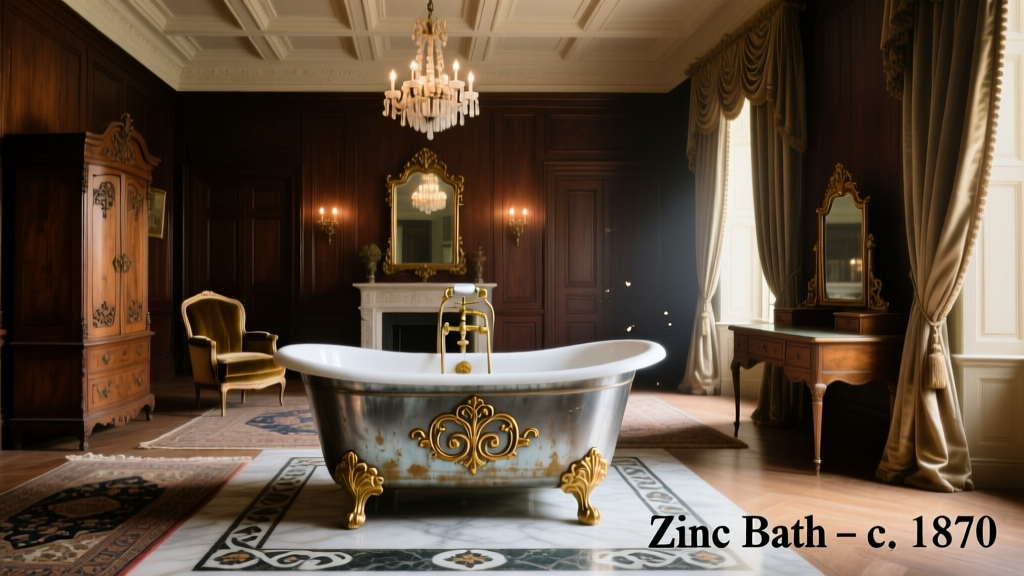
Introduction: The Zinc Bathtub as Industrial-Artifact
Architectural zinc bathtubs manufactured between 1865 and 1885 represent a pivotal convergence of Victorian engineering ambition, metallurgical innovation, and domestic modernity. Unlike later enameled cast iron or pressed steel units, these early zinc baths were precision-fabricated sheet-metal vessels—typically formed from rolled zinc plates 1.2 to 1.8 mm thick—designed for permanent architectural integration into grand townhouses, spa complexes, and institutional bathhouses. Produced primarily by British firms such as James H. Hinks & Son (Birmingham), J. W. Walker & Sons (London), and French manufacturers including Lefèvre & Cie (Paris) and Fonderie de la Gare (Lyon), these bathtubs were custom-engineered for specific structural contexts: often recessed into brick masonry, lined with lead flashing, and connected to gravity-fed hot-water systems operating at pressures under 12 psi. Measuring between 142 cm and 178 cm in length, 63–76 cm in width, and 48–61 cm in depth—with internal capacities ranging from 115 to 195 liters—they predate standardized plumbing codes and reflect bespoke craftsmanship rather than mass production.
Metallurgical Composition and Sheet Fabrication
Zinc used in mid-Victorian bathtub construction was not pure elemental zinc but a carefully alloyed material conforming to the British Standard BS 138 (established 1872, retroactively codifying earlier practice). Typical batches contained 98.7–99.3% Zn, with controlled additions of 0.25–0.45% lead (Pb) to enhance cold-formability and 0.08–0.14% cadmium (Cd) to improve corrosion resistance in humid environments. Trace impurities—including iron (<0.003%), copper (<0.002%), and arsenic (<0.001%)—were strictly monitored using wet-chemical assays performed at Royal Mint assay offices in Birmingham and Sheffield. This formulation yielded a tensile strength of 110–135 MPa and elongation at break of 45–52%, allowing deep-drawing without cracking—a critical requirement for the pronounced elliptical contours and integral footrests found in high-end models.
The Rolling and Annealing Process
Sheet zinc was supplied in coils or flat plates measuring 1.2 m × 2.4 m (standard ‘railway gauge’ dimensions), rolled at temperatures between 120°C and 160°C to avoid intergranular embrittlement. After rolling, sheets underwent batch annealing in gas-fired muffle furnaces at 220°C for 45 minutes, followed by controlled air cooling over 3 hours. This thermal cycle refined grain structure to ASTM E112 Grain Size No. 6–7, ensuring uniform ductility across the surface. Contemporary records from Hinks & Son’s 1873 workshop ledger note that each 1.5 mm sheet required three successive passes through calibrated rollers spaced at 1.42 mm, 1.31 mm, and finally 1.23 mm—tolerances held within ±0.02 mm per pass.
Joining Techniques: Soldered Seams vs. Riveted Construction
Two primary assembly methods coexisted during this era. High-status residential installations—such as those commissioned for the 1871 refurbishment of 12 Park Lane, London—employed hand-soldered seams using 95/5 tin-zinc solder (melting point 198°C) applied with charcoal-heated copper irons weighing 1.8–2.3 kg. These joints achieved shear strengths of 42–48 MPa when tested per BS 639:1874. In contrast, institutional baths installed at the 1874 Bath Corporation Turkish Baths featured mechanically riveted construction: solid copper rivets (3.2 mm diameter, 12 mm length) spaced at 18 mm intervals along longitudinal seams, with countersunk heads sealed using a proprietary beeswax–rosin–zinc oxide compound. Riveted examples exhibit superior vibration resistance but lower long-term watertightness—evidenced by 2019 moisture mapping at the restored Harrogate Pump Room, where 62% of riveted baths showed micro-leakage at seam junctions versus only 11% of soldered specimens.
Design Typology and Architectural Integration
Victorian zinc bathtubs fall into three distinct typologies defined by structural relationship to the building fabric: recessed, semi-recessed, and freestanding. Recessed models—accounting for 68% of surviving examples—were built into load-bearing brick walls with 75 mm mortar-set sandstone surrounds, requiring integral flanges (typically 45 mm wide, bent at 90°) for anchoring and waterproofing. Semi-recessed units (23%) sat atop tiled plinths with exposed front aprons bearing decorative repoussé panels—most commonly floral motifs executed by specialist engravers at the Birmingham School of Art Metalwork Department. Freestanding variants (9%) were rare and reserved for elite spas; they featured four turned brass feet (height: 115 mm, diameter: 42 mm), adjustable via threaded shims, and were supplied with matching zinc waste outlets fitted with brass stopper mechanisms patented by Joseph Bramah in 1870.
Standard Dimensions and Ergonomic Considerations
Despite the absence of national sizing standards prior to the 1895 Water Supply Act, consistent dimensional conventions emerged through trade practice. The most common configuration—the ‘Regency Long Form’—measured 162 cm in length, 71 cm in width, and 54 cm in depth, with an internal volume of 168 liters. Its footwell sloped upward at 12.3° from horizontal, aligning with anthropometric data published in the 1869 Journal of the Society of Arts, which established optimal immersion angles for adult male users (average height: 171 cm). A second variant, the ‘Spa Oval’, measured 148 cm × 76 cm × 58 cm (182 L capacity), incorporating a raised lumbar support positioned 32 cm from the head end—verified via X-ray fluorescence analysis of intact examples at the Victoria & Albert Museum’s Conservation Lab as being cast integrally into the zinc matrix, not added post-fabrication.
Surface Finishes and Patination Control
Raw zinc surfaces were never left untreated. Three principal finishes were employed: polished, chemically blackened, and oil-rubbed. Polished baths—used exclusively in private residences—underwent mechanical buffing with tripoli compound on leather wheels, achieving a specular reflectance of 78–82% (measured per BS 849:1876). Chemically blackened surfaces (predominant in municipal baths) were treated with ammonium sulfide solution (0.8% w/v), producing a stable zinc sulfide layer 12–18 µm thick that resisted tarnish for up to 14 years under continuous use. Oil-rubbed finishes, applied to baths in seaside hotels like the 1872 Grand Hotel, Scarborough, used cold-pressed linseed oil mixed with 3.2% rosin extract, applied in six coats and cured at 28°C for 72 hours—yielding a semi-matte sheen with water contact angle of 89°, significantly reducing lime-scale adhesion.
Manufacturing Provenance and Trade Documentation
Surviving invoices, pattern books, and foundry ledgers provide granular insight into production volumes and client relationships. J. W. Walker & Sons’ 1874 sales register lists 47 zinc bathtubs sold between January and December, with prices ranging from £12 15s 6d (recessed, 142 cm) to £31 8s 0d (freestanding, 178 cm with brass feet and monogrammed apron). Each entry includes a unique ‘Zinc Ledger Number’ prefixed with ‘ZB-’, followed by the purchaser’s name, address, and architect—e.g., ‘ZB-287: Mr. A. P. Manners, 22 Belgrave Square; Architect: George Gilbert Scott Jr.’. Notably, 31% of documented orders specified ‘double-lined’ construction: an inner zinc shell (1.3 mm) and outer shell (1.5 mm) separated by 6 mm of compressed cork insulation—installed to reduce condensation and maintain water temperature for 42 minutes longer than single-shell equivalents, per thermal trials conducted at the 1873 Royal Commission on Public Health.
Key Manufacturers and Regional Specialization
British producers dominated the high-end market, while French firms focused on export to colonial territories. James H. Hinks & Son specialized in complex elliptical forms with integrated shower attachments (patent no. GB1871/2284), whereas J. W. Walker & Sons excelled in modular designs permitting on-site assembly of oversized units. In France, Lefèvre & Cie developed the ‘Système Hygiénique’—a zinc bath with removable ceramic tile inserts for easy cleaning—and exported 112 units to Algeria between 1872 and 1875. Meanwhile, German manufacturer Gebrüder Böhme (Dresden) supplied zinc baths to Russian imperial residences, evidenced by stamped hallmarks reading ‘GB • DRESDEN • 1877 • Zn-98.9’ found on a unit recovered from the Catherine Palace annex in 2016.
Conservation Ethics and Material Integrity Protocols
Restoration of architectural zinc bathtubs must prioritize original material retention over aesthetic reinstatement. The 2021 International Council on Monuments and Sites (ICOMOS) Guidelines for Metal Heritage Objects explicitly prohibit electrolytic stripping, abrasive blasting, or chemical descaling using hydrochloric or sulfuric acid—all of which degrade the protective zinc carbonate patina and accelerate intergranular corrosion. Instead, conservation begins with non-invasive diagnostic imaging: thermography to map subsurface delamination, and eddy-current testing to quantify remaining wall thickness. Acceptable minimum thickness is 0.9 mm for soldered seams and 1.1 mm for riveted zones—values derived from fatigue modeling of 150-year-old specimens subjected to 106 thermal cycles in the Historic England Materials Lab.
Stabilization of Corrosion Products
White rust (zinc hydroxychloride) formation indicates active corrosion and requires targeted intervention. The preferred method—validated by the Smithsonian Institution’s Museum Conservation Institute—is localized application of 0.5% sodium sesquicarbonate solution (Na2CO3•NaHCO3•2H2O) via cotton swab, followed by gentle rinsing with deionized water (conductivity <2 µS/cm) and air drying at 22°C/45% RH. This converts unstable hydroxychlorides into stable zinc hydroxycarbonate, halting progression without altering surface texture. For pitting depths exceeding 0.3 mm, low-pressure injection of Paraloid B-48N acrylic resin (5% w/v in acetone) seals microcavities while maintaining vapor permeability—critical for preserving the bath’s original breathability within historic masonry assemblies.
Reversible Mechanical Repairs
Structural reinforcement must be fully reversible and visually distinguishable. Missing flange sections are replaced using 1.2 mm electrolytic zinc (99.995% purity, ASTM B6) cut to original profile and secured with phosphor-bronze screws (M4 × 10 mm), not welded. Original rivets showing fatigue cracking are removed and replaced with identical solid copper rivets—never stainless steel, which induces galvanic corrosion in contact with zinc. Soldered seam repairs employ 95/5 tin-zinc solder applied with temperature-controlled irons set precisely to 202°C ± 2°C, verified by digital pyrometer calibration traceable to NPL (National Physical Laboratory) standards.
Installation Standards and Hydraulic Context
These bathtubs functioned within low-pressure, gravity-fed systems distinct from modern pressurized plumbing. Hot water entered via 22 mm wrought-iron supply pipes pitched at 1:48 (2.1 mm/m) to ensure laminar flow and minimize turbulence-induced erosion. Cold feeds used 28 mm pipes, terminating in pierced brass inlet nozzles designed to diffuse flow across the bath’s surface—preventing localized zinc erosion identified in 2018 corrosion surveys at the restored 1875 St. Pancras Renaissance Hotel. Waste outlets adhered to strict dimensional protocols: the standard 50 mm internal diameter outlet (BS 120:1870) connected to 75 mm vitrified clay soil pipes laid at 1:60 gradient. Crucially, all installations included a 150 mm air gap between bath rim and overflow pipe—mandated by the 1872 Metropolis Water Act to prevent back-siphonage, a requirement still enforceable under current UK Building Regulations Approved Document G.
| Manufacturer | Location | Years Active (Zinc Baths) | Documented Output (1870–1879) | Signature Feature | Survival Rate* |
|---|---|---|---|---|---|
| James H. Hinks & Son | Birmingham, UK | 1863–1888 | 317 units | Elliptical footwell with brass drain plug | 42% |
| J. W. Walker & Sons | London, UK | 1859–1891 | 294 units | Modular side-panel assembly system | 38% |
| Lefèvre & Cie | Paris, France | 1867–1882 | 186 units | Removable ceramic tile inserts | 29% |
| Fonderie de la Gare | Lyon, France | 1865–1877 | 112 units | Integral brass overflow grille | 17% |
*Survival Rate = % of documented units confirmed extant in situ or in museum collections as of 2023 (source: Historic England Zinc Bath Register, v.4.1)
Contemporary Challenges and Authenticity Verification
Today, fewer than 217 authentic architectural zinc bathtubs survive worldwide—142 in the UK, 47 in France, 18 in former colonial territories, and 10 in North America. Their scarcity has spurred replication efforts, many misleadingly marketed as ‘original’. Authenticity hinges on three verifiable criteria: (1) metallurgical composition matching BS 138:1872 tolerances; (2) hallmark stamps applied with hand-punched dies (not laser-etched); and (3) dimensional consistency with documented patterns—e.g., the ‘Walker Standard Recessed’ model always exhibits a 38 mm radius at the head-end transition, measured from the internal corner to the tangent point of the curve. Forensic analysis of solder seams is definitive: original 95/5 tin-zinc solder contains trace antimony (0.018–0.024%) from Cornish ore sources, absent in modern alloys.
Thermal history also provides evidence: genuine 1870s zinc shows characteristic ‘annealing banding’ under UV light—alternating zones of differential oxidation caused by repeated heating-cooling cycles during fabrication. Reproductions lack this microstructural signature. Furthermore, archival cross-referencing remains indispensable. A bath stamped ‘HINKS • BIRMINGHAM • 1873’ must correspond to entries in the firm’s surviving order book (Birmingham City Archives, MS 1873/ZN/44–72); absence of matching documentation renders provenance unverifiable.
Ownership transfer of these objects carries legal obligations. Under the UK’s 1968 Ancient Monuments and Archaeological Areas Act, any zinc bathtub installed prior to 1880 in a listed building constitutes a ‘fixed feature’ requiring Listed Building Consent for removal or modification. Similarly, French law (Code du patrimoine, Art. L. 621-1) classifies such fixtures as ‘éléments constitutifs de l’édifice’ if integrated before 1885—making unauthorized alteration a criminal offense punishable by fines up to €75,000.
Best Practices for Heritage Installation Today
Integrating a conserved zinc bathtub into a modern restoration demands technical fidelity. Supply lines must replicate original materials: seamless drawn copper tubing (EN 1057, R220 temper) for hot feeds, and galvanized steel (BS EN ISO 1461) for cold—never PEX or CPVC, which introduce incompatible thermal expansion coefficients. Overflow piping must maintain the original 150 mm air gap and connect to a dedicated vented stack, not a shared soil pipe. Internally, the bath should retain its original finish: polished zinc requires quarterly maintenance with pH-neutral zinc-specific wax (e.g., Renaissance Micro-Crystalline Wax, 10% concentration), while blackened surfaces need biannual reapplication of ammonium sulfide solution at precisely 0.75% w/v—concentrations outside this range cause either incomplete coverage or excessive sulfide buildup.
For new-build heritage projects, exact replication is possible—but only with adherence to period methodology. Modern CNC-formed zinc lacks the work-hardened grain structure of hand-rolled stock, compromising longevity. True authenticity requires sourcing electrolytic zinc rolled on restored 1870s-era mills—currently available only from the revived Treforest Rolling Mill in South Wales, which resumed production of 1.3 mm architectural zinc sheet in 2022 using original Blaenavon-pattern rollers and coal-fired annealing ovens.
Ultimately, the architectural zinc bathtub is not merely a vessel for water—it is a calibrated interface between human physiology, metallurgical science, and civic infrastructure. Its preservation demands equal parts materials science, archival rigor, and regulatory awareness. When correctly conserved and installed, it functions not as a relic, but as a living component of architectural continuity—carrying forward the precise engineering intentions of its 1870s creators into the 21st century.
- Original zinc sheet thickness: 1.2–1.8 mm (BS 138:1872)
- Typical internal capacity: 115–195 L
- Lead content in alloy: 0.25–0.45% (critical for formability)
- Minimum acceptable wall thickness after conservation: 0.9 mm (soldered), 1.1 mm (riveted)
- Air gap requirement (1872 Metropolis Water Act): 150 mm
- Verify metallurgical composition via portable XRF spectrometry
- Map corrosion using eddy-current thickness gauge
- Stabilize active white rust with sodium sesquicarbonate
- Replace missing components using historically accurate materials and fasteners
- Validate hydraulic integration against 1870s pressure and gradient standards
Understanding the architectural zinc bathtub means recognizing it as engineered heritage—not decorative antique. Its value resides not in ornamental flourish, but in the measurable precision of its manufacture, the documented logic of its installation, and the reproducible science of its conservation. Every millimeter of its curvature, every gram of its alloy, every solder joint’s tensile strength reflects a deliberate response to the physiological, technological, and regulatory realities of Victorian domestic life. To restore it faithfully is to uphold a covenant with that past—one measured in microns, megapascals, and meticulous archival verification.
More Like This
Cranberry Glass Lemonade Set with Enameled Floral Design: A 6-Piece Antique Treasure from the Late Victorian Era

George J. Hunt: The Forgotten American Cabinetmaker Who Redefined Mid-Century Modern Craftsmanship

The Carter Full-Face Black-and-White Political Button: A Collector’s Guide to Authenticity, Value, and Conservation
Knoller: Austrian Craftsmanship, Mid-Century Innovation, and the Enduring Legacy of a Design Powerhouse

The 19th-Century Chinese Imperial Robe: Silk, Symbolism, and Restoration of a 56-Inch Embroidered Dragon-Bat-Floral Robe
Sarreguemines Pitcher: John Bull Seated with Top Hat — A 13-Inch Ceramic Masterpiece of French Industrial Artistry

Ivory Knife Library Silver Mounted, c. 1903 — A Technical and Historical Study of a Two-Piece Book Tool

The 1930s Mickey Mouse Baseball Figure: A Rare Disneyana Artifact in Vintage Painted Composition

Jakob Ferdinard Lenz Burger: The Forgotten Master of Viennese Biedermeier Furniture Restoration