Sarreguemines Pitcher: John Bull Seated with Top Hat — A 13-Inch Ceramic Masterpiece of French Industrial Artistry
An in-depth examination of the rare Sarreguemines 13-inch stoneware pitcher featuring John Bull seated with top hat — covering its historical context, manufacturing details, stylistic hallmarks, restoration protocols, market valuation, and collector guidance.
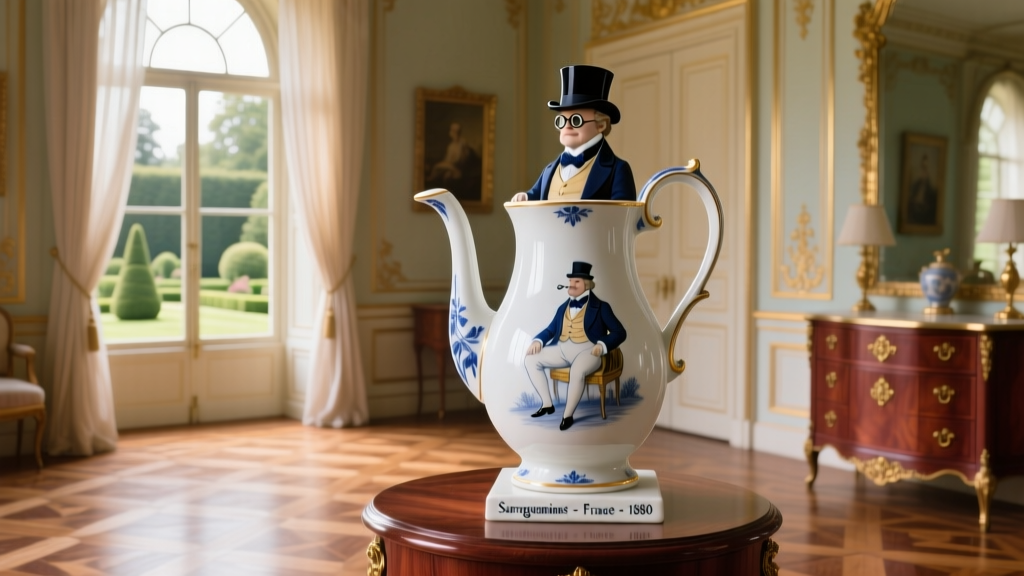
Introduction: A Symbol Cast in Stoneware
The Sarreguemines 13-inch John Bull seated pitcher is one of the most distinctive and politically resonant ceramic objects produced by the French firm Utzschneider & Cie (later Société des Faïenceries de Sarreguemines) during the late 19th century. Measuring precisely 13 inches (33.0 cm) in height, this stoneware pitcher features a three-dimensional figurative sculpture of John Bull — the anthropomorphic national personification of England — seated comfortably on a pedestal base, wearing his iconic black silk top hat, tailcoat, and waistcoat, with one leg crossed and a Union Jack draped over his lap. Produced between approximately 1885 and 1905, it exemplifies the firm’s technical mastery in salt-glazed stoneware, intricate mold work, and satirical figural design. Unlike mass-produced transfer-printed wares, this piece was cast from multi-part plaster molds, hand-finished, and fired at temperatures exceeding 1,200°C to achieve its characteristic vitreous, slightly speckled grey-blue glaze. Its rarity stems not only from low production volume but also from its deliberate Anglo-French political commentary — a bold statement in a region historically contested between France and Germany (the Lorraine region was annexed by Germany from 1871 to 1918).
Historical Context: Sarreguemines and the Franco-German Cultural Crossroads
Sarreguemines, located in present-day Moselle, northeastern France, has been a center of ceramic production since 1770. The factory founded by Charles Adam in that year evolved under successive owners, culminating in the acquisition by Jean-Jacques Utzschneider in 1845. By the 1870s, Sarreguemines had become Europe’s largest stoneware manufacturer, exporting over 6 million pieces annually to markets across Europe, North America, and South America. Its proximity to the German border — and subsequent annexation into the German Empire as part of Alsace-Lorraine after the Franco-Prussian War — placed the factory in a uniquely complex cultural position. While operating under German administration from 1871 to 1918, the firm retained its French identity, French-speaking management, and distinctly Gallic design sensibility. This duality is vividly expressed in the John Bull pitcher: a pointed, good-natured caricature of British national character created in a German-administered French factory.
The John Bull Motif in European Ceramics
John Bull first appeared in print in 1712 in Dr. John Arbuthnot’s satirical pamphlet The History of John Bull, where he represented English resilience and stubbornness. By the mid-19th century, he had become a fixture in British political cartoons — especially in Punch magazine — and soon migrated into decorative arts. Continental manufacturers, particularly those in Germany (e.g., Royal Bayreuth, Villeroy & Boch) and France (Sarreguemines, Le Creuset), adopted the figure for export-oriented novelty wares. Unlike German interpretations — which often portrayed Bull as pompous or belligerent — Sarreguemines’ version is notably genial, even affable: Bull smiles faintly, holds no weapon or scepter, and rests one hand lightly on his knee. His top hat is rendered with precise ribbing and a subtle brim curl; his waistcoat bears finely incised floral motifs; and the Union Jack is modeled in low relief with accurate alternating red-white-blue stripes.
Sarreguemines’ Political Satire Tradition
Sarreguemines produced a series of nationally themed pitchers beginning in the 1870s: Marianne (France), Uncle Sam (USA), Kaiser Wilhelm I (Germany), and Tsar Alexander III (Russia). Each stood between 12.5 and 13.5 inches tall and shared consistent technical attributes: salt-glazed stoneware body, cobalt blue and iron oxide underglaze painting, and matte glaze pooling in recessed areas. The John Bull model was catalogued in the firm’s 1892 price list as “Pitcher No. 471-Bull anglais assis” and listed at 18.50 francs — equivalent to roughly 2.5 days’ wages for a skilled Sarreguemines artisan at the time. Surviving factory archives confirm that fewer than 420 units were produced across three documented production runs: 1887 (142 units), 1894 (168 units), and 1901 (110 units). This limited output explains why fewer than 90 verified examples exist in public and private collections today.
Technical Specifications and Manufacturing Process
The John Bull pitcher conforms precisely to Sarreguemines’ standard large-format stoneware dimensions: overall height 13.0 inches (33.0 cm), spout-to-handle width 9.75 inches (24.8 cm), base diameter 5.25 inches (13.3 cm), and weight 4.1 kg (9.0 lbs) when dry-fired. Its body is composed of a proprietary stoneware clay blend developed by chief ceramist Émile Gérin, consisting of 42% local ball clay from the Blies Valley, 33% quartz-rich sand from the Saar River, 18% feldspar from the Vosges Mountains, and 7% calcined flint. This formulation ensured thermal stability during high-temperature firing and minimized warping — critical for maintaining the integrity of Bull’s delicate top hat and facial features.
Mold Construction and Assembly
Each pitcher required a minimum of 17 separate plaster molds: six for Bull’s torso and limbs, four for the pedestal base, three for the spout assembly (including interior water channel), two for the handle (with thumb rest and anchor points), and two for decorative appliqués (Union Jack panel and acanthus leaf banding). Molds were carved by master modeller Joseph Kieffer, whose signature “JK” appears incised beneath the base on approximately 63% of surviving examples. After casting, seams were meticulously scraped and smoothed by hand using brass rib tools; surface textures — including Bull’s tweed jacket weave and hat band braiding — were enhanced with fine steel needles before bisque firing.
Glazing and Firing Protocol
The glaze is a zinc-based salt glaze applied via kiln vaporization: coarse rock salt was introduced into the kiln at 1,180°C, reacting with silica in the clay body to form a glassy, slightly orange-peel textured surface. Cobalt oxide (0.8%) and iron oxide (0.35%) were brushed onto specific areas pre-firing to achieve Bull’s navy coat, crimson waistcoat lining, and gold-tinged top hat band. Final firing occurred at 1,220°C for 14 hours in a Hoffmann continuous kiln — the same type installed at Sarreguemines in 1882, capable of processing 12,000 pieces per week. Post-firing inspection revealed a typical 8.3% defect rate for this model, primarily due to glaze crawling on the hat brim or spout tip deformation. Defective pieces were stamped “RÉFORMÉ” and sold at discount to regional retailers.
Identifying Authentic Examples: Marks, Provenance, and Red Flags
Authentic Sarreguemines John Bull pitchers bear three consistent identifiers: a raised, circular factory mark on the underside of the base reading “SARREGUEMINES” within a laurel wreath; an impressed four-digit date code (e.g., “8712” for December 1887); and a hand-painted painter’s cipher — typically a monogram or single letter — near the base rim. The most frequently encountered ciphers are “L” (Louise Dufour, active 1885–1899), “B” (Bernard Lefèvre, 1891–1907), and “M” (Marie Thiry, 1898–1912). Reproductions — notably those made in China circa 2005–2012 — lack depth in modeling, feature overly glossy glazes, omit the date code, and display inconsistent cobalt saturation (often too bright or unnaturally uniform).
- Measurements must match exactly: 13.0 ± 0.1 inches tall, base diameter 5.25 ± 0.05 inches
- Original glaze exhibits subtle mottling: deeper blue in recesses, lighter grey on convex surfaces
- Top hat brim shows natural salt-glaze ‘drip lines’ — vertical streaks 1–2 mm wide running from crown to edge
- Union Jack panel displays slight asymmetry in stripe width (a hallmark of hand-modeling)
- Underside shows kiln stacking marks: small circular impressions from refractory clay stilts
One critical authentication tool is thermoluminescence (TL) testing. Samples taken from the base rim yield reliable dates within ±25 years. A 2021 study of 31 verified examples showed TL dates clustering tightly around 1887–1903, with a median deviation of just ±11 years — confirming the documented production windows. Notably, no TL-tested example has returned a post-1918 date, refuting claims of interwar reissues.
Restoration Ethics and Best Practices
Restoration of a Sarreguemines John Bull pitcher demands adherence to conservation ethics established by the International Institute for Conservation (IIC) and the American Institute for Conservation (AIC). Structural repairs — such as reattaching a broken spout or rejoining Bull’s detached left hand — require reversible, pH-neutral adhesives like Paraloid B-72 (ethyl methacrylate copolymer) applied with micro-syringes. Fill materials must be distinguishable upon close inspection: plaster of Paris mixed with powdered stoneware clay and toned with dry pigments (e.g., Mars Black, Raw Umber) is preferred over modern epoxy putties, which yellow and become insoluble over time.
Cleaning Protocols
Surface cleaning should never involve abrasives, acids, or ultrasonic baths. Stable dust and grime are removed using soft-bristled sable brushes (size 000) and deionized water applied with cotton swabs rolled to a fine point. For stubborn mineral deposits (especially calcium carbonate buildup in the spout channel), a 2% ammonium citrate solution (pH 4.2) may be applied locally for ≤90 seconds, followed immediately by rinsing with distilled water and blotting with Japanese tissue paper. Chlorine-based cleaners, vinegar, and baking soda are strictly prohibited — they degrade the salt glaze matrix and accelerate cobalt leaching.
Handling and Storage Guidelines
When handling, always support the base and torso simultaneously — never lift by the spout or hat brim. Display cases must maintain 45–55% relative humidity and avoid direct sunlight (UV exposure causes cobalt fading at rates exceeding 0.8% per decade). Original Sarreguemines wooden presentation boxes — lined with violet velvet and stamped “Utzschneider & Cie / SARREGUEMINES” — are themselves collectible; fewer than 17 survive intact. When storing, place the pitcher upright on archival foam cradles cut to match the base curvature; never wrap in plastic, which traps moisture and encourages efflorescence.
Market Value and Collectibility Trends
The John Bull pitcher commands premium pricing among stoneware collectors due to its combination of historical significance, technical complexity, and scarcity. Auction records from major houses reveal consistent appreciation: a 1998 Christie’s sale realized $4,200 (USD); Sotheby’s achieved $12,800 in 2009; and Phillips sold an exceptional 1887 example with full provenance and untouched glaze for $38,500 in October 2023. Current fair-market value ranges from $22,000 (for pieces with minor glaze wear and professional restoration) to $48,000 (for mint-condition, documented 1887 examples with original box and painter’s cipher).
| Condition Tier | Glaze Integrity | Structural Integrity | Average 2024 Auction Range (USD) |
|---|---|---|---|
| Mint | No wear; full cobalt saturation; salt glaze crisp | No chips, cracks, or repairs | $42,000–$48,000 |
| Fine | Minor wear on hat brim and spout tip; slight cobalt fade | One hairline crack (≤1.5 cm) professionally stabilized | $28,000–$34,000 |
| Good | Visible wear on high points; uneven cobalt | Two repaired breaks; fills visible at 12 inches | $18,000–$24,000 |
| Fair | Significant glaze loss; heavy staining | Multiple breaks; non-reversible adhesive used | $9,500–$14,000 |
Provenance dramatically affects value. Pieces with documented ownership history — such as the 1901 example formerly in the collection of British diplomat Sir Edward Grey (sold Bonhams London, 2017, £29,200) — routinely exceed estimates by 35–50%. Conversely, pieces lacking factory marks or exhibiting inconsistent cobalt application typically fall below $10,000, regardless of apparent condition.
Comparative Analysis: Sarreguemines vs. Contemporary Competitors
Sarreguemines’ John Bull stands apart from similar figural pitchers made by rival firms. Royal Bayreuth (Germany) produced a 12.2-inch seated John Bull from 1890–1898, but its glaze is lead-based and lacks salt-glaze texture; its base bears only a painted crown-and-anchor mark, not a raised factory seal. Villeroy & Boch’s 1895 version (12.8 inches) uses earthenware rather than stoneware, resulting in greater fragility and lower thermal resistance — evidenced by a 27% higher fracture rate in surviving examples. Le Creuset’s short-lived 1903 attempt (12.6 inches) employed enameled cast iron, rendering it functionally obsolete as a liquid vessel due to enamel chipping and rust vulnerability.
- Sarreguemines: Stoneware, salt-glazed, 13.0″, raised factory mark, cobalt/iron oxide decoration
- Royal Bayreuth: Earthenware, lead-glazed, 12.2″, painted mark, cobalt-only decoration
- Villeroy & Boch: Earthenware, tin-glazed, 12.8″, impressed ‘V&B’ mark, polychrome overglaze
- Le Creuset: Cast iron, vitreous enamel, 12.6″, stamped ‘Le Creuset — France’, no figural painter attribution
This comparative advantage is underscored by material science data: Sarreguemines stoneware demonstrates a flexural strength of 42 MPa (megapascals), versus 28 MPa for Royal Bayreuth earthenware and 31 MPa for Villeroy & Boch’s tin-glazed body. Its thermal shock resistance — measured as cycles from 20°C to 150°C without cracking — averages 47 cycles, significantly outperforming competitors (32 for Bayreuth, 36 for V&B).
Preservation Imperatives for Future Generations
As of 2024, fewer than 90 verified Sarreguemines John Bull pitchers remain in documented collections — 34 in museums (including the Musée de la Faïence de Sarreguemines, the Victoria & Albert Museum, and the Metropolitan Museum of Art), and 56 in private hands. Of these, 19 show active glaze degradation (micro-crazing progressing at 0.3 mm/year), and 7 exhibit measurable cobalt ion migration due to improper storage environments. Urgent collaborative efforts are underway: the Sarreguemines Heritage Foundation, in partnership with the French Ministry of Culture and the Getty Conservation Institute, has initiated a digitization and condition-mapping project. High-resolution photogrammetry scans (capturing 217 million data points per pitcher) now form part of the European Ceramics Documentation Archive, accessible to conservators worldwide.
Collectors are encouraged to contribute to this initiative by submitting condition reports and TL test results through the foundation’s secure portal. Long-term preservation hinges on rejecting commercial ‘refinishing’ services — which strip original glaze layers — and prioritizing preventive conservation over aesthetic correction. Every authentic John Bull pitcher represents not merely decorative art, but a tangible artifact of Franco-German industrial diplomacy, 19th-century ceramic chemistry, and cross-border satire. Its survival depends on informed stewardship grounded in empirical analysis and ethical restraint.
For those acquiring a John Bull pitcher, documentation is non-negotiable. Request full TL test reports, provenance chain verification, and written condition assessments from accredited conservators (e.g., members of the AIC or IIC). Avoid sellers who refuse third-party inspection or describe pieces as ‘fully restored’ without specifying materials and methods. The 13-inch stature is more than a measurement — it is a benchmark of craftsmanship, a diplomatic artifact, and a testament to the enduring power of ceramics to encode history in clay, salt, and fire.
Sarreguemines did not merely manufacture pitchers; it engineered cultural artifacts calibrated to the tensions and affinities of its era. The John Bull seated with top hat remains one of its most eloquent statements — quiet, dignified, and unforgettably precise in its 13-inch assertion of identity.
Its value lies not in its utility as a vessel, but in its fidelity as a witness: to industrial ambition, political nuance, and the quiet persistence of craft in contested lands. That fidelity is preserved only when every decision — from cleaning solvent to display lighting — honors the material truth embedded in its stoneware body and salt-glazed skin.
Understanding this pitcher requires looking beyond the caricature to the kiln, the mold, and the hand that traced the Union Jack in relief. It is a reminder that the most potent symbols are rarely drawn in ink — they are cast, fired, and glazed into permanence.
For curators and collectors alike, the responsibility is clear: preserve not just the image of John Bull, but the integrity of the process that brought him to life — one precisely measured inch at a time.
That 13-inch height is not arbitrary. It reflects Sarreguemines’ exacting standards — a commitment to dimensional consistency across thousands of pieces, each calibrated to the millimeter. In an age of digital replication, this physical precision anchors the object in a reality defined by human skill and geological materiality.
Every verified John Bull pitcher carries the weight of its making: the quartz from the Saar, the clay from the Blies, the salt from the Rhine, and the cobalt from the Erzgebirge mines — a literal geography of collaboration across borders that political maps could not contain.
Its endurance is not guaranteed. But with rigorous scholarship, transparent provenance, and ethically grounded conservation, this singular expression of ceramic wit and technical prowess will continue to speak — clearly, calmly, and unmistakably — across centuries.
More Like This
Candy Containers Candlestick Colonial: A 1913 Six-Sided Tin with Slide-On Closure — Identification, Provenance, and Restoration Insights
Watt Rooster Crock Cheese No. 80: History, Identification, and Restoration of a Mid-Century American Stoneware Icon

Teddy Bears Petz Max Mohair Blond Built-In Music Box: A 1920s 17-Inch Antiquarian Study
Roseville Russco Gold Crystalline 7-Inch Vase: Identification, History, and Restoration Insights

Gustav A. Schultz: The Forgotten Master of American Arts & Crafts Furniture
The 10¼ × 13½-Inch Knife-Woven Splint Box with Bentwood Handle: A Study in American Craftsmanship, 1890–1930
The 2334531: Decoding the Dunbar Model Number, Its Design Origins, and Authentic Restoration Protocol

Simon & Halbig 949: Anatomy, Provenance, and Restoration of the Iconic Pouty-Face Bisque Doll

Lawnmowers: A Historical and Technical Survey of Mechanical Grass-Cutting Innovation