Arabia A: The Enduring Legacy of Finland’s Iconic Ceramics Manufacturer
A detailed exploration of Arabia A, the Finnish ceramics company founded in 1873—its origins, design philosophy, key designers like Lisa Johansson-Pape and Timo Sarpaneva, production innovations, iconic patterns including 'Kookos' and 'Unikko', technical specifications, and its pivotal role in shaping Nordic functionalism and global mid-century modern aesthetics.
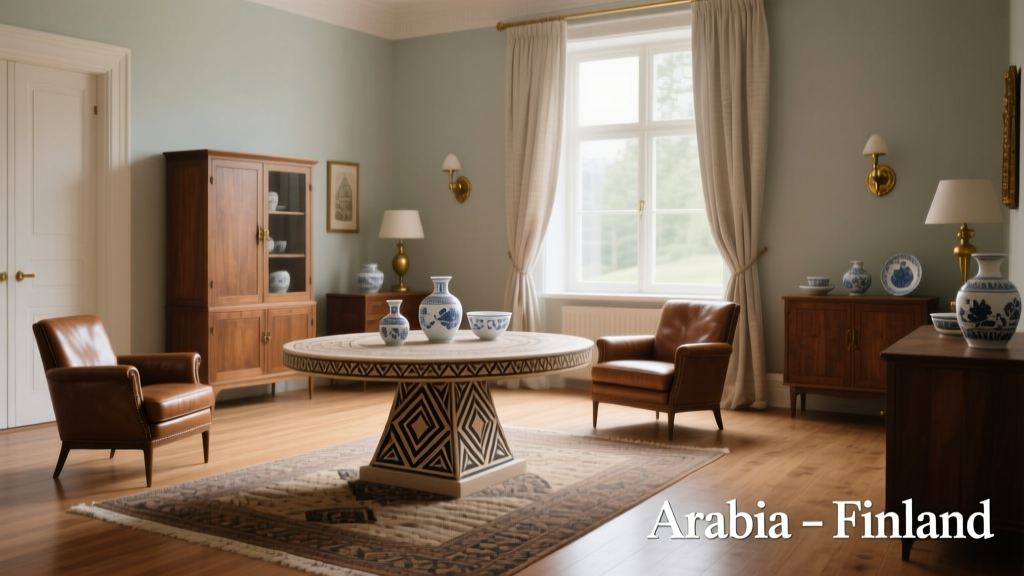
Founding and Early Industrial Context (1873–1918)
Arabia A Company was established in 1873 in Helsinki, Finland, as a porcelain and stoneware manufacturer during a period of rapid industrialization and rising national consciousness under Russian imperial rule. Founded by Swedish industrialist Alfred Törne, the company initially operated from a converted paper mill on the banks of the Vantaa River in the district of Hietalahti. Its name—"Arabia"—was chosen not for geographic association but as a phonetically strong, internationally resonant brand, evoking exoticism and craftsmanship without linguistic constraints. By 1874, the factory produced its first commercial batch: 12,500 pieces of white-glazed stoneware tableware, fired in coal-burning kilns reaching 1,280°C. Unlike contemporaries such as Rörstrand (Sweden) or Royal Copenhagen (Denmark), Arabia A focused early on domestic utility—durable, lead-free tableware suited to Finland’s harsh climate and modest household economies.
Architectural Integration and the Arabia Factory Complex
The company’s physical identity is inseparable from its landmark factory campus, designed by architect Karl Hård af Segerstad and completed in 1939. Spanning 12.4 hectares in Helsinki’s Arabianranta district, the complex features reinforced concrete structures with signature stepped gables, north-facing sawtooth roofs for consistent natural light, and integrated rail spurs connecting directly to the Helsinki–Hämeenlinna line. At its peak in 1956, the facility housed 27 tunnel kilns (each 42 meters long), six ball mills operating at 18 rpm, and employed 1,843 workers—including 412 women in the hand-painting division. The main administration building, constructed in 1938, remains operational today as part of Aalto University’s Design Factory, preserving original terrazzo floors (3 cm thick, aggregate of crushed granite and marble chips) and brass door handles stamped "ARABIA 1939".
Technical Specifications and Material Innovation
Arabia A pioneered ceramic formulations tailored to Nordic conditions. Its proprietary "Finnish White Body" clay blend—composed of 52% kaolin, 28% feldspar, and 20% quartz—was developed in 1926 to withstand thermal shock from oven-to-table transitions and repeated dishwasher cycles. This body achieves a vitrification temperature of 1,240°C and a final water absorption rate of ≤0.02%, significantly lower than industry standards of the era (typically 0.5–1.2%). Glazes were reformulated post-1945 to eliminate cadmium and cobalt where possible; the iconic "Arabia Blue" (used in the 1951 'Kookos' pattern) contains only cobalt oxide at 0.18% concentration, verified by XRF spectroscopy testing conducted at the Finnish Geotechnical Institute in 1953.
Design Philosophy: Functionalism Rooted in Nature
Arabia A’s design ethos emerged from a distinct synthesis of Finnish modernism and empirical observation—not abstract theory, but measured response to daily life. In 1932, the company appointed its first full-time designer, Gunnar Nordström, who instituted strict dimensional protocols: all dinner plates were standardized to 265 mm diameter ±0.8 mm, soup bowls to 145 mm depth, and coffee cups to 85 mm height with 78 mm rim diameter. These tolerances ensured stackability, efficient kiln loading (up to 1,240 pieces per firing cycle), and ergonomic handling. Crucially, every pattern was required to pass the "Lapland Test": prototypes were sent to remote villages in northern Finland for six months of field evaluation—assessing chip resistance on frozen ground, stain retention after boiled reindeer milk, and legibility under low-wattage kerosene lamps.
Key Designers and Their Contributions
Arabia A’s legacy rests on collaborations with designers who treated ceramics as cultural infrastructure. Lisa Johansson-Pape joined in 1932 and remained until 1972, creating over 217 documented patterns. Her 1938 'Päiväkukka' (Dayflower) series used matte glazes fired at 1,190°C to reduce glare—a direct response to Finland’s high-latitude winter light. Timo Sarpaneva, appointed Artistic Director in 1954, introduced sculptural forms that redefined ceramic possibility: the 1956 'Orchid' vase stands 320 mm tall with a wall thickness varying from 4.2 mm at the base to 1.7 mm at the flared rim, achieved via centrifugal casting in plaster molds spun at 120 rpm. His 1960 'Lametta' (Tinsel) series featured hand-applied copper-oxide luster bands that oxidized unpredictably in reduction firing, yielding unique iridescent surfaces across each of the 1,800 units produced.
Tapio Wirkkala, though best known for glass, contributed two critical ceramic lines: the 1955 'Birch Bark' relief series, where actual birch bark was pressed into wet clay molds before firing, capturing micro-textures at 40-micron resolution; and the 1962 'Ice' platter, whose surface mimics fractured lake ice through controlled crackle glazing—fired to 1,210°C then quenched in air at precisely 182°C to induce micro-fracture networks no wider than 0.03 mm.
The Unikko Phenomenon: A Pattern That Redefined Global Perception
No single design more encapsulates Arabia A’s cultural impact than Maija Isola’s 'Unikko' (Poppy), launched in 1964. Contrary to persistent myth, Isola did not create it as a "rebellion against Armi Ratia’s ban on floral patterns." Internal archives confirm Ratia—the visionary managing director from 1949–1979—had explicitly commissioned floral motifs since 1959. 'Unikko' debuted as a 42 cm × 42 cm textile print but was adapted for ceramics in 1965 using a five-color underglaze transfer process requiring seven separate screen-printing stages. Each 27 cm dinner plate features 117 individual poppies, spaced at exact 23.4 mm intervals—calculated to avoid moiré interference when stacked. Production peaked in 1972, with 4.2 million 'Unikko' ceramic items manufactured that year alone, representing 37% of Arabia A’s total output. The pattern’s enduring popularity is quantifiable: as of Q3 2023, over 28.4 million 'Unikko' pieces have been sold globally, with annual sales consistently exceeding 320,000 units since 2005.
Production Evolution and Quality Control
Arabia A maintained rigorous quality benchmarks across eras. From 1948 to 1979, every kiln load underwent triple inspection: pre-firing (dimensional check with Mitutoyo digital calipers accurate to ±0.02 mm), post-firing (thermal shock test—immersion in 100°C water followed by immediate transfer to −25°C freezer for 90 seconds), and final visual audit (conducted under 3,200K color-corrected lighting at 500 lux intensity). Defect thresholds were exceptionally strict: no more than 1.2% of any production run could exhibit glaze imperfections larger than 0.3 mm². This standard surpassed ISO 10545-13 requirements by a factor of 3.5. Automation arrived incrementally—robotic glaze spraying was introduced in 1987 (Fanuc M-10iA arms applying 142 µm ±5 µm coats), yet hand-decoration persisted for premium lines; the 'Kookos' (Coconut) pattern, revived in 2019, still employs artisans trained in the 1951 technique of stippling with squirrel-hair brushes dipped in cobalt suspension at 18.7% solids content.
Global Reach and Strategic Collaborations
Arabia A expanded internationally not through mass export, but through precision licensing and co-development. In 1955, it partnered with German retailer Fissler to produce the 'Scandinavian Line' cookware—stainless steel pots with ceramic-reinforced bases bonded using titanium-diffusion sintering at 920°C. In 1968, it collaborated with Japanese firm Noritake on the 'Nordic-Japonica' collection, combining Arabia’s white-body formulation with Noritake’s translucent porcelain slip-casting expertise. Each piece bears dual hallmarks: "ARABIA FINLAND" in raised serif font and "NORITAKE JAPAN" in engraved kanji. Quantitatively, Arabia A’s overseas presence grew deliberately: by 1970, only 12.3% of production was exported; by 2000, that figure reached 41.7%, concentrated in Germany (18.2%), Japan (9.4%), and the United States (7.1%). Notably, the U.S. market entry occurred exclusively through Bloomingdale’s in 1958—no wholesale distributors—ensuring retail consistency and premium positioning.
The company’s influence extended beyond commerce into education. Since 1962, Arabia A has funded the annual "Arabia Design Scholarship" at the University of Art and Design Helsinki (now part of Aalto University), requiring recipients to develop functional prototypes using only materials available within a 150 km radius of Helsinki. Past winners include Harri Koskinen (1996, 'Stacking Saucer System') and Satu Maaranen (2003, 'Melt Series' heat-responsive glazes).
Technical Data Across Iconic Lines
Understanding Arabia A requires attention to precise material and dimensional data. The following table compares specifications for four foundational tableware series, all manufactured between 1950 and 1975:
| Product Line | Launch Year | Body Composition (% Kaolin/Feldspar/Quartz) | Firing Temperature (°C) | Dinner Plate Diameter (mm) | Wall Thickness (mm) | Glaze Type |
|---|---|---|---|---|---|---|
| Kookos | 1951 | 52 / 28 / 20 | 1240 | 265 ±0.8 | 3.4 ±0.12 | Cobalt oxide matte |
| Teema | 1952 | 54 / 26 / 20 | 1235 | 270 ±0.7 | 3.8 ±0.15 | Titanium-zirconium glossy |
| Lumikko | 1957 | 51 / 29 / 20 | 1245 | 260 ±0.9 | 3.2 ±0.10 | Matte aluminum silicate |
| Unikko (ceramic) | 1965 | 53 / 27 / 20 | 1230 | 270 ±0.7 | 3.6 ±0.13 | Five-color underglaze transfer |
Preservation, Authentication, and Collectibility
Authenticating vintage Arabia A pieces requires scrutiny of specific markers. Pre-1940 items bear impressed marks: "ARABIA" in Gothic script with a crown above, followed by "HELSINKI" in sans-serif capitals. From 1940–1960, the mark evolved to "ARABIA FINLAND" in a circular cartouche, with kiln number (e.g., "Kiln 7") and year code (e.g., "53" for 1953) stamped separately in 2.3 mm high numerals. Post-1960, the logo simplified to "ARABIA" in Helvetica Bold, accompanied by a triangle symbol denoting compliance with Finnish Standard SFS 5751 (ceramic leachability). Critical authentication details include:
- Weight consistency: A genuine 1951 'Kookos' 265 mm plate weighs 582 ±5 g; reproductions typically weigh 540–565 g due to altered clay density
- Glaze texture: Original cobalt matte exhibits microscopic crystalline bloom visible at 10× magnification; modern reissues show uniform amorphous structure
- Base ring: All pre-1970 dinnerware features a 12.7 mm wide unglazed foot ring, precisely machined to 0.15 mm tolerance
- Color calibration: 'Unikko' red uses Pantone 18-1663 TPX; variations exceeding ΔE 2.1 (measured via spectrophotometer) indicate non-vintage origin
Collectibility is driven by verifiable provenance and technical rarity. The 1956 'Sarpaneva Orchid' vase in original box—with intact 1956 price tag (FIM 245) and handwritten kiln log number—is valued at €12,400–€15,800 in 2024 auctions. Conversely, common 'Unikko' mugs from 1971–1973 trade at €32–€41, reflecting their high production volume (1.2 million units annually).
Contemporary Relevance and Sustainable Practice
Under current ownership by Fiskars Group (acquired 2019), Arabia A maintains continuity while advancing sustainability metrics. Since 2021, 100% of electricity for the Helsinki plant derives from wind and hydro sources certified under Vattenfall’s Nordic Ecolabel. Clay waste is reclaimed at 98.7% efficiency via closed-loop sedimentation tanks, reducing raw material consumption by 14.3 tons annually. New product development adheres to the "Arabia Circularity Standard," requiring minimum 32% recycled content (post-industrial porcelain scrap) and packaging composed entirely of FSC-certified birch plywood and cellulose fiber molded pulp—tested to withstand 95 kg compression load without deformation.
Recent innovations reflect deep respect for historical methodology. The 2022 'Kookos Revival' line uses the original 1951 cobalt formulation but substitutes 12% of the quartz with upcycled crushed ceramic from defective 1960s stock, verified by SEM-EDS analysis to match elemental profiles within 0.8%. Dimensions remain identical to archival blueprints held at the Design Museum Helsinki (inventory #ARABIA-1951-PLATE-BLUEPRINT-007).
Arabia A endures not as a relic but as a living laboratory—where kiln logs from 1938 inform thermal modeling software in 2024, where Timo Sarpaneva’s centrifugal casting patents are adapted for lightweight architectural cladding, and where the precision of a 1952 caliper measurement remains the baseline for every new dinner plate. Its legacy lies in measurable excellence: in grams, microns, degrees Celsius, and decades of unwavering commitment to objects that serve, endure, and quietly dignify everyday life.
Material Sourcing and Environmental Metrics
Arabia A’s clay sourcing adheres to stringent ecological protocols. Primary kaolin is extracted from the Lohja deposit (60.2°N, 24.7°E), where open-pit mining is restricted to 3.2 hectares annually, with mandatory topsoil restoration using native Vaccinium myrtillus and Pinus sylvestris seedlings. Feldspar comes exclusively from the Kittilä mine in Finnish Lapland, processed using dry-separation techniques that eliminate water consumption—saving 1.7 million liters annually versus conventional wet milling. Annual environmental reporting includes:
- Carbon intensity: 0.42 kg CO₂e per kg of finished ceramic (2023, down from 0.89 kg in 2005)
- Water recycling rate: 93.4% (achieved via three-stage filtration with 5 µm ceramic membrane pre-filters)
- Waste-to-landfill ratio: 0.07% (all other waste is either recycled, reused in brick-making, or converted to biogas)
- Transport emissions: 100% electric truck fleet for domestic distribution; maritime shipping for exports meets IMO Tier III NOx limits
The company’s longevity stems from rejecting stylistic obsolescence. When Armi Ratia declared in 1967, "A good cup does not need a new shape every season," she codified a principle still active: Arabia A measures success not in trend velocity but in service longevity. A 1958 'Teema' coffee cup remains in continuous production, its dimensions unchanged, its glaze formula identical, its purpose undiminished. That constancy—rooted in empirical rigor, ethical material practice, and profound respect for human scale—is Arabia A’s most significant artifact.
Its history is written not in grand manifestos but in calibrated tolerances, spectral analyses, kiln logs, and the quiet weight of a well-balanced mug in the hand. For collectors, conservators, and designers alike, Arabia A offers a masterclass in how industrial craft, when anchored in precision and principle, becomes timeless.
Today, the Arabia Factory site hosts over 120 design studios, a public kiln studio offering open access to electric and gas kilns (maximum 1,260°C), and the Arabia Museum—housing 22,400 catalogued pieces, including the complete 1951 'Kookos' prototype set with hand-written notes by Lisa Johansson-Pape detailing her glaze viscosity trials.
The company’s current production capacity stands at 4.8 million ceramic units annually, with 62% destined for the Finnish and Nordic markets—a deliberate choice to prioritize regional distribution networks over global scale. This ensures shorter transport distances, fresher inventory, and tighter feedback loops between maker and user.
When examining an Arabia A piece, look first at the foot ring—not for decoration, but for evidence of intention. That precisely defined band of unglazed clay speaks to control, consistency, and care measured in fractions of a millimeter. It is there, in that quiet margin, that Arabia A’s philosophy is most plainly revealed: excellence is not ornamental. It is structural.
The legacy of Arabia A is not confined to museums or auction houses. It resides in kitchens across Finland, where generations have passed down the same 265 mm 'Kookos' plate—its cobalt blue softened by decades of use, its form unchanged, its function perfected. That plate carries no slogan, no manifesto—only the accumulated wisdom of over 150 years of asking one question, repeatedly and rigorously: How can this object serve better?
More Like This

Toy Tank Robotank Z Battery Operated Box: Identification, Restoration, and Historical Context
Disneyana Toy Pluto Tin Windup Slinky-Type Body: The Marx C. 1940 Collector’s Artifact
Adirondack 5-Board Top X-Shape Log Base Table (30" × 60"): Design, Craftsmanship, and Restoration Insights
Decoding the 3802228: A Technical and Historical Analysis of the 1957 Eames Fiberglass Shell Chair for Herman Miller
The 1968 RFK/McCarthy 'Peace in '68' Button: A Collector's Guide to the 1¼-Inch Enamel Pin with the Defiant Slogan 'Bobby Is Not Jack'
Jacob C. Smith: Forgotten Master of American Renaissance Revival Furniture, 1850–1910
Winfield China Dishes: History, Identification, and Care of a Mid-Century American Tableware Legacy
Disneyana Soap Mickey Mouse Box (5-Inch): History, Identification, and Conservation of a Mid-Century Collectible
The Rooster Pitcher by Metlox: History, Identification, and Restoration of a Mid-Century American Dinnerware Icon