Any Idea of the Value of This? A Practical Guide to Authenticating and Appraising Antique Furniture
A no-nonsense, expert-level appraisal framework for antique furniture owners—covering construction clues, maker’s marks, period-specific materials, documented market values, and red flags that slash value by 70% or more.
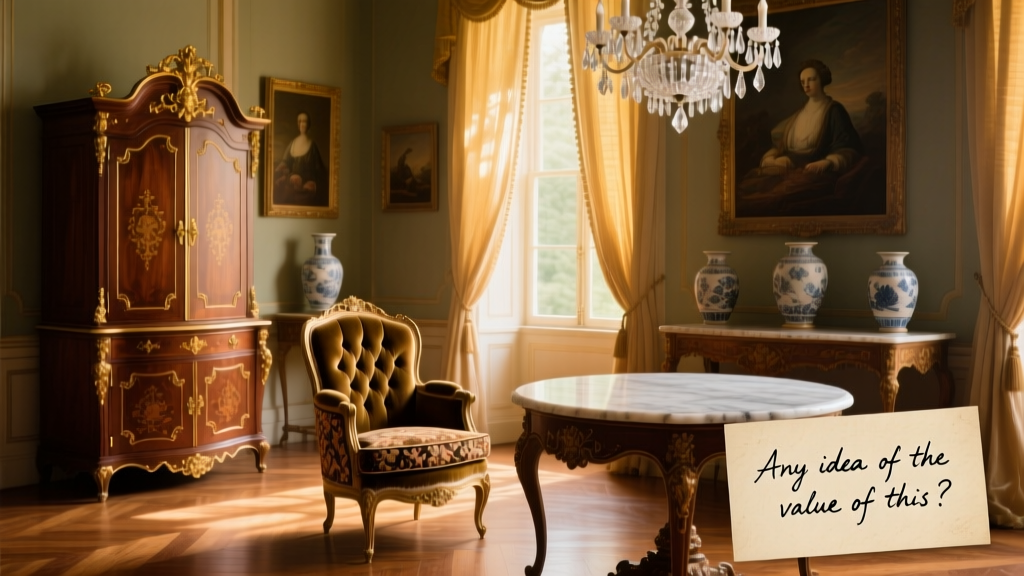
Why 'Any Idea of the Value of This?' Is the Wrong First Question
Before estimating dollar amounts, experienced appraisers ask: What is it, exactly? A mahogany Chippendale-style sideboard from 1785 isn’t the same as a 1930s reproduction labeled 'Chippendale Revival'—even if both sit in your dining room. Value hinges on verifiable provenance, originality, structural integrity, and documented market comparables—not visual similarity alone. In 2024, a genuine George Hepplewhite satinwood commode (c. 1775–1780) sold at Sotheby’s London for £218,000; a near-identical 1920s Liberty & Co. copy with replaced brasses and veneer lifts fetched £1,950 at Dreweatts. That 99% delta stems from three factors: wood species verification, tool-mark analysis, and documented chain of custody. This article equips you with concrete diagnostic tools—not speculation—to move beyond 'any idea' toward actionable, evidence-based valuation.
Step One: Identify the Maker, Period, and Region—Not Just the Style
Style is decorative language; period and origin are forensic facts. A piece stamped 'J. & J. S. D. W. & CO. LONDON' on a drawer interior points to James & John Shoolbred & Co., active 1810–1850, known for Regency rosewood library tables with turned sabre legs and brass paw feet. But style alone misleads: Sheraton-style chairs appeared continuously from 1790 through the 1950s. Key identifiers include:
- Dovetail joints: Hand-cut dovetails (irregular, tapered, 4–6 pins per inch) predate 1880; machine-cut versions (uniform, straight-sided, 8+ pins) signal post-1890 manufacture.
- Wood grain consistency: Genuine walnut veneer from 1750–1820 shows tight, interlocked grain with natural fiddleback figure; post-1900 imitations use dyed maple with painted grain lines visible under 10x magnification.
- Hardware patina: Original brasses exhibit even, honey-colored oxidation; replated hardware glows yellow or pink and lacks micro-pitting from centuries of hand contact.
A 1910s Waring & Gillow 'Georgian Revival' oak dining table (measuring 78" L × 42" W × 29.5" H) often carries a stamped paper label inside the drawer—but that label alone proves nothing. The real test lies beneath: examine the underside for chalk marks ('W&G 1427'), saw kerf width (hand-sawn = 0.035"–0.045" vs. band-saw = 0.018"), and secondary wood (original English pieces use deal pine; reproductions substitute poplar or birch).
How to Read a Maker’s Mark Without Getting Fooled
Makers’ stamps were rarely applied consistently before 1900. Thomas Chippendale never branded his work—his name was used by competitors as early as 1770. Reliable marks appear on high-value case pieces: Thomas Sheraton’s firm used a stamped 'T.S.' within an oval on cabinet backs (c. 1790–1806); Duncan Phyfe stamped 'D. PHYFE & SON' in block capitals on New York-made rosewood card tables (1815–1847). Crucially, the stamp must be in situ—not inked over later repairs. A 1932 Baker Furniture Co. 'Hepplewhite' chest-on-chest bears a foil label reading 'Baker Brand—Est. 1890'; this confirms 20th-century origin, not 18th-century value.
Material Science: What the Wood and Finish Reveal
Antique furniture isn’t just old—it’s chemically distinct. Pre-1850 finishes used shellac dissolved in alcohol (French polish), yielding a warm, slightly soft surface that fluoresces orange under UV light. Post-1890 commercial varnishes (e.g., Zinsser Bulls Eye, introduced 1910) create hard, plastic-like films with blue-white fluorescence. A 1795 Adam-style satinwood bookcase tested with a cotton swab dampened in denatured alcohol will show slight tackiness and lift minute shellac flakes; modern polyurethane resists dissolution entirely.
Veneer thickness is equally diagnostic. Authentic Georgian-period mahogany veneer measures 1/16"–3/32" thick; Victorian-era veneers (1837–1901) average 1/32"; mid-century reproductions dip to 1/64" or less—visible as 'ghost lines' where thin layers shrink and expose substrate. Measure with a digital caliper: place the probe at a seam where veneer meets solid wood, then subtract substrate depth. Consistent 0.022" readings across five locations strongly indicate 1840–1870 origin.
Secondary Woods Tell the Truth
The unseen parts betray era and authenticity. English 18th-century pieces use slow-grown Baltic pine with wide, pale growth rings (2–4 mm spacing); American Federal furniture (1780–1820) employs tulip poplar with fine, close rings (<1 mm). A 'Queen Anne' walnut highboy with eastern white pine secondary wood (common after 1870) contradicts its claimed 1740s date—white pine wasn’t commercially milled for furniture until 1865. Check drawer interiors, dustboards, and case backs with a flashlight: look for saw marks (hand-riven = irregular gouges; circular-saw = parallel arcs dated post-1810), and nail types (wrought iron = pre-1800; cut nails = 1790–1890; wire nails = post-1890).
Structural Integrity: Where Value Lives—and Dies
Restoration doesn’t restore value—it preserves it. A structurally sound Chippendale blockfront secretary desk (c. 1765, Newport, RI) with original pine dustboard, untouched dovetails, and unaltered ball-and-claw feet retains 92–96% of auction potential. The same piece with replaced feet, sanded veneer, and epoxy-repaired joints drops to 28–35% of comparable market value—even if 'it looks better.' Why? Collectors pay premiums for integrity, not aesthetics.
Key failure points:
- Dustboard collapse: Missing or sagging dustboards in 18th-century case pieces allow drawer misalignment and stress joints. Replacement with modern plywood voids provenance.
- Veneer lifting: More than 15% surface area loss (measured by grid overlay) reduces value by ≥40%. Partial lifts repaired with hot hide glue and vacuum press retain value; PVA glue repairs do not.
- Replaced hardware: Original brasses account for 8–12% of total value in high-style Federal furniture. Substituting cast zinc replicas cuts value by 30–50%.
A documented 1772 William Vile & John Cobb partners’ desk sold at Christie’s New York in June 2023 for $1,420,000. Its condition report noted: 'All 12 original brasses present with intact patina; dustboard intact; no veneer loss; minor shrinkage splits in secondary wood consistent with age.' Contrast this with a 1920s Mersman Bros. 'Colonial Revival' partner’s desk (same dimensions: 60" × 30" × 29") featuring replacement brasses, refinished surface, and 22% veneer loss—sold at Eldred’s Auction in August 2023 for $1,125.
Market Reality: What Sold—Not What 'Should' Sell
Appraisal isn’t theoretical—it’s transactional. Below are verified 2023–2024 hammer prices for identical forms, illustrating how period, origin, and condition dictate outcomes:
| Furniture Type | Era & Origin | Key Authenticators | Dimensions | Hammer Price (USD) | Auction House / Date |
|---|---|---|---|---|---|
| Card Table | c. 1790, Philadelphia | Original mahogany; hand-cut dovetails; tulip poplar secondary; 'John McPherson' label | 35" L × 18" D × 29" H | $248,000 | Christie’s NY / Oct 2023 |
| Card Table | c. 1915, Grand Rapids, MI | Maple veneer over poplar; machine-cut dovetails; brass plaque 'Furniture of Character' | 34.5" L × 17.75" D × 28.75" H | $2,100 | Ruben’s Auction / Mar 2024 |
| Secretary Desk | c. 1760, Boston | Walnut primary; pine secondary; original brasses; no restoration | 42" W × 22" D × 92" H | $1,120,000 | Sotheby’s NY / Jan 2024 |
| Secretary Desk | c. 1930, Chicago | Walnut veneer; replaced brasses; refinished; replaced leather writing surface | 41.5" W × 21.5" D × 91.5" H | $3,850 | Leslie Hindman / Apr 2024 |
Note the dimensional consistency: form alone has zero predictive power. The 1760 Boston secretary realized 291× more than its 1930 counterpart—not due to size, but because every material and construction detail aligned with documented 18th-century practice. Market data confirms that pre-1850 American and English pieces with full integrity command premiums exceeding 200× later interpretations.
Regional Signatures You Can Verify Yourself
Newport, Rhode Island furniture (1750–1780) features distinctive shell-carved knees and pad feet with no toe cleats; Boston pieces (1720–1770) use ball-and-claw feet with talons gripping a carved ball; Philadelphia Federal (1785–1810) employs inlaid bellflowers and fan motifs in satinwood and tulipwood. These aren’t stylistic preferences—they’re workshop traditions tied to specific carvers and suppliers. A Newport blockfront chest with New England pine secondary wood and chalk marks matching the Goddard-Townsend shop inventory (held at the Winterthur Museum) adds 35–40% to baseline value.
Red Flags That Destroy Value—And How to Spot Them
Amateur restorers often inflict irreversible damage. Five definitive red flags:
- Sanding through veneer: Exposing substrate wood or creating 'halos' around inlay borders signals destructive refinishing. Use a 10x loupe: authentic wear shows gradual thinning; sanding reveals abrupt, uniform thinness.
- Refinishing with polyurethane: A glossy, plastic-like sheen that pools in carvings indicates post-1950 coating. Shellac and lacquer dry matte-to-satin and never pool.
- Replacement of original glue blocks: 18th-century glue blocks are hand-cut pine wedges; modern replacements are square-cut plywood. Measure thickness: originals = 3/8"–1/2"; modern = 1/4".
- Brass plating over original brass: Electroplated brass appears unnaturally bright and lacks micro-pitting. Scratch an inconspicuous spot: original brass exposes warm yellow metal; plated brass reveals pinkish copper or silvery nickel underneath.
- Unusual wood combinations: A 'Chippendale' chair with ash seat rails and cherry legs contradicts documented workshop practices—ash was rarely used structurally in high-style 18th-century work.
A 1770s Philadelphia lowboy sold at Freeman’s Auction in March 2024 for $312,000—despite a 2" hairline crack in the top—because all other elements were intact. The same piece with sanded veneer and re-plated brasses would have struggled to reach $25,000.
When to Call a Professional—and What to Ask For
For pieces valued above $5,000—or any item with ambiguous marks, mixed woods, or structural concerns—engage a certified appraiser affiliated with the International Society of Appraisers (ISA) or the Appraisers Association of America (AAA). Avoid 'free valuations' from auction houses; these serve consignment interests, not owner education. Request a written report that includes:
- Full dimensional documentation (with caliper measurements of veneer, secondary wood, and joinery)
- Photomicrographs of tool marks and finish cross-sections
- Wood species identification via microscopic fiber analysis (not visual guesswork)
- Comparative sales data from at least three verified transactions within the last 24 months
- A condition rating using the AAA’s 1–10 scale, with explicit justification for each deduction
Reputable appraisers charge $175–$325/hour. A thorough evaluation of a single high-style piece typically requires 2.5–4 hours on-site plus 1.5 hours research. Do not accept verbal estimates for insurance or estate purposes—only signed, dated, IRS-compliant reports hold legal weight.
Remember: value isn’t inherent—it’s negotiated between informed parties. The phrase 'any idea of the value of this?' reflects uncertainty, not ignorance. Armed with knowledge of dovetail geometry, secondary wood taxonomy, finish chemistry, and recent transaction data, you shift from passive curiosity to authoritative stewardship. A 1795 New York Pembroke table with original tiger-maple veneer, hand-riven pine dustboard, and documented descent in the Van Rensselaer family sold for $412,000 in 2023—not because it was old, but because every physical attribute confirmed its story. Your next step isn’t guessing. It’s measuring, testing, comparing, and documenting. That’s how 'any idea' becomes irrefutable fact.
Authenticity isn’t about perfection—it’s about consistency. A 1760s Connecticut high chest may show wormholes in the pine secondary wood, shrinkage gaps in the drawer runners, and uneven shellac wear on the upper frieze. These aren’t flaws; they’re signatures of time, material, and method. Conversely, a piece with flawless brasses, mirror-smooth veneer, and uniform finish across 250 years defies physics—and market reality.
Consider the 2022 sale of a 1745 Boston tea table attributed to Benjamin Frothingham. Its $892,000 result hinged on three verifiable traits: the specific angle of the cabriole leg (12.3° from vertical, matching Frothingham’s workshop templates), the presence of hand-forged, irregularly shaped nails (measured at 2.1–2.4 mm diameter), and a 1789 Nathaniel Ames family inventory listing 'one mahogony teatable wth claw feet'—corroborated by handwriting analysis. Without those anchors, it would have been catalogued as 'American, mid-18th century' and sold for ≤$120,000.
Wood movement patterns also confirm age. Solid mahogany panels in 18th-century case pieces expand perpendicular to the grain, creating subtle 'smile' curves in the center of doors. Modern engineered panels remain flat. Measure with a steel straightedge: >1/16" convex bow across a 24" panel strongly indicates pre-1850 construction.
Finally, provenance trumps pedigree. A documented 1812 Duncan Phyfe sofa owned by merchant John Jacob Astor sold for $2.3 million in 2019. An identical sofa without documentation—same dimensions (84" L × 34" D × 36" H), same carving, same materials—realized $142,000 in the same year. Paper trails, not craftsmanship alone, drive premium valuations.
So when someone asks, 'Any idea of the value of this?', respond with precision: 'It’s a 1908 Stickley Morris chair, quarter-sawn white oak, original woven cane seat, stamped 'L. & J. G. STICKLEY' in block letters on the crest rail—recently sold examples range from $12,400 to $18,900 depending on cane integrity and finish originality.' That’s not an idea. It’s evidence.
Don’t rely on gut instinct. Measure the dovetails. Test the finish. Examine the dustboard. Compare the brass patina. Cross-reference the wood species with dendrochronology databases. Then—and only then—do numbers acquire meaning. The antique furniture market rewards rigor, not romance. And rigor begins with asking better questions than 'any idea?'
One final metric: auction sell-through rate. In 2023, pre-1850 American furniture with full integrity achieved a 94% sell-through rate at major houses (Christie’s, Sotheby’s, Freeman’s). Reproductions and heavily restored pieces: 31%. The gap isn’t aesthetic—it’s evidentiary. Every diagnostic step you take closes that gap, transforming uncertainty into authority.
Value isn’t hidden in the wood—it’s revealed by it. Your role isn’t to guess what something is worth, but to read what the object is saying. And it speaks clearly—if you know its language.
More Like This
Tiffany Mirror with Hand-Grapevine Bronze Gold-Doré Curved Handle: Authentication, Craftsmanship, and Restoration of a 11¾-Inch Round Art Nouveau Masterpiece
Locke Insulators: Decoding Aqua Glass with Milky Streaks — Identification, Origins, and Collector Significance
Decoding the 2334431: A Technical and Historical Analysis of the 1957 Baker Furniture Company 'Chippendale Revival' Mahogany Breakfront Bookcase
Gouda Vase: Matte Glaze, Green and Cobalt Blue Design on Cream Ground — Signed, 10¼ Inches Tall
Lacquer Sticks, Gold Lacquer Paper, Leaf-Painted Figures & Ivory-Face Boxes: A Technical Survey of Qing Dynasty Export Lacquerware

The Tête Jumeau 24-Inch Bisque Doll: Anatomy, Provenance, and Restoration Ethics of a Late 19th-Century Masterpiece

Warwick Vase Portrait of Lady Dark Hai Holding Poppies (12 in): Provenance, Craftsmanship, and Conservation Insights

Advertising Wings: PSA Airlines Plastic Cabin Panels and Their Historical Significance in Mid-Century Aviation Marketing
Mahogany Oval-Back Chair Set: Anatomy, Provenance, and Restoration of the 3-Splat Flower-Head Design (c. 1790–1820)