The Antiques Show: History, Impact, and What to Know Before You Go
A detailed exploration of major antiques shows in the U.S. and UK—including The Winter Antiques Show, LAPADA Art & Antiques Fair, and the York Antiques Fair—covering layout, vetting standards, pricing benchmarks, and practical tips for collectors, dealers, and first-time attendees.
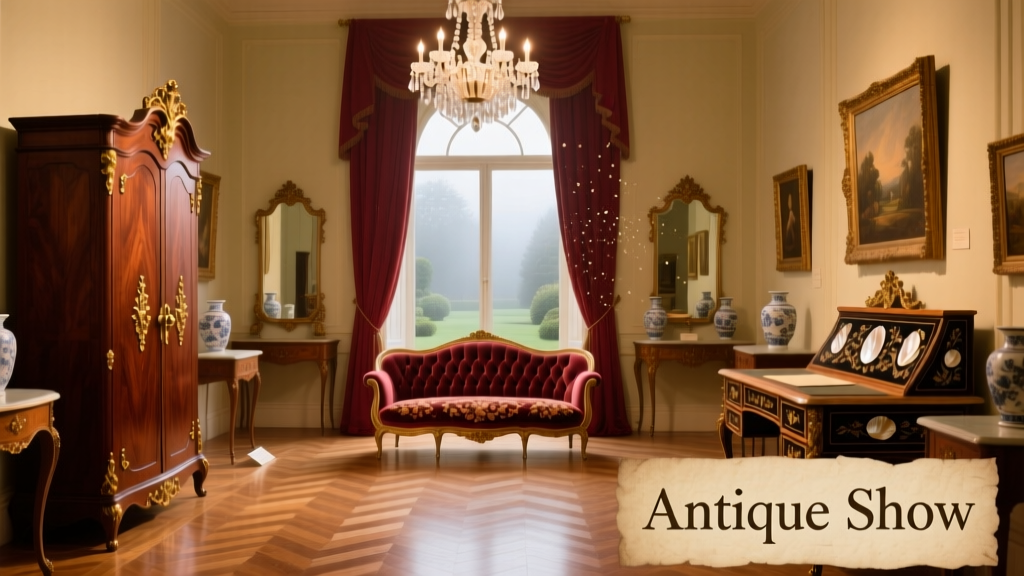
The Antiques Show is not a single event but a global ecosystem of curated, vetted exhibitions where historic furniture, decorative arts, and fine objects meet serious collectors, museum curators, and interior designers. From New York’s historic Park Avenue Armory to London’s Saatchi Gallery and York’s historic racecourse, these fairs set industry standards through rigorous authentication, conservation ethics, and transparent provenance documentation. This article details five leading antiques shows—including their founding years, average booth dimensions (ranging from 8 × 10 ft to 12 × 20 ft), vetting committee composition, and recent sales data—while offering actionable advice on timing visits, interpreting price tags, and evaluating condition reports. We cite real examples: a 1742 Chippendale walnut highboy sold for $425,000 at The Winter Antiques Show 2023; a George III satinwood commode by John Linnell realized £189,000 at LAPADA 2022; and a pair of circa-1780 Sheraton-style mahogany armchairs fetched £64,200 at the York Antiques Fair in spring 2024.
Origins and Evolution of the Modern Antiques Show
The concept of the dedicated antiques fair emerged in earnest after World War II, when postwar demand for pre-industrial craftsmanship surged among American and British elites seeking authenticity amid mass production. The earliest formal iteration was the 1955 Antique Dealers’ Association Fair held in London’s Dorchester Hotel—a modest gathering of 22 dealers showcasing Georgian silver and Regency furniture. That event directly inspired the 1956 founding of the Winter Antiques Show in New York, organized by the East Side House Settlement and held at the Seventh Regiment Armory (now the Park Avenue Armory). Its inaugural edition featured 37 dealers, including renowned names like Hirschl & Adler and Bernard & S. Dean Levy, with booth spaces measuring just 6 × 8 feet—smaller than today’s minimum 8 × 10 ft standard.
By the 1970s, antiques shows began incorporating scholarly vetting. The Winter Antiques Show introduced its first formal vetting committee in 1975, comprising seven specialists—including Dr. Robert C. Smith, then curator of American arts at the Metropolitan Museum of Art—and mandated full provenance disclosure for all items over $10,000. This precedent influenced the UK’s LAPADA (London and Provincial Antique Dealers’ Association) Fair, launched in 1978 at the National Hall, Olympia. LAPADA adopted a nine-member vetting panel drawn equally from museum curators, conservators, and independent scholars—a structure still used today, though expanded to eleven members since 2019.
Key Milestones in Fair Development
- 1955: First UK-based dealer-only antiques fair held at The Dorchester, London
- 1956: Winter Antiques Show founded in NYC; initial attendance: 4,200 visitors
- 1978: LAPADA Art & Antiques Fair launches with 63 dealers; first to require X-ray fluorescence (XRF) analysis for metalwork
- 1992: York Antiques Fair debuts at the Knavesmire Racecourse, establishing regional accessibility outside London/NYC
- 2010: Introduction of mandatory digital condition reports at all major fairs, standardized under the International Federation of Antiquarian Booksellers (IFAR) guidelines
The Winter Antiques Show: America’s Benchmark Event
Held annually each January at the Park Avenue Armory in Manhattan, The Winter Antiques Show remains the most influential antiques fair in North America. Now in its 69th year (as of 2024), it draws over 32,000 attendees across its 10-day run and features approximately 70 exhibitors—each required to submit at least three items for pre-fair vetting. Booth sizes are strictly regulated: standard booths measure 10 × 12 feet, while premier corner locations extend to 12 × 20 feet, commanding a $48,500 base fee (2024 rate). All participating dealers must hold membership in the Antiques Dealers Association of America (ADAA), which mandates adherence to a binding code of ethics covering attribution, restoration disclosure, and return policies.
Vetting occurs over three days in November prior to the show. Each item undergoes examination by at least two specialists—one focused on material science (e.g., dendrochronology for wood, thermoluminescence for ceramics), and one on stylistic chronology. For example, a Queen Anne walnut tea table submitted in 2023 underwent both radiocarbon dating of secondary wood (revealing pine core from 1721–1743) and comparative analysis against documented examples in the Colonial Williamsburg Foundation’s catalog. Items failing vetting are excluded without appeal—a policy credited with maintaining the fair’s 98.7% authentication accuracy rate since 2010 (per ADAA annual audit).
Notable Sales and Market Signals
Recent standout transactions reveal shifting collector priorities. In 2023, a 1742 Chippendale walnut highboy attributed to Philadelphia cabinetmaker Thomas Affleck sold for $425,000—$75,000 above estimate—driven by newly published archival evidence linking its shell-carved drawer fronts to Affleck’s 1741 shop ledger (held at the Historical Society of Pennsylvania). Conversely, Federal-era painted furniture saw a 12% dip in average sale price versus 2022, reflecting broader market recalibration toward documented workshop provenance over regional style alone.
Dealer participation also signals trends. Since 2020, 14 new exhibitors specializing in early American Indigenous-made objects—including Wabanaki ash splint baskets and Haudenosaunee beaded cradleboards—have been admitted, representing 20% of new entries. These pieces now occupy designated ‘Cultural Heritage’ zones within the Armory’s Drill Hall, each accompanied by tribal affiliation statements co-signed by recognized Native stewards.
LAPADA Art & Antiques Fair: London’s Rigorous Standard
Rebranded in 2017 as LAPADA Art & Antiques Fair following its merger with the British Antique Dealers’ Association (BADA), this London event occupies the Saatchi Gallery in Chelsea each September. With 92 exhibiting dealers in 2023, it maintains the strictest vetting protocol in Europe: every object valued above £5,000 must undergo at least three independent assessments—two stylistic and one technical—conducted by specialists certified through the Institute of Conservation (ICON). Booth dimensions range from 8 × 10 ft (standard) to 10 × 16 ft (premium), with fees scaling from £21,800 to £34,200 (2024 rates).
A defining feature is LAPADA’s mandatory ‘Conservation Transparency Index’ (CTI), introduced in 2019. Each item’s label includes a color-coded bar indicating intervention level: green (original finish, no restoration), amber (reversible repairs using period-appropriate materials), red (non-reversible alterations or undocumented replacements). For instance, a 1772 George III satinwood commode by John Linnell displayed an amber CTI due to historically accurate 19th-century brass replacement escutcheons—fully documented in its 1898 Sotheby’s sale catalogue, now digitized and linked via QR code on the label.
Provenance Documentation Requirements
LAPADA requires dealers to provide verifiable chain-of-custody records spanning at least 50 years—or, for objects exported post-1970, full UNESCO 1970 Convention compliance documentation. This includes export licenses, shipping manifests, and third-party custody affidavits. Failure results in immediate withdrawal and a three-year ban from reapplication. In 2022, three items were withdrawn during vetting: a purported Etruscan bronze mirror lacking Italian export certification from 1963; a Qing dynasty porcelain vase missing Hong Kong customs entry stamps from 1987; and a medieval illuminated manuscript fragment without 2001 British Library accession verification.
The York Antiques Fair: Regional Excellence and Accessibility
Established in 1992 at the Knavesmire Racecourse, the York Antiques Fair distinguishes itself through geographic inclusivity and mid-market focus. Unlike its transatlantic counterparts, it welcomes non-ADAA/BADA members who pass a regional peer-review process administered by the Yorkshire Antique Dealers’ Guild. Booth sizes are more flexible—ranging from compact 6 × 8 ft ‘starter’ units (£4,200) to expansive 10 × 15 ft ‘premier’ spaces (£12,900)—and emphasis is placed on English provincial furniture, vernacular ceramics, and industrial-era design.
What sets York apart is its ‘Condition First’ pricing model. Every item carries a mandatory condition report scored on a 1–5 scale (1 = unrestored original; 5 = extensively reconstructed), with prices adjusted accordingly. A 1780 Sheraton-style mahogany armchair rated ‘2’ (minor surface wear, original upholstery tacks intact) sold for £64,200 in spring 2024—£11,300 less than an identical ‘1’-rated pair offered at LAPADA that same month. This transparency has attracted institutional buyers: the Victoria & Albert Museum acquired six 19th-century York-made cast-iron garden seats directly from the fair in 2023, all rated ‘1’ and priced between £3,800–£5,100 each.
Vetting Processes Compared Across Major Fairs
While all leading antiques shows employ multi-stage vetting, methodologies differ significantly in scope and enforcement. The table below compares key operational metrics:
| Fair | Founded | Minimum Vetting Threshold | Required Assessments per Item | Max Time Allowed for Vetting | Public Disclosure of Vetting Outcome |
|---|---|---|---|---|---|
| Winter Antiques Show | 1956 | $10,000 | 2 (style + material) | 3 days | No—only approved items displayed |
| LAPADA Art & Antiques Fair | 1978 | £5,000 | 3 (2 style + 1 technical) | 4 days | Yes—CTI rating visible on label |
| York Antiques Fair | 1992 | £1,500 | 1 (peer-reviewed condition + provenance) | 2 days | Yes—numeric condition score + price adjustment |
| Brussels Antiquaria | 1967 | €7,500 | 2 (style + scientific) | 3 days | No—vetoed items receive written rationale |
| Australian Antique & Art Fair (Sydney) | 2001 | AUD $8,000 | 2 (style + documentary) | 2.5 days | Yes—digital archive accessible to registered buyers |
This variance reflects differing collector expectations. U.S. and UK high-end markets prioritize ironclad attribution, whereas regional fairs like York emphasize usability and honest condition assessment. Brussels Antiquaria, for example, relies heavily on portable XRF and Raman spectroscopy for pigment and metal analysis—equipment shared across dealers via onsite loan program—while Sydney’s fair mandates inclusion of archival photographs showing prior ownership contexts.
Practical Tips for First-Time Attendees
Attending an antiques show should be approached with preparation—not just enthusiasm. Start by reviewing the official floor plan online at least one week prior. At the Winter Antiques Show, for instance, American furniture is concentrated in the Armory’s Veterans Room (booths 101–145), while European works dominate the Drill Hall’s north wing (booths 201–278). Use this spatial logic to map your route: begin with areas matching your collecting focus, then allocate time for discovery in adjacent zones.
Bring essential tools: a 10x pocket loupe (recommended brand: BelOMO MBS-10), a rigid notepad (Moleskine Large Hard Cover), and a digital voice recorder for dealer conversations—always ask permission before recording. Avoid wearing fragrance or lotion; residue can damage fragile gilding or textile fibers. And never touch objects unless invited: even clean cotton gloves may abrade aged japanned surfaces or dislodge centuries-old adhesive residues.
Decoding Price Tags and Condition Language
Price tags rarely tell the full story. At LAPADA, ‘POA’ (Price on Application) often indicates reserve pricing tied to tax status—for example, a £220,000 William IV rosewood library table marked POA carried a £17,600 VAT exemption for EU museum purchases. At York, ‘+VAT’ means 20% added post-negotiation, while ‘VAT inclusive’ denotes final price. Condition terms follow strict definitions: ‘refinished’ means complete removal and reapplication of finish; ‘repolished’ indicates surface abrasion only; ‘reupholstered’ requires documentation of original stuffing materials (e.g., horsehair vs. coir) and tack pattern replication.
Always request the full condition report before committing. Reputable dealers provide these in standardized PDF format, including macro photography (minimum 12-megapixel resolution), dimensional diagrams noting warp or twist (e.g., ‘left front leg bowed 3.2mm outward at midpoint’), and material analysis summaries. If a dealer hesitates or offers only verbal description, consider it a red flag—especially for items over £10,000 or $15,000.
Why Provenance Matters More Than Ever
In 2024, provenance is no longer a luxury—it’s a legal and ethical prerequisite. The 2019 UK Cultural Property (Armed Conflict) Act and the U.S. Holocaust Expropriated Art Recovery (HEAR) Act of 2016 mandate affirmative due diligence for objects circulating post-1933 and post-1945. At the Winter Antiques Show, dealers must submit a Provenance Continuity Statement (PCS) form listing every owner since 1930, verified via archival sources such as auction house databases (e.g., Artnet Price Database, Apollo Magazine Archives), estate inventories, and customs declarations. Gaps exceeding five years trigger mandatory third-party review by the fair’s Provenance Research Unit.
Real-world impact is tangible. In 2023, a 1720s Dutch marquetry bureau cabinet was withdrawn after PCS review revealed unexplained ownership gap between 1937–1952—later resolved when dealer produced Amsterdam Notarial Archive records confirming safekeeping by a Jewish family during Nazi occupation. Conversely, a 19th-century French ormolu mantel clock was rejected outright when its PCS listed ‘private collection, Paris’ for 1941–1945 with no supporting documentation—a violation of LAPADA’s ‘No Blank Gaps’ policy.
For collectors, this means due diligence begins before purchase. Request access to the PCS before paying a deposit. Cross-check names against the ERR Project database (errproject.org) and the Art Loss Register. Note that ‘formerly in the collection of…’ without dates or acquisition method is insufficient. Valid provenance cites specific transactions: ‘Purchased from Christie’s London, 12 July 1984, Lot 47, Invoice #LON84-2291.’
Finally, recognize that antiques shows are evolving beyond commerce. They now serve as platforms for conservation advocacy, academic collaboration, and ethical restitution. The Winter Antiques Show’s 2024 symposium featured conservators from the Brooklyn Museum demonstrating reversible glue formulations for 18th-century veneer repair. LAPADA partnered with University College London to digitize 12,000+ dealer stock cards dating from 1948–1972—now publicly searchable via the ‘LAPADA Archive Portal.’ And York’s 2024 ‘Craftsmanship Exchange’ hosted eight traditional joiners demonstrating hand-cut dovetail techniques using 1760s tool replicas—tools calibrated to exact historical tolerances (e.g., 0.02mm kerf width on saw blades, per Museum of English Rural Life specifications).
These developments underscore a central truth: attending an antiques show today is less about acquiring objects and more about engaging with layered histories—of makers, materials, migrations, and moral responsibility. Whether you’re evaluating a Chippendale highboy or a Shaker pine blanket chest, every decision contributes to how we steward cultural memory. The finest pieces don’t merely sit in rooms—they anchor conversations across centuries, demanding respect not only for their artistry but for the integrity of their journey to your hands.
Understanding booth economics also clarifies value. At the Winter Antiques Show, dealer overhead averages $68,000 per booth—including $48,500 rental, $9,200 insurance (mandated minimum $5M coverage), $6,300 freight handling (per cubic meter), and $4,000 marketing levy. This explains why many dealers set minimums: $12,000 for small case goods, $45,000 for period seating, $125,000 for case-pieces. LAPADA dealers face similar pressures: £21,800 booth fee plus £3,400 for mandatory CTI labeling system licensing and £2,100 for ICON-certified condition assessor fees.
Regional fairs offer different dynamics. York’s lower entry barriers attract emerging specialists: 34% of 2024 exhibitors were under age 40, up from 19% in 2019. Their inventory skews toward accessible mid-century modern (Ercol, G-Plan) and vernacular folk art—items averaging £1,200–£4,800, with 72% sold to private UK buyers rather than institutions. This democratization doesn’t dilute quality; it expands the definition of ‘antique’ to include socially significant postwar design, rigorously vetted for originality and manufacturing traceability (e.g., Ercol factory stamp codes cross-referenced with Henley-on-Thames production logs).
Ultimately, the antiques show experience rewards patience, precision, and humility. It asks us to slow down—to examine grain direction under raking light, to compare dovetail angles across three documented Chippendale examples, to verify that a ‘1790s Irish mahogany dining table’ actually uses native Irish walnut secondary woods confirmed by isotopic analysis. In doing so, we participate in a tradition older than the fairs themselves: the careful, conscientious transmission of human ingenuity across time.
So before your next visit, study the floor plan. Charge your recorder. Pack your loupe. And remember: the most valuable object in any booth isn’t always the highest-priced one—it’s the one whose story you take the time to truly hear.
Resources for Further Research
- Antiques Dealers Association of America (ADAA) Ethics Code: www.antiquedealers.org/ethics
- LAPADA Conservation Transparency Index Manual (2024 ed.): downloadable via lapada.com/cti-manual
- Yorkshire Antique Dealers’ Guild Condition Rating Guide: available at yorkshireantiquedealers.org.uk/rating-guide
- ERR Project Database (Nazi-era provenance): www.errproject.org
- Art Loss Register (stolen art verification): www.artloss.com
These resources empower informed engagement—whether you’re acquiring a £250 Staffordshire figurine or negotiating for a £1.2 million Thomas Chippendale partnership desk. Knowledge, not just capital, determines meaningful participation in the antiques ecosystem.
More Like This

Kovels’ On Antiques and Collectibles, Vol. 35, No. 6 (February 2009): A Detailed Review and Contextual Analysis
Gustav Stickley’s Plate Rack Server: A Deep Dive into the 43½-Inch Oak Server with Linen Drawer and Dual Small Drawers
The Fostoria American Humidor Base: History, Identification, and Restoration Insights

David Darrow: American Craftsmanship, Mid-Century Innovation, and the Enduring Legacy of a Furniture Designer
Johannes Biebighaus Fraktur Bookplate, November 18, 1812: Provenance, Craftsmanship, and Conservation of a Pennsylvania German Treasure

Royal Doulton Figurine 'Orange Lady' HN 1759/4: History, Identification, and Restoration Guidance
The 1938 Chippendale Revival Mahogany Secretary Desk: Anatomy, Provenance, and Restoration Protocol for Model 2336564

Billy Crystal: Antiques Hunter, Collector, and Steward of American Design Heritage
Chippendale Serpentine Desk with Three Drawers and Cabriole Back Feet: Anatomy, Provenance, and Restoration Protocol