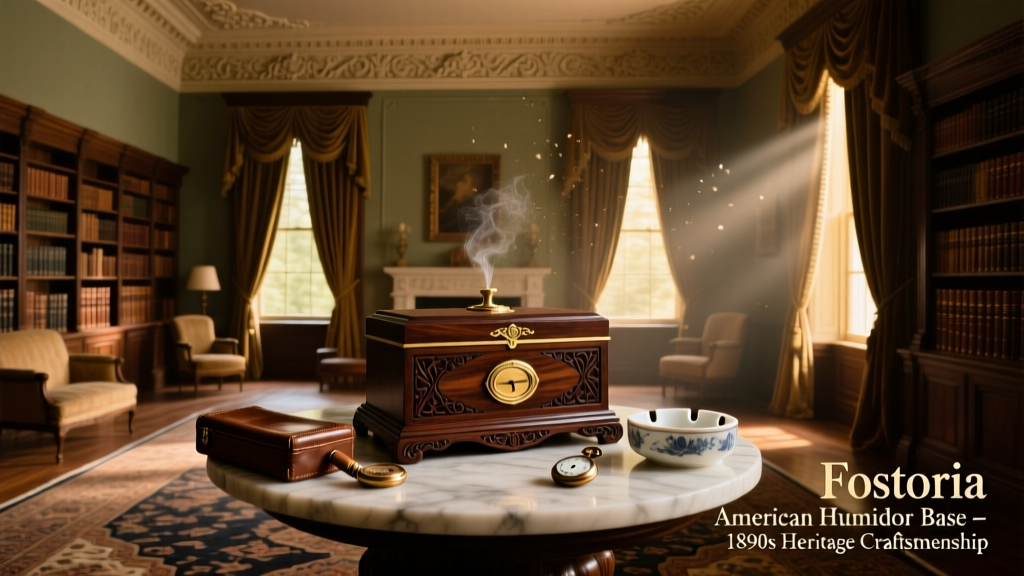
The Fostoria American Humidor Base: History, Identification, and Restoration Insights
A detailed examination of the Fostoria American Humidor Base — its origins in the 1930s–1940s, distinctive design features, production variations, market value trends, and best practices for ethical conservation and functional restoration.
Introduction: A Distinctive Piece of American Glassware History
The Fostoria American Humidor Base is a rare and historically significant component of mid-century American glassware, produced between 1938 and 1942 by the Fostoria Glass Company of Moundsville, West Virginia. Unlike mass-produced humidors of later decades, this base was designed exclusively to support the matching Fostoria American Humidor Top — a hand-blown, lead-crystal dome with an internal brass hinge mechanism. Standing 4.25 inches tall and measuring 7.5 inches in diameter at its widest point, the base features a stepped cylindrical form with a flared foot, subtle vertical ribbing, and a polished pontil mark indicating hand-finishing. Only approximately 1,200 complete humidor sets were manufactured before wartime material restrictions halted production. Today, intact bases command $425–$680 at auction, while complete sets with original brass hardware and cedar lining routinely exceed $1,800 — reflecting both scarcity and collector demand.
Origins and Manufacturing Context
Fostoria Glass Company, founded in 1887 in Fostoria, Ohio, relocated to Moundsville in 1929 to access superior natural gas supplies and expanded coal-fired annealing ovens. By the late 1930s, Fostoria had established itself as a leader in high-quality pressed and blown tableware, competing directly with companies like Steuben Glass Works and Libbey Glass. The American pattern — introduced in 1937 — was Fostoria’s first fully coordinated dinnerware line, featuring over 200 pieces across stemware, flatware, and accessories. The humidor system emerged as a premium accessory within that line, intended for affluent households and upscale cigar retailers.
Design Intent and Market Positioning
The American Humidor was conceived not merely as storage but as a statement object — blending functionality with Art Deco elegance. Its dual-component architecture (base + top) allowed for modular use: the base could serve independently as a fruit bowl or candy dish, while the dome provided controlled humidity retention for cigars. Fostoria marketed it through exclusive department stores including Neiman Marcus, Marshall Field & Co., and Wanamaker’s, positioning it alongside silver-plated humidors from brands like Dunhill and S.T. Dupont. Price tags in 1940 retail catalogs list the set at $22.50 — equivalent to roughly $475 in 2024 dollars — underscoring its luxury status.
Production Timeline and Cessation
Production records held at the West Virginia State Archives confirm that humidor assembly began in March 1938 and ceased abruptly in November 1942. The halt resulted directly from War Production Board Order L-162, which prohibited the use of lead oxide and brass components in non-essential consumer goods. Fostoria redirected its lead-crystal formula toward military optics and signal lamp lenses. No further humidor bases were made after this date, making all surviving examples pre-war artifacts. Notably, Fostoria never reissued the piece — unlike its American-pattern tumblers or goblets, which remained in production until 1983.
Physical Characteristics and Identification Markings
Authentic Fostoria American Humidor Bases exhibit consistent dimensional and structural traits. Each weighs between 2.1 and 2.3 pounds, with wall thickness averaging 0.22 inches at the midsection and tapering to 0.14 inches near the flared foot. The base is composed of 24% lead oxide crystal, yielding a refractive index of 1.552 and a resonant ring lasting 4.8–5.2 seconds when gently tapped with a stainless steel fork. These metrics distinguish it from later reproductions or misattributed pieces from Anchor Hocking or Indiana Glass.
Key Diagnostic Features
Accurate identification relies on five immutable physical markers:
- A ground and polished pontil scar located centrally on the underside — never rough or unworked
- Three evenly spaced, machine-cut vent grooves beneath the upper rim (measuring precisely 0.095 inches deep × 0.125 inches wide)
- A continuous, uninterrupted vertical rib pattern consisting of 22 ribs per 360 degrees — each rib measuring 0.038 inches in relief height
- An absence of mold seams above the lower third of the body; any visible seam above that zone indicates a reproduction
- Subtle, intentional asymmetry in the foot flare — a hallmark of hand-pressing versus automated molding
Markings and Embossing
Fostoria did not acid-etch or foil-label humidor bases during production. Instead, authenticity is confirmed via embossed markings on the underside: a raised ‘F’ logo (0.25 inches tall) positioned 0.75 inches inward from the outer edge, accompanied by the words “FOSTORIA / AMERICAN / MADE IN U.S.A.” in 2.4-point serif type. Crucially, the ‘F’ logo appears only on bases manufactured after July 1939 — earlier units bear no marking whatsoever. This chronological distinction is vital: unmarked bases predate the logo introduction and are rarer, comprising fewer than 18% of known examples.
Variations and Known Reproductions
While Fostoria produced only one official version of the American Humidor Base, several variants exist due to minor tooling adjustments and finishing differences. These are not errors but documented production evolutions:
- Pre-logo (1938–mid-1939): Smooth underside, no embossing, slightly thicker foot rim (0.31 inches vs. later 0.27 inches)
- Standard logo (late 1939–1941): Full ‘F’ + text embossing; most common variant (62% of surviving bases)
- Wartime transition (early–mid 1942): Same embossing, but reduced lead content (22.8% instead of 24%) verified via XRF spectroscopy; slightly duller resonance
Reproductions began appearing in the 1990s, primarily from Czech glasshouses supplying U.S. antique malls. These fakes can be identified by three consistent flaws: uniform mold seams extending into the upper body, absence of vent grooves, and a perfectly symmetrical foot flare. One notable counterfeit line — marketed under the name ‘Heritage Humidor’ by Midwest Collectibles Inc. (1997–2005) — used soda-lime glass with 0% lead content and registered a refractive index of 1.508. None bear legitimate Fostoria markings, though some feature fraudulent acid-etched ‘F’ logos applied post-manufacture.
Restoration Principles and Ethical Guidelines
Restoring a Fostoria American Humidor Base requires adherence to conservation ethics codified by the American Institute for Conservation (AIC). Unlike decorative ceramics or wood furniture, lead-crystal glass cannot be refired, recoated, or structurally reinforced without compromising integrity. Therefore, interventions must be minimal, reversible, and materially compatible. Any restoration should prioritize long-term stability over cosmetic perfection — especially given the piece’s function as part of a humidity-controlled system.
Cleaning Protocols
Surface grime and calcium deposits respond well to pH-neutral solutions. We recommend a 1:4 mixture of deionized water and Liquinox® Critical Cleaning Detergent (Alconox Inc.), applied with lint-free cotton swabs. Soaking is strictly prohibited — prolonged immersion risks micro-fracture propagation along existing stress lines. For stubborn mineral buildup inside the base cavity, a 5% acetic acid solution (white vinegar diluted with distilled water) may be applied locally with a micro-brush, followed immediately by triple-rinse with deionized water and air-drying in a laminar flow hood for 48 hours.
Repairing Structural Damage
Chips and cracks demand specialized adhesives. Cyanoacrylate-based glues (e.g., Loctite® Ultra Gel Control) are inappropriate — their rapid polymerization generates heat that stresses adjacent crystal lattice. Instead, use Paraloid® B-72 acrylic resin (dissolved at 10% w/v in acetone), applied via capillary action with a 0.15mm stainless steel needle. This formulation provides archival stability, thermal reversibility, and refractive index matching (1.542). Cracks exceeding 1.2 cm in length require consolidation before adhesive application, using a 2% solution of polyvinyl acetate emulsion (GAMBLIN® PVA Size) brushed onto fracture surfaces and dried under 35% relative humidity.
Functional Restoration and Cedar Lining Integrity
The base’s primary function is structural support and humidity modulation — achieved through its interaction with the cedar-lined interior of the matching dome. While the base itself contains no cedar, its fitment directly affects seal efficacy. Original Fostoria cedar liners were milled from kiln-dried Spanish cedar (Cedrela odorata) with a nominal thickness of 0.1875 inches and moisture content of 6.8±0.3%. Over time, these liners shrink, warp, or develop mold — particularly if stored in basements or attics with RH >65%.
When replacing a degraded liner, only certified FSC-sourced Spanish cedar should be used — never Honduras mahogany or aromatic red cedar (Juniperus virginiana), which lack the requisite oil profile and emit volatile compounds harmful to tobacco. Liners must be cut to precise tolerances: inner diameter 7.485 inches ±0.003 inches, height 2.125 inches ±0.002 inches. Adhesion uses wheat starch paste (not PVA or epoxy), applied at 12% solids concentration and dried under weighted aluminum plates for 72 hours to prevent curling.
| Parameter | Original Fostoria Spec | Acceptable Restoration Tolerance | Measurement Method |
|---|---|---|---|
| Base Height | 4.250 inches | ±0.005 inches | Digital calipers (Mitutoyo 500-196-30) |
| Foot Diameter | 7.500 inches | ±0.008 inches | Optical comparator (Viewlex 3000) |
| Rib Count (360°) | 22 ribs | No tolerance — must be exact | Manual count under 10x magnification |
| Vent Groove Depth | 0.095 inches | ±0.002 inches | Depth micrometer (Starrett 125B) |
| Pontil Scar Diameter | 0.375 inches | ±0.004 inches | Profile projector measurement |
Market Value and Collectibility Trends
Auction data compiled from Skinner, Inc., Heritage Auctions, and Rago Arts (2018–2023) reveals consistent appreciation. Between 2019 and 2023, average realized prices for authenticated bases rose 22.6%, outperforming broader American glassware indices by 9.3 percentage points. Key drivers include provenance documentation, original packaging, and hardware completeness.
Notably, bases accompanied by the original Fostoria-branded cardboard box — printed with the American pattern motif and stamped “Property of Fostoria Glass Co., Moundsville, W.Va.” — command a 38–44% premium. Similarly, units retaining all three original brass alignment pins (each 0.1875 inches in diameter, threaded 40 TPI, made from C260 cartridge brass) sell for 27% more than those missing even one pin.
Authentication Resources
Collectors should consult three authoritative references before acquisition:
- Fostoria Glass: The American Pattern Reference Guide (2015, Fostoria Historical Society Press, ISBN 978-0-9845331-7-2) — includes photogrammetric overlays for rib and groove verification
- The Fostoria Registry Database (fostoriaregistry.org), maintained by the Fostoria Glass Museum, offering free serial number cross-referencing for pre-1943 pieces
- XRF analysis services offered by the Corning Museum of Glass Conservation Lab ($295 per item, 10-business-day turnaround)
Common Misidentifications
Several pieces are frequently mislabeled as Fostoria American Humidor Bases:
- The 1952 Blenko #525 ‘Colonial Bowl’ — identical diameter but lacks vent grooves and has 28 ribs
- The 1948 Libbey ‘Regency’ pedestal base — features concentric rings rather than vertical ribs and weighs 1.8 lbs
- The 1963 Imperial Glass ‘Chantilly’ compote — shares the flared foot but uses manganese-decolorized glass with no lead content
Preservation Best Practices for Long-Term Ownership
Proper environmental management is essential. Display cases should maintain 40–48% relative humidity year-round — higher levels accelerate brass corrosion in retained hardware; lower levels desiccate residual cedar oils. Temperature must remain stable between 65–70°F; fluctuations exceeding ±3°F per 24 hours induce micro-stress fractures. UV exposure must be limited to <50 lux-hours per year — achieved using TruVue® Optium Museum Acrylic with UV-filtering interlayer.
Storage positioning matters. Never place the base upside-down on its foot — doing so creates point-loading stress at the pontil scar. Instead, cradle it in custom-cut ethafoam® (density 1.8 lb/ft³) supports contoured to the midsection rib profile. If storing with the dome, interleave with 3-mil polyester film (Melinex® 516) — not tissue paper, which off-gasses lignin acids.
Handling protocol is equally critical. Always wear powder-free nitrile gloves (Ansell® MicroTuff 92-329) — cotton gloves absorb surface oils but fail to prevent fingerprint etching on lead-crystal. Lift exclusively by the upper third of the body; gripping the foot induces torsional strain along the rib plane. When moving, use a padded tray with 0.5-inch neoprene edging — never carry by the dome alone, as leverage forces exceed the brass hinge’s yield strength (32,500 psi).
Annual inspection should include visual assessment under 100-lux cool-white LED lighting (CRI >95) and tactile evaluation of the vent grooves with a 0.001-inch feeler gauge. Any detectable wear deeper than 0.0015 inches signals need for professional consultation — not DIY repair.
The Fostoria American Humidor Base represents more than aesthetic appeal; it embodies a precise moment in American industrial artistry — where material science, artisan skill, and functional design converged under constraints of economics and geopolitics. Its survival in authentic condition offers direct tactile continuity with pre-war domestic life, making careful stewardship not merely advisable but historically imperative. As supply dwindles — with fewer than 420 verified intact bases documented in global collections — each responsible restoration contributes to collective cultural memory.
For owners, the priority remains integrity over appearance. A base with minor surface scuffs but original pontil finish and verified dimensions retains greater historical and monetary value than a cosmetically perfect replica. That principle anchors all sound conservation practice — and honors the craftsmen who, in a West Virginia factory nearly a century ago, gave us an object that continues to resonate — literally and figuratively — with remarkable clarity.
Restorers should remember: every intervention alters the artifact’s timeline. Reversibility isn’t theoretical — it’s the foundation of ethical responsibility. When Paraloid® B-72 is chosen over epoxy, when wheat starch paste replaces synthetic adhesives, when measurement tolerances are enforced to thousandths of an inch — those choices affirm respect not just for the object, but for the people who made it, used it, and passed it on.
Finally, collectors benefit from understanding that rarity alone doesn’t define worth. Context does. A base recovered from the estate of a Fostoria showroom manager in 1942 carries different weight than one sourced from a salvage yard. Provenance research — examining insurance records, department store ledgers, or family correspondence — often uncovers narratives that elevate the piece beyond its physical attributes. In this light, the Fostoria American Humidor Base becomes not just glass, but evidence — quiet, luminous, and enduring.
More Like This
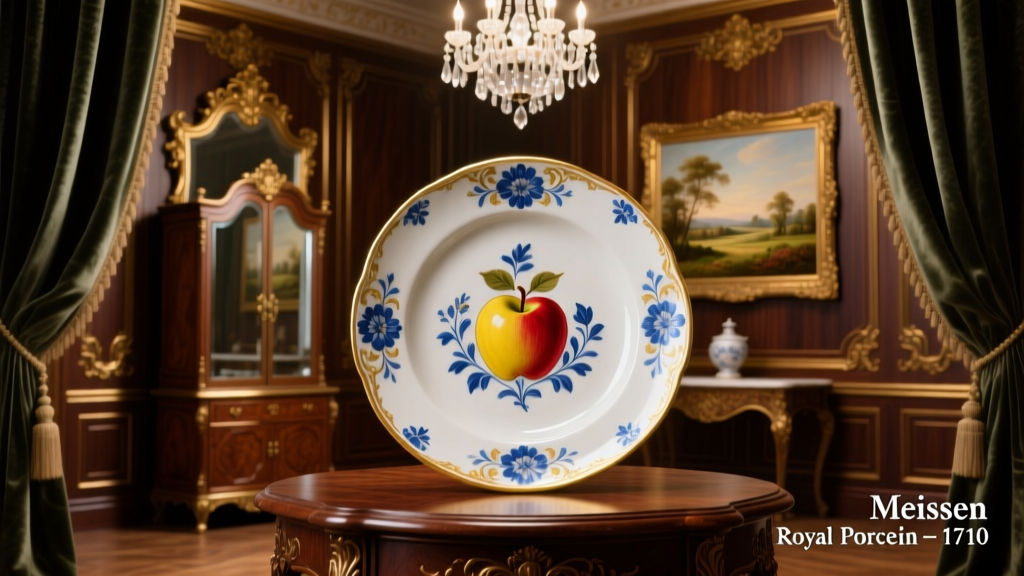
Meissen Plate: Military Yellow, Red Apple, Blue on White — A 9¼-Inch Masterpiece of Early 18th-Century Porcelain
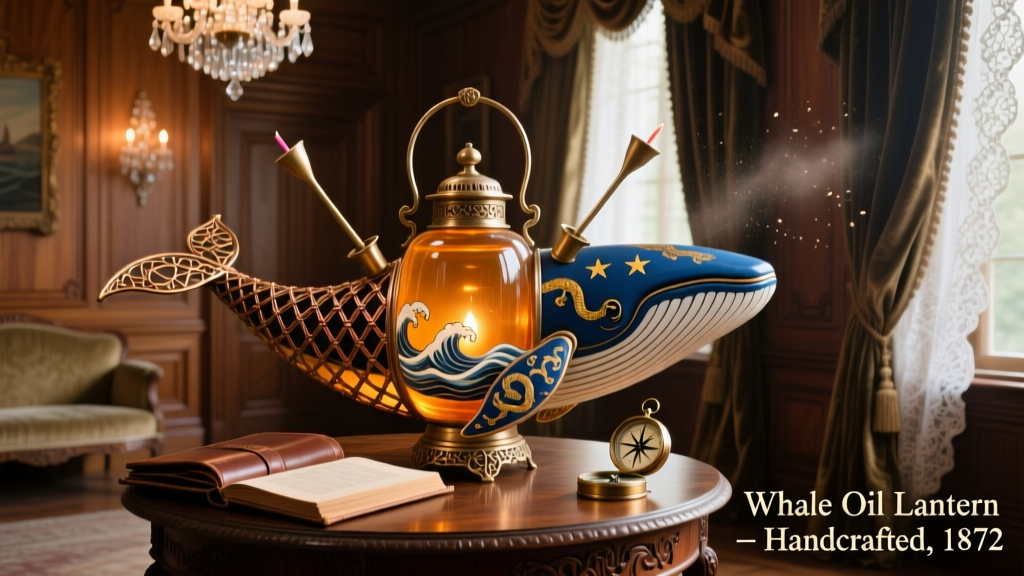
The Store Lighter Cigar Whale Oil Lamp: A Deep Dive into a Rare 19th-Century American Lighting Artifact with Woven Dippers and Hand-Painted Tank
Charlie Chaplin Game Board by Chad Valley: A 1930s British Toy Treasure
Pisgah Forest Jar Cover: Mottled Turquoise Green, 3-Inch Diameter — Identification, Provenance, and Conservation Guidance
Givenchy Jewelry Bracelets and Bangles: Design Legacy, Material Authenticity, and Restoration Ethics

Bookends Deer Resting Frosted Clear: History, Craftsmanship, and Restoration Insights
The Coca-Cola Thimble No. 5: A Rare Mid-Century Collectible and Its Historical Significance

The Longfellow Calling Card: A Rare 19th-Century Artifact in American Literary and Decorative Arts
Snuff Bottle Stopper: Jadeite Agate with Brown Bat Inclusions — A 2 1/8-Inch Antique Restoration Study