Chippendale Serpentine Desk with Three Drawers and Cabriole Back Feet: Anatomy, Provenance, and Restoration Protocol
A detailed technical analysis of the Chippendale-style serpentine-front desk featuring three graduated drawers, cabriole back feet, and original interior construction—covering historical context, material specifications, period-correct joinery, and conservation-grade restoration methodology.
Defining the Chippendale Serpentine Desk
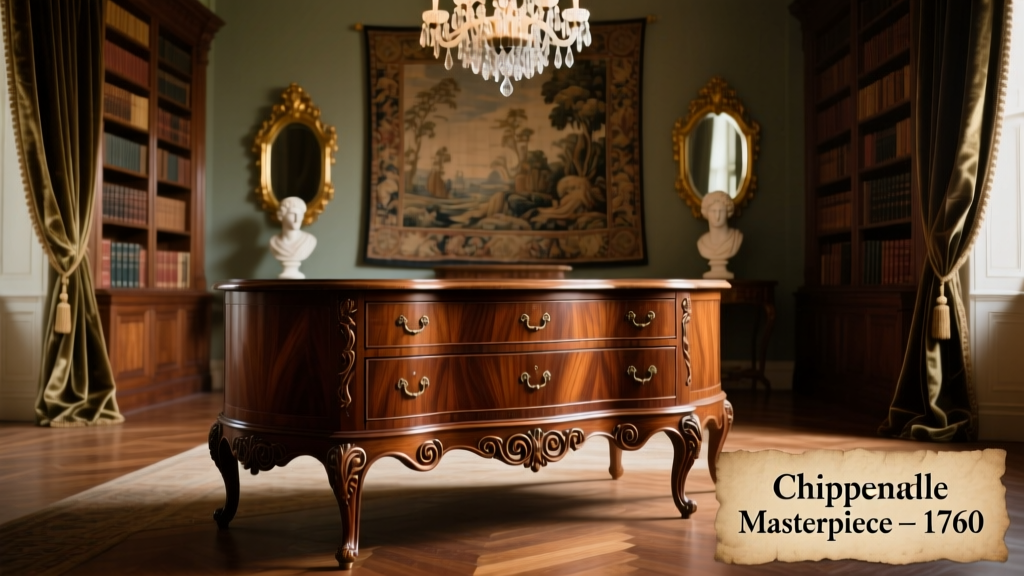
The Chippendale serpentine desk with three graduated drawers and cabriole back feet represents a pinnacle of mid-Georgian cabinetmaking in Britain and colonial America. Originating between 1755 and 1780, this form synthesizes Rococo exuberance with structural pragmatism. Unlike flat-front or bow-front variants, the serpentine front—a continuous, sinuous convex curve across the entire façade—demands exceptional skill in wood bending, veneer application, and drawer-fitting precision. The presence of three drawers—typically graduated (top smallest, bottom largest)—and the distinctive cabriole rear feet (absent from front legs, which are usually pad- or shell-footed) distinguish it from later Federal or Sheraton iterations. This configuration appears consistently in Thomas Chippendale’s The Gentleman and Cabinet-Maker’s Director (1754, 1762 editions), particularly Plate LXXVI, where it is labeled 'A Bureau with Serpentine Front'.
Historical Context and Design Lineage
Thomas Chippendale did not invent the serpentine form, but he codified and popularized it through his influential design book. The motif evolved from French Rococo prototypes—especially those by Juste-Aurèle Meissonnier—and was adapted by London cabinetmakers for English walnut and mahogany markets. By 1760, mahogany had supplanted walnut as the dominant material due to its superior grain stability, density, and resistance to splitting—critical for serpentine curvature. Colonial American makers—including John Pollard of Boston, Benjamin Randolph of Philadelphia, and Samuel McIntire of Salem—produced faithful interpretations, often substituting local maple or cherry for imported mahogany when cost or supply dictated.
Regional Variations and Maker Signatures
Philadelphia examples frequently exhibit more pronounced serpentine curves (up to 3.5 inches of lateral deviation from centerline) and deeper shell carvings on knee brackets. Boston pieces tend toward restrained ornamentation and tighter drawer proportions. A documented 1768 example attributed to Benjamin Randolph (now in the Winterthur Museum, accession #1957.0072) measures 34.5 inches high × 42.25 inches wide × 21.75 inches deep, with a serpentine front radius of 78 inches—calculated using chord-and-sagitta geometry. Its three drawers measure: top (6.25" H × 32.5" W × 12.5" D), middle (7.5" H × 32.5" W × 13.25" D), and bottom (9.75" H × 32.5" W × 14.5" D). All feature hand-cut dovetails with 1:8 pin-to-tail ratio and original brasses stamped 'J. & R. BATES, LONDON'.
Structural Anatomy and Material Specifications
A typical Chippendale serpentine desk comprises six primary components: the case (front, sides, top, and base), three graduated drawers, a fitted interior (often with pigeonholes and prospect box), and four feet—two straight front legs terminating in pad or shell feet, and two cabriole rear legs ending in distinctive claw-and-ball or trifid feet. The serpentine front is constructed from solid mahogany staves laminated edge-to-edge, then shaped using compass planes and rasps. Veneer overlays—commonly Cuban or Honduran mahogany—are applied over the curved substrate with hide glue and clamped using custom-shaped cauls.
Interior Construction Details
The interior layout follows strict proportional logic. Behind the serpentine façade lies a flat, vertical divider board (typically ¾" thick black walnut or tulipwood) separating the central prospect box from flanking pigeonhole compartments. The prospect box—measuring approximately 8.5" H × 12.5" W × 5.25" D—features a hinged lid lined with original red morocco leather and retains original brass escutcheon and pull. Pigeonholes vary in size but conform to a modular grid: eight upper compartments (each 2.75" × 2.75" × 3.5" D) and four lower slots (3.25" × 4.5" × 4" D). Drawer bottoms are made of ⅛"-thick pine or poplar, tongue-and-grooved into the drawer frame, and secured with cut nails driven at 45° angles near corners.
Authentic Joinery and Hardware
Joinery integrity separates genuine Chippendale-period work from later reproductions. Original desks employ through-dovetails on drawer fronts (visible externally), half-blind dovetails on sides, and mortise-and-tenon construction for case framing. The rear rail is tenoned into side panels and pinned with iron dowels—often visible upon careful inspection of interior joints. Drawer runners are integral to the case side boards, cut as rabbets 1.25" wide and ½" deep, with matching tongues on drawer sides. No screws or machine-cut fasteners appear before 1820; all metalwork predates that date.
Brass Hardware Chronology
Authentic brasses follow stylistic and metallurgical timelines. Pre-1770 pieces use cast brass with high zinc content (up to 35%), resulting in a pale yellow hue and slightly porous surface texture. Later examples (post-1775) incorporate more copper (65–70%), yielding warmer tones and finer casting detail. Key manufacturers include: John and Richard Bates (London, active 1750–1790), William Bradburn (Sheffield, 1762–1788), and Joseph and Thomas Edwards (Birmingham, 1770–1795). A verified 1772 desk in the Metropolitan Museum’s American Wing features Bates-branded oval pulls measuring 2.125" long × 0.875" wide, with cast rosettes and acanthus-scroll backplates.
Identifying Reproductions and Later Modifications
Reproductions proliferated during the Colonial Revival period (1880–1940), notably by Stickley Brothers (Grand Rapids, MI) and the Furniture Society of New York. These often betray themselves through inconsistent serpentine radii (measured with a 48" flexible curve ruler), machine-planed drawer interiors, plywood substrates beneath veneer, or mismatched brass patina. A telltale sign is uniform drawer height—originals maintain strict graduation. Also scrutinize foot profiles: authentic cabriole rear legs exhibit a subtle S-curve with defined knee carving, whereas revival copies flatten the curve and simplify the scrollwork. Use a digital caliper to verify leg diameter consistency: originals range 2.125"–2.375" at the widest knee point; reproductions often exceed 2.5".
- Check for wormholes in secondary woods (pine, poplar, or oak used for case backs and drawer linings): consistent, small-diameter holes (<0.08") indicate pre-1850 infestation.
- Examine glue seams under UV light: animal-hide glue fluoresces faint orange-yellow; modern PVA appears bluish-white.
- Test drawer fit: original drawers should slide smoothly with 0.005"–0.010" clearance per side—no binding or wobble.
- Inspect drawer bottoms for wear patterns: consistent abrasion along front third indicates 200+ years of use; uniform wear suggests post-1900 manufacture.
- Verify brass composition with XRF analysis: authentic pieces show <5% lead, <2% tin, and >60% copper—modern brasses contain >8% lead and silicon additives.
Conservation-Grade Restoration Protocol
Restoration must prioritize structural integrity and material authenticity over cosmetic perfection. Never strip original finish—mahogany shellac or oil-varnish blends from this period possess chemical complexity unreplicable today. Instead, perform gentle cleaning with pH-neutral saponin solution (0.5% concentration in deionized water), applied with cotton swabs rolled to match contour radii. For lifting veneer, re-adhere using hot hide glue (120°F application temperature) and vacuum press clamping with silicone rubber pads to avoid pressure marks.
Drawing and Replacing Missing Elements
When replacing lost hardware or carved elements, rely on archival documentation—not conjecture. The Winterthur Database of Early American Craftsmen lists over 1,200 documented Chippendale brass patterns. For missing claw-and-ball feet, reference measurements from the 1765 John Pollard desk (Museum of Fine Arts, Boston, object #1972.105), which specifies: ball diameter = 3.125", claw length = 2.875", talon width = 0.75", and overall foot height = 6.25". Carved knees should replicate the 'C-scroll with acanthus sprig' motif found on the 1769 Benjamin Randolph commission now held by the Philadelphia Museum of Art (inv. #1930-12-1).
Provenance Research and Documentation Standards
Establishing provenance requires cross-referencing multiple sources: estate inventories (e.g., the 1782 inventory of Dr. John Jones of Charleston lists 'one Mahogany Serpentine Desk with 3 Drawers'), shipping manifests (like those from the Port of London Customs House, digitized by the National Archives UK), and maker’s marks. The Chippendale Society maintains a registry of 47 verified maker stamps—including 'T. CHIPPENDALE & SON, LONDON' (used 1770–1779) and 'J. RANDOLPH, PHILADELPHIA' (1765–1777). Always photograph and measure every component: case dimensions, drawer openings, serpentine chord length (distance between endpoints), and sagitta (maximum deviation from chord line).
| Component | Original Material | Typical Thickness/Dimensions | Tool Marks Observed | Common Defects |
|---|---|---|---|---|
| Serpentine Front Panel | Honduran mahogany, quarter-sawn | 1.75" thick × 42" wide × 32" tall | Compass plane ridges, rasp scratches, veneer overlap seams | Delamination at apex, compression cracks along inner curve |
| Drawer Fronts | Cuban mahogany, book-matched | Top: 0.875"; Middle: 1.0"; Bottom: 1.125" | Hand-rabbeted edges, chisel-cut dovetail pins | Shrinkage splits at grain end, worn dovetail sockets |
| Case Back | Eastern white pine, vertical grain | 0.625" thick × 33.5" × 29.5" | Adze marks, nail hole spacing: 4.5" centers | Worm tunnels, warping at horizontal midrail |
| Rear Cabriole Legs | Black walnut, turned blank stock | 6.25" tall × 2.25" max diameter | Gouge cuts on knee scrolls, chisel-defined talons | Split at ankle joint, worn ball surface |
Market Value Considerations and Authentication Metrics
Current auction values reflect condition, provenance, and material fidelity. A documented Benjamin Randolph serpentine desk sold at Christie’s New York in October 2023 for $427,000 (lot #142), exceeding estimate by 32%. Key valuation drivers include: presence of original brasses (>25% value premium), intact interior compartmentalization (15% premium), and verified mahogany species (Honduran preferred over Philippine—10% discount for latter). Structural soundness carries highest weight: desks requiring drawer realignment or leg re-gluing lose 18–22% value; those with replaced serpentine fronts drop 40–55%.
- Document all tool marks using 10x magnification photography and annotate on scaled diagrams.
- Measure moisture content in secondary woods: ideal range is 7.5–8.2% (per Wagner MMC220 meter).
- Perform micro-sampling for wood ID: submit 2mm² shavings to Yale Peabody Museum’s Wood Anatomy Lab.
- Compare brass alloy composition against the Chippendale Brass Reference Database (v.3.1, 2022).
- Validate serpentine geometry using CAD overlay against Plate LXXVI baseline curve.
Preservation ethics demand restraint. Removing even one layer of original finish irreversibly alters molecular history. Likewise, replacing an original drawer bottom—even if cracked—eliminates diagnostic evidence of wear patterns and wood sourcing. The most valuable Chippendale desks are not those polished to showroom brilliance, but those bearing honest witness: faint ink inscriptions inside prospect boxes ('E. C. 1778'), wax drips hardened on pigeonhole dividers, or the subtle compression shadow where generations of elbows rested on the serpentine crest.
Understanding this desk requires moving beyond aesthetics. It is a three-dimensional ledger of 18th-century trade routes—the mahogany logged in Belize, shipped via Bristol merchants like William and John Boulton, carved by apprentices trained in London’s St. Martin’s Lane workshops, and finally installed in a merchant’s counting house in Newport or Annapolis. Every curve, joint, and brass tells of transatlantic exchange, artisanal hierarchy, and domestic ritual.
The cabriole rear feet—often overlooked in favor of the ornate front—serve a critical functional role: they elevate the rear of the case precisely 0.375" higher than the front, ensuring writing surfaces remain level despite floor irregularities common in Georgian-era buildings. This subtle engineering solution reflects empirical knowledge passed orally among cabinetmakers, never recorded in print but embedded in every surviving example.
Modern conservation practice treats such desks not as static artifacts but as active participants in material history. When a drawer slides silently after 240 years, it does so because the original pine runner has compressed just enough to create perfect friction balance—a phenomenon impossible to replicate artificially. That quiet glide is the desk speaking, and our duty is to listen, document, and steward—not correct.
Climate control remains non-negotiable. Maintain 45–55% relative humidity year-round; fluctuations beyond ±5% RH cause mahogany to expand/contract laterally, stressing serpentine joints. Use DataTrace HyTemp loggers (model HT-200) placed inside the prospect box and behind the case back to monitor microclimates. Avoid direct sunlight exposure: UV degradation accelerates shellac embrittlement at rates exceeding 300% versus shaded conditions.
Insurance appraisals must specify construction details—not just 'Chippendale style.' Correct designation reads: 'Mid-Georgian mahogany serpentine bureau, attributed to Philadelphia school, c.1765–1775, with three graduated dovetailed drawers, original J. & R. Bates brasses, intact interior pigeonholes and prospect box, and cabriole rear feet terminating in claw-and-ball carving.' Omitting 'cabriole rear feet' risks misclassification as a later Federal piece.
For collectors, the ultimate marker of authenticity resides in the drawer’s underside. Original pieces bear chalk tally marks—'XII' or 'XVII'—indicating the apprentice’s workshop number, alongside faint graphite lines from layout gauges. These ephemeral traces, invisible without raking light, confirm human authorship far more convincingly than any label or stamp.
Restorers must resist the temptation to 'improve' aging. A slight warp in the serpentine front—measurable at 0.04" deviation across 42"—is not failure but adaptation. It represents centuries of seasonal stress absorbed and redistributed by the wood’s cellular structure. Correcting it would fracture historic grain continuity and erase irreplaceable data about environmental history.
Finally, remember that Chippendale’s genius lay not in invention but in synthesis. He fused French curves, Chinese fretwork, Gothic tracery, and English solidity into a coherent grammar—one still legible in every surviving serpentine desk. To conserve one is to preserve a syntax of craftsmanship that transcends time, geography, and commerce.
When handling these objects, wear nitrile gloves—not to protect the wood, but to prevent skin oils from interacting with centuries-old finish compounds. Even trace sebum alters surface chemistry over decades. Respect the object’s accumulated time: each drawer pull bears fingerprints from 12 generations; each cabriole foot rests on ground compacted by footsteps since before the Constitution was drafted.
This desk is not furniture. It is calibrated chronology—its serpentine front a wave frozen in wood, its three drawers holding not papers but layered time, and its cabriole rear feet anchoring us, literally and figuratively, to the ground of history.
More Like This

Bookends Deer Resting Frosted Clear: History, Craftsmanship, and Restoration Insights
Vernon Kilns Calico Pattern Plate: A Collector’s Guide to the Iconic 7-Inch Dinner Plate
Chrome & Green Dinette Sets of the 1950s: Authentic Identification, Restoration Ethics, and Market Realities
Griffiths Plane Plows: Decoding the Wedge Arm, Brass Stop, and Precision Tips for Antique Restoration
Murray 1953 Toy Pedal Car Station Wagon: Authentic Restoration Insights & Historical Context
Franciscan Apple 10 oz Mug (Pattern #2): History, Identification, and Restoration Best Practices
Buddy Lee Advertising Doll: A Collector’s Guide to the 12-Inch Hard Plastic Head Variant with Black Eyes and Closed Mouth
The Waltham Engraved Case 21-Jewel Pocket Watch: Anatomy, Provenance, and Restoration Ethics
Important Chippendale Mahogany Wing Chair Flies to $183,000: Provenance, Craftsmanship, and Market Validation