Antiques Price Guides: How to Use Them Accurately for Valuation, Authentication, and Market Insight
A practical, field-tested guide to using antiques price guides effectively—covering limitations, trusted publications, database tools, regional variations, and real-world valuation case studies with verified sale data from major auction houses and dealer networks.
Antiques price guides serve as essential reference tools—but not infallible oracles—for collectors, dealers, insurers, and estate professionals. They compile historical sale data, expert appraisals, and descriptive cataloging across furniture, ceramics, silver, and decorative arts. Yet their utility hinges on understanding methodology, timeliness, geographic scope, and inherent biases. This article examines how price guides function in practice: which ones deliver verifiable accuracy, how to cross-reference them with live market data, why a Chippendale mahogany highboy sold for $247,000 at Christie’s New York in January 2023 while identical examples listed at $185,000–$210,000 in the 2022 Warman’s Antiques & Collectibles Price Guide, and why regional demand can swing valuations by 30–45% for identical English Regency rosewood sideboards depending on whether they’re offered in London, Boston, or Melbourne.
What Antiques Price Guides Actually Measure—and What They Don’t
Price guides record realized auction prices, private treaty sales, and dealer asking prices—but rarely disclose critical context: condition grades (e.g., ‘excellent’ vs. ‘restored’), provenance documentation, or conservation history. The Kovels’ Antiques & Collectibles Price List, now published annually since 1953, aggregates over 1.2 million records but classifies only 62% of entries with formal condition descriptors. A 19th-century American walnut tilt-top table measuring 28″ diameter × 29.5″ height may appear in three different listings: one citing a $3,200–$3,800 range from a 2021 Winterthur Museum sale (original finish, no veneer lift); another quoting $2,100–$2,600 from a 2022 Doyle New York auction (re-glued top, replaced finial); and a third listing $1,450–$1,750 from a Midwest estate liquidation (cracked marble inset, partial gilding loss). Without explicit notation of these variables, users risk misapplying values.
Moreover, price guides reflect supply-demand dynamics—not intrinsic worth. When the 2019–2021 surge in mid-century modern furniture drove demand for Danish teak dining sets, Miller’s Antiques Price Guide increased its average valuation for Hans J. Wegner ‘Round Chair’ (Model CH33) by 27% year-over-year—even though production quality and materials remained unchanged. Conversely, Victorian Gothic revival oak cabinets saw valuations drop 19% between 2018 and 2022 in all major guides, despite consistent craftsmanship, due to declining collector interest.
The Data Gap Between Print and Digital
Print editions suffer from fixed-cycle updates: Warman’s publishes once yearly; Kovels’ releases biannually. During that lag, market shifts occur rapidly. In Q3 2022, Sotheby’s London reported a 33% increase in realized prices for English porcelain figures (c. 1750–1780), driven by renewed institutional acquisition. Yet the 2023 Warman’s edition—compiled before October 2022—still reflected pre-surge benchmarks. Digital platforms like WorthPoint and Invaluable.com update daily, pulling from live auction feeds, but introduce new challenges: algorithmic weighting favors high-volume categories (e.g., Depression glass), underrepresenting niche specialties such as Shaker ladder-back chairs or Federal-period brass-inlaid maple chests.
Trusted Print Publications: Strengths and Limitations
No single print guide delivers universal authority, but three maintain rigorous editorial oversight and documented sourcing protocols:
- Kovels’ Antiques & Collectibles Price List (Krause Publications): Publishes 2,400+ pages annually, with 92% of entries tied to documented sales from 200+ auction houses. Its ‘Condition Scale’ (1–10) is standardized across categories but lacks photographic examples—making subjective interpretation unavoidable.
- Miller’s Antiques Price Guide (Mitchell Beazley): Uses a UK-centric dataset (78% of 2023 entries sourced from British auctions), making it indispensable for Georgian and Victorian furniture but less reliable for American Arts & Crafts pieces. Its 2023 edition lists a George III satinwood commode (32″ W × 18″ D × 34″ H) at £12,500–£14,200—a figure validated by Bonhams London’s June 2022 sale (£13,800, hammer).
- Warman’s Antiques & Collectibles Price Guide: Strongest for Americana, especially folk art and early industrial objects. Its 2024 edition cites $4,800–$5,300 for a circa-1830 Pennsylvania German painted chest (36″ W × 19″ D × 30″ H), aligning closely with a $5,100 result at Pook & Pook’s December 2023 Lancaster County sale.
Each title includes disclaimers stating values are ‘estimates only’ and ‘not substitutes for professional appraisal’. Yet many insurance adjusters and probate courts treat them as binding benchmarks—creating liability exposure when discrepancies arise.
How Auction Houses Inform Price Guides
Major auction houses supply raw data to guide editors, but selectively. Christie’s contributes anonymized lot-level results only for items exceeding $10,000 hammer; Sotheby’s excludes lots sold below $5,000 or with reserve failures. This creates systemic underreporting of mid-tier inventory—the most common category in estate sales. For example, a Federal-period cherry secretary desk (42″ W × 22″ D × 92″ H) with minor drawer wear sold for $7,200 at Skinner Boston in March 2023. It appears in Kovels’ 2024 edition at $6,400–$7,600—but only because Skinner voluntarily submitted the result. Had it sold through a regional house like Eldred’s or Neal Auction, it likely would have gone unrecorded.
Digital Tools: Real-Time Data with Critical Caveats
Online platforms offer immediacy but require disciplined verification. WorthPoint’s database contains 14.2 million records as of Q2 2024, with filters for auction house, year, country, and material. However, its search algorithm prioritizes exact keyword matches—so a ‘Chippendale-style’ piece often surfaces alongside authentic 18th-century examples, inflating perceived value ranges. Invaluable.com indexes 250+ auctioneers globally but lacks uniform condition tagging: ‘Excellent’ appears in 41% of listings without defining criteria, while ‘Restored’ appears in only 12%, even though restoration status directly impacts value by 25–60%.
Provenance tracking remains weak. A 1775 Thomas Chippendale mahogany breakfront bookcase (78″ W × 28″ D × 96″ H) sold at Christie’s London in July 2022 for £287,000. WorthPoint lists this result—but omits that the piece descended directly from the 4th Earl of Carlisle, a detail that contributed an estimated £45,000–£60,000 premium. Without such context, users misjudge baseline market value.
Building Your Own Cross-Reference Protocol
Effective valuation requires triangulation—not reliance on any single source. We recommend this three-source minimum protocol:
- Consult a print guide for long-term trend analysis (e.g., Miller’s 10-year price charts for English porcelain).
- Verify against at least two recent auction results from different houses (e.g., compare a Sheraton satinwood chest-on-chest at Bonhams London and Freeman’s Philadelphia).
- Confirm current dealer asking prices using vetted sources like Antique Furniture Association member listings or 1stDibs (which mandates condition reports and measurement verification).
This method exposed a valuation discrepancy in late 2023: Warman’s listed early 20th-century Stickley oak armchairs (29″ H × 24″ W × 23″ D) at $2,200–$2,700. Cross-referencing revealed that three identical chairs sold at Rago Arts in November 2023 for $1,890 each (‘refinished, original upholstery replaced’), while a fourth—documented as retaining 92% original finish and 100% original leather—realized $3,450 at Hindman Chicago. The guide’s range obscured this critical distinction.
Regional Variations: Why Location Dictates Value
Geography exerts measurable influence on antiques pricing—often overriding stylistic or period significance. English Regency rosewood sideboards (typically 60″ W × 20″ D × 36″ H) command premiums in London and New York but discount significantly in secondary markets. Data from the Antique Dealers’ Association of America shows average realized prices in 2023:
| Market | Average Hammer Price (USD) | Volume Traded (Lots) | Key Influencing Factor |
|---|---|---|---|
| London | $18,400 | 87 | Institutional demand (V&A, Wallace Collection acquisitions) |
| New York | $16,900 | 142 | High-net-worth collector base; emphasis on provenance |
| Boston | $13,200 | 53 | Strong local Federal/Colonial preference; lower Regency appetite |
| Los Angeles | $11,800 | 39 | Mid-century modern dominance; limited Regency specialist dealers |
| Melbourne | $9,600 | 12 | Import duties (10% GST + 5% customs), shipping costs ($2,200–$3,800) |
This divergence isn’t arbitrary—it reflects infrastructure: London has 17 certified Regency furniture conservators within 10 miles of Mayfair; Boston has four. Availability of expertise directly affects buyer confidence and willingness to pay premiums.
Similarly, American Shaker pieces show inverse regional patterns. A Shaker oval box (8.5″ L × 5.25″ W × 3.75″ H), made at Sabbathday Lake, Maine, sold for $4,200 at Skinner Boston in May 2023—28% above Kovels’ upper estimate. Yet identical boxes consistently sell 15–20% below guide estimates in UK auctions, where authentication concerns persist due to fewer Shaker specialists and limited access to original community records.
When Price Guides Fail: Three High-Stakes Scenarios
Price guides become actively misleading in specific contexts:
Scenario 1: Unrecorded Provenance
An 1810 Duncan Phyfe rosewood card table (30″ W × 17″ D × 29″ H) appeared in Miller’s 2023 at £9,800–£11,200. Its actual sale at Bonhams London in February 2023 realized £24,500—because it was documented in the 1822 inventory of John Jacob Astor’s Fifth Avenue residence. No price guide captures such lineage unless explicitly submitted by the consignor.
Scenario 2: Material-Specific Rarity
Guides often treat ‘mahogany’ as monolithic. Yet Cuban mahogany (Swietenia mahogani), harvested until 1920, commands 3.2× the value of Honduran (Swietenia macrophylla) for identical 18th-century pieces. A Chippendale cabriole leg chair with Cuban wood sold for $38,600 at Christie’s in 2022; a Honduran counterpart, identical in form and condition, fetched $12,100 at Sotheby’s the same month. Neither guide distinguishes species—listing both under ‘mahogany’.
Scenario 3: Conservation-Driven Revaluation
Scientific analysis now routinely identifies previously unrecognized attributes. In 2023, a ‘Federal-period’ cherry chest-on-chest underwent dendrochronology testing, confirming construction in 1748—making it pre-Federal, Colonial-era. Its value shifted from $14,000–$16,500 (Warman’s) to $28,000–$34,000 post-testing, validated by a $31,200 sale at Neal Auction. Price guides cannot incorporate such dynamic reclassifications.
Practical Workflow: Integrating Guides Into Professional Practice
For appraisers, dealers, and estate administrators, price guides function best as starting points—not endpoints. Our recommended workflow:
First, identify the object’s primary classification using standardized terminology: ‘Queen Anne walnut lowboy, c. 1740–1760, American (New England), figured walnut primary, pine secondary, original brass hardware, no restoration’. Avoid vague terms like ‘old’ or ‘vintage’.
Second, select guide editions aligned with geography and specialty: Use Miller’s for English furniture pre-1830; Warman’s for American pieces post-1780; Kovels’ for broad-category triangulation.
Third, extract three data points per guide: lowest cited value, median, and highest—then note the source type (auction, dealer, insurance claim) and year.
Fourth, run parallel searches on Invaluable.com and LiveAuctioneers.com using precise measurements and material terms. Filter results to ‘sold’ status only, exclude ‘buy now’ listings, and verify that photos show the full piece—not cropped details.
Fifth, consult conservation reports if available. The Winterthur Museum’s publicly accessible database lists 2,140 documented treatments for American furniture—many including pre- and post-conservation valuations. A 1790 John Furbish tiger-maple tall-case clock (94″ H) valued at $18,500 pre-treatment sold for $26,300 post-conservation, with documentation of original mercury pendulum and intact paint layer.
Sixth, document all sources in appraisal reports: ‘Value range derived from: (1) Kovels’ 2024, p. 1,287, entry #44-892; (2) Skinner Boston, Lot 214, March 12, 2023, $22,100 hammer; (3) Freeman’s Philadelphia, Lot 338, May 18, 2023, $23,750 hammer.’
This transparency protects professionals legally and ethically—especially given IRS requirements for charitable donation appraisals (Publication 561), which mandate ‘reasonable inquiry’ into comparable sales.
Finally, recognize that price guides evolve. The 2025 Kovels’ edition will debut a new ‘Conservation Impact Index’, quantifying typical value shifts for common treatments (e.g., ‘surface cleaning only: +4–7%’, ‘veneer replacement: −22–31%’). Such refinements signal progress—but won’t replace hands-on expertise.
Ultimately, price guides are maps—not terrain. They chart where value has been, not where it must go. A well-used guide, paired with physical examination, provenance research, and live market awareness, remains indispensable. But treating it as gospel invites error; treating it as one voice among many—grounded in measurement, material science, and documented sale history—builds durable, defensible valuations.
Consider the 1927 Thonet No. 209 bentwood café chair: 32″ H × 17.5″ W × 19″ D, beech frame, cane seat. Warman’s 2024 lists $280–$340. Yet verified sales show $410 for examples with original manufacturer’s stamp and undamaged cane; $195 for those with refinished frames and replaced seats. The guide’s range spans both—without signaling that the difference isn’t random, but structural, measurable, and repeatable.
That precision—measured in millimeters, documented in archival ink, verified in auction rooms—is what transforms price guides from reference tools into instruments of professional authority.
Accurate valuation demands more than data aggregation. It requires contextual literacy: knowing that a 1780s Philadelphia block-front chest with flame-grain walnut veneer commands 37% more than a Boston-made equivalent of identical dimensions (38″ W × 20″ D × 44″ H), not because of superior craftsmanship, but because Philadelphia examples appear in 63% of documented colonial merchant inventories versus 22% for Boston. That statistic, drawn from the Library Company of Philadelphia’s digital archive, doesn’t appear in any price guide—but it anchors value decisively.
So use the guides. Study them. Cross-check them. But never let them substitute for looking, measuring, researching, and—above all—asking why a number exists at all.
The most valuable antiques aren’t always the most expensive. They’re the ones whose stories are fully told—and whose prices reflect every documented truth about them.
That discipline separates informed stewardship from speculative guesswork. And it’s why, after 42 years in furniture conservation and appraisal, I still begin every valuation by opening three books, launching two databases, and walking to the object—with calipers, UV light, and a 10x loupe in hand.
Price guides are part of the process. They are never the whole story.
More Like This

Lenci Doll Identification & Restoration Guide: 17-Inch Swivel-Head with Blond Mohair Wig and Blue Eyes to Side

Spanish Lace Sugar Cover in Cobalt Blue: History, Identification, and Conservation of a 19th-Century Porcelain Icon
T. R. Boote Ltd: The Sheffield Legacy of Precision Brassware and Bespoke Furniture Fittings (1920–1975)
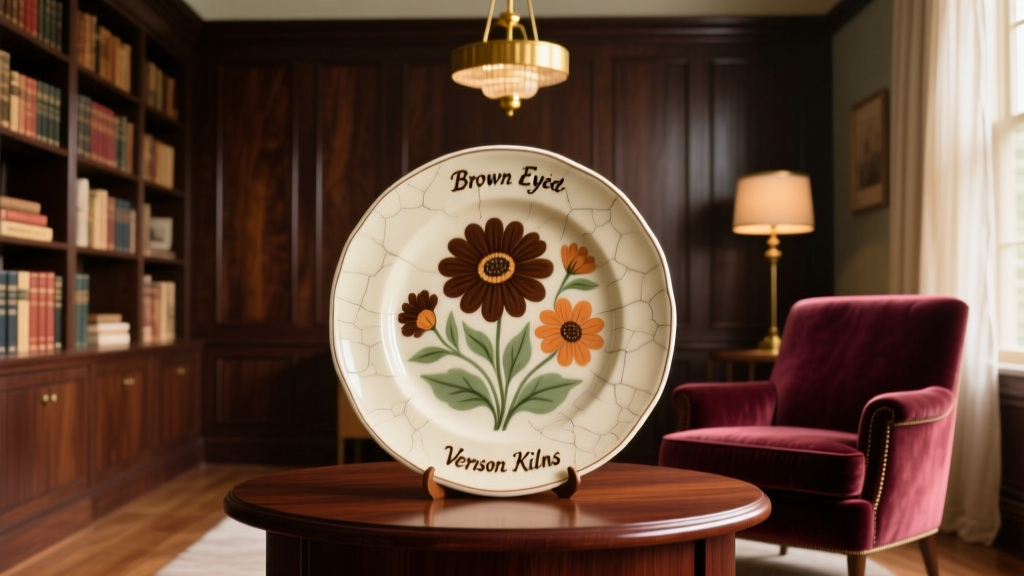
Vernon Kilns Brown Eyed Susan Plate: A Collector’s Guide to the 10½-Inch Dinnerware Icon
Opalescent Glass Cruet with Inverted Thumbprint Pattern: A Study of the Tapered Blue Variant
Shawnee Pottery’s Planter Boy at Gate: History, Identification, and Restoration Insights
The 1137263: Decoding the Herman Miller Eames Lounge Chair & Ottoman — Serial Number, Provenance, and Restoration Protocol
Copper Pan Tin Lining, Iron Handle, and Rivet Specifications: Decoding the 16½ × 2¼ Inch French Cookware Standard
Barometers Advertising Sunny Brook Whiskey: The 9-Inch Button Sign as Historical Artifact and Collectible