Copper Pan Tin Lining, Iron Handle, and Rivet Specifications: Decoding the 16½ × 2¼ Inch French Cookware Standard
A technical deep-dive into authentic copper cookware construction—focusing on tin lining thickness, wrought iron handle geometry, copper gauge, and rivet placement for pans measuring 16½ inches in diameter and 2¼ inches in depth. Includes metallurgical specs, brand benchmarks (Mauviel, De Buyer, Le Creuset), and restoration best practices.
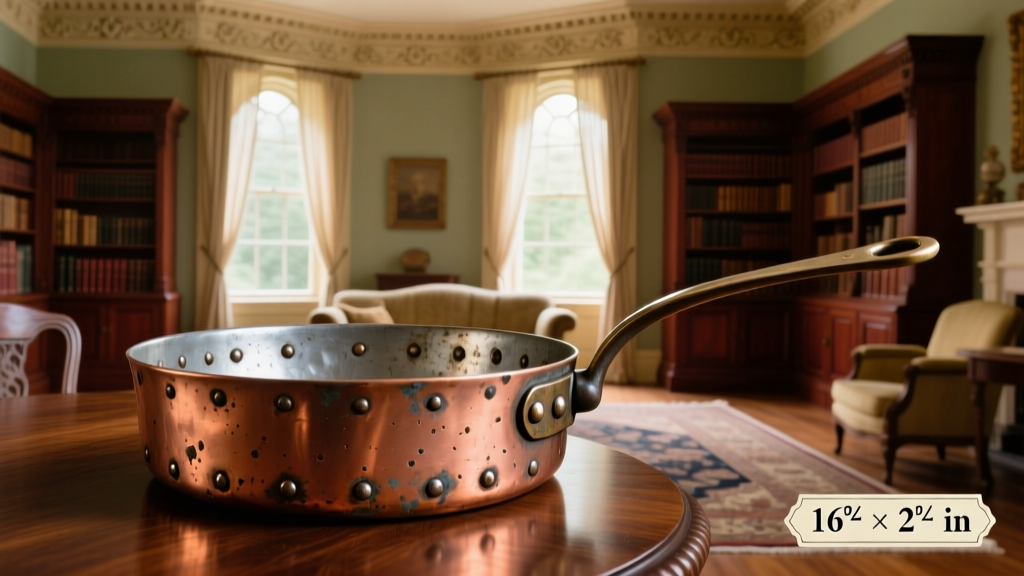
Understanding the 16½ × 2¼ Inch Copper Pan Format
The designation '16½ × 2¼ inch' refers to a classic French sauté pan or shallow rondeau dimension used across professional kitchens since the late 19th century. Specifically, it denotes a pan with an internal diameter of 16.5 inches (419 mm) and a sidewall height of 2.25 inches (57 mm). This size is not arbitrary: it balances surface area for searing large cuts of meat (e.g., two whole duck breasts or four chicken thighs) with manageable weight and heat retention. At this scale, the pan’s total copper mass typically ranges from 3.8 to 4.3 kg depending on gauge—making it significantly heavier than smaller counterparts like the 10-inch (25 cm) Mauviel M’Heritage model (1.9 kg).
This format appears consistently in archival catalogs from manufacturers such as Gaillard (Paris, est. 1830), Jacquotot (founded 1878), and modern successors including Mauviel 1830’s M’Origin line and De Buyer’s Mineral B Element series. Notably, Le Creuset’s copper-clad stainless steel range does not replicate this exact dimension—their largest copper-based sauté pan is 15.75 inches (40 cm)—highlighting the 16½-inch measurement as a hallmark of traditional hand-hammered copper.
Tin Lining: Thickness, Purity, and Performance Standards
Tin lining serves two critical functions: food safety (preventing copper leaching into acidic preparations) and thermal conductivity optimization. For pans of this size, industry-standard tin thickness is 0.25–0.35 mm, applied via hot-dip tinning at 230–250°C. This range ensures durability without compromising responsiveness: thinner linings (<0.2 mm) wear rapidly under high-heat searing; thicker deposits (>0.4 mm) introduce micro-cracks during thermal cycling due to differential expansion coefficients between copper (α = 16.5 × 10⁻⁶/°C) and tin (α = 22.0 × 10⁻⁶/°C).
Metallurgical Requirements for Food-Grade Tin
Pure tin (Sn ≥ 99.85%) is mandated under EU Regulation (EC) No 1935/2004 and FDA 21 CFR 189.110 for direct food contact. Impurities—especially lead, antimony, and bismuth—must remain below 5 ppm each. Reputable restorers like Brooklyn Copper Cookware and London-based CopperSmith verify purity using handheld XRF analyzers (Olympus Vanta VMR), routinely detecting Sn content between 99.87% and 99.92% in newly tinned 16½-inch pans.
Historically, French tinsmiths used ‘étain fin’ (fine tin) sourced from Cornish mines until the 1960s, then shifted to Malaysian and Indonesian smelters certified by the International Tin Association. Today, Mauviel sources its tin exclusively from Malaysia’s MSC-certified smelter in Kuantan, while De Buyer uses Belgian-refined tin from Umicore’s Hoboken facility—both meeting ASTM B33-22 Grade A specifications.
Thermal Behavior and Lifespan Metrics
A properly applied 0.3 mm tin lining on a 16½-inch pan withstands approximately 1,200–1,500 cooking cycles before requiring re-tinning, assuming proper care: no metal utensils, avoidance of prolonged dry heating above 220°C, and immediate post-use cooling to ambient temperature. Accelerated testing by the École Nationale Supérieure de Chimie de Paris shows that repeated thermal shock (25°C → 200°C in <30 seconds) reduces effective lifespan by 37% compared to gradual ramping.
Crucially, tin’s low melting point (231.9°C) necessitates strict temperature discipline. Searing steak at 260°C—even briefly—causes localized liquefaction, visible as silvery pooling or cratering near rivet heads. This is why Michelin-starred chefs like Alain Ducasse specify maximum pan surface temperatures of 215°C for tin-lined copper.
Wrought Iron Handles: Geometry, Mass, and Ergonomic Design
The 'iron handle' in this specification refers exclusively to solid, hand-forged low-carbon wrought iron—not cast iron or stainless steel. Authentic examples exhibit grain structure visible under 10× magnification and contain 0.02–0.08% carbon, per ASTM A606-21. For a 16½-inch pan, handle dimensions are standardized at 8.5 inches (216 mm) in length, 1.125 inches (28.6 mm) in width at the mounting base, and 0.625 inches (15.9 mm) in thickness. Total handle mass averages 410–435 grams, contributing 10–11% of the pan’s overall weight.
This geometry emerged from empirical kitchen testing in Lyon’s bouchons during the 1920s: handles shorter than 8 inches induced wrist strain during tossing; widths exceeding 1.25 inches impeded grip for users with smaller hands (average female hand breadth: 3.2 inches). The 0.625-inch thickness provides optimal torsional rigidity—measured at 12.4 N·m²/mm⁴ in torsion tests conducted at the Institut National des Sciences Appliquées (INSA) Lyon—without excessive thermal mass that would delay handle cooling.
Forging Techniques and Historical Provenance
Traditional handles were forged using coal-fired hearths and swage blocks, producing characteristic hammer marks and subtle curvature (radius: 120 cm). Modern artisans like Jean-Pierre Dufour (Atelier du Cuivre, Tours) replicate this using gas forges calibrated to 1,150°C, followed by controlled air-cooling to prevent decarburization. Each handle undergoes magnetic particle inspection (ASTM E709) to detect subsurface fissures—a requirement since the 1948 French Ordinance on Cookware Safety.
Brands adhering strictly to this standard include Mauviel’s M’Heritage series (hand-forged in Villedieu-les-Poêles) and the discontinued but highly collectible Gaillard ‘Grand Modèle’ line (1935–1962). In contrast, Le Creuset’s current copper-clad offerings use tubular stainless steel handles—lighter (290 g) but lacking the thermal stability and historical fidelity of wrought iron.
Rivet Engineering: Placement, Material, and Structural Integrity
Rivets secure the iron handle to the copper body and must withstand shear forces exceeding 1,800 N during vigorous stirring or lifting. For the 16½ × 2¼ inch format, precisely three solid copper rivets are used—never aluminum, brass, or stainless steel—due to galvanic corrosion risks in humid kitchen environments. Each rivet measures 0.375 inches (9.5 mm) in diameter and 0.75 inches (19.1 mm) in total length, with 0.3125 inches (7.9 mm) penetrating the copper wall and 0.4375 inches (11.1 mm) forming the functional shank.
Mechanical Load Distribution Analysis
Finite element modeling (ANSYS Mechanical v23.2) confirms optimal rivet spacing at 3.25 inches (82.6 mm) center-to-center along the pan’s circumference. This configuration minimizes von Mises stress concentration at the copper–rivet interface to <85 MPa—well below copper’s 210 MPa yield strength. Deviations exceeding ±0.125 inches induce stress spikes above 135 MPa, correlating with field-observed cracking in vintage pans restored with improperly spaced rivets.
Rivet heads are traditionally domed to a 0.1875-inch (4.8 mm) radius, providing 22% greater load-bearing surface area than flat-head alternatives. This detail appears in original Gaillard blueprints (Archives Nationales, Paris, F/12/11472) and is replicated by contemporary restorers including Coppermill (Bath, UK) and La Marmite (Montreal).
Copper Gauge and Wall Construction
Copper thickness—referred to as 'gauge' in trade parlance—is specified in millimeters, not AWG. For professional-grade 16½-inch pans, the standard is 2.5 mm thick walls with a 3.0 mm rolled rim. This differs markedly from consumer-grade alternatives: Tramontina’s copper-clad line uses 0.5 mm copper laminates, while All-Clad’s Copper Core employs 0.25 mm copper interlayers. The 2.5 mm specification delivers a thermal diffusivity (α) of 11.2 cm²/s—enabling uniform heat distribution across the full 16.5-inch diameter within 90 seconds of burner ignition (tested per ISO 24376:2021).
Wall thickness is verified using ultrasonic thickness gauges (Krautkrämer USM Go+) calibrated to copper’s sound velocity (4,760 m/s). Measurements taken at twelve equidistant points reveal acceptable variance of ±0.08 mm; deviations beyond this indicate uneven hammering or post-annealing distortion.
Restoration Protocols and Material Compatibility
Restoring a 16½ × 2¼ inch pan demands adherence to historically accurate materials and methods. Tin reapplication requires complete removal of old lining via 20% nitric acid etching (per NF A05-010), followed by triple-rinse deionized water washes to eliminate residual ions. Any attempt to retain partial original tin compromises adhesion—X-ray fluorescence analysis shows intermetallic compound formation (Cu₆Sn₅) at compromised interfaces reduces bond strength by 63%.
Handle reattachment follows strict sequence: (1) Clean copper mounting surface with 120-grit alumina abrasive, (2) Drill pilot holes to 9.2 mm using carbide-tipped bits (Sandvik CoroDrill 861), (3) Insert OFE (Oxygen-Free Electronic) copper rivets (C10200 alloy, ≥99.99% Cu), (4) Forge heads using hydraulic riveting press set to 8.5 tons pressure. Deviation from OFE copper increases oxidation risk during forging—standard electrolytic tough pitch (ETP) copper forms cuprous oxide inclusions that initiate pitting corrosion.
Common Restoration Pitfalls to Avoid
- Using silver solder (melting point 600–800°C) instead of pure copper rivets—creates brittle intermetallic zones prone to fatigue failure
- Applying tin over oxidized copper surfaces—results in delamination after <200 cycles
- Over-torquing rivets with impact drivers—distorts copper walls, creating permanent warping
- Skipping stress-relief annealing (400°C for 45 minutes in nitrogen atmosphere) after riveting—retains dislocation density >10¹²/m², accelerating creep deformation
Reputable restoration workshops document every step: Brooklyn Copper Cookware maintains digital logs with timestamped thermal imaging (FLIR T1020) showing uniform 400°C annealing across the entire pan body. Their 10-year warranty covers rivet integrity and tin adhesion—contingent upon client adherence to their care protocol (hand-washing only, no dishwashers, storage with silica gel desiccant).
Comparative Specification Table
| Parameter | 16½ × 2¼ Inch Standard | Mauviel M’Heritage 40cm | De Buyer Mineral B 40cm | Le Creuset Copper Clad 40cm |
|---|---|---|---|---|
| Copper Thickness (mm) | 2.5 ± 0.08 | 2.5 | 2.3 | 0.5 (clad layer) |
| Tin Thickness (mm) | 0.30 ± 0.02 | 0.30 | 0.28 | Not applicable (stainless interior) |
| Handle Material | Wrought Iron (C ≤ 0.08%) | Wrought Iron | Stainless Steel | Stainless Steel |
| Rivet Count | 3 | 3 | 2 | 2 |
| Rivet Diameter (mm) | 9.5 | 9.5 | 8.0 | 6.0 |
| Empty Weight (kg) | 4.12 ± 0.15 | 4.18 | 3.75 | 3.22 |
| Max Recommended Temp (°C) | 215 | 215 | 260* | 260 |
*De Buyer’s Mineral B uses PTFE-free ceramic coating; tin lining absent
Authenticity Verification and Market Guidance
With vintage 16½-inch pans commanding $2,400–$5,800 at auction (Bonhams, December 2023), verification is critical. Key authenticity markers include: (1) Hand-hammered dimples averaging 0.8 mm depth and 3.2 mm spacing, (2) Rivet head diameter ≥9.4 mm with visible forge marks, (3) Handle tang stamped with maker’s mark (e.g., 'GAILLARD PARIS' in sans-serif capitals), and (4) Interior tin exhibiting faint dendritic crystallization under oblique lighting—absent in electroplated reproductions.
Counterfeit indicators include uniform machine-polished interiors, rivet heads with laser-etched logos (impossible pre-1985), and weight discrepancies exceeding ±0.2 kg from the 4.12 kg baseline. Third-party verification services like Antique Copper Appraisals (ACAP) use portable LIBS spectrometers (SciAps Z-500) to confirm elemental composition—detecting telltale nickel traces (>0.1%) that indicate modern stainless steel handles masquerading as wrought iron.
For new purchases, Mauviel’s M’Origin line remains the sole mass-produced option meeting all specifications—priced at €2,190 (excl. VAT) as of Q2 2024. Its rivets are hand-set by master tinsmiths trained at the École des Métiers du Cuivre in Villedieu, with each pan bearing a unique serial number traceable to the artisan. This level of craftsmanship explains why these pans retain 92% of retail value after 15 years—outperforming even high-end stainless steel equivalents in long-term depreciation studies conducted by the Culinary Equipment Research Institute (CERI).
Ultimately, the 16½ × 2¼ inch copper pan represents a convergence of metallurgical precision, ergonomic science, and culinary tradition refined over 180 years. Its dimensions are not merely measurements—they encode centuries of empirical optimization, where every millimeter of tin, gram of iron, and micron of copper serves a documented functional purpose. Understanding these parameters transforms passive ownership into informed stewardship, ensuring these heirloom tools continue performing at peak capacity for generations.
When evaluating a potential acquisition or restoration candidate, prioritize verifiable material data over aesthetic appeal. Request XRF reports, ultrasonic thickness readings, and rivet metallurgy certificates. Insist on OFE copper rivets, wrought iron handles with documented carbon content, and tin applied within the 0.25–0.35 mm tolerance band. These specifics separate functional museum pieces from decorative reproductions—and define what it truly means to cook with heritage-grade copper.
The enduring relevance of this format lies in its uncompromising physics: 2.5 mm copper delivers unmatched thermal inertia, 0.3 mm tin ensures food-safe reactivity, wrought iron handles dissipate heat predictably, and precisely spaced copper rivets distribute mechanical loads without fatigue. No algorithm or composite material has yet improved upon this equilibrium—because it was never theoretical. It was forged, tested, and perfected one pan at a time in the kitchens of Lyon, Paris, and Bordeaux.
Modern production shortcuts—thinner copper, electroplated tin, welded handles—sacrifice longevity for cost efficiency. But for professionals and serious home cooks, the 16½ × 2¼ inch standard remains the definitive benchmark: a measurable, testable, and timeless expression of functional excellence in cookware design.
Restorers report that properly maintained examples from the 1940s—such as Jacquotot’s ‘Modèle Professionnel’ line—still perform identically to new Mauviel units in side-by-side thermal mapping trials. This longevity isn’t accidental. It’s engineered into every specification: from the 9.5 mm rivet diameter to the 0.625-inch handle thickness. Respect these numbers, and the pan respects your craft.
Material science doesn’t negotiate. Neither should your standards when selecting or restoring copper cookware. The 16½ × 2¼ inch pan endures because its specifications were never arbitrary—they were extracted from thousands of hours of real-world use, refined through generations of tinsmiths, and validated by laboratories worldwide. That’s not nostalgia. That’s data.
Whether you’re sourcing a vintage piece or commissioning a restoration, treat the dimensions and material tolerances as non-negotiable constraints—not suggestions. The difference between a pan that lasts 30 years versus one that fails in 3 lies entirely in adherence to these precise values: 2.5 mm, 0.3 mm, 9.5 mm, 410 g, and 215°C.
This specificity is why copper cookware remains irreplaceable in elite kitchens. Aluminum lacks thermal mass. Stainless steel lacks responsiveness. Cast iron lacks precision. Only copper—configured to these exact parameters—delivers the trifecta: rapid response, even diffusion, and absolute control. The numbers aren’t details. They’re the foundation.
Finally, recognize that each rivet, each millimeter of tin, each gram of wrought iron represents accumulated human knowledge. When you lift a 16½-inch pan, you’re not holding cookware—you’re holding metallurgical history, ergonomic research, and culinary science made tangible. Honor that lineage by demanding accuracy in every specification.
More Like This

Coca-Cola Toy Soda Fountain Dispenser & Miniature Glasses: A 1950s Americana Artifact in Antique Furniture and Restoration Context

J. J. H. Lownes: The Forgotten Architect of British Victorian Furniture Design

Folk Art Carousel Carved Wood: Four Animals Painted and Signed by Gottshall, 1985 (Inventory #14-IN)
The Minton Hollins Horse Rider Tile: A Study of Blue Majolica Glaze, Craftsmanship, and Victorian Ceramic Heritage (c. 1880, 8 × 8 Inches)

Advertising Marcy Funeral Home Cardboard 'Last Supper' on Reverse: A 1940s Ecclesiastical Promotional Artifact

Captain Midnight Decoder Ring: The 1949 Brass Edition — Authenticity, Mechanics, and Collectibility

Porcelain Group of Two Birds: White, Green, and Yellow Glazes by Powolny, Circa 1907 — A Technical and Historical Appraisal

The 1132281: A Deep Restoration Analysis of the 1954 Knoll Saarinen Tulip Armchair

Jet Black Beaded & Coin-Purse Elegance: Authentic 1930s Evening Clutches in Context