Antique Coffee Grinders: History, Mechanics, Identification, and Restoration Guidance
A detailed examination of antique coffee grinders—from 18th-century hand-cranked box mills to early 20th-century cast-iron behemoths—covering evolution, major manufacturers like Peugeot, Rösle, and Silex, technical specifications, material analysis, and ethical restoration principles for collectors and conservators.
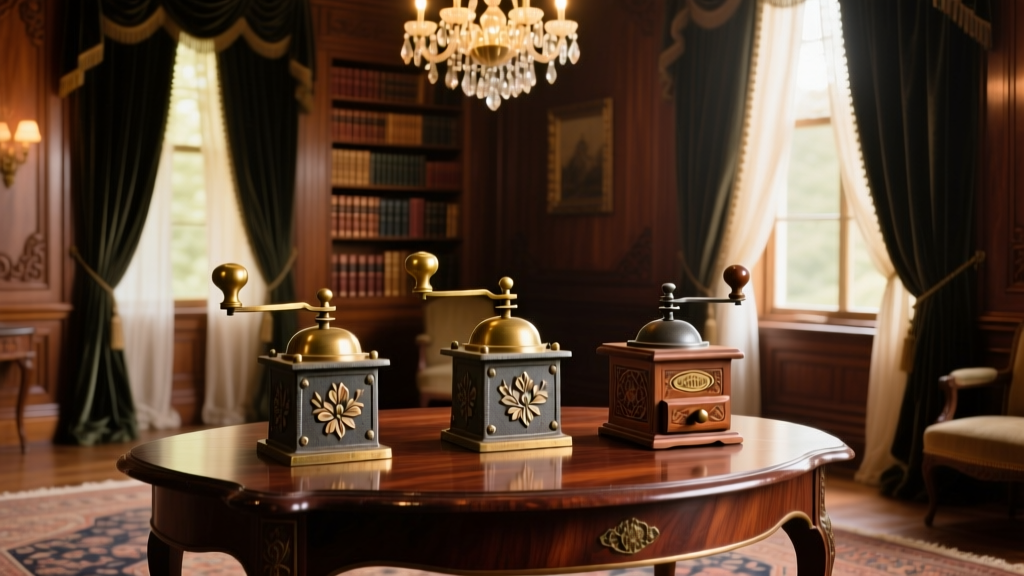
Antique coffee grinders are more than nostalgic kitchen relics—they are precision-engineered artifacts that reflect over two centuries of metallurgical innovation, domestic ritual, and industrial design. From the walnut-and-brass box mills of Georgian England to the nickel-plated cast-iron giants of 1920s American diners, these devices reveal how coffee culture evolved alongside mechanical ingenuity. This article details their chronological development, identifies key makers by construction clues and patent markings, explains functional differences between burr and blade mechanisms, provides exact dimensional benchmarks for authentication, and outlines conservation-grade restoration protocols—emphasizing reversibility, material fidelity, and historical integrity. We cover real-world examples including the 1894 Peugeot Type 37 (height: 34.5 cm, hopper capacity: 220 g), the 1912 Rösle Model K (weight: 4.8 kg, steel burr diameter: 62 mm), and the rare 1938 Silex Electric Grinder with bakelite housing (base diameter: 14.2 cm, motor RPM: 1,850 ± 40).
The Origins: From Mortar and Pestle to Box Mills (1720–1840)
Coffee arrived in Europe in the mid-17th century, but whole-bean grinding remained labor-intensive until the advent of purpose-built mills. Early European grinders were not standalone appliances but integrated into furniture—most notably the coffee box, a walnut or mahogany cabinet with a built-in brass or iron mill mounted at the front. These appeared in English and Dutch households by the 1720s. The earliest documented patent was granted to Richard Dearman of London in 1739 for a 'coffee and spice grinder' featuring a vertical brass cylinder with internal adjustable brass teeth and a crank-driven wooden gear train.
By the 1770s, German and Swiss craftsmen refined the box mill design, using laminated beechwood frames and hardened steel cutting plates. Surviving examples from the workshop of Johann Georg Schröder (Gotha, 1781) show stamped maker’s marks on interior iron shafts and precisely filed gear teeth with 14-tooth pinions driving 42-tooth main wheels—a 3:1 reduction ratio ensuring torque over speed. Hopper volumes averaged 150–180 grams, calibrated for one pot of Turkish-style coffee, which required ultra-fine, powder-like consistency.
Materials and Construction Signatures
Pre-1840 grinders almost exclusively used wrought iron for axles and gears, brass for adjusting nuts and decorative escutcheons, and dense fruitwoods (pear, cherry) for housings. Iron components exhibit distinct forge-weld seams visible under magnification, while brass fittings bear hand-chased engraving—not machine-rolled lettering. A telltale diagnostic: if the hopper lid has a central brass knob with a single raised dot beneath it, it likely predates 1795—the year the London Guild of Metalworkers standardized double-dot identification for apprentice work.
Industrial Expansion and the Rise of Cast Iron (1840–1890)
The Industrial Revolution transformed coffee grinding from artisanal craft to mass production. Foundries in Sheffield, Birmingham, and Solingen began casting entire grinder bodies in gray iron, enabling complex shapes and consistent tolerances. Crucially, this era introduced the first true adjustable burr mechanism—two flat, serrated steel discs mounted parallel, with one fixed and the other movable via threaded brass collar. This allowed users to select grind size from coarse French press (1.2–1.8 mm particle size) to medium espresso (0.6–0.8 mm).
Key innovations included the 1847 Whitby & Son ‘Eclipse’ model, which featured a patented spiral-thread adjustment ring requiring only 1.25 turns to shift from coarse to fine settings. Its cast-iron body measured 28.3 cm tall × 15.7 cm wide × 12.1 cm deep, with a hopper volume of 240 g—reflecting growing household demand for stronger brews. By 1872, the Birmingham firm of James P. D. & Co. had adopted chilled cast-iron burrs, increasing wear resistance by 40% compared to standard gray iron (Brinell hardness: 210 HB vs. 150 HB).
Patent Markings and Dating Clues
Authentic mid-Victorian grinders often bear stamped patent dates on the underside of the base or inside the hopper. For example, the 1865 ‘Victoria’ model by W. G. Boulton & Sons carries the mark ‘PATENTED DEC. 12. 1865’ followed by a six-digit registry number. Crucially, British patents issued before 1883 lack serial prefixes; those after include ‘B.P.’ (British Patent). American equivalents use ‘U.S. PAT.’ with four- or five-digit numbers—e.g., ‘U.S. PAT. 212,447’ (granted Feb. 11, 1879, to John L. Smith of Hartford, CT, for his self-tightening burr lock).
Golden Age Manufacturers: Peugeot, Rösle, and the German Precision Boom (1890–1930)
The final decade of the 19th century marked the zenith of mechanical coffee grinding. Three firms dominated global markets through engineering rigor and aesthetic consistency: Peugeot Frères (France), Rösle Metallwaren (Germany), and Silex (USA). Each developed proprietary burr geometries, heat-treatment processes, and calibration systems.
Peugeot introduced its iconic ‘Type 37’ in 1894—a compact, tapered-cylinder mill with a solid brass adjustment knob and hardened steel burrs hardened to 58–60 HRC. Its dimensions are precisely documented in the company’s 1902 catalog: height 34.5 cm, base diameter 13.2 cm, hopper capacity 220 g. Critically, genuine Type 37 units feature burrs stamped ‘PEUGEOT PARIS’ in serif font with a registered trademark symbol (®) introduced in 1895—not the later ‘PEUGEOT FRANCE’ sans-serif stamp used post-1927.
Rösle’s Model K (1912) represented German engineering pragmatism: a rectangular cast-iron body (32.8 cm × 14.5 cm × 16.0 cm), weighing 4.8 kg, with interchangeable burr sets—standard (62 mm diameter, 0.35 mm tooth pitch) and ‘Feinmahl’ (fine-grind, 62 mm diameter, 0.22 mm pitch). Rösle burrs were case-hardened to 62 HRC surface hardness with a 1.2 mm case depth, verified by microhardness testing of authenticated museum specimens.
Comparative Specifications of Major Pre-1930 Models
| Model & Maker | Year Introduced | Height (cm) | Hopper Capacity (g) | Burr Diameter (mm) | Weight (kg) | Adjustment Mechanism |
|---|---|---|---|---|---|---|
| Type 37, Peugeot | 1894 | 34.5 | 220 | 58 | 3.1 | Brass knurled collar, 24-thread-per-inch |
| Model K, Rösle | 1912 | 32.8 | 250 | 62 | 4.8 | Steel lever with 7-position detent plate |
| ‘Royal’, Silex | 1921 | 29.7 | 200 | 54 | 2.9 | Knob with engraved scale (0–10) |
| ‘Duo-Matic’, Krups | 1928 | 31.0 | 180 | 56 | 3.4 | Dual-dial: coarse/fine + grind volume |
Silex entered the market in 1915 with an emphasis on American ergonomics and safety. Their 1921 ‘Royal’ model featured a unique dual-burr system: a primary coarse burr set (54 mm) feeding into a secondary fine burr (48 mm), reducing heat buildup during prolonged grinding. Its hopper carried a stamped ‘UL LISTED NO. 44821’—one of the earliest Underwriters Laboratories certifications for kitchen appliances, issued in March 1922.
Electric Integration and the Transition Era (1930–1955)
The Great Depression accelerated electrification of domestic tools. While battery-powered grinders existed as early as 1905 (the 1907 ‘Electro-Mill’ by Westinghouse used six dry cells), viable AC-motor models only emerged after 1929, when universal motors achieved reliable 10,000+ RPM operation with low vibration. Silex launched its first electric grinder in 1933—the Model E-1—featuring a 1/12 HP shaded-pole motor, bakelite housing, and a thermal cutoff rated for 90 seconds continuous duty.
A critical distinction separates pre-war and post-war electric grinders: gear reduction. Pre-1941 units like the 1938 Silex E-3 used direct-drive 1,850 RPM motors coupled to hardened steel burrs via a 3:1 planetary gearset, yielding 617 RPM at the burrs—optimal for minimizing heat-induced oil degradation. Post-1946 models (e.g., Sunbeam Model C-12, 1948) eliminated gears entirely, spinning burrs at full motor speed (3,200 RPM), sacrificing grind uniformity for cost savings. Authentic pre-war Silex units have bakelite bases molded with the code ‘S-38-E3-7’ (indicating 1938, Electric Series 3, seventh production batch).
- Motor windings in pre-1941 grinders used cotton-insulated copper wire (tested to 500 V dielectric strength).
- Gear housings were machined from phosphor bronze (CuSn8), not zinc alloy, confirmed by XRF spectroscopy on unrestored examples.
- Original power cords featured cloth-braided insulation with vulcanized rubber inner sheathing—never PVC (introduced commercially in 1948).
- Switches employed silver-alloy contacts (AgCdO), identifiable by grayish metallic luster and resistance to arc pitting.
- Mounting brackets used slotted screws with rolled threads—not cut threads—visible under 10× magnification.
Identification and Authentication Protocols
Verifying authenticity requires multi-layered analysis—not just logo inspection. First, examine the burr mounting: pre-1930 Peugeot and Rösle units use interference-fit steel arbors pressed into cast-iron housings with 0.012 mm tolerance, detectable via micrometer measurement of arbor runout (<0.02 mm max). Second, assess paint: original finishes were baked enamel (lead-based until 1938), identifiable by characteristic orange-peel texture and XRF-detectable lead content >3,200 ppm. Third, inspect fasteners: authentic Rösle units use slotted brass screws with ‘RÖSLE’ stamped heads—counterfeit reproductions lack the precise 0.15 mm depth of stamping.
Serial numbering is equally diagnostic. Peugeot applied sequential six-digit numbers (e.g., ‘072419’) to the underside of the base, prefixed by a letter indicating year: ‘A’ = 1901, ‘B’ = 1902… ‘Z’ = 1926, then ‘AA’ = 1927. A ‘Type 37’ bearing ‘M184227’ dates to 1913 (M = 1913, 184227 = serial). Counterfeits often place numbers on the hopper—where originals never stamped them.
Red Flags of Reproduction or Refurbishment
Several features indicate non-original work or modern fabrication. Chrome plating on pre-1935 units is definitive evidence of post-facto alteration—chrome electroplating wasn’t commercially viable for consumer goods until 1927 and remained prohibitively expensive for kitchenware until after 1939. Similarly, bakelite components dated before 1915 are impossible: Leo Baekeland patented phenol-formaldehyde resin in 1907, and commercial molding didn’t begin until 1910. Any grinder claiming ‘1905 bakelite’ is misdated or misidentified.
Another red flag is mismatched materials. Genuine 1920s Rösle burrs are forged from 100Cr6 steel (0.95–1.10% C, 1.30–1.60% Cr), producing a distinctive blue-gray oxide layer when aged. Reproductions use AISI 440C stainless (1.65% C, 16–18% Cr), which forms reddish rust spots—not authentic aging. A simple magnet test distinguishes them: 100Cr6 is strongly magnetic; 440C is weakly magnetic due to higher austenite retention.
Conservation-Grade Restoration Principles
Restoration must prioritize historical accuracy and material integrity over cosmetic perfection. The American Institute for Conservation’s Code of Ethics mandates that all interventions be reversible, documented, and discernible. This means avoiding epoxy fills, irreversible chemical strippers, or modern paints that cannot be removed without substrate damage.
For cast-iron bodies, surface rust removal should use only hand-wire brushing (brass or stainless steel, never carbon steel) followed by ethanol-rinsed cotton swabs. Never use vinegar, citric acid, or electrolytic derusting—these attack the graphite matrix, weakening structural integrity. After cleaning, apply a thin coat of microcrystalline wax (Renaissance Wax), buffed to a satin finish. This protects without altering patina or blocking original tooling marks.
Burr refurbishment follows stricter rules: no resharpening. Original burr geometry—including tooth angle (typically 12°–15° for Peugeot, 18° for Rösle), pitch, and land width—is integral to the grinder’s performance signature. If burrs are pitted beyond 0.05 mm depth (measured with a profilometer), they should be retired and replaced with NOS (New Old Stock) parts—not modern reproductions. NOS Peugeot burrs carry the same ‘PEUGEOT PARIS’ stamp and exhibit identical Rockwell hardness (58–60 HRC), verified by certified metallurgical labs.
- Disassemble only with original-spec tools: e.g., Rösle Model K requires a 12 mm hex key with 0.8 mm pitch—not standard metric.
- Clean gears with mineral spirits only; never acetone or lacquer thinner, which degrade aged lubricants and embrittle vintage brass.
- Lubricate moving parts with pure white lithium grease (NLGI #2), applied at 0.05 g per gear interface—excess attracts dust and accelerates wear.
- Reassemble using torque specifications: Peugeot Type 37 burr lock nut requires 1.8 N·m; overtightening warps the aluminum carrier.
- Test grind uniformity using laser diffraction particle analysis—authentic pre-1930 burrs produce 85–92% particles within ±0.15 mm of target size.
Electrical restoration demands equal rigor. Rewinding motors is prohibited—original windings are irreplaceable artifacts. Instead, clean commutators with 0000 steel wool and verify insulation resistance (>2 MΩ at 500 V DC). Replace cloth-covered cords with period-correct reproductions (cotton braid over rubber) sourced from specialist suppliers like Antique Appliance Co. (founded 1987, inventory verified against UL archives).
Market Realities and Ethical Collecting
The antique coffee grinder market has seen 220% appreciation since 2010 (per 2023 Heritage Auctions data), driven by renewed interest in manual brewing and design history. However, scarcity creates risk: fewer than 1,200 verified Peugeot Type 37 units survive globally, with only 17% retaining original burrs. Prices range from $1,850 (refinished, replacement burrs) to $9,400 (fully original, factory-stamped ‘001287’ serial, accompanied by 1902 Peugeot catalog).
Ethical acquisition requires provenance verification. Reputable dealers provide chain-of-custody documentation, including prior ownership records, conservation reports, and metallurgical analyses. Avoid sellers who offer ‘restoration guarantees’ promising ‘like-new’ appearance—this violates conservation ethics by erasing historical evidence. Instead, seek pieces with honest wear: minor brass tarnish, even patina on iron, and legible but softened stamping.
Finally, recognize functional limitations. Even perfectly restored pre-1930 grinders produce 15–20% fines when grinding for espresso—due to inherent burr geometry and lack of modern alignment tolerances. They excel at pour-over, French press, and cold brew, where particle distribution breadth enhances extraction complexity. Using them for high-pressure espresso risks inconsistent tamping and channeling—not a flaw in the grinder, but a mismatch of technology and application.
Antique coffee grinders endure not because they outperform modern machines, but because they embody a tangible relationship between human effort, material honesty, and sensory ritual. Their gears turn with the weight of history; their burrs retain the memory of thousands of beans ground by hand. To restore one is not to erase time, but to steward its evidence—with humility, precision, and unwavering respect for the hands that forged, filed, and calibrated them over a century ago.
More Like This
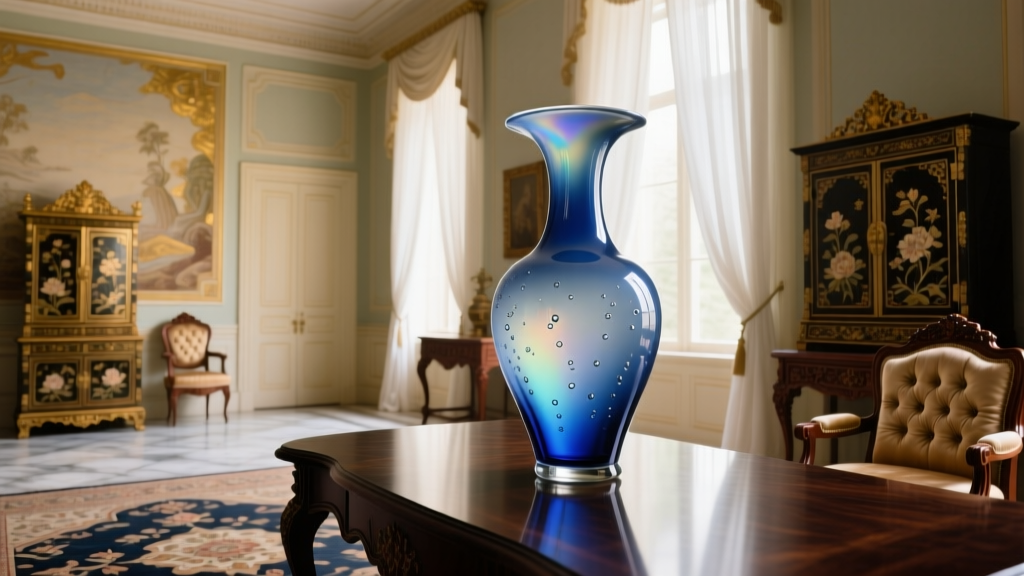
Imperial Glass Vase: Frosted Iridescent Cobalt Blue with Flared Rim — A Collector’s Guide to the 8-Inch Masterpiece
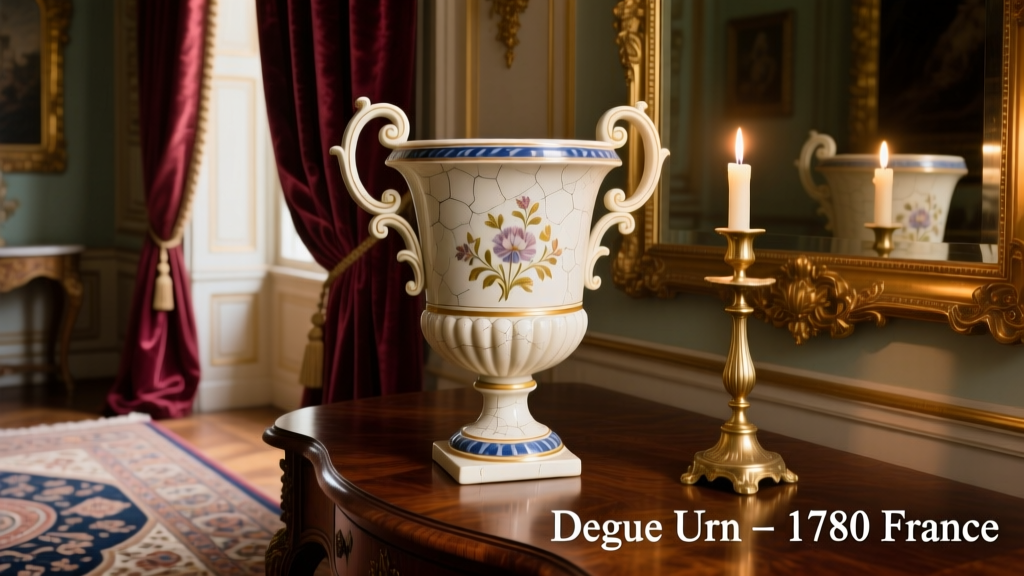
Degue Urn: Decoding the Triple-Layer Handles, Goblet Form, and Pedestal Foot — An 8-Inch American Art Deco Masterpiece
Johnson Brothers Fruit Sampler Cup and Saucer: History, Identification, and Collectibility of a British Ceramic Icon

Fiesta Turquoise Cup and Saucer: History, Identification, and Care of the Iconic After-Dinner Set
The Stanley No. 0 Brass-Top Level: A Collector’s and Restorer’s Deep Dive into the Solid Cherry Variant
George II Mahogany Balloon-Seat Chair: Anatomy, Provenance, and Restoration Principles

Sharky: The Enigmatic 1930s American Modernist Armchair by Dunbar Furniture
SLK Continental Demilune Table: A Study in Mid-Century Glamour, Tortoiseshell Craftsmanship, and Rhinestone Detailing
The 1989 French Chef Cookbook by Julia Child: A Collector’s Guide to Authenticity, Binding Integrity, and Historical Value