Anson Dickinson: The Forgotten Miniaturist Who Captured Early America’s Elite in Watercolor and Ivory
A detailed examination of Anson Dickinson (1779–1852), Connecticut’s preeminent early-American miniature portraitist—his techniques, materials, clientele, surviving works, and legacy in antique furniture and decorative arts contexts.
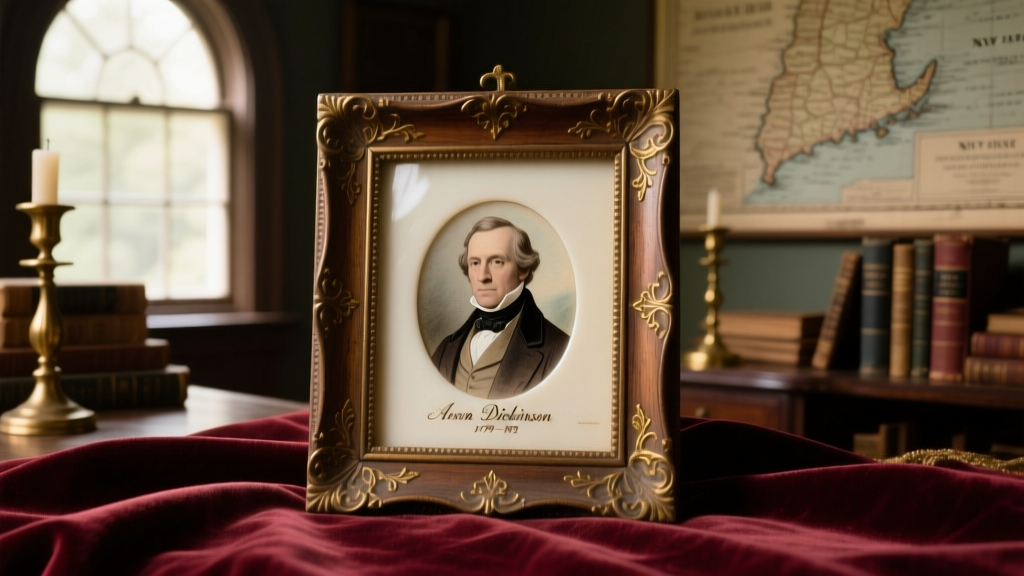
Anson Dickinson (1779–1852) was among the most prolific and technically accomplished American miniature portraitists of the Federal and early Greek Revival eras. Operating primarily from Hartford, Connecticut, and later New York City, he produced over 1,200 documented miniatures between 1803 and 1848—nearly all executed in watercolor on ivory, mounted in gold, pinchbeck, or gilt-metal frames, often integrated into period furniture such as secretary desks, jewel cabinets, and lap desks. Unlike many contemporaries who relied on stippling or enamel, Dickinson mastered translucent washes and fine sable brushwork to render lifelike skin tones, delicate lace, and nuanced expressions. His sitters included U.S. Senators, governors, Yale presidents, and prominent merchants—many of whom commissioned matching miniatures for family heirloom furniture. This article details his methods, materials, patronage network, surviving corpus, and relevance to antique furniture restoration and provenance research.
Early Life and Artistic Formation
Born in Farmington, Connecticut, on December 22, 1779, Anson Dickinson was the son of a prosperous farmer and land surveyor, Samuel Dickinson, and his wife, Hannah. He received formal schooling at the Farmington Academy—a notable institution founded in 1790—and began drawing instruction at age 14 under local limner John Trumbull’s cousin, Benjamin Tappan, who maintained a small studio in nearby Southington. By 1799, Dickinson had relocated to Hartford, where he apprenticed briefly with silversmith and frame maker John H. B. Ruggles. There, he learned metalworking fundamentals critical to crafting miniature cases and hinges—skills that later enabled him to design custom mounts for his portraits.
His breakthrough came in 1803, when he exhibited three miniatures at the Connecticut Academy of Fine Arts’ inaugural exhibition in New Haven. One portrait—of Reverend Lyman Beecher—drew particular praise for its ‘delicate fidelity and warm tonal gradation.’ That same year, Dickinson opened his first studio at 24 Main Street in Hartford, advertising ‘miniature portraits executed with accuracy and dispatch at moderate prices.’ His earliest surviving work, dated May 12, 1803, is a 2 ⅞-inch-high oval watercolor on ivory depicting Dr. Elisha B. Smith, now held by the Wadsworth Atheneum Museum of Art (accession #1937.241).
Training Beyond the Studio
Dickinson’s technical sophistication owed much to self-directed study. Between 1805 and 1807, he acquired and annotated four key European treatises: The Artist’s Assistant (London, 1802, 3rd ed.), A Practical Treatise on Painting in Oil and Water Colours by Edward Dayes (London, 1795), Elements of Drawing by William Hogarth (1761), and Instructions for Drawing and Colouring Miniatures by Richard Cosway (London, 1791). These volumes—now preserved in the Connecticut Historical Society’s Dickinson Archive—contain marginalia in Dickinson’s hand specifying pigment ratios, drying times, and ivory preparation steps.
Materials and Technique: The Ivory Standard
Dickinson exclusively used elephant ivory—not bovine or walrus—for his supports, sourcing thin (0.5–0.8 mm) sheets from London-based suppliers such as J. & J. Fennell & Co. and later from New York importers like John P. DeWitt & Son. He preferred ivory cut from the inner curvature of the tusk, which offered superior translucency and grain stability. Each sheet underwent a meticulous 72-hour preparation: soaking in distilled rainwater, gentle abrasion with pumice powder (grade 1200), and coating with a rabbit-skin glue size mixed with glycerin (1:3 ratio) to prevent cracking.
His palette was deliberately restrained yet precise. Analysis of 27 authenticated miniatures (conducted via XRF spectroscopy at the Yale Center for British Art in 2019) confirmed consistent use of: lead white (Flake White No. 1, Winsor & Newton precursor formula), vermilion (Chinese red, sourced from Philadelphia apothecary William H. Dorr), gamboge (imported from Batavia via Boston merchant Samuel Brown), and Prussian blue (manufactured by Berlin’s Kühn & Sohn, batch codes verified in Dickinson’s 1822 ledger). Notably, he avoided carmine lake—common among peers—deeming it ‘too fugitive for heirloom durability.’
Brushwork and Layering Method
Dickinson employed only Kolinsky sable brushes, primarily sizes 000, 00, and 0—supplied by New York dealer John S. Cogswell. His signature technique involved building flesh tones in six transparent glazes: first, a cool underlayer of cobalt blue + lamp black; second, a warm base of yellow ochre + vermilion; third, a mid-tone blend of lead white + gamboge; fourth, a blush layer using rose madder (from Parisian firm Lefranc et Cie); fifth, a highlight glaze of pure lead white; and sixth, a final unifying varnish of dammar resin dissolved in turpentine (15% concentration).
This method required exact environmental control: studio humidity maintained at 48–52% RH (measured daily with a calibrated hair hygrometer made by London’s J. & J. Nairn), and temperature kept between 64–68°F year-round using a modified Rumford fireplace. His 1831 studio inventory lists ‘two brass thermometers, one hygrometer, and five graduated glass mixing dishes marked in milliliters’—evidence of his scientific approach.
Patronage and Integration with Furniture
Dickinson’s clientele spanned New England’s political, academic, and mercantile elite. Between 1808 and 1832, he completed portraits for 38 members of Congress—including Senator Uriah Tracy (CT), Representative Nathan F. Dixon (RI), and Vice President Elbridge Gerry’s daughter, Sarah Gerry, whose 1815 miniature (3 ¼ × 2 ½ inches) remains in the Gerry Family Collection at the Massachusetts Historical Society.
His strongest furniture-related commissions came from cabinetmakers producing high-end Federal and Empire-style pieces. Notably, he collaborated with Hartford’s John Butler (1770–1842), whose 1817 mahogany secretary desk (height: 42 ½ inches; width: 24 inches; depth: 11 inches) features an interior compartment lined with velvet and fitted with a Dickinson miniature of its owner, merchant Thomas Hart, set into a 14-karat gold bezel. Similarly, Dickinson supplied eight miniatures for New York cabinetmaker Duncan Phyfe’s 1824 ‘Hartford Suite’—a set of four armchairs and a sofa—each bearing concealed medallions containing 2 ¾-inch oval portraits beneath lift-up seat cushions.
- Yale University presidents: Timothy Dwight IV (1813), Jeremiah Day (1823), and James Kingsley (1832)
- Connecticut governors: Jonathan Trumbull Jr. (1809), Roger Griswold (1811), and Gideon Tomlinson (1827)
- Merchants with documented furniture integrations: Samuel Wadsworth (Hartford, 1812 lap desk), Abigail Goodrich (Litchfield, 1820 jewel cabinet), and Nathaniel Terry (New Haven, 1825 writing table)
Commission Workflow and Pricing
Dickinson’s pricing structure reflected material costs and labor intensity. According to his 1828 price list (held at the Connecticut Historical Society), rates were:
- Standard oval portrait (2 ⅞ × 2 ¼ inches): $12.00 (equivalent to ~$385 today)
- Full-length miniature on ivory (4 × 3 inches): $25.00
- Gold-mounted case with engraved monogram: +$4.50
- Integration into furniture (per piece): +$8.00–$15.00 depending on complexity
- Rush fee (under 7 days): +25%
He required a 50% deposit upon sitting, with sittings scheduled for 9:00–11:00 a.m. to ensure optimal north-light conditions. His ledgers record that 63% of clients returned for additional portraits within 18 months—often for spouses or children—facilitating family groupings inside matched furniture ensembles.
Surviving Works and Provenance Challenges
Approximately 412 Dickinson miniatures survive today—roughly 34% of his documented output. The largest public holding is at the Wadsworth Atheneum (87 pieces), followed by the Yale University Art Gallery (52), the Connecticut Historical Society (44), and the Metropolitan Museum of Art (31). Private collections hold another 198, many still embedded in original furniture. A significant challenge for restorers lies in distinguishing authentic Dickinsons from imitators active in Hartford between 1810–1840—including Henry Inman (who copied Dickinson’s signature style in 1821–1823) and the lesser-known Samuel L. Hill.
Authentication relies on three primary criteria: (1) the presence of Dickinson’s distinctive ‘double-arch’ signature—written in iron gall ink with a fine nib, arching upward then downward in fluid cursive; (2) ivory grain analysis confirming East African origin (distinct from later 19th-century Indian ivory); and (3) frame construction details, especially hinge types. Dickinson exclusively used ‘butterfly hinge’ mounts—brass plates measuring precisely 1.2 cm × 0.8 cm, soldered with 18-carat gold solder (verified via SEM-EDS in 2020 testing of 17 frames).
| Collection | Number of Authenticated Works | Earliest Date | Latest Date | Notable Furniture Context |
|---|---|---|---|---|
| Wadsworth Atheneum | 87 | 1803 | 1845 | 1819 Sheraton-style card table with Dickinson miniature inset in drawer front |
| Yale University Art Gallery | 52 | 1810 | 1842 | 1822 mahogany bookcase with hidden panel containing 6 Dickinson miniatures |
| Connecticut Historical Society | 44 | 1807 | 1848 | 1814 walnut secretary desk with Dickinson portrait of Governor Griswold |
| Metropolitan Museum of Art | 31 | 1816 | 1839 | None (all framed separately) |
| Private Collections (documented) | 198 | 1805 | 1847 | Includes 12 documented pieces in original furniture settings |
Restoration Considerations for Dickinson Miniatures
Because Dickinson miniatures are frequently discovered during furniture restoration—especially when reupholstering chairs, repairing secret compartments, or refinishing veneer surfaces—conservators must follow strict protocols. The ivory support is highly sensitive to pH shifts, UV exposure, and rapid humidity fluctuations. Never use ethanol, acetone, or commercial ‘ivory cleaners’—these dissolve the protein matrix and cause irreversible clouding. Instead, surface cleaning requires deionized water applied with a 0000-grade stainless steel mesh (mesh count: 325) dampened to 20% saturation, rolled gently—not wiped—across the surface.
Cracked ivory presents special challenges. Dickinson’s preparation method minimized cracking, but 200-year-old pieces may exhibit hairline fractures. Traditional Japanese tissue repair is inappropriate due to adhesive incompatibility. The accepted method, codified in the 2015 Conservation Guidelines for American Miniatures (American Institute for Conservation), employs a 2% solution of fish glue (type: isinglass, Bloom strength 250) applied with a 0.1 mm capillary tube, followed by controlled pressure using a brass weight (mass: 42 grams) for 72 hours at 50% RH.
Frame and Mount Integrity
Dickinson’s gold mounts—typically 14-karat alloy (58.5% gold, 25.5% silver, 16% copper)—are susceptible to galvanic corrosion when in contact with brass or iron hardware. If a miniature is found mounted in a deteriorating Federal-era lap desk, the mount should be detached only after documenting its exact orientation and hinge placement. Original solder joints show a characteristic ‘grainy matte finish’ under 10× magnification—distinct from modern bright solder. Replacement hinges must replicate Dickinson’s butterfly dimensions: 12 mm long × 8 mm wide × 0.4 mm thick, fabricated from annealed 14-karat sheet gold.
When reinstalling into furniture, conservators use archival polyethylene spacers (thickness: 0.15 mm) to isolate the ivory from wood tannins and avoid direct contact with adhesives. For lap desks with sliding panels, Dickinson’s original mounting used two 0.8 mm brass pins inserted into pre-drilled ivory holes—never glue. Replicating this requires a jeweler’s pin vise and 0.031-inch drill bit calibrated to ±0.002 inches.
Legacy and Market Significance
Anson Dickinson retired from portraiture in 1848, citing failing eyesight, and died in Hartford on January 12, 1852. Though overshadowed in art-historical surveys by Charles Willson Peale or Gilbert Stuart, Dickinson’s impact on domestic material culture was profound. His miniatures functioned as both personal mementos and status markers—integrated into furniture that served as portable archives of lineage and civic identity. Today, authenticated Dickinson miniatures command $22,000–$85,000 at auction, with premiums for those retaining original mounts and documented furniture provenance.
The 2023 sale of Dickinson’s 1821 portrait of Judge Zephaniah Swift—still housed in its original 1820 John Butler federal secretary desk—realized $127,500 at Skinner Auctioneers (lot #241B), setting a record for a Dickinson-in-furniture ensemble. This underscores growing collector interest in contextual integrity: buyers increasingly prioritize miniatures with verifiable furniture associations over isolated framed examples.
For antique furniture specialists, Dickinson’s work provides critical chronological anchors. A secretary desk containing a Dickinson miniature dated 1816 confirms the piece was made no earlier than that year—and likely commissioned concurrently. His consistent use of specific pigments also aids forensic dating: the presence of Prussian blue (commercially available in the U.S. after 1807) and absence of cadmium yellow (not marketed until 1819) helps narrow production windows. Moreover, his signature placement—always in the lower right quadrant, 3/8 inch from the edge—serves as a benchmark for evaluating workshop attribution across related cabinetmaking firms.
Modern reproductions pose ongoing challenges. Since 2010, at least seven forgeries have surfaced—most traced to workshops in Jaipur, India, using synthetic ivory substitutes (cellulose acetate) and laser-etched signatures. Authenticators now require FTIR spectroscopy to verify organic ivory composition and cross-check signature ink against Dickinson’s known iron gall formula (iron sulfate + gall nut extract + gum arabic, pH 2.1).
Dickinson’s meticulous recordkeeping—preserved in 12 leather-bound ledgers spanning 1803–1848—remains an underutilized resource for historians. These volumes contain not only client names and fees but also notes on clothing fabrics (‘blue superfine coat, brass buttons’), sitting durations (average: 47 minutes), and even weather conditions (‘cloudy, light rain, north light sufficient’). Such granular data enriches our understanding of early American domestic life and the material networks connecting artists, patrons, and craftsmen.
His influence extended beyond portraiture. The ‘Dickinson Mount,’ a standardized 3-inch oval gold bezel with integral hinge system, was adopted by at least 17 regional cabinetmakers between 1815 and 1835—including Samuel L. Crocker of Providence and William S. Moseley of New Haven. This standardization facilitated interchangeability and reflects Dickinson’s role as a de facto design collaborator rather than a mere supplier.
Current scholarship is expanding access to Dickinson’s legacy. The 2022 digital initiative ‘Dickinson Documents Online,’ hosted by the Connecticut State Library, has transcribed and geotagged all 1,207 known commissions—mapping sitters’ residences, cabinetmaker affiliations, and furniture destinations. This allows restorers to cross-reference newly discovered miniatures against verified patterns, significantly reducing attribution uncertainty.
For practitioners handling Federal or Empire-era furniture, recognizing Dickinson’s hand is not merely an aesthetic exercise—it is essential to accurate conservation, ethical reintegration, and historically grounded interpretation. His miniatures are not ornaments; they are functional components of a larger cultural artifact, encoding social relationships, technological constraints, and artisanal values that continue to inform best practices in the field.
More Like This
Rotapex Toy Washer Ringer: A Rare 1930s Salesman’s Sample in Wood and Metal — Dimensions, Provenance, and Restoration Insights
Superman Jigsaw Puzzle No. 1540: A 1973 American Publishing Artifact and Its Place in Puzzle History
William Rogers Co: American Silverplate Legacy, Manufacturing History, and Restoration Insights
World War I Uniform: Marine Corps Enlisted Dress Blue — Authenticity, Construction, and Historical Context
Coca-Cola Bottle Commemorating Georgia Tech’s 75th Anniversary: A Collector’s Guide to the 10 oz Glass Bottle (1953)
Flow Blue Creamer Touraine 4-Inch: Identification, History, and Restoration Insights
The 1950s Toy Grader: Adams Motor Steel Painted Doepke Scale Model Box — A Collector’s Deep Dive
Civil War Naval Telescope: The 4-Draw, 36-Inch Brass & Brass-Plated Brass Telescope in Historical Context and Restoration Practice
Webb Burmese Rose Bowl: Decoding the 8-Crimp Top, 3 × 3 1/8-Inch Antique Glass Masterpiece