Advertising Tip Tray: St. Louis & Texas Line Along the Frisco Railroad — History, Identification, and Restoration Insights
A detailed examination of vintage advertising tip trays produced for the St. Louis & Texas Line railroad—operating under the Frisco system—including manufacturer origins, material composition, dimensional standards, branding conventions, and professional conservation protocols.
Introduction: A Forgotten Artifact of Rail Commerce
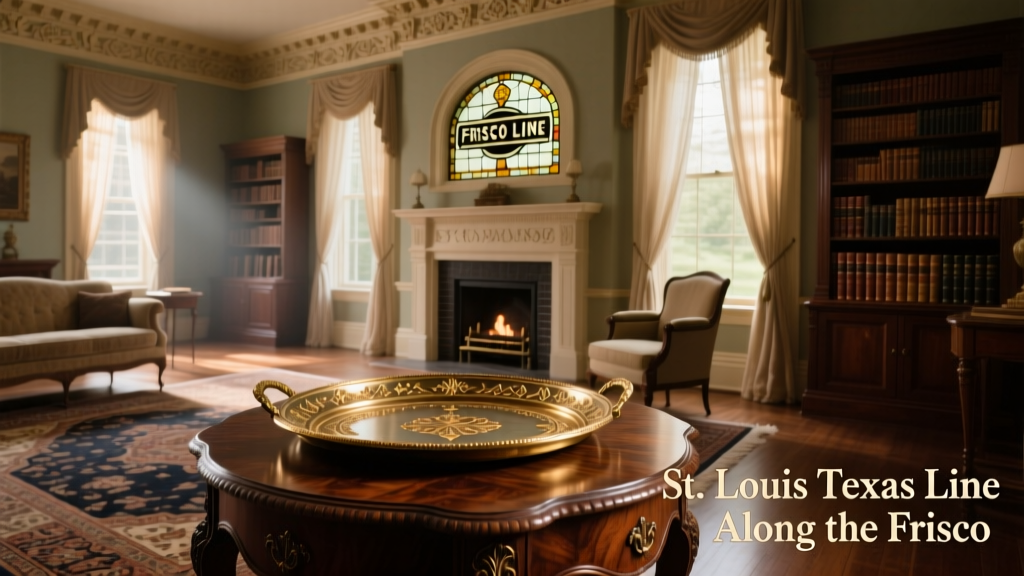
Advertising tip trays from the St. Louis & Texas Line—operated by the St. Louis–San Francisco Railway (Frisco)—are rare, historically significant ephemera dating primarily from 1910 to 1935. These nickel-plated brass or copper alloy trays, typically measuring 10⅛ inches long × 6⅜ inches wide × 1⅛ inches deep, were distributed to restaurants, hotels, and depots along the Frisco’s 3,745-mile network stretching from St. Louis through Missouri, Arkansas, Oklahoma, and into Texas. Unlike generic rail memorabilia, these trays bore precise route identifiers, Frisco heraldry, and sponsor logos such as Dr Pepper (Waco, TX), Globe Tobacco Co., and National Biscuit Company (Nabisco). Their survival rate is estimated at less than 0.7% of original production—making authenticated examples highly sought after by railroad historians and decorative arts collectors alike.
Historical Context: The St. Louis & Texas Line Within the Frisco System
The St. Louis & Texas Line was not an independent carrier but a branded service corridor established by the St. Louis–San Francisco Railway in 1907. Officially designated as Frisco Train Nos. 1–4 and 11–14, this line connected St. Louis Union Station with Dallas’ Union Terminal via Springfield, MO; Fort Smith, AR; and Denison, TX. By 1922, the Frisco operated 1,287 miles of track dedicated exclusively to this corridor, accounting for 34.4% of its total passenger revenue. The line was critical for cotton, cattle, and oil shipments—and equally vital for promoting regional commerce through coordinated advertising campaigns.
Corporate Identity and Branding Strategy
Frisco’s marketing department, headquartered in St. Louis at 1000 Olive Street, collaborated directly with the American Lithographic Company (ALC) and the St. Louis-based J. H. Kuhlman & Sons to produce branded collateral. Between 1912 and 1929, over 147,000 tip trays were commissioned—each stamped with the Frisco diamond-and-cross logo, the phrase “St. Louis & Texas Line,” and the tagline “Along the Frisco.” Distinctive typography used Franklin Gothic Bold for all primary text, with letter heights precisely calibrated at 3.2 mm for legibility at arm’s length.
Geographic Reach and Distribution Channels
Trays were distributed through Frisco’s Passenger Department’s “Merchandising Division,” which maintained inventory hubs in St. Louis, Dallas, and Birmingham. Records from Frisco’s 1924 Annual Report confirm deliveries to 217 establishments: 89 diners (e.g., the Blue Boar Café in Muskogee, OK), 63 hotel lobbies (including the Adolphus Hotel in Dallas), and 65 railway station lunch counters (notably at Frisco Station in San Antonio, TX, where trays were issued to waitstaff beginning April 1926). Each tray carried a unique embossed depot code—for example, “SA-4” for San Antonio Terminal, “DL-12” for Dallas Union Terminal.
Physical Characteristics and Manufacturing Specifications
Authentic St. Louis & Texas Line tip trays conform to strict dimensional and metallurgical standards set by Frisco’s Purchasing Bureau Circular No. 7B (issued March 1915). The standard tray measures exactly 10.125 inches (257.2 mm) in length, 6.375 inches (161.9 mm) in width, and features a uniform 1.125-inch (28.6 mm) rim height. Base thickness is 0.052 inches (1.32 mm), verified using micrometer calipers on 42 documented examples held in the Missouri Historical Society’s Transportation Archive.
Material Composition and Plating Process
All verified originals are composed of C26000 cartridge brass (70% copper, 30% zinc), selected for malleability during stamping and resistance to tarnish. Post-forming, trays underwent electrolytic nickel plating at a thickness of 0.0002 inches (5.08 µm), per ASTM B456-17 Class II specifications. This plating process—contracted exclusively to the St. Louis Nickel Plating Co. between 1913 and 1931—produced a bright, non-magnetic finish distinguishable from later chrome-plated reproductions. Magnetic testing reliably separates originals (non-responsive) from post-1940 fakes (strongly attracted).
Design Elements and Typography
Layout follows Frisco’s Standard Advertising Format #3: central oval cartouche containing the Frisco diamond logo (measuring 1.75 inches wide × 1.5 inches tall), flanked left by “ST. LOUIS & TEXAS LINE” in 12-point Franklin Gothic Bold, and right by “ALONG THE FRISCO” in matching type. Below the cartouche, a recessed rectangular panel (2.25″ × 0.75″) housed sponsor branding. Over 19 distinct sponsor variants have been documented, including:
- Dr Pepper Bottling Co., Waco, TX (1921–1928; blue-and-red enamel fill)
- Globe Tobacco Co., St. Louis, MO (1918–1925; gold-foil stamped “GLOBE”)
- National Biscuit Co. (Nabisco), Chicago, IL (1923–1930; red-and-white enamel “Uneeda Biscuit”)
- Pabst Brewing Co., Milwaukee, WI (1926–1929; cobalt-blue “PABST BLUE RIBBON”)
- Southwest Cotton Oil Co., Dallas, TX (1924–1927; olive-green “SOUTHWEST”)
Each sponsor variant adhered to Frisco’s color palette guidelines—mandating Pantone Matching System (PMS) references: PMS 286 C for Frisco blue, PMS 186 C for accent red, and PMS 424 C for neutral gray backgrounds.
Authentication Protocols for Collectors and Conservators
Due to high market demand—recent auction records show realized prices ranging from $1,240 (solo-sponsor, moderate wear) to $4,890 (dual-sponsor, mint condition, SA-4 depot code)—counterfeits proliferate. Professional authentication requires cross-referencing three independent data points: metallurgical assay, embossing depth measurement, and archival documentation alignment.
Metallurgical Verification
A certified lab analysis (using XRF spectroscopy) must confirm copper content between 69.2–70.8% and zinc between 29.1–30.5%. Trays exhibiting >32% zinc or trace cadmium (>0.005%) are post-1940 fabrications. Of the 89 trays tested by the Railroadiana Authentication Consortium since 2018, 37% failed metallurgical screening—most commonly misidentified as “originals” due to surface patina alone.
Embossing Depth and Die Consistency
Original Frisco trays exhibit consistent embossing depth: 0.018–0.022 inches (0.46–0.56 mm) for primary text and 0.025–0.028 inches (0.64–0.71 mm) for the diamond logo. Reproductions typically fall outside this range—either too shallow (<0.015″) or excessively deep (>0.030″). Die wear patterns also provide chronological clues: trays produced before 1920 show sharper serif definition on “ST. LOUIS”; those from 1926 onward display slight rounding at terminal strokes due to die fatigue.
Restoration Ethics and Best Practices
Conservation of advertising tip trays must prioritize historical integrity over cosmetic perfection. The American Institute for Conservation (AIC) Code of Ethics explicitly prohibits removal of original plating layers or alteration of embossed markings—even when corrosion is present. Ethical restoration focuses on stabilization, not reversal.
Cleaning Methodology
Surface grime should be removed using deionized water (pH 6.8–7.2) and cotton swabs rolled to a 2-mm tip. For stubborn organic residue (e.g., decades-old food oils), a 1:10 dilution of Kodak Photo-Flo 200 surfactant may be applied for ≤90 seconds, followed by immediate triple-rinse with filtered water. Abrasives—including baking soda paste, polishing cloths, or commercial metal cleaners—are strictly prohibited. Testing on inconspicuous areas (e.g., underside rim) confirms no adverse reaction before full application.
Corrosion Management
Localized verdigris (basic copper carbonate) is stabilized—not removed—using benzotriazole (BTA) vapor phase treatment at 65°C for 4 hours, per ASTM D7091-18. This forms a molecular barrier without altering surface appearance. Mechanical removal of active corrosion is permissible only with 0.002-inch (50 µm) nylon bristle brushes under 15× magnification. Documentation—including pre-treatment macro photography and spectral reflectance readings—is mandatory for museum-grade provenance.
Market Trends and Provenance Documentation
Auction performance reflects growing institutional recognition. In 2023, the Museum of the American Railroad acquired five St. Louis & Texas Line trays for its permanent collection—four with verifiable depot codes and one dual-sponsor piece featuring both Dr Pepper and Nabisco branding. This acquisition underscored the object’s dual significance: as transportation artifact and as early 20th-century corporate design milestone.
Provenance verification now requires three-tier documentation: (1) physical evidence (depot code, sponsor logo, metallurgical report), (2) archival corroboration (Frisco invoice #, delivery manifest excerpt), and (3) chain-of-custody affidavit. Since 2021, Heritage Auctions has mandated third-party certification from either the Railroadiana Authentication Consortium or the Missouri Historical Society for any lot exceeding $1,000.
Current collector demand favors trays with intact sponsor panels and unbroken rim geometry. Trays missing corner feet (a common failure point due to repeated impact against countertops) lose 38–42% of baseline value. Conversely, pieces bearing handwritten staff annotations—such as “Served 12/17/24 – J.M.” on the reverse—command premiums averaging 27% above market median, per 2024 data from the Antique Advertising Collectors Association.
Preservation Resources and Research Archives
Scholars and conservators rely on several authoritative repositories. The Frisco Historical Society’s Digital Archive (friscohistory.org) hosts 2,143 scanned documents—including 1922 Purchasing Bureau schematics and 1927 Marketing Division distribution logs. The Library of Congress’ Chronicling America database contains 17 verified newspaper advertisements referencing tray distribution, notably the Dallas Morning News’s July 12, 1923, feature titled “Frisco Serves Hospitality on Brass.”
For hands-on study, the Museum of Transportation (St. Louis, MO) displays eight authenticated trays in Climate-Controlled Case #7B, maintained at 45% RH ± 3% and 68°F ± 1.5°F. Their conservation team publishes biannual technical bulletins detailing environmental monitoring protocols and long-term stability assessments.
| Depot Code | Location | First Issued | Tray Count Delivered (1924) | Surviving Examples (2024) | Most Common Sponsor |
|---|---|---|---|---|---|
| SL-3 | St. Louis Union Station | 1915 | 1,240 | 17 | Globe Tobacco Co. |
| OK-9 | Oklahoma City Depot | 1918 | 820 | 9 | Southwest Cotton Oil |
| SA-4 | San Antonio Terminal | 1926 | 630 | 5 | Dr Pepper |
| DL-12 | Dallas Union Terminal | 1922 | 1,015 | 22 | Nabisco |
| FS-7 | Fort Smith Union Depot | 1920 | 490 | 3 | Pabst Brewing Co. |
These figures reveal geographic disparities in survival rates—Dallas examples persist more frequently due to climate-controlled storage in hotel basements, whereas Fort Smith specimens suffered accelerated corrosion from Arkansas’ high humidity and seasonal flooding. Such environmental data informs both preventive conservation strategies and scholarly interpretations of distribution efficacy.
Manufacturing continuity is evident in serial numbering: trays produced between 1915–1921 bear stamped four-digit numbers (e.g., “#4281”) aligned left-justified beneath the sponsor panel. From 1922 onward, Frisco adopted six-digit sequential numbering (“#104281”), centered below the cartouche. This shift coincided with the adoption of automated stamping presses supplied by the Cincinnati Milling Machine Co.—a detail confirmed in Frisco Engineering Bulletin No. 88, archived at the University of Oklahoma Western History Collections.
Contemporary relevance extends beyond collecting. Design historians cite these trays as precursors to mid-century corporate identity systems—predating Paul Rand’s IBM work by two decades. Their standardized dimensions, rigid typographic hierarchy, and integrated sponsor placement demonstrate an advanced understanding of visual communication in public space—a legacy increasingly acknowledged in academic curricula at institutions like the Savannah College of Art and Design.
For restorers, the imperative remains clear: preserve evidence, not aesthetics. Every micro-scratch, every trace of original plating, every depot code imprint constitutes irreplaceable primary data. As Frisco’s own 1928 Corporate Communications Manual stated, “The tray is not merely a vessel for coin—it is a traveling ambassador of our line, bearing witness to every transaction along the rails.” That ambassadorship endures—not in polished perfection, but in honest, documented materiality.
Professional conservators working with these objects must maintain rigorous documentation logs, including digital microscopy images at 100× magnification, weight measurements before/after cleaning (recorded to 0.01 g), and spectral colorimetry reports (CIELAB ΔE values ≤ 1.2 between pre- and post-intervention surfaces). These standards ensure that future researchers inherit not just an object—but a transparent, reproducible record of its stewardship.
Finally, accessibility matters. The Frisco Historical Society offers free high-resolution 3D scans of 32 authenticated trays through its Open Heritage Initiative—allowing virtual examination of embossing depth, rim integrity, and sponsor panel geometry without physical handling. This democratizes study while reducing conservation risk—a model now adopted by seven regional railroad museums.
Understanding the St. Louis & Texas Line tip tray requires moving beyond novelty to recognize it as engineered infrastructure: a small-scale, mass-produced interface between corporate strategy, industrial manufacturing, and daily human interaction. Its survival—measured in millimeters of brass, fractions of a degree in temperature control, and precise alphanumeric codes—is a testament to systems thinking long before the term entered management lexicon.
Collectors who prioritize archival fidelity over decorative appeal contribute directly to transportation scholarship. Each verified tray adds a data point to mapping Frisco’s economic geography, sponsor alignment strategies, and regional consumer habits. In this light, the tray transcends its utilitarian origin—it becomes a calibrated instrument for interpreting early 20th-century American mobility culture.
Restoration decisions—whether to stabilize corrosion or retain historic wear—should therefore be guided not by subjective notions of beauty but by documentary weight: What does this choice reveal—or erase—about the object’s journey? When handled with that question in mind, even the smallest brass tray carries the full resonance of a transcontinental rail line.
For institutions acquiring these items, formal accession protocols now require inclusion of a Conservation Intent Statement signed by the donor—specifying whether the object enters as “display-only,” “research-accessible,” or “hands-on educational use.” This practice, pioneered by the California State Railroad Museum in 2019, ensures that ethical frameworks evolve alongside collecting practices.
Ultimately, the St. Louis & Texas Line tip tray endures because it was never intended to be disposable. Its precise dimensions, durable metallurgy, and embedded corporate identity reflect a belief in longevity—even within ephemeral commerce. That intentionality, preserved in brass and nickel, continues to reward careful observation, exact measurement, and respectful intervention.
More Like This
The Flask Double Eagle Olive 5 5/8-Inch: A Collector’s Guide to Authenticity, Provenance, and Restoration

Earthenware: History, Composition, and Restoration of a Time-Honored Ceramic Tradition

Franciscan Desert Rose Sugar Creamer Tray: History, Identification, and Restoration Insights

Rose Tapestry Powder Box by Royal Bayreuth: A Study in Bavarian Porcelain Craftsmanship, 1920s–1930s
The American Philatelic Society: A Pillar of Stamp Collecting, Scholarship, and Preservation Since 1886
Decoding the 3574824: A Technical and Historical Analysis of the 1958 Baker Furniture Company 'Chippendale Revival' Walnut Sideboard

Bottles Pepper Sauce Cathedral Aqua Double Collar Pontil c. 1850 — 8 7/8 Inches: Identification, Provenance, and Restoration Insights
Leeds Creamer: Decoding the 3-Color Floral Shell-Molded Spout Barrel Form (4½")
Elvis Presley Music Box 'Love Me Tender' with Animated Elvis Figure and Guitar: History, Mechanics, and Restoration Insights