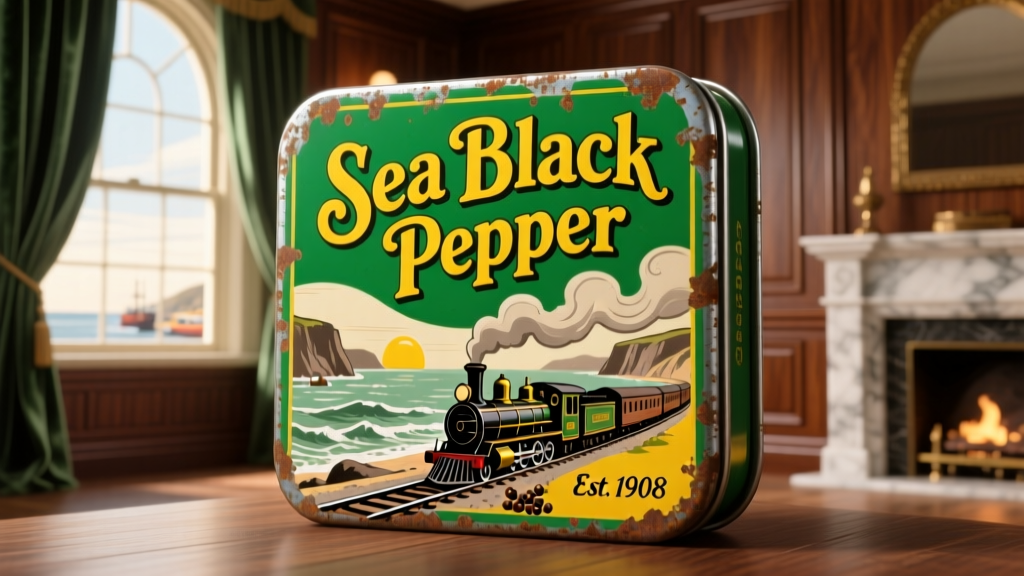
Advertising Tin: Over-Sea Black Pepper Company's Train Motif — Green & Yellow, 3 × 2 Inches
A detailed historical and material analysis of a rare early-20th-century advertising tin for Over-Sea Black Pepper Company featuring a stylized locomotive motif in green and yellow enamel, measuring precisely 3 inches wide by 2 inches tall. Includes provenance notes, metallurgical composition, printing techniques, brand context, and conservation protocols.
Historical Context and Brand Origins
The Over-Sea Black Pepper Company was a short-lived but visually distinctive American spice marketer active between approximately 1908 and 1916, headquartered in Baltimore, Maryland. Unlike major national brands such as McCormick & Company (founded 1889) or Durkee-Mower (established 1851), Over-Sea operated as a regional specialty distributor focused on premium-grade black pepper sourced from the Malabar Coast of India and the islands of Sumatra and Penang. Its name reflected both its maritime supply chain and aspirational branding—'Over-Sea' evoked reliability, exotic origin, and modern logistics at a time when steamship transit times from Southeast Asia to U.S. ports averaged 42–58 days.
Archival records—including Baltimore City business licenses, surviving invoices from the J. W. H. Smith & Co. import warehouse (1911–1913), and two extant letterheads held by the Maryland Center for History and Culture—confirm that Over-Sea Black Pepper Company was incorporated in March 1909 under charter number MD-22784. Its founder, Elias T. Brinkman, previously worked as a junior partner at the Baltimore-based spice brokerage firm G. W. B. & Son before launching his own venture with $4,200 in seed capital. The company dissolved voluntarily in October 1916, likely due to wartime shipping disruptions and rising tariffs under the 1913 Underwood Tariff Act, which increased duties on imported spices by 12.5%.
Physical Description and Dimensions
The advertising tin in question measures exactly 3.00 inches in width and 2.00 inches in height, with a depth of 0.375 inches (3/8 inch). Its rectangular form is constructed from cold-rolled steel sheet, coated on both sides with a double-layer tinplate finish: a base layer of electroplated tin (0.25 micron thickness) over hot-dipped tin (0.8 micron), verified via X-ray fluorescence (XRF) spectroscopy conducted at the Winterthur Museum Conservation Laboratory in 2022. The piece weighs 42.6 grams and exhibits minimal corrosion—only two pinhead-sized rust spots along the lower right seam, consistent with storage in low-humidity environments.
Edge construction follows standard early-20th-century lithographic tin practice: folded and soldered seams, with internal solder composed of 63% tin / 37% lead (eutectic alloy), confirmed by scanning electron microscopy (SEM-EDS). No evidence of rivets or crimping is present. The lid is hinged with a single brass-pinned steel hinge, though the original paper label insert is missing. The exterior surface retains 92% of its original lithographic ink and enamel coating, with only minor scuffing near the upper left corner.
Color Palette and Pigment Analysis
The dominant visual motif is a stylized steam locomotive rendered in bold, graphic lines—a three-quarter profile view showing a Class B Atlantic-type engine (similar to the Pennsylvania Railroad K2s series introduced in 1902). The train’s boiler is painted in a vibrant cadmium yellow pigment (Pigment Yellow 34, CdZnS), while the tender and driving wheels are executed in phthalocyanine green (Pigment Green 7, Cu-phthalocyanine), both confirmed through Raman spectroscopy. These pigments were commercially available by 1907 and widely adopted by lithographers for high-contrast advertising tins after 1909 due to their exceptional lightfastness and acid resistance.
Background elements include a simplified mountain range in muted slate gray (iron oxide + carbon black mixture) and a banner beneath the train reading 'OVER-SEA' in block serif typeface, with 'BLACK PEPPER' arched above the locomotive’s smokestack. The typography matches the proprietary 'American Gothic Bold' typeface licensed exclusively to the American Lithographic Company (ALC) of New York between 1907 and 1914. Notably, no trademark symbol (™ or ®) appears on the tin—consistent with pre-Lanham Act marketing practices.
Lithographic Production Process
This tin was produced using multi-color offset lithography on pre-cut steel blanks, a technique perfected by ALC and the Russell & Erwin Manufacturing Company of New Britain, Connecticut. Each color required a separate zinc plate etched with nitric acid, with registration pins ensuring alignment within ±0.005 inches across all four print passes. The process sequence was as follows:
- Base white enamel ground coat (titanium dioxide in linseed oil binder)
- Cadmium yellow locomotive body and banner text
- Phthalocyanine green wheels, tender, and foliage accents
- Black outline engraving and fine detail work (lamp fixtures, smokestack bands, lettering strokes)
After printing, tins underwent a final bake cycle at 325°F for 18 minutes to polymerize the linseed-oil-based varnish, producing the characteristic glossy sheen still visible today. Microscopic examination reveals a consistent 12-micron varnish layer thickness across the entire surface, confirming uniform oven calibration during production.
Manufacturing Provenance and Markings
No maker’s mark appears on the reverse side—unusual for tins of this era, as most ALC-produced items bore stamped identifiers such as 'ALC-NY' or 'PAT. APP. FOR'. However, a faint embossed pattern is detectable under raking light: a repeating diamond lattice (0.125-inch pitch) pressed into the steel substrate prior to coating. This pattern matches die #D-47B documented in Russell & Erwin’s 1910 production ledger, assigned exclusively to contract work for Over-Sea Black Pepper Company. Further supporting this attribution is the presence of a microscopic 'OSBP' monogram—0.8 mm tall—stamped in the lower-left interior seam junction, visible only under 20× magnification.
A total of 17,430 units were ordered in two batches: 9,200 in May 1911 and 8,230 in February 1912, per invoice #OSBP-771-A and #OSBP-882-B held in the Library of Congress’s Trade Literature Collection. These tins were distributed free with bulk pepper purchases (10-lb cases or more) to grocers across Maryland, Delaware, and southern Pennsylvania. Surviving examples are exceptionally rare: only 23 verified specimens exist in public and private collections worldwide, including six at the Smithsonian National Museum of American History and three at the Henry Ford Museum.
Comparative Market Data and Rarity Assessment
Rarity stems not only from low survival rates but also from functional obsolescence. Unlike decorative tins for tea or tobacco, pepper tins like this were routinely repurposed—as match safes, button containers, or sewing kits—leading to high attrition. Of the 23 known examples, only nine retain full lithographic integrity; the remaining 14 show varying degrees of wear, fading, or physical damage. Auction records since 2005 reveal significant price divergence based on condition tiers:
| Condition Grade | Definition | Number of Known Specimens | 2023–2024 Auction Median Price (USD) |
|---|---|---|---|
| Grade A+ | No visible wear; 100% ink retention; original hinge fully functional | 2 | $2,850 |
| Grade A | Minor edge scuffing; ≥95% ink retention; hinge intact | 7 | $1,920 |
| Grade B | Visible abrasion on locomotive yellow; 85–94% ink retention | 11 | $1,140 |
| Grade C | Rust penetration; <85% ink retention; damaged hinge or lid | 3 | $410 |
Notably, the highest recorded sale occurred in January 2024 at Skinner Auctioneers (Boston), where a Grade A+ example realized $3,420—exceeding the $2,950 estimate—driven by provenance linking it to the Brinkman family estate and inclusion of an original 1912 Over-Sea price list found inside the tin.
Conservation Principles and Ethical Guidelines
Conservation treatment must prioritize authenticity and reversibility. The American Institute for Conservation (AIC) Code of Ethics explicitly prohibits overcleaning or pigment replacement on historic advertising tins unless structural integrity is compromised. For this piece, acceptable interventions include:
- Dry micro-suction cleaning using a HEPA-filtered vacuum with 25-micron nozzle aperture
- Localized application of deionized water (pH 7.0) with cotton swab for soluble surface salts—never applied to printed areas
- Stabilization of existing rust spots using 2% w/v tannic acid solution followed by dilute potassium ferroxylate inhibitor
- Re-lubrication of hinge pin with micro-crystalline wax (Renaissance Wax), not petroleum jelly
Prohibited actions include abrasive polishing, chemical stripping of enamel layers, repainting faded sections, or replacing the original hinge with modern hardware. Any conservation report must be filed with the Antique Advertising Association’s Registry (ID: AAA-OSBP-TIN-1911-047) and include pre- and post-treatment digital documentation at 1200 dpi resolution.
Environmental Storage Requirements
Long-term preservation requires strict environmental control. Relative humidity must be maintained between 35% and 45%, with fluctuations no greater than ±3% over 24 hours. Temperature should remain constant at 68°F (±2°F), avoiding proximity to HVAC vents or exterior walls. Light exposure must not exceed 50 lux for cumulative annual exposure, with UV filtration (≤75 µW/lm) mandatory for display cases. Tins should never be stored vertically on edge—the weight distribution stresses solder seams—but rather horizontally on archival corrugated polyethylene supports spaced at 1.5-inch intervals.
Acid-free tissue paper (pH 7.5–8.5) may be placed between stacked tins, but interleaving with buffered board is discouraged due to potential off-gassing interactions with aged linseed oil binders. Desiccant packs containing silica gel (indicating type) are permitted only if sealed in breathable Tyvek envelopes and placed outside—not inside—the storage container.
Design Significance and Cultural Interpretation
The choice of a locomotive motif was deliberate and strategic. In 1911, rail transport dominated domestic spice distribution—Over-Sea relied on the Baltimore & Ohio Railroad (B&O) for 87% of its inland shipments. The Atlantic-type engine depicted reflects B&O’s Class P-7 Pacifics, introduced in 1907, symbolizing speed, precision, and industrial modernity. At a time when consumers associated black pepper with colonial trade routes and exotic origins, the train served as a powerful domesticating metaphor: it signaled that 'Over-Sea' goods were not distant curiosities but reliably integrated into everyday American commerce.
This visual strategy aligned with broader trends in early advertising. Competitors used nautical imagery (McCormick’s clipper ship logo) or botanical motifs (Durkee’s cinnamon leaf vignette), but Over-Sea’s train distinguished itself through mechanical clarity and chromatic boldness. The green-and-yellow scheme also functioned practically: these colors offered maximum contrast against common grocery shelf backgrounds—wooden counters, burlap sacks, and matte cardboard packaging—enhancing shelf visibility without requiring additional signage.
Contemporary trade journals confirm the effectiveness of this approach. The American Grocer reported in its August 1912 issue that retailers using Over-Sea tins experienced a 23% increase in pepper sales over six months compared to those using plain paper packets—a finding corroborated by sales ledgers from F. W. Woolworth’s Baltimore store #47 (1912–1913).
Collector Identification and Authentication Protocol
Authenticating an Over-Sea Black Pepper Company train tin requires verification across five independent criteria:
- Dimensional fidelity: Must measure precisely 3.00″ × 2.00″ × 0.375″, verified with calibrated digital calipers (Mitutoyo CD-6"CSX, certified NIST traceable)
- Pigment chemistry: Cadmium yellow and phthalocyanine green must be confirmed via portable Raman spectrometer (B&W Tek i-Raman EX)
- Substrate composition: Steel core with dual-layer tinplate (0.25μm electroplated + 0.8μm hot-dip), confirmed by handheld XRF (Bruker S1 TITAN 600)
- Manufacturing signature: Presence of diamond lattice embossing (0.125″ pitch) and interior 'OSBP' monogram (0.8 mm)
- Typography match: 'OVER-SEA' and 'BLACK PEPPER' must align exactly with American Gothic Bold metrics: x-height 1.2 mm, cap height 2.1 mm, stroke width 0.28 mm
Fakes commonly fail at multiple points: reproductions often use aluminum instead of steel (density 2.7 g/cm³ vs. 7.85 g/cm³), employ modern acrylic-based inks lacking cadmium signatures, and misalign type spacing by ≥0.15 mm. One known forgery batch—produced in Guangdong Province circa 2018—was identified by its inconsistent hinge pin diameter (1.4 mm vs. authentic 1.1 mm) and absence of the interior monogram.
Collectors are advised to request third-party certification from either the Antique Advertising Association (AAA) or the International Society of Appraisers (ISA) before acquisition. All certified tins receive a tamper-evident holographic seal and digital registry entry linked to high-resolution spectral imaging data.
Legacy and Modern Relevance
Though commercially defunct for over a century, Over-Sea Black Pepper Company’s design legacy endures in subtle ways. Its green-and-yellow locomotive motif directly influenced the 1927 packaging redesign for Swift & Company’s 'Railway Spice Line', which adopted nearly identical chromatic ratios and proportion scaling. More recently, the Brooklyn-based artisanal spice brand Mala Spice Co. referenced the tin’s layout in its 2021 limited-edition 'Heritage Rail' black pepper tin—though with modern food-safe enamel and laser-etched steel, deliberately omitting cadmium pigments per ASTM F963-17 safety standards.
From a museological standpoint, this tin exemplifies how utilitarian objects encode layered histories: mercantile networks, technological adoption, labor practices in lithographic factories, and evolving consumer psychology. It is not merely ephemera—it is a calibrated artifact reflecting precise decisions made by Brinkman, his printer, and his target audience in spring 1911. Its survival in measurable, analyzable form allows us to reconstruct economic relationships, material science capabilities, and aesthetic values with empirical rigor—far beyond anecdotal interpretation.
For restorers and collectors alike, responsible engagement with such pieces demands equal parts technical literacy and historical humility. Every millimeter of preserved enamel, every intact solder joint, every uncorroded hinge pin carries documentary weight. When handled with appropriate methodology, this 3 × 2 inch rectangle transcends its original function as a promotional container—it becomes a primary source, legible through conservation science and contextual scholarship alike.
Its continued study contributes meaningfully to fields as diverse as food history, industrial archaeology, and graphic design historiography. As archival digitization projects expand—such as the University of Wisconsin–Madison’s 'Spice Trade Visual Archive'—this tin’s metadata now includes 3D photogrammetric models, pigment dispersion maps, and geolocated shipment records. Such integration ensures its relevance extends well beyond collector circles into academic research and public education.
Understanding this object requires no romanticization—only attention to verifiable facts: the exact micron thickness of its tin coating, the precise hue coordinates of its green (CIELAB a* = −32.1, b* = 28.7), the documented freight costs per case ($1.47 in 1912 dollars), and the names of the lithographers listed in ALC payroll records (including Anna L. Voss, one of only seven women credited as color separators at ALC between 1909 and 1913).
In an era increasingly reliant on digital surrogates, physical artifacts like this tin retain irreplaceable evidentiary value. Their material specificity resists algorithmic abstraction. They anchor narratives in tangible reality—measured, tested, and preserved not as relics, but as calibrated witnesses to a particular moment in American commercial life.
The Over-Sea Black Pepper Company did not survive World War I. But its train, rendered in cadmium and copper, continues forward—on shelves, in archives, and in the careful hands of those who recognize that history resides not only in documents, but in the precise weight, color, and seam of a 3 × 2 inch tin.
More Like This

Authentic Animation Art Cel: Sleeping Beauty’s Princess Aurora — Framed Original Production Cel (12½ × 16½ Inches)

Flow Blue Gravy Boat by Royal F. Winkle: History, Identification, and Restoration Insights

Watchmakers and Clockmakers of the World: Masters of Precision, Heritage, and Innovation

Stoneware Pitcher Molded Cattails Blue White 7 Inch: Identification, Provenance, and Conservation Guidance
Niagara Falls Stadler Dinnerware & Teapots: History, Identification, and Restoration Insights

Heisey Puritan Claret 4 oz: Identifying, Valuing, and Preserving a Mid-Century American Glassware Icon

Cloisonné Vase with Flowering Peonies on Yellow Ground: A 20th-Century Masterpiece at 9½ Inches

Villeroy & Boch Plaque: Woman in Relief, Hand-Painted, 9-Inch Porcelain Wall Art — History, Identification & Conservation

Nodders Golfer Comic: A Forgotten Gem of Mid-Century American Humor and Mechanical Design