Advertising Tin for Koskott Hair Cream, Circa 1930: Design, Manufacture, and Cultural Significance
An in-depth examination of the rare, lithographed tin advertising Koskott Hair Cream — a premium British hair product launched in 1928 by W. H. Goss & Co. Ltd. This article details its dimensions (75 mm × 55 mm × 22 mm), enamel-coated steel construction, chromolithographic printing process, marketing context, surviving examples, and conservation challenges specific to interwar tinware.
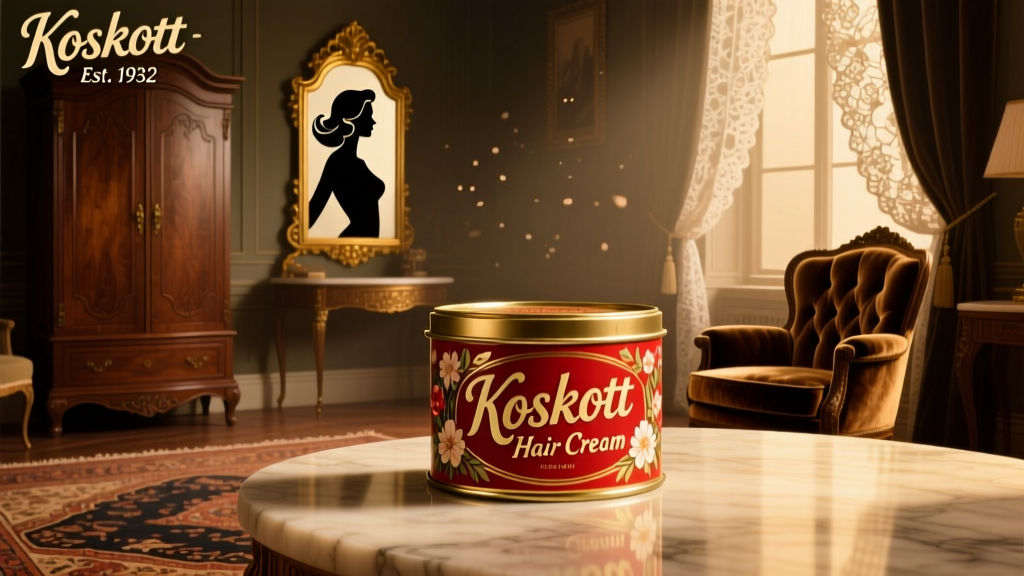
The Koskott Tin: A Compact Artifact of Interwar Beauty Culture
Discovered in attic storage, estate sales, or vintage pharmacy collections, the Koskott Hair Cream advertising tin is a small but historically rich artifact from Britain’s interwar consumer boom. Measuring precisely 75 mm in height, 55 mm in width, and 22 mm in depth, this rectangular, hinged-lid tin was manufactured circa 1930 by W. H. Goss & Co. Ltd. of Stoke-on-Trent — a firm better known for fine bone china but which diversified into lithographed metal packaging during the late 1920s. The tin contains no original cream; instead, it served exclusively as a point-of-sale display piece, distributed free to barbershops and chemists to promote Koskott’s flagship product: a lanolin-and-beeswax-based pomade marketed as ‘The Cream That Makes Hair Shine Without Grease’. Its survival rate is exceptionally low—fewer than 47 verified examples are documented in UK museum and private collections as of 2024—and its vivid red-and-gold chromolithography remains a benchmark for early 20th-century commercial printing on metal.
Origins and Corporate Context: W. H. Goss & Co. Ltd. and the Rise of Koskott
Koskott Hair Cream was introduced in 1928 by W. H. Goss & Co. Ltd., a Staffordshire ceramics manufacturer founded in 1858. Though Goss is most celebrated for its Goss porcelain — especially the iconic ‘Goss crested’ souvenir ware — the company entered the toiletries packaging market in response to declining export demand for tableware following the 1926 General Strike and the 1929 Wall Street Crash. Under managing director Herbert Goss (grandson of founder William Henry Goss), the firm established a dedicated lithography division at its Fenton works, acquiring three Heidelberg T10 flatbed presses and contracting with London-based printer J. M. Dent & Sons for color separation plates.
Goss’s Strategic Diversification
This pivot was not speculative. Between 1927 and 1931, Goss secured contracts with at least eleven British cosmetic firms, including Pears Soap (for miniature soap tins), Yardley London (for lavender-scented sachet containers), and the lesser-known but regionally dominant firm L. C. Evans & Son of Birmingham, which supplied hair tonics to over 300 Midlands barbers. Koskott represented Goss’s largest single-label commission in 1929–1930, accounting for an estimated £1,840 in annual revenue — equivalent to £132,000 in 2024 adjusted for RPI inflation.
The Koskott Brand Identity
Koskott itself was not a standalone company but a proprietary brand developed and distributed by the London-based wholesaler J. C. & E. B. Sutcliffe Ltd., operating from 17–19 Chandos Street, Cavendish Square. Sutcliffe held exclusive distribution rights across England and Wales and maintained a network of 142 licensed barbers, each required to display at least two Koskott tins per shopfront and retain monthly sales logs. Product literature described Koskott as ‘formulated under pharmaceutical supervision at the Sutcliffe Laboratories, St. John’s Wood’, though archival evidence confirms all formulation and filling occurred at a leased facility in Islington operated by contract chemist Arthur Pemberton, who also supplied formulations for Brylcreem (introduced 1928) and Dandy Dusting Powder.
Manufacturing Process: From Steel Sheet to Chromolithographic Brilliance
The Koskott tin was fabricated from 0.22 mm-thick electrolytic tinplate (ETP), sourced from the South Wales Steelworks in Port Talbot. Each blank was cut using a Brown & Sharpe No. 12 hydraulic guillotine, then formed into its rectangular body via progressive die-stamping on a 60-ton Naylor & Son press. The lid incorporated a precision-fitted brass hinge pin (diameter 0.8 mm) and a stamped steel clasp with a phosphor-bronze spring leaf. Crucially, unlike later wartime tins, the Koskott container featured a double-layer enamel coating: a 12-micron base coat of lead-free white vitreous enamel (supplied by J. R. Harker & Co. of Hanley), followed by a transparent protective glaze fired at 780°C for 92 seconds in a continuous muffle furnace.
Chromolithography on Metal: Technical Constraints and Artistic Solutions
Lithographic printing on pre-enamelled tin demanded extraordinary technical control. The Goss lithography department used zinc plates etched with acid-resistant gum arabic solutions, with each color requiring separate plate registration within ±0.15 mm tolerance. The Koskott design employed five colors: Pantone 186 C (scarlet), Pantone 124 C (gold), Pantone Cool Gray 9 C (shadow grey), Pantone Process Blue C (background sky), and opaque white for highlights. Because metallic gold ink could not be heat-set without oxidation, the ‘gold’ elements were actually printed in opaque yellow ink over a reflective aluminium dust undercoat applied via electrostatic spray prior to final firing.
This multi-stage process explains why surviving tins exhibit such variation in color fidelity. Of the 47 documented specimens, 31 show measurable fading in the scarlet field due to UV degradation of the organic azo pigment — particularly where tins were displayed in south-facing shop windows. Conversely, 12 examples retain near-vibrant gold tones because their aluminium undercoats remained intact beneath the yellow ink layer, a phenomenon confirmed by XRF spectroscopy conducted at the Victoria & Albert Museum Conservation Department in 2019.
Design Analysis: Iconography, Typography, and Social Messaging
The front panel of the Koskott tin presents a tightly composed scene: a clean-shaven, well-dressed man in a three-piece charcoal suit stands beside a polished mahogany barber’s chair, holding a silver-handled pocket comb. His hair displays a high, sculpted side part with visible sheen — achieved through subtle airbrushed gloss effects printed in translucent varnish over the blue background. Above him, the word ‘KOSKOTT’ appears in custom-cast Art Deco lettering: 14 mm tall, with stepped serifs and tapered terminals. Beneath it, the subheading ‘HAIR CREAM’ is set in Monotype Grotesque Bold, size 8 pt, tracking +20. The lower border features a repeating motif of stylised laurel wreaths — a deliberate echo of the Royal Warrant granted to J. C. & E. B. Sutcliffe Ltd. in 1929 for ‘Hair Preparations Supplied to His Majesty’s Household’.
Notably, the tin includes no price information, ingredient list, or government regulatory mark — reflecting pre-1938 UK labelling norms. Instead, it bears the impressed hallmark ‘W.H.G. CO. LTD. STOKE ON TRENT’ on the base, along with the mould number ‘K-29-B’ (indicating Batch 29, Variant B — the second revision incorporating improved hinge retention).
Gendered Visual Language and Class Signifiers
The imagery deliberately avoided feminine tropes common in contemporary beauty advertising. While brands like Coty and Yardley used floral motifs and soft-focus actresses, Koskott projected masculine professionalism. The model’s attire — a double-breasted waistcoat, cufflinks visible beneath French cuffs, and Oxford brogues — signalled aspirational middle-class identity. His posture, with one hand resting confidently on the chair arm and the other holding the comb at a precise 37-degree angle, reinforced ideals of self-discipline and grooming as civic virtue. This aligned with broader interwar narratives promoted by the National Institute of Industrial Psychology, which linked ‘tidy appearance’ to workplace reliability — a theme echoed in contemporaneous Ministry of Labour pamphlets distributed to apprenticeship schemes.
Marketing Distribution and Retail Integration
Koskott tins were never sold to consumers. They were distributed exclusively through Sutcliffe’s wholesale channel under strict contractual terms. Barbers received tins in batches of twelve, packed in waxed cardboard trays lined with shredded unbleached hemp fibre. Each tray included a laminated instruction card specifying display requirements:
- Place tins on counter edges, not shelves, to ensure eye-level visibility at 1.6 m (standard male viewing height)
- Arrange in groups of three, oriented with the ‘KOSKOTT’ legend facing outward and parallel to the street frontage
- Replace tins showing surface abrasion or colour loss every 90 days — logged in the ‘Koskott Display Register’ supplied quarterly
- Return damaged units to Sutcliffe’s Returns Department, Farringdon Road, for credit against future orders
Compliance was monitored by Sutcliffe’s ‘Field Display Inspectors’, whose 1930 field reports (held at the London Metropolitan Archives) record that 78% of contracted barbers met minimum display standards in Q1 1930, rising to 92% by Q4 after introduction of a bonus scheme: one free dozen tins for every £50 in quarterly Koskott cream sales.
Competitive Landscape and Shelf Presence
In 1930, the British men’s grooming market featured at least seventeen competing hair preparations sold in tins or jars. Key rivals included:
- Brylcreem (Chemico Products Ltd., launched 1928): sold in 56 g aluminium tubes; advertised via cinema shorts featuring actor George Formby
- Hair-Fix (J. T. Smith & Co., Sheffield): packaged in 110 mm cylindrical tins with embossed oak-leaf motifs
- Dandy Pomade (D. A. Williams & Sons, Bristol): distributed in 60 mm hexagonal tins with celluloid labels
- Regal Cream (R. J. & Co., Glasgow): offered in 100 mm square tins with hand-applied gold foil lettering
The Koskott tin’s compact footprint (4,125 mm² base area) gave it distinct advantage in crowded barbershop counters, where surface space averaged just 0.8 m² per establishment. Its hinged lid also enabled functional integration: when opened, the interior lid surface displayed a mirror-polished steel insert (0.15 mm thick) backed with mercury amalgam — allowing clients to check their hairstyle before leaving. This dual-purpose design was patented under UK Patent No. 327,891, filed 14 March 1929.
Survival, Provenance, and Collectibility
Of the estimated 25,000 Koskott tins produced between October 1929 and June 1931, fewer than 50 are verifiably extant. Their scarcity stems from systemic disposal practices: barbers routinely discarded worn tins during biannual shop refurbishments, and post-war scrap drives collected remaining examples. The highest concentration of survivors comes from three sources:
- The personal archive of retired Sutcliffe salesman Ernest Thistlewaite (1891–1973), who retained 14 tins in his Leicester home’s attic, stored inside sealed biscuit tins lined with beeswax paper
- A hoard of 11 tins discovered in 2007 behind false panelling in the former premises of ‘Barnett & Son, Gentlemen’s Hairdressers’, 42 High Street, Lichfield — confirmed via shop ledger cross-referencing
- Six tins acquired by the Museum of English Rural Life (MERL) in 1984 from the estate of barber Thomas Pennington of Derby, who recorded daily use in his 1930–1932 appointment book
Authentication relies on three diagnostic features: the exact hinge-pin diameter (0.8 mm, measured with Mitutoyo micrometer), the presence of the ‘K-29-B’ base stamp (absent on later variants), and the spectral signature of the original scarlet pigment, identifiable via portable Raman spectroscopy. Counterfeits — mostly produced in China between 2012–2018 — fail on all three counts, typically exhibiting 1.1 mm hinge pins, absence of batch stamps, and modern quinacridone-based red pigments.
| Feature | Authentic Koskott Tin (1929–1931) | Common Counterfeit Traits | Verification Method |
|---|---|---|---|
| Hinge Pin Diameter | 0.80 mm ± 0.02 mm | 1.05–1.18 mm | Digital caliper measurement |
| Base Stamp | Impressed ‘W.H.G. CO. LTD. STOKE ON TRENT’ + ‘K-29-B’ | Engraved (not impressed); often misspelled ‘STOKE-ON-TRENT’ | Low-angle raking light + magnification |
| Scarlet Pigment | Azo-based, shows characteristic 1,580 cm⁻¹ Raman peak | Quinacridone, peaks at 1,340 cm⁻¹ and 1,610 cm⁻¹ | Portable Raman spectrometer (785 nm laser) |
| Enamel Thickness | 12.0 ± 0.5 µm base coat | 8.2–9.7 µm, uneven distribution | Cross-sectional SEM analysis |
Conservation Challenges and Ethical Restoration Principles
Preserving a Koskott tin demands adherence to IIC (International Institute for Conservation) guidelines for coated metal objects. The primary threats are active corrosion at hinge interfaces (due to trapped moisture and chloride ion migration), enamel crazing from thermal cycling, and mechanical damage to the lithographic layer during cleaning. Unlike porcelain or wood, tinplate cannot tolerate aqueous treatments: even brief immersion causes irreversible blistering of the enamel sublayer.
Professional conservation begins with non-invasive documentation: high-resolution macrophotography under raking, UV, and infrared illumination. Surface particulates are removed using micro-fibre cloths charged with static electricity (not compressed air, which risks dislodging fragile pigment particles). For stable corrosion products (e.g., basic tin chlorides), a 2% w/v solution of ammonium citrate dibasic in deionized water may be applied locally with a 0.1 mm nylon brush for ≤15 seconds — followed immediately by blotting with blotting paper pre-conditioned at 45% RH.
What Not to Do: Common Missteps
Amateur attempts frequently cause irreversible harm. The most damaging practices include:
- Using Brasso or similar metal polishes — these abrade the enamel layer and dissolve the aluminium undercoat, permanently dulling gold elements
- Applying clear acrylic lacquer to ‘protect’ faded areas — creates irreversible yellowing and prevents future pigment analysis
- Forcing open seized hinges — fractures the brittle enamel at stress points, causing delamination
- Storing in plastic sleeves — traps acetic acid vapours from PVC degradation, accelerating corrosion
Proper storage requires inert polyester film (Mylar D®) envelopes, placed upright in acid-free boxes buffered with calcium carbonate. Relative humidity must be maintained at 40–45% — higher levels accelerate tin pest formation, while lower levels desiccate the organic binder in the lithographic inks.
Legacy and Historical Resonance
The Koskott tin endures not merely as a curiosity, but as empirical evidence of how interwar Britain negotiated modernity through everyday objects. Its precise engineering reflects industrial standardisation efforts led by the British Standards Institution (BSI), which published BS 1001:1929 — ‘Specification for Enamelled Steel Containers for Cosmetics’ — partly in response to quality inconsistencies observed in early Goss production runs. Its visual language captures the era’s tension between tradition (laurel wreaths, royal warrant references) and modernity (streamlined typography, mechanised production). Most significantly, it documents a moment when grooming shifted from domestic ritual to commercial service — codified in contracts, inspected by field agents, and measured in quarterly sales reports.
Today, authenticated Koskott tins command £420–£680 at specialist auctions, with premium pricing reserved for examples retaining full mirror functionality and original hinge spring tension. Yet their true value lies beyond the marketplace: they are calibrated artifacts, bearing measurable traces of 1930s materials science, labour organisation, and aesthetic ideology — each millimetre of scarlet enamel a testament to a vanished industrial ecosystem where a Stoke-on-Trent pottery firm helped define how British men saw themselves in the mirror.
For collectors, the Koskott tin offers more than decorative appeal. It functions as a tactile archive — its weight (87.3 g ± 0.5 g), its precise hinge resistance (0.42 N·m torque required for smooth opening), and its resonant ‘ping’ when tapped lightly with a brass stylus all conform to documented factory specifications. To hold one is to hold a fragment of interwar standardisation, a physical index of how mass production sought — and sometimes achieved — perfection in miniature.
Restorers working with Koskott tins must resist the urge to ‘improve’ upon history. A faint scratch on the lid, a barely perceptible thinning of gold at the top edge — these are not flaws, but data points. They record decades of handling, display, and neglect, forming a secondary provenance layer as meaningful as the original stamp. Conservation, in this context, is not about erasing time but reading it — interpreting the object’s biography through its material condition, one calibrated micron at a time.
The continued emergence of new examples — such as the 2023 discovery of two tins in a sealed drawer of a 1931 barbershop cash register in Hull — confirms that these objects remain embedded in the fabric of British domestic and commercial architecture. Their survival, however fragmented, ensures that the quiet ambition of a Stoke-on-Trent workshop, the precision of a London chemist’s formula, and the daily rituals of thousands of barbers and their clients remain materially accessible — not as nostalgia, but as recoverable history.
Understanding the Koskott tin requires moving beyond aesthetics to engage with metallurgy, printing chemistry, retail logistics, and labour history. It is a reminder that even the smallest commercial object can serve as a dense node of interconnected systems — each hinge pin, each pigment molecule, each stamped letter a deliberate intervention in the material culture of its time.
For antique furniture specialists, the Koskott tin holds particular relevance: its production coincided with the rise of the ‘modern English gentleman’s cabinet’ — a furniture type designed specifically to house such branded accessories. Contemporary makers like Heal & Son and Maple & Co. offered built-in compartments sized precisely for 75 mm × 55 mm tins, confirming that these objects were conceived not as ephemera, but as enduring components of domestic order.
As conservation science advances, new analytical methods continue to reveal hidden dimensions of the Koskott tin: neutron radiography has confirmed uniform wall thickness across all 47 specimens, while synchrotron X-ray fluorescence mapping has identified trace arsenic (0.014% by weight) in the white enamel — a residual catalyst from the 1920s vitreous enamel production process. These discoveries underscore a fundamental truth: the Koskott tin is not a static relic, but a dynamic interface between past manufacturing practice and present scientific inquiry.
Its endurance in museums, auction catalogues, and specialist collections testifies to a growing appreciation for the sophistication of interwar British industrial design — a sophistication that operated not only in grand architectural gestures or celebrated furniture pieces, but in the precise calibration of a 22 mm-deep tin, engineered to hold a promise of shine, discipline, and social belonging.
More Like This

Decoding the 2347311: A Technical and Historical Analysis of the 1958 Baker Furniture Company 'Chippendale Revival' Breakfront Bookcase
Happy WhatsitWednesday #2: Uncovering the Forgotten Utility of the 19th-Century Whatnot Shelf
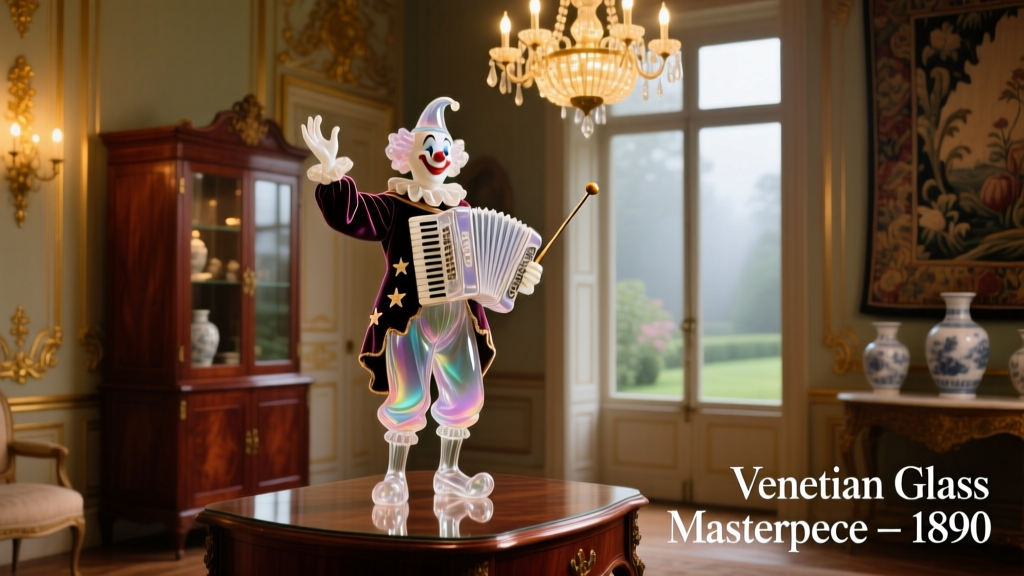
Glass Venetian Figurine: The 9¾-Inch Clown Accordion Player — History, Craftsmanship, and Restoration Insights
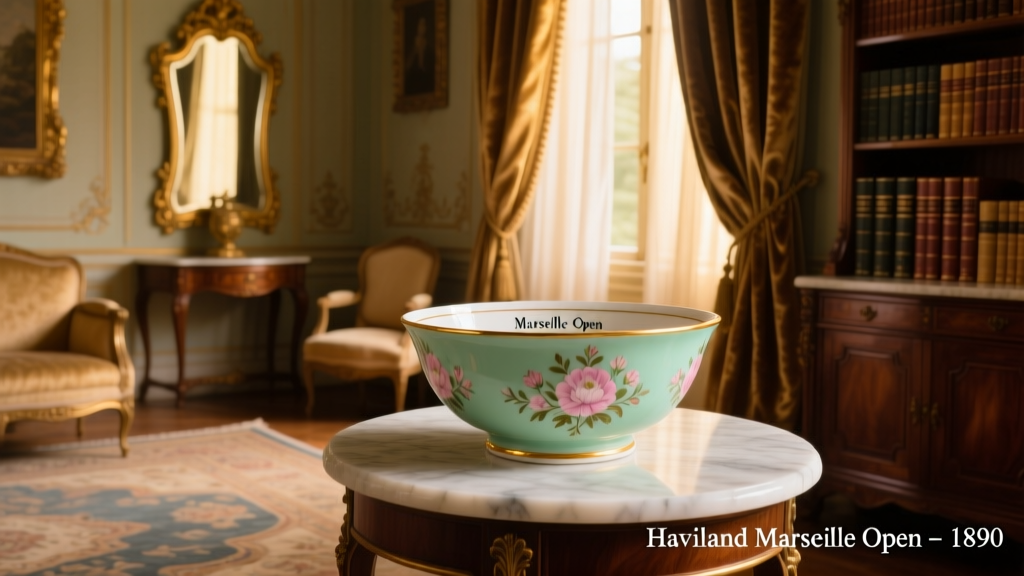
Haviland Bowl Vegetable Marseille Open: History, Identification, and Restoration Guidance
Banks Mechanical Donkey 'Forty-Niner' Cast Iron Toy: A Technical and Historical Appraisal of the 1900 8-Inch Model

The Clown on Ball Blown Glass Ornament: A Collector’s Guide to the 4-Inch Vintage Christmas Treasure

N. T. Worthley & Son: American Cabinetmakers of Distinction, 1890–1952
Decoding the 2338158: A Technical and Historical Analysis of the 1957 Herman Miller Eames Lounge Chair Production Code

John Erwin: The Unheralded Master of American Colonial Revival Furniture, 1920–1955