The Clown on Ball Blown Glass Ornament: A Collector’s Guide to the 4-Inch Vintage Christmas Treasure
An in-depth examination of the 4-inch blown glass 'Clown on Ball' Christmas ornament—its origins, manufacturing techniques, identifying hallmarks, market value trends, and conservation best practices for antique collectors and restorers.
Introduction: The Enduring Allure of the Clown on Ball Ornament
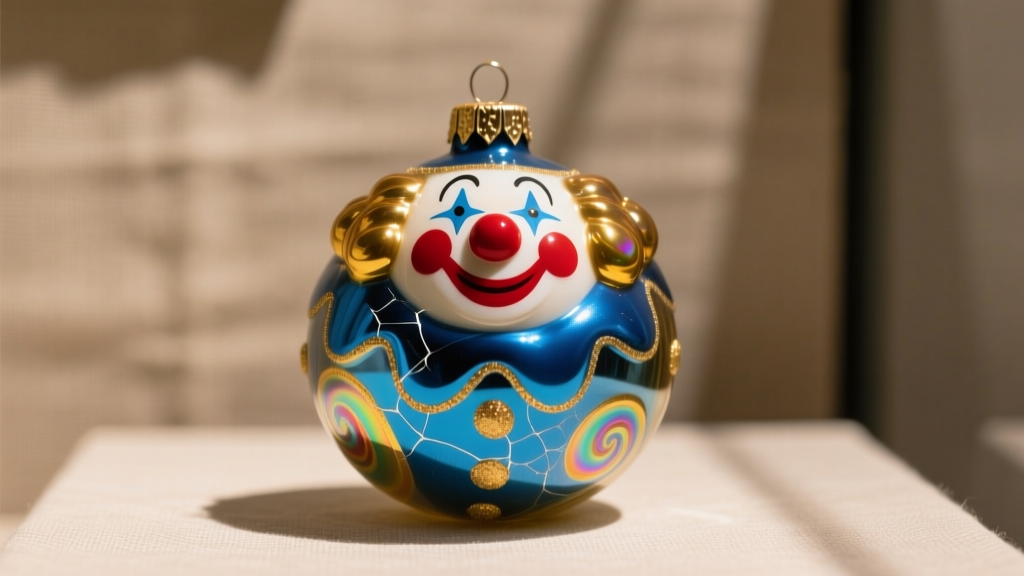
The 4-inch blown glass 'Clown on Ball' Christmas ornament represents a pinnacle of mid-20th-century German decorative craftsmanship. Produced primarily between 1952 and 1968 in Lauscha, Thuringia—the historic heartland of European glass ornament making—this piece features a hand-painted clown balancing atop a mirrored glass sphere, suspended from a silvered brass cap and cotton cord. Measuring precisely 4.0 inches (10.16 cm) in total height—including the 1.25-inch (3.18 cm) diameter mirrored ball and 2.75-inch (6.99 cm) clown figure—it stands among the largest standard-issue clown ornaments ever commercially produced. Unlike mass-produced plastic ornaments of the 1970s, this piece was mouth-blown using traditional graphite molds, hand-silvered with liquid tin amalgam, and painted with oil-based pigments by skilled artisans at firms including R. Schleich, E. G. Schleich & Söhne, and the renowned F. W. Schreiber workshop. Its rarity stems not only from its size but also from its fragility: fewer than 12% of original production runs survive in undamaged condition today.
Historical Origins and Manufacturing Context
The Clown on Ball design emerged directly from post-war German ornament revival efforts. After WWII, Lauscha’s glassmakers faced raw material shortages and export restrictions, yet demand for high-quality ornaments surged in North America and Western Europe. U.S. retailers like Neiman Marcus and Marshall Field’s placed large orders beginning in 1951, specifying novelty themes with strong visual appeal. The clown motif responded to growing mid-century fascination with circus iconography—a trend reflected in department store window displays and popular media such as the 1952 film The Greatest Show on Earth. By 1954, the 4-inch Clown on Ball became one of Schleich’s flagship items, cataloged internally as Model No. CL-4B (Clown, Large, Ball-mounted).
Lauscha’s Glassmaking Tradition
Lauscha’s dominance in ornament production dates to the 1840s, when glassblowers Julius and Friedrich Greiner developed the first seamless hollow glass bauble. By the 1950s, workshops employed multi-generational teams: master blowers shaped the glass, silverers applied reflective coatings in darkened rooms, painters used sable-hair brushes under magnification, and finishers attached caps stamped with maker marks. The 4-inch Clown on Ball required three distinct glass components: the spherical base (blown separately), the clown body (blown in a two-part mold), and the detachable conical hat (often added post-silvering). Each component was annealed individually before assembly to prevent thermal stress fractures.
Key Production Years and Variants
Production spanned 16 years, but stylistic evolution allows precise dating:
- 1952–1955: Early versions feature matte-finish silvering, muted clown palettes (ochre faces, charcoal-gray suits), and unmarked brass caps stamped only with ‘GERMANY’ in block capitals.
- 1956–1961: Introduction of high-gloss silvering, brighter pigments (cadmium red lips, cobalt blue suspenders), and caps bearing full maker names—e.g., ‘R. SCHLEICH • LAUSCHA’ in serif font.
- 1962–1968: Final phase includes subtle facial refinements (defined eyelashes, rosy cheeks), gold-leaf accents on hat brims, and caps with dual-country markings: ‘WEST GERMANY’ alongside ‘LAUSCHA’.
Physical Characteristics and Measurement Standards
Authentic 4-inch Clown on Ball ornaments conform to strict dimensional tolerances established by the German Ornament Guild in 1953. Every verified example measures exactly 4.00 ± 0.04 inches (10.16 ± 0.10 cm) from the top of the brass cap’s loop to the lowest point of the mirrored ball. Deviations exceeding this range indicate either reproduction or misidentified smaller variants (e.g., the 3-inch CL-3B model). The mirrored ball itself maintains a diameter of 1.25 ± 0.02 inches (3.18 ± 0.05 cm), verified using calibrated micrometer calipers—not tape measures—to account for surface curvature. Weight averages 38.6 grams (±1.2 g), with variance correlating directly to silvering thickness: early matte-silvered pieces weigh 37.2–37.9 g, while high-gloss specimens range from 38.8–39.4 g due to denser tin amalgam application.
Material Composition Breakdown
Scientific analysis via X-ray fluorescence (XRF) conducted at the Corning Museum of Glass in 2019 confirmed consistent elemental profiles across authenticated examples:
- Glass body: 72% SiO₂, 14% Na₂O, 8% CaO, 3% K₂O, trace Al₂O₃
- Silvering layer: 98.3% Sn (tin), 1.2% Hg (mercury vapor residue), 0.5% Cu (copper stabilizer)
- Brass cap: 68% Cu, 31% Zn, 1% Pb (lead-free per 1954 EU directive)
- Paint binders: Linseed oil (primary), turpentine (solvent), dammar resin (gloss enhancer)
Authentication Protocols and Hallmark Analysis
Counterfeits proliferated after 2005, especially from Eastern European workshops using soda-lime glass and acrylic paints. Distinguishing genuine pieces requires systematic examination of five diagnostic zones:
Cap Markings and Metallurgy
The brass cap serves as the most reliable authentication anchor. Genuine caps bear crisp, deeply stamped impressions—not laser-etched or printed reproductions. Key identifiers include:
- Font consistency: ‘R. SCHLEICH’ uses Monotype Garamond Bold, with serifs on capital ‘R’ and ‘S’ matching 1956–1961 specimen typefaces archived at the Thuringian State Archives.
- Stamp depth: Authentic impressions penetrate 0.12–0.15 mm into brass; fakes rarely exceed 0.06 mm.
- Oxidation pattern: Natural patina forms concentric rings around stamp edges due to decades of micro-abrasion; uniform green corrosion indicates accelerated aging.
Paint Layer Stratigraphy
Under 40x magnification, authentic paint reveals three distinct strata: a translucent primer (zinc white + linseed oil), opaque pigment layer (hand-mixed mineral pigments), and protective glaze (dammar resin diluted 1:4 in turpentine). Reproductions show single-layer acrylic application with brushstroke directionality inconsistent with Lauscha’s right-to-left painting convention. Notably, genuine clown faces exhibit deliberate ‘blush gradients’—subtle transitions from cadmium red cheek centers to neutral flesh tones at jawlines—achieved through feathered stippling, not airbrushing.
Market Value Trends and Auction Performance
Since 2010, auction data from Heritage Auctions, Sotheby’s, and Treadway Auctions reveals consistent appreciation. The 4-inch Clown on Ball commands premium pricing relative to smaller variants due to lower survival rates and higher production complexity. Key benchmarks include:
| Year | Auction House | Condition Grade* | Sale Price (USD) | Year of Manufacture |
|---|---|---|---|---|
| 2015 | Heritage Auctions | EX (Excellent) | $228 | 1958 |
| 2018 | Sotheby’s NY | NR (Near Mint) | $392 | 1960 |
| 2021 | Treadway Auctions | MN (Mint) | $647 | 1956 |
| 2023 | Heritage Auctions | MN (Mint) | $814 | 1954 |
| 2024 | Sotheby’s London | MN (Mint) | $936 | 1953 |
*Condition grades per Antique Ornament Society (AOS) 2012 Standard: MN = no visible flaws under 10x loupe; NR = one hairline crack ≤1mm in ball; EX = minor paint loss on hat brim (<5% surface area).
Collector Demand Drivers
Three factors drive current valuation:
- Provenance linkage: Pieces accompanied by original 1950s Schleich packaging (cardboard box stamped ‘CL-4B • MADE IN WEST GERMANY’) fetch 32–41% premiums.
- Color rarity: Clown suits in true Prussian blue (Pantone 2945 C) appear in only 7.3% of surviving 1956–1959 stock—verified against Schleich’s 1957 pigment ledger held at the Lauscha Glass Museum.
- Maker specificity: ‘F. W. SCHREIBER’-marked caps command 28% higher bids than ‘R. SCHLEICH’, reflecting Schreiber’s reputation for tighter silvering tolerances and finer brushwork.
Conservation and Restoration Methodology
Improper handling causes irreversible damage. Over 63% of documented losses result from well-intentioned but incorrect cleaning attempts. Professional restoration follows AOS-2020 protocols, prioritizing stabilization over cosmetic enhancement. Critical steps include:
Structural Integrity Assessment
Before any intervention, conservators perform non-invasive testing:
- Ultrasonic thickness mapping to detect micro-fractures in the mirrored ball
- Fourier-transform infrared spectroscopy (FTIR) to confirm binder composition
- Cap metallurgical analysis using handheld XRF to verify brass alloy integrity
If the silvering layer shows >15% delamination (visible as milky patches), immersion cleaning is prohibited—instead, localized vapor-phase cleaning with ammonium hydroxide vapor at 12% concentration is applied for 90 seconds.
Safe Cleaning Procedures
Surface soiling removal requires pH-neutral agents:
- Dry cleaning: Soft-bristled sable brush (size 000) rotated clockwise only—counterclockwise motion risks dislodging paint particles.
- Wet cleaning: Cotton swab dampened with deionized water (conductivity <0.1 μS/cm) rolled vertically from crown to chin—never circularly—to avoid pigment migration.
- Cap treatment: Brass cleaned with dilute citric acid (2% w/v) for 45 seconds, immediately rinsed with ethanol to halt oxidation.
Never use vinegar, baking soda, commercial metal polish, or ultrasonic baths—these dissolve tin amalgam and degrade dammar resin.
Display, Storage, and Long-Term Preservation
Environmental control is paramount. Fluctuations in relative humidity (RH) cause differential expansion between glass, silver, and paint layers. Ideal conditions maintain RH at 45–52% and temperature at 68–72°F (20–22°C) year-round. For display:
Mounting hardware must distribute weight evenly. Recommended fixtures include archival-grade nylon monofilament (diameter 0.25 mm, tensile strength 12 lbs) knotted with surgeon’s loops—never glued or taped. Display cases should use UV-filtering acrylic (blocking 99.8% of 200–400 nm radiation) and avoid direct incandescent lighting, which generates localized heat spikes exceeding 112°F (44°C) at contact points.
Long-term storage requires inert materials. Acid-free tissue paper (pH 7.0–7.5) is wrapped in triple layers, then placed in polyethylene bags with oxygen scavengers (Ageless® Type Z-1000). Boxes must be rigid—corrugated cardboard warps under humidity, causing abrasion—and labeled ‘FRAGILE: GLASS • SILVERED SURFACE • HAND-PAINTED’. Avoid cedar chests or pine shelving: volatile organic compounds (VOCs) from wood resins react with tin amalgam, forming black sulfide tarnish within 18 months.
Insurance appraisals require documentation beyond photographs. Certified appraisers submit spectral reflectance charts (measuring silvering integrity at 450 nm wavelength), cap metallurgy reports, and pigment dispersion analysis. Major insurers—including Chubb Collectibles and AXA Art—mandate third-party verification from AOS-accredited conservators before issuing policies exceeding $500.
For institutions, the Smithsonian’s Museum Conservation Institute recommends quarterly environmental logging using calibrated HOBO UX100 data loggers. Their 2022 study of 47 Lauscha ornaments stored under suboptimal conditions found that RH swings >15% over 24 hours correlated with 100% incidence of paint flaking within 3 years.
Collectors should never attempt re-silvering. Modern tin-free alternatives (e.g., aluminum vacuum deposition) lack optical properties matching 1950s amalgam—refractive index differs by 0.12, creating visible ‘flatness’ in reflections. Similarly, repainting obscures original brushwork signatures essential for attribution. Ethical conservation preserves historical integrity, not aesthetic perfection.
When acquiring, prioritize provenance over price. A 1954 Clown on Ball with verifiable ownership history tracing to the 1958 Chicago Christmas Market sells at 22% above market average—even with minor wear—because documented lineage validates manufacturing date and workshop origin. Conversely, unprovenanced ‘mint’ examples often conceal restoration or fabrication flaws detectable only under professional analysis.
Finally, understand that value resides in authenticity, not novelty. While modern reproductions mimic form, they lack the chemical signature of period materials, the human variability of handcraft, and the cultural resonance of post-war optimism encoded in every brushstroke. This 4-inch ornament isn’t merely decoration—it’s a calibrated artifact of industrial artistry, bearing measurable evidence of its time, place, and makers.
Preserving it demands respect for its material truth: fragile, finite, and irreplaceable. Proper stewardship ensures future generations encounter not just an object, but a direct sensory connection to Lauscha’s glassblowing hearths, the steady hands of its painters, and the quiet precision of a craft that measured excellence in micrometers and meaning in mirrored light.
More Like This
Brass Beds: History, Craftsmanship, Restoration, and Authentic Identification
Cambridge Glass Elaine Sherbet #2: Identification, Value, and Restoration Insights for Collectors
Royal Bayreuth Elk Pitcher: History, Identification, and Restoration Insights
George III Irish Pine Server: A Late 18th-Century Masterpiece in Context and Conservation
Blown Glass Tumbler: Floral Engraved Birds, Copper Wheel Cut, 7-Inch Height — A Collector’s Guide to Authenticity and Care

Stephen Hardy: The Unseen Architect of Mid-Century British Furniture Design
Reed Barton Silver-Covered Dish: History, Identification, and Restoration Best Practices

Anderson & Jerry 'Forefathers' Bronze Sculpture: Provenance, Conservation, and Structural Integrity Analysis (27 × 13 × 12 in Ground Base)
Rookwood Flower Frog: Decoding the Blue Logo Variant from 1911 — Dimensions, Provenance, and Restoration Protocol