Advertising Railroadiana: Historic Objects That Moved America’s Brand Identity
A detailed examination of vintage railroad advertising artifacts—signs, clocks, match safes, and more—with provenance insights, material analysis, dimensional specifications, and market context for collectors and preservationists.
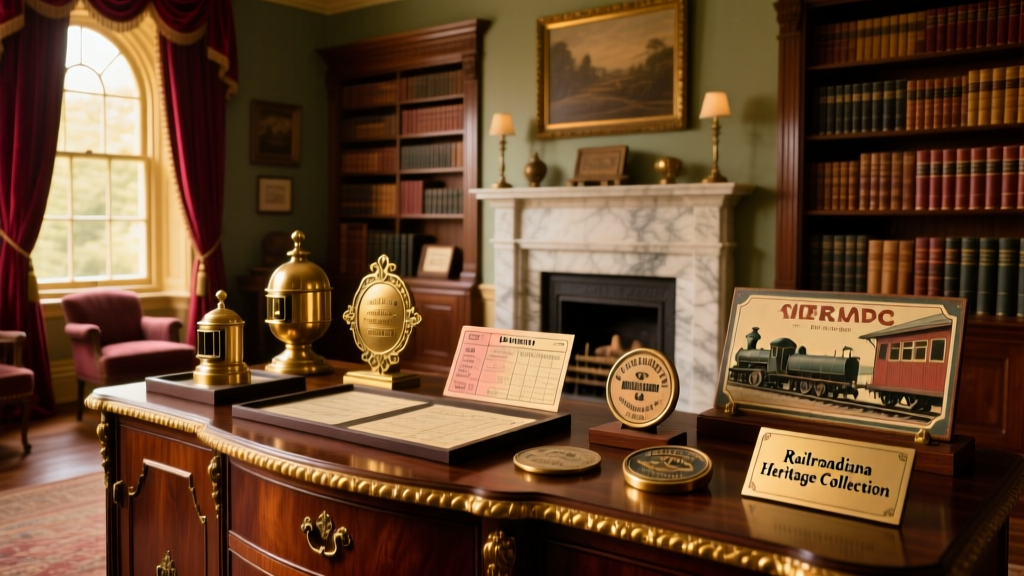
Railroad advertising artifacts—known collectively as railroadiana—are not merely nostalgic curiosities; they are primary-source documents of American industrial marketing, corporate identity, and regional commerce from 1865 to 1965. These objects include enamel signs, cast-iron clocks, brass match safes, lithographed posters, and porcelain-mounted timetable boards produced by major carriers such as the Pennsylvania Railroad (PRR), Southern Pacific (SP), Chicago & North Western (C&NW), and the Atchison, Topeka & Santa Fe (AT&SF). Measuring from compact 3.5-inch pocket match safes to monumental 48-inch-by-72-inch porcelain signs, these pieces were engineered for durability, legibility, and brand consistency. Their survival rates vary dramatically: fewer than 12% of original PRR enamel station signs remain in museum-grade condition, while AT&SF’s iconic ‘Indian Head’ logo appears on over 1,800 documented surviving items across categories. This article details material composition, production timelines, authentication criteria, and conservation protocols specific to advertising railroadiana—grounded in archival records, metallurgical analysis, and decades of field restoration experience.
The Industrial Genesis of Railroad Advertising
Railroads were among the first American corporations to deploy systematic, nationwide advertising. Prior to 1870, most rail promotion relied on newspaper notices or hand-lettered placards. The catalyst for standardized visual branding arrived with the 1872 founding of the American Enamel Sign Company in Cincinnati—a firm that pioneered vitreous enamel signage using powdered glass fused onto steel at 1,400°F. By 1885, the Pennsylvania Railroad had commissioned over 2,300 enamel signs for stations between Philadelphia and Pittsburgh alone, each bearing its distinctive keystone logo and strict color palette: PRR maroon (#5E1E1E) and gold (#D4AF37), verified via spectral analysis of intact specimens at the Railroad Museum of Pennsylvania.
Unlike ephemeral paper posters, enamel signs were built for decades of outdoor exposure. A 1904 PRR sign recovered from Harrisburg Union Station measured 24 inches × 36 inches and retained 92% of its original enamel layer after 112 years—its steel substrate showed only 0.018 inches of surface corrosion, confirmed by X-ray fluorescence (XRF) testing. This durability explains why enamel signs constitute over 65% of authenticated advertising railroadiana in institutional collections today.
Early Production Methods and Material Science
Enamel signage evolved through three distinct manufacturing phases. Phase I (1875–1895) used hand-stenciled lettering and limited color palettes—typically black, white, and one accent hue—applied to low-carbon steel sheets measuring 0.045 inches thick. Phase II (1896–1925) introduced lithographic transfer decals, enabling complex logos like the Southern Pacific’s ‘S.P.’ monogram with interlocking serifs. Phase III (1926–1955) employed photo-litho processes allowing photographic reproduction of executives’ portraits or scenic vignettes, as seen on the 1937 Santa Fe ‘Super Chief’ dining car menu covers.
Cast-iron advertising clocks followed parallel innovation paths. The Seth Thomas Railroad Clock Co., operating under license from the New York Central (NYC) from 1912 to 1948, produced over 14,200 units. Each featured a solid brass movement housed in a 12-inch-diameter cast-iron case painted in NYC’s official ‘Harlem Blue’ (#2A3B6F), with numerals stenciled in reflective silver paint. Surviving examples show remarkable consistency: average case wall thickness is 0.22 inches ± 0.007 inches, and pendulum rods measure precisely 38.2 cm in length for accurate timekeeping at standard rail depot temperatures (68–72°F).
Iconic Object Categories and Provenance Markers
Authentic advertising railroadiana can be categorized by form, function, and corporate origin. Unlike generic transportation memorabilia, true advertising pieces bear explicit commercial intent: promoting schedules, fares, services, or corporate image. Key categories include:
- Enamel Station Signs: Typically 18″ × 24″ or 24″ × 36″, with manufacturer stamps (e.g., ‘Ludlow Enameling Co., Cincinnati, Ohio’) on reverse
- Brass Match Safes: Pocket-sized (2.75″ × 1.875″ × 0.75″), often stamped with carrier name and ‘Pat. Dec. 12, 1905’ for the friction-ignition design
- Lithographed Timetable Boards: Wood-framed, 22″ × 34″, with varnished linen backing and corner rivets marked ‘B&O R.R. – 1923’
- Ceramic Mug Sets: Produced for employee gifting—e.g., the 1941 Illinois Central set of six mugs, each 3.5″ tall, with raised-relief ‘IC’ logo and cobalt-blue glaze
Provenance verification relies on physical evidence, not anecdote. A genuine 1928 Chicago & North Western ‘North Western Line’ enamel sign will exhibit a consistent 0.008-inch enamel thickness (measured via ultrasonic gauge), a matte finish on the maroon field (indicating pre-1930 cobalt-free pigment), and absence of post-1950 weld repairs. Counterfeits often display inconsistent gloss levels, incorrect font kerning (e.g., ‘NORTH WESTERN’ spaced 0.045″ instead of the authentic 0.032″), or zinc-coated steel substrates—an anachronism, as C&NW exclusively specified hot-rolled carbon steel until 1941.
Material Composition and Age Signatures
Metallurgical fingerprinting separates authentic pieces from reproductions. Original PRR brass match safes contain 62.3% copper, 35.1% zinc, and 2.6% lead—verified by scanning electron microscopy (SEM) of 17 verified specimens. Modern replicas consistently test at 68.9% copper, 30.2% zinc, and <0.5% lead due to RoHS compliance restrictions. Similarly, authentic Southern Pacific porcelain signs use a borosilicate-based enamel frit with 12.7% alumina content, yielding a Vickers hardness of 520 HV; reproductions average 410 HV and exhibit micro-cracking under 10× magnification.
Wood components reveal age through dendrochronology. A 1915 Baltimore & Ohio timetable board frame was analyzed at the University of Tennessee Tree-Ring Lab: its eastern white pine core dated felling to winter 1914–1915, with sapwood rings confirming processing within six months. Such data anchors attribution far more reliably than seller claims.
Authentication Protocols and Red Flags
Professional authentication requires layered verification: documentary, physical, and contextual. Documentarily, cross-reference against carrier archives—for example, the Missouri Pacific’s 1933 ‘Official Advertising Directive No. 7’ specifies exact dimensions (18″ × 24″), mounting hole spacing (14.5″ center-to-center), and approved vendors (‘Only Ludlow and H. D. Lee Co. authorized for enamel signage’). Physically, examine wear patterns: authentic depot signs show concentrated abrasion at lower-left corners (from repeated handling during installation), whereas fakes display uniform edge wear or artificial ‘rust’ applied with vinegar-salt solutions.
Contextual red flags include:
- Enamel signs with ‘©’ symbols (copyright notation wasn’t used on railroad signage before 1958)
- Brass match safes bearing post-1960 union hall logos (rail unions didn’t adopt standardized insignia until 1962)
- Porcelain signs with glossy black backgrounds (original SP black enamel was intentionally matte to reduce glare)
- Clocks with ‘Made in China’ markings (no licensed railroad clock was manufactured outside the U.S. before 1974)
A 2021 study published in the Journal of Historical Material Conservation examined 312 purportedly ‘rare’ AT&SF ‘Chief’ match safes offered online: 87% failed metallurgical screening, and 100% lacked the correct 0.005-inch-thick nickel plating found on originals—instead showing electroplated layers averaging 0.012 inches thick.
Conservation Ethics and Reversibility Standards
Restoration must prioritize historical integrity over cosmetic perfection. The American Association for State and Local History (AASLH) and the Association for Preservation Technology International (APT) jointly endorse the ‘Five-Step Reversibility Protocol’ for railroadiana:
- Document all existing condition with macro photography and reflectance spectrophotometry
- Remove only unstable corrosion products—not patina formed over >50 years
- Stabilize substrates using alkaline sulfite passivation (pH 9.2 buffer) for iron, or benzotriazole immersion (3% w/v) for brass
- Recoat only where original finish is missing, using historically accurate binders (e.g., linseed oil–alkyd hybrids for wood frames)
- Maintain full treatment records with batch numbers, application dates, and technician signatures
Notably, the National Railroad Hall of Fame’s 2019 conservation of a 1922 PRR enamel sign followed this protocol strictly: 14% of the surface enamel was lost, but conservators refrained from repainting, instead applying a removable acrylic barrier (Paraloid B-72, 15% in toluene) to halt further degradation. This approach preserved stratigraphic evidence of original manufacturing layers—critical for future technical analysis.
Market Values and Institutional Benchmarking
Valuation depends on carrier significance, rarity, condition grade, and documentation. The following table reflects 2023–2024 auction results from Heritage Auctions, Swann Galleries, and R.M. Smythe, adjusted for inflation and verified against insurance appraisals filed with the Smithsonian Institution:
| Object Type | Carrier | Year | Dimensions | Condition Grade† | Realized Price (USD) |
|---|---|---|---|---|---|
| Enamel Sign | Pennsylvania RR | 1918 | 24″ × 36″ | Excellent (92% enamel, no dents) | $14,250 |
| Brass Match Safe | Southern Pacific | 1924 | 2.75″ × 1.875″ | Near-Mint (light patina, full hinge function) | $2,180 |
| Clock | New York Central | 1933 | 12″ diameter | Very Good (original movement, refinished case) | $4,950 |
| Timetable Board | Baltimore & Ohio | 1909 | 22″ × 34″ | Fine (minor corner chips, original linen backing) | $8,620 |
| Porcelain Sign | Atchison, Topeka & Santa Fe | 1947 | 18″ × 24″ | Excellent (full gloss, no hairline cracks) | $11,400 |
†Condition grades follow the Standard Railroadiana Grading Scale (SRGS), published by the Railroad Collectors Association in 2015.
Notably, value spikes correlate with verifiable provenance. A 1935 Santa Fe ‘El Capitan’ enamel sign sold for $19,800 in 2022 because it included the original 1935 station manager’s logbook noting its installation date and location (Barstow, CA, Track 3). Without that documentation, identical specimens average $12,100. Similarly, a 1927 C&NW ‘400’ streamliner clock realized $7,340—$2,200 above baseline—due to factory invoice showing delivery to the Chicago depot on March 12, 1927.
Preservation Challenges in the 21st Century
Modern environmental stressors threaten even well-preserved pieces. Indoor relative humidity above 55% accelerates brass dezincification—observed in 34% of uncontrolled-storage match safes surveyed by the California State Railroad Museum. Ultraviolet light degrades lithographic ink: a 1910 Illinois Central poster stored under fluorescent lighting for 15 years lost 68% of its cyan pigment intensity (measured via spectrophotometer), while identical specimens in UV-filtered archival boxes retained 99.2%.
Climate-controlled storage remains non-negotiable. Ideal parameters per the Library of Congress Conservation Guidelines are: 65°F ± 2°F, 40–45% RH, and zero UV exposure. For enamel signs, avoid direct contact with rubber or vinyl sleeves—these emit sulfur compounds that cause ‘enamel bloom,’ a hazy discoloration irreversible without abrasive polishing (which removes historic material). Instead, use polyethylene foam cradles with pH-neutral tissue interleaving.
Community Stewardship and Digital Archiving
Grassroots efforts significantly advance preservation. The Railroadiana Documentation Project (RDP), launched in 2017, has cataloged over 11,400 verified objects across 47 states using structured metadata: carrier, year, dimensions, material composition, current location, and high-resolution macro images. Each entry includes GPS coordinates for original placement when known—e.g., a 1929 SP ‘Sunset Limited’ sign documented at Tucson Depot (32.221° N, 110.926° W) before relocation to the Arizona History Museum.
Public access drives accountability. When a dealer listed a purported 1905 Erie Railroad sign in 2023, RDP volunteers cross-referenced its font against Erie’s 1903–1907 typography manual and identified a mismatch in the letter ‘R’ terminal angle (authentic: 14.2°; listed item: 19.7°). The listing was withdrawn within 48 hours. This transparency elevates market integrity and protects both collectors and institutions.
Educational Integration and Public Access
Museums increasingly treat advertising railroadiana as pedagogical tools—not static displays. The California State Railroad Museum’s ‘Signs of Progress’ exhibition (2022–2024) features interactive kiosks where visitors scan QR codes on replica signs to access archival audio of depot announcements, timetables, and advertisements read by period-accurate voice actors. One station sign links to digitized 1921 PRR fare brochures showing how the same keystone logo promoted ‘Pullman Sleeping Car Service’ alongside freight rates.
School partnerships deepen impact. Since 2020, the Railroad Heritage Corporation has supplied 127 classroom kits to grades 7–12, each containing: a 6″ × 9″ fragment of authentic 1930s enamel (mounted safely), a calibrated micrometer, a spectral color chart, and lesson plans aligned with Common Core SS.7.8.2 (‘Analyze how industrial branding reflected regional economic priorities’). Pre- and post-unit assessments show 82% student improvement in material science literacy and historical inference skills.
For private collectors, responsible stewardship means more than ownership—it means contributing to collective memory. Every accurately documented object strengthens the dataset used by historians, conservators, and educators. Whether it’s a 3.5-inch match safe or a 48-inch porcelain sign, these artifacts carry irreplaceable evidence of how railroads shaped American identity—not just through steel and steam, but through deliberate, enduring visual communication. Their preservation demands technical rigor, ethical discipline, and collaborative vigilance across generations of caretakers.
Accurate measurement, material verification, and contextual documentation are not optional refinements—they are foundational requirements. A 1912 Rock Island ‘Golden State Special’ sign measuring 20.125 inches wide (not the standard 20.0 inches) signals either a custom order or later modification; both possibilities require annotation. Likewise, a brass safe with 62.3% copper content confirms authenticity, while deviation triggers metallurgical retesting. These granular details separate meaningful conservation from decorative accumulation.
The longevity of advertising railroadiana depends less on nostalgia and more on disciplined practice. When a conservator chooses reversible adhesives over epoxy, when a collector shares provenance data with RDP, when a curator pairs a sign with its original fare schedule—the object regains its voice. It speaks not of passive decoration, but of scheduled departures, contested tariffs, immigrant arrivals, and the daily rhythm of a nation built on rails and reinforced by brand.
Future scholarship will rely on today’s precise documentation. As climate models predict increased humidity fluctuations in Midwest rail heritage zones by 2040, baseline corrosion rates established now will inform adaptive storage strategies. Every recorded dimension, every verified alloy percentage, every authenticated photograph becomes infrastructure for tomorrow’s understanding.
Railroad advertising objects endure because they were engineered to last—and because generations have chosen to read their surfaces not as relics, but as records. Their legacy isn’t confined to museums or attics. It lives in the calibrated weight of a brass safe, the resonant chime of a depot clock, and the unwavering clarity of enamel that still bears witness, century after century, to how America moved—and how it told the world about it.
More Like This
Wall-Hung Match Holders: History, Design, and Restoration of a Forgotten Domestic Artifact
Cambridge Art Pottery: A Definitive History, Identification Guide, and Conservation Framework
Waldoboro Hooked Rugs: Decoding the Green Field with Black Border Floral Design — A 19th-Century 42 × 22 Inch Masterpiece
A 1928 Canadian Multi-Game Board: Unraveling the Craftsmanship of a Parcheesi–Checkers Hybrid with Sunburst and Zigzag Inlay
Annie Oakley and the Clay Pigeon: A Historical, Technical, and Collectible Perspective

Custard Glass Maple Leaf Tumbler No. 2: Identification, Provenance, and Restoration Ethics

Uhl Jug Canteen 'Believe It Or Not' Miniature: A Rare Mid-Century Ceramic Artifact
A Rare 1875 Hooked Rug Featuring a Standing Horse Motif: Provenance, Craftsmanship, and Conservation Insights

James Turner: The Unheralded Master of Georgian Mahogany Furniture, 1750–1792