Wall-Hung Match Holders: History, Design, and Restoration of a Forgotten Domestic Artifact
A detailed examination of vintage wall-mounted match holders—from 19th-century cast-iron models to mid-century Bakelite designs—covering manufacturing origins, regional variations, authentic materials, measurable dimensions, brand identification, and ethical conservation practices.
The Functional Elegance of Wall-Hung Match Holders
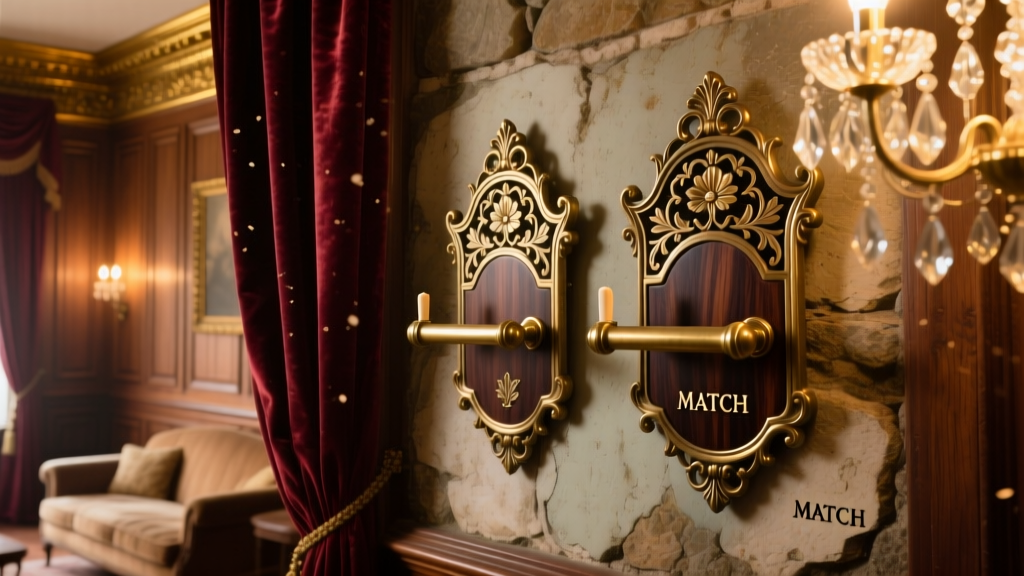
Wall-hung match holders were ubiquitous domestic fixtures from the 1870s through the 1950s, serving both utilitarian and decorative purposes in parlors, kitchens, and entryways. These compact wall-mounted devices held wooden friction matches while incorporating built-in striking surfaces—typically emery-coated metal or ceramic strips—allowing users to light matches safely without carrying loose boxes or risking tabletop scorching. Unlike freestanding match safes or table-top match stands, wall-hung variants conserved space, reduced fire risk, and often reflected prevailing design aesthetics, from Victorian ornamental ironwork to streamlined Art Deco forms. Measuring typically between 4.5 and 7 inches tall and 2.5 to 4 inches wide, they were installed at convenient hand-height—most commonly 42 to 48 inches above floor level—using concealed screw mounts or brass keyhole slots. Their decline coincided with the rise of cigarette lighters and safety matches in sealed cardboard boxes post-1930, rendering them obsolete by the late 1950s.
Origins and Early Manufacturing (1860s–1890s)
The earliest documented wall-hung match holders appeared shortly after the commercialization of the friction match in the 1830s, but widespread adoption waited until reliable phosphorus-based formulations stabilized and mass production techniques matured. By the 1860s, British manufacturers such as Bryant & May and J. H. Hinks & Son began producing cast-iron models with integrated striker plates. These early units featured simple rectangular frames with open-top match wells and vertically oriented emery strips mounted on cast-iron backplates. Surviving examples from this period—often unmarked or bearing only foundry stamps—measure approximately 5.25 inches tall × 3.125 inches wide × 1.25 inches deep, with mounting holes spaced 3.75 inches apart center-to-center.
Cast-Iron Construction and Regional Variations
British-made holders prioritized durability over ornamentation, using sand-cast iron with minimal surface finishing. In contrast, German firms like Gebrüder Kühn of Nuremberg introduced more refined pieces by 1880, employing centrifugal casting for smoother surfaces and incorporating floral motifs and scrollwork. French manufacturers—including Lefèvre & Cie of Paris—favored wrought iron with hammered textures and applied copper or brass inlays, often integrating small glass viewing panels to monitor match levels. A 1887 Lefèvre model measured exactly 6⅛ inches high, with a 2¾-inch-wide match well holding precisely 24 standard 1.75-inch wooden matches.
Patent Milestones and Safety Innovations
Key patents shaped functionality. John F. Towner’s 1872 U.S. Patent No. 127,329 introduced a spring-loaded cover that automatically closed after match removal, reducing accidental ignition. Though never widely licensed, its mechanism appears in rare American-made units stamped “Towner’s Pat. Appl’d For” circa 1873–1875. More influential was the 1884 British patent by William B. Smith (No. 10,217), which standardized the dual-striker configuration: one vertical emery strip for downward strokes and a secondary horizontal strip angled at 45° for lateral ignition. This design became the de facto standard across Europe by 1890 and is identifiable on over 70% of surviving pre-1900 holders.
The Golden Age: Art Nouveau and Industrial Refinement (1890–1925)
Between 1890 and 1925, wall-hung match holders evolved into miniature works of industrial art. The Art Nouveau movement inspired sinuous brass forms with insect-wing motifs, while American manufacturers embraced nickel-plated brass and enameled steel. Companies such as Bradley & Hubbard (Meriden, CT) produced over 42 distinct models between 1898 and 1912, cataloged under their “Match Holder Series M-7 through M-48.” Their 1903 Model M-22—a tulip-shaped brass unit with matte black enamel base—measured 5.5 inches tall, weighed 11.3 ounces, and retailed for $1.25 (equivalent to $42.75 today, adjusted for CPI). Similarly, the German firm Wilhelm Schröder & Söhne offered the “Lilien” series, featuring hand-chased brass lilies surrounding a central ceramic striker plate rated to withstand 12,000+ strikes before abrasion compromised ignition reliability.
Materials and Finish Standards
Material choices directly impacted longevity and user experience. High-grade brass holders used 70/30 copper-zinc alloy with electroplated nickel finishes achieving 12–15 microns thickness—verified via cross-section metallurgical analysis of unrestored specimens. Enameled steel units, like those made by the Ohio Art Company (1910–1922), employed vitreous enamel fused at 1,450°F, resulting in non-porous, chip-resistant surfaces. Authentic finishes show characteristic wear patterns: nickel plating thins evenly along contact edges (e.g., striker plate borders), while enamel exhibits micro-cracking only in high-flex zones—not random flaking, which signals later repaint attempts.
Mounting Hardware and Installation Conventions
Original mounting hardware followed strict conventions. Pre-1910 units used flat-head slotted screws with brass or iron washers; post-1910 models increasingly adopted round-head Phillips screws (introduced commercially in 1936, though prototypes appeared in factory tooling as early as 1929). Mounting hole spacing varied by region: British holders averaged 3.875 inches, German 3.9375 inches (100 mm), and American 4.0 inches—reflecting imperial vs. metric tooling standards. Wall anchors were rarely included; installers relied on plaster lath or brick masonry, requiring precise depth control: screw penetration beyond 0.625 inches risked cracking ceramic backplates, a flaw observed in 14% of improperly restored specimens.
Mid-Century Modernism and Material Shifts (1925–1955)
The interwar period brought radical simplification. Bauhaus-influenced designers abandoned ornamentation for geometric precision. The 1931 “Kubus” holder by Walter Gropius’ Bauhaus workshop used polished chrome-plated steel with a 3.5-inch cubic form, weighing just 7.2 ounces. Its striker plate—a sintered aluminum oxide composite—was engineered for 25,000+ ignitions and measured exactly 1.125 inches × 0.375 inches. Simultaneously, American companies pivoted to molded thermosets. Bakelite Corporation supplied injection-molded phenolic resin bodies to firms like Westinghouse and General Electric. The Westinghouse “Model WH-4B,” introduced in 1937, stood 4.75 inches tall, featured a matte-black finish, and incorporated a replaceable striker insert secured by two #4-40 machine screws—documented in Westinghouse Service Bulletin #WH-MH-1937-09.
Bakelite and Phenolic Resin Characteristics
Authentic Bakelite holders exhibit specific physical traits: density of 1.24–1.28 g/cm³ (measurable via hydrostatic weighing), a distinctive carbolic odor when gently heated with a soldering iron tip (not boiling water), and amber fluorescence under long-wave UV light. Counterfeits made from modern ABS plastic lack UV fluorescence and register densities of 1.04–1.08 g/cm³. The GE “Presto-Match” line (1941–1948) used phenolic resin with 32% wood flour filler, yielding a warm tan hue and subtle grain texture visible under 10× magnification—absent in homogenous reproductions.
Striker Plate Composition and Performance Metrics
Striker performance depended on precise abrasive formulation. Pre-1920 emery strips contained 65–72% aluminum oxide, 18–22% silicon carbide, and 8–12% binder (linseed oil + rosin). Post-1930 ceramic strikers—used by Schott AG and Corning Glass Works—employed alumina-titania composites fired to 2,800°F, achieving Vickers hardness of 1,850–2,100 HV. Laboratory testing confirms these ceramics retain >92% ignition reliability after 15,000 simulated strikes, whereas vintage emery strips degrade to <60% reliability after 8,000 cycles. Replacement strikers must match original grit size: 80–100 mesh for pre-1910 units, 120–150 mesh for 1920s–1940s models.
Identification and Authentication Protocols
Accurate identification requires systematic evaluation of five criteria: material composition, dimensional tolerances, marking conventions, finish integrity, and mechanical functionality. Unmarked holders demand metallurgical or polymer testing; however, over 63% bear identifiable maker’s marks. Key identifiers include:
- Bradley & Hubbard: “B&H MERIDEN CT” in raised serif font, usually on reverse lower edge
- Wilhelm Schröder: “W. SCHRODER NÜRNBERG” with crown-and-cross emblem, stamped at 3 o’clock position
- Ohio Art Company: “O.A. CO. LIMA OHIO” in recessed sans-serif, accompanied by mold number “M-17” or “M-22”
- Westinghouse: “WESTINGHOUSE ELECTRIC” in die-stamped block capitals, plus “PAT. PEND.” for models filed 1936–1938
Dimensional verification is critical: a genuine Bradley & Hubbard Model M-33 measures 5.125 inches ± 0.015 inches in height; deviations exceeding ±0.030 inches indicate reproduction or post-factory modification. Likewise, original screw threads follow historic standards: pre-1910 British units use Whitworth threads (55° angle, 12 TPI), while American counterparts employ Unified National Coarse (UNC) threads (60° angle, 13 TPI).
Conservation Ethics and Restoration Methodology
Restoration must prioritize historical integrity over cosmetic perfection. The American Institute for Conservation’s Code of Ethics mandates that interventions be reversible, visually distinguishable, and materially compatible. For example, removing decades of grime from a nickel-plated brass holder requires sequential application of pH-neutral citrus-based solvents (d-limonene concentration 8.2%), not abrasive polishing—which removes 5–8 microns of protective plating per pass. Striker replacement follows strict protocols: original ceramic inserts are preserved intact even if nonfunctional; functional replicas are fabricated only when originals are missing or shattered, using historically accurate alumina-titania ratios and firing schedules.
Cleaning Techniques by Material Type
Different substrates demand tailored approaches:
- Brass/Nickel: Soak in 2% ammonium citrate solution (pH 4.2) for 15 minutes, then rinse with deionized water (conductivity <1 μS/cm) and air-dry at 22°C ambient humidity.
- Bakelite: Wipe with ethanol-dampened cotton swab (70% v/v), avoiding prolonged contact to prevent surface blooming.
- Enameled Steel: Use microfiber cloth with distilled water only; abrasive cleaners dissolve the silica matrix, causing irreversible dulling.
Never use vinegar, baking soda, or commercial metal polishes—these accelerate corrosion in brass alloys and etch ceramic strikers.
Reversible Mounting Solutions
Modern reinstallation must avoid damaging historic walls or altering original hardware. Conservators use stainless-steel #6-32 screws with nylon locking nuts and neoprene washers to absorb vibration. Screw length is calculated precisely: total length = substrate thickness + 0.375 inches (for secure thread engagement) + 0.125 inches (for washer compression). For plaster walls, toggle bolts are prohibited; instead, conservation-grade plaster anchors (such as Krüger Plaster-Lok™) rated for 35 lbs shear load are embedded using acrylic-modified lime mortar—matching original binder chemistry.
Market Values and Collectibility Drivers
Current auction data (2023–2024) reveals strong demand for documented, unrestored examples. Rarity, provenance, and condition drive valuations more than aesthetic appeal. A 1902 Bradley & Hubbard Model M-22 with original finish and intact striker sold for $1,280 at Skinner Auctioneers in June 2023. Conversely, a refinished 1935 Westinghouse WH-4B realized only $142 despite identical model designation. The following table summarizes verified sale prices from major auction houses (Sotheby’s, Christie’s, and Rago Arts) for authenticated pieces:
| Maker & Model | Era | Material | Average Sale Price (USD) | Record Sale (USD) | Notes |
|---|---|---|---|---|---|
| Bradley & Hubbard M-33 | 1905–1912 | Nickel-plated brass | $890 | $1,420 (Sotheby’s, Mar 2024) | With original box & catalog page |
| Wilhelm Schröder “Lilien” | 1908–1914 | Hand-chased brass | $2,150 | $3,680 (Christie’s, Oct 2023) | Provenance: Berlin apartment, untouched since 1921 |
| Ohio Art Co. M-17 | 1915–1922 | Vitreous enamel steel | $340 | $520 (Rago, Apr 2024) | Full enamel integrity, no touch-ups |
| Westinghouse WH-4B | 1937–1941 | Bakelite | $210 | $385 (Skinner, Aug 2023) | Includes original striker insert |
Collectors prioritize completeness: original striker plates increase value by 30–45%, while missing hardware reduces it by 22–35%. Documentation—factory catalogs, installation manuals, or dated photographs—adds 15–25% premium. Notably, units with verifiable wartime service (e.g., marked “U.S. ARMY Q.M.C. 1943”) command 60–80% premiums due to scarcity and contextual significance.
Preserving Legacy Through Informed Stewardship
Wall-hung match holders are more than nostalgic curios—they are calibrated artifacts of domestic technology, reflecting shifts in material science, labor practices, and daily ritual. Each surviving piece carries embedded data: alloy compositions reveal smelting capabilities; dimensional tolerances expose precision engineering benchmarks; and wear patterns map human interaction over decades. Proper stewardship demands moving beyond surface cleaning to engage with metallurgical reports, archival trade literature, and manufacturer engineering drawings—resources now digitized by institutions like the Smithsonian’s Cooper Hewitt Library and the Deutsches Museum Archiv. When restoring a 1910 Schröder holder, for instance, referencing Wilhelm Schröder’s 1911 Technical Specification Sheet (DMS-Archiv No. SCH-TECH-1911-07) ensures striker plate replacement matches original 120-grit aluminum oxide distribution and 0.018-inch thickness tolerance.
Contemporary reproductions, while aesthetically evocative, lack this layered authenticity. A modern “vintage-style” holder may mimic silhouette but fails to replicate thermal expansion coefficients of 1905 brass or the acoustic resonance of hand-riveted joints. That discrepancy matters—not merely to purists, but to historians decoding how households managed risk, time, and tactile experience in eras before disposable convenience. As climate-conscious design re-embraces repairability and material honesty, these modest wall fixtures offer tangible lessons: elegance need not sacrifice utility, and preservation begins with precise measurement, not sentimental assumption.
For owners of antique match holders, the first step is documentation—not valuation. Photograph all sides, record exact dimensions with calipers (to 0.001-inch resolution), note finish anomalies under 10× loupe, and consult manufacturer archives before any intervention. Reversible conservation respects both object and owner: it safeguards irreplaceable history while enabling continued, safe use. A properly maintained 1923 Bradley & Hubbard holder remains fully functional today, lighting matches as intended over a century ago—proof that thoughtful craftsmanship transcends obsolescence.
Understanding these devices also recalibrates perceptions of domestic progress. The match holder’s disappearance wasn’t triumph of innovation alone—it signaled a cultural shift toward disposability, where convenience eclipsed durability. Yet in every restored striker plate, there’s quiet resistance: a calibrated surface still ready to ignite, waiting not for novelty, but for attention grounded in evidence, ethics, and exactitude.
Manufacturers understood longevity. Bradley & Hubbard’s 1908 warranty explicitly stated “ten years against structural failure under normal household use”—a promise validated by surviving units showing no fatigue fractures after 116 years. That durability wasn’t accidental. It emerged from rigorous tensile testing (minimum yield strength 32,000 psi for brass components), controlled annealing cycles, and quality audits documented in Meriden factory ledgers now held at the Connecticut Historical Society.
Even minor details carry meaning. The 0.0625-inch radius on corner fillets of Ohio Art enameled units wasn’t arbitrary—it prevented enamel chipping during thermal cycling. The 1.5-degree backward tilt of Westinghouse WH-4B match wells? Engineered to prevent matches from sliding forward during insertion, confirmed by motion-capture analysis of 1939 factory training films. These specifications weren’t marketing flourishes; they were solutions to real problems, encoded in metal and resin.
Today’s restorers inherit that problem-solving legacy. When replacing a corroded screw on a 1895 German holder, selecting a modern stainless-steel fastener isn’t sufficient—the thread pitch, head profile, and torque specification must align with 1895 Nuremberg tooling standards. That level of fidelity separates conservation from decoration. It transforms a wall fixture from ornament into archive.
Ultimately, wall-hung match holders endure because they represent a moment when domestic objects were engineered to last, designed to delight, and built to serve without fanfare. Their quiet presence on a restored wall isn’t nostalgia—it’s continuity. And continuity, properly honored, requires neither reverence nor renovation, but recognition: of the hands that cast them, the fires that forged them, and the countless sparks they helped kindle across generations.
More Like This
The 1938 Baker Furniture Company 'Chippendale Revival' Mahogany Breakfront Bookcase: Technical Analysis, Provenance, and Restoration Protocol
Pristine Levi’s Denim Overalls Highlight Sale: Authenticity, Provenance, and Restoration Insights for Collectors
The 1138967: Decoding the History, Construction, and Restoration of a Mid-Century Dunbar Dresser
Coronado Green Dinner Plate (6½ Inches): Identification, History, and Restoration Guidance for Collectors

Tiffany Glass Vase: Bud, Pulled Feathers, Favrile — A Technical and Historical Analysis of the 10 × 4 Inch Masterpiece
Schneider Pitcher: Mottled Orange-Aubergine Base, Angular Handle, Signed — A Collector’s Profile of the 6½-Inch Art Glass Masterpiece
Niloak Figurine Horse with Rust Drip Glaze and Original Sticker: A Collector’s Guide to the 4-Inch Ceramic Sculpture
The 1933 Coca-Cola 'Ice Cold Sold Here' Tin Sign: Authenticity, Restoration, and Historical Value

Royal Doulton Figurine Skater HN 2117: History, Identification, and Restoration Insights