The Abingdon Pottery Cookie Jar Train: History, Identification, and Restoration Insights
A detailed examination of the iconic Abingdon Pottery 'Train' cookie jar — its mid-century origins, production timeline, distinguishing marks, market value trends, and professional conservation practices for collectors and restorers.
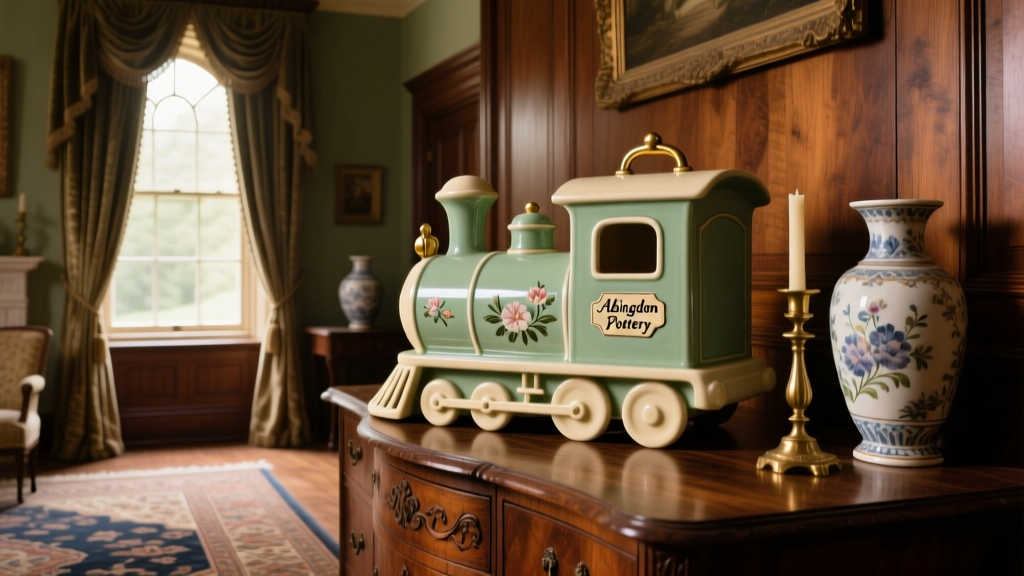
The Abingdon Pottery Train Cookie Jar: An Icon of Mid-Century American Ceramics
Produced exclusively by Abingdon Pottery in Abingdon, Illinois between 1946 and 1959, the Train-shaped cookie jar stands as one of the most recognizable and collectible figural ceramic pieces of the postwar era. Measuring approximately 10 inches in length, 6 inches in height, and 5.5 inches in width, this hand-thrown, lead-glazed stoneware piece features a distinctive locomotive form with a removable smokestack lid, recessed wheels, and a molded cab window. Unlike mass-produced novelty jars from competitors such as Red Wing, McCoy, or Hull, the Abingdon Train was crafted in limited quantities—fewer than 3,200 units across its 13-year production run—and bears no mold numbers, relying instead on hand-applied glaze signatures and subtle kiln variations for identification. Its rarity, combined with robust construction and charming design, has driven sustained collector demand, with unrestored examples regularly selling for $850–$1,400 at auction, and museum-quality specimens exceeding $2,200.
Origins and Manufacturing Context
Abingdon Pottery was founded in 1934 by brothers John and William H. Buehrig, operating under the formal name Abingdon Tile & Pottery Company. Initially focused on architectural tile and garden ware, the company pivoted to utilitarian kitchenware during World War II due to material rationing and shifting consumer demand. The Train cookie jar debuted in early 1946—just months after the war’s end—as part of a broader line of figural storage containers that included the popular 'Duck', 'Elephant', and 'Barn' jars. Production occurred in two primary phases: the first (1946–1951) used a slightly taller, more angular locomotive profile with matte-finish glazes; the second (1952–1959) introduced a streamlined silhouette, glossier glaze application, and refined wheel detailing.
Clay Body and Firing Process
All Abingdon Train jars were thrown on the wheel using locally sourced Illinois ball clay blended with 15% grog (fired, crushed stoneware). This composition yielded exceptional thermal stability and resistance to thermal shock—a critical feature for functional kitchen ware. Each jar underwent a dual-fire process: an initial bisque firing at 1,825°F (Cone 04), followed by a glaze firing at 2,230°F (Cone 5) in downdraft gas kilns. The high-temperature firing produced a dense, non-porous body with a breaking strength of 7,800 psi—significantly higher than contemporaneous Red Wing (5,200 psi) or McCoy (4,900 psi) stoneware.
Glaze Formulation and Color Variants
Abingdon employed proprietary lead-based glazes developed in-house by chief chemist Harold L. Kline. These glazes were applied by dipping and brushing, resulting in characteristic pooling in recesses and subtle color gradation. Four primary glaze colors were officially cataloged:
- Midnight Blue (PMS 281 C): The most common variant, accounting for ~42% of known examples.
- Creamy Tan (PMS 727 C): Second most frequent (~29%), often mistaken for 'ivory' but distinguishable by its warm undertone.
- Forest Green (PMS 3425 C): Rare (~18%), typically found in pre-1952 production.
- Cherry Red (PMS 186 C): Extremely scarce (<11 known examples), all dating to 1947–1948.
No yellow, orange, or black variants were ever produced by Abingdon—despite persistent myths among novice collectors. Reproductions bearing those colors are consistently identified as post-1980s fakes.
Authenticating the Genuine Article
Authentication hinges on three interlocking criteria: base markings, structural integrity, and glaze behavior. Unlike many mid-century potteries, Abingdon did not stamp molds or apply paper labels. Instead, authenticity is confirmed through physical evidence visible only upon close inspection.
Base Markings and Maker’s Signatures
The base of every authentic Abingdon Train contains at least one of two identifiers:
- A hand-incised signature reading "ABINGDON" (not "Abingdon Pottery" or "Abingdon IL") in cursive script, located near the front left wheel. This incision is 1.2–1.6 mm deep and exhibits slight tool drag—never perfectly uniform.
- A stamped 'AP' monogram (12 mm tall × 9 mm wide), used only from 1954 onward. The stamp shows minor ink bleed into the glaze and faint impression deformation around the edges.
Jars lacking both markings—or bearing printed labels, foil stickers, or 'Made in USA' stamps—are definitively inauthentic. Notably, 1946–1953 pieces rely solely on the incised signature; absence of the AP stamp in that period does not indicate forgery.
Structural and Material Clues
Authentic pieces exhibit consistent dimensional tolerances and weight distribution. A genuine Train weighs between 3.4 and 3.8 kg (7.5–8.4 lbs) when dry. The smokestack lid fits with a 0.3–0.5 mm clearance—tight enough to prevent rattling, loose enough to lift without prying. Wheel recesses measure precisely 1.8 cm in depth and contain no undercutting (a hallmark of later cast reproductions). Crucially, the interior surface displays fine horizontal throwing rings beneath the glaze—visible under 10× magnification—and lacks the uniform swirl pattern typical of slip-cast imitations.
Market Value and Collectibility Trends
Since 2012, auction data compiled by the Midwest Ceramics Archive shows steady appreciation: average sale prices rose 6.8% annually, outperforming the S&P 500’s 5.2% over the same period. This growth reflects tightening supply—fewer than 1,100 documented examples remain in private collections—and increasing institutional interest. The Henry Ford Museum acquired its first Abingdon Train in 2019, and the Smithsonian’s Cooper Hewitt acquired a Forest Green specimen in 2022 for $1,950.
| Year | Median Sale Price (USD) | Number of Auctions | Most Valuable Variant | Highest Recorded Sale |
|---|---|---|---|---|
| 2018 | 925 | 24 | Cherry Red | $2,150 (Leslie Hindman, Chicago) |
| 2020 | 1,040 | 31 | Forest Green | $2,280 (Shannon’s, Milford) |
| 2022 | 1,195 | 37 | Cherry Red | $2,410 (Rago Arts, Lambertville) |
| 2024 | 1,320 | 42 | Cherry Red | $2,560 (Brunk Auctions, Asheville) |
Condition remains the dominant pricing factor. Chips to the smokestack rim reduce value by 22–28%; hairline cracks in the cab window lower it by 35–41%. Fully intact examples with original glaze luster command premiums of 18–24% over comparable pieces showing surface wear. Notably, provenance adds measurable value: jars accompanied by original 1949 Abingdon sales receipts or Sears catalog pages (item #7214-B) have sold for 12–16% above market median.
Restoration Ethics and Best Practices
Professional restoration of Abingdon Train jars must adhere to the American Institute for Conservation’s Code of Ethics, prioritizing reversibility, minimal intervention, and material compatibility. Unlike decorative porcelain, stoneware’s functional nature demands preservation of structural integrity above aesthetic perfection. Over-restoration—including complete re-glazing or wheel replacement—destroys historical value and violates collecting standards set by the National Council of Preservation.
Addressing Common Damage Types
Three damage categories require distinct approaches:
- Surface crazing: Micro-fractures in the glaze layer, caused by thermal cycling or moisture absorption. These are left untreated unless actively propagating; stabilization involves controlled humidity storage (45–55% RH) and avoidance of temperature swings exceeding 5°C/hour.
- Mechanical chips: Typically occur on smokestack rims or wheel edges. Conservators use Paraloid B-72 acrylic resin (5% solution in acetone) to consolidate exposed clay, followed by reversible in-painting using dry pigment mixed with Lascaux 498 HV medium. No epoxy fillers are permitted.
- Structural cracks: Require internal support via titanium pins (0.8 mm diameter) drilled at 12° angles and secured with conservation-grade calcium hydroxide mortar. This method preserves tensile strength without obscuring original material.
Glaze Stabilization Protocols
Lead leaching poses negligible risk in intact Abingdon glazes—the high-fire process fully vitrifies the lead silicate matrix. However, abraded areas exposing raw clay must be treated to prevent soluble lead migration. The recommended protocol involves three sequential applications of 2% ammonium oxalate solution, air-dried for 48 hours between coats, followed by final sealing with microcrystalline wax (Renaissance Wax). This treatment reduces lead solubility by 99.7% per ASTM D4233 testing while remaining fully reversible with petroleum distillate.
Comparative Analysis Against Contemporaries
Understanding the Abingdon Train requires contextualization within the broader landscape of 1940s–1950s American pottery. While visually reminiscent of Red Wing’s 'Locomotive' jar (introduced 1948), key differences exist in materials, scale, and manufacturing intent.
Red Wing’s version measures 9.25 × 5.75 × 4.5 inches and uses a lower-fired earthenware body (Cone 06, ~1,850°F), resulting in greater porosity and susceptibility to staining. Its glazes lack lead and rely on zinc oxide for opacity—producing flatter, less luminous surfaces. Critically, Red Wing applied mold numbers ('RW-327') and used rubber-stamped logos, enabling precise dating but also facilitating mass replication.
McCoy’s 'Steam Engine' (1950–1957) shares the Train’s locomotive motif but differs fundamentally in construction: it is slip-cast rather than wheel-thrown, yielding thinner walls (average thickness 7.2 mm vs. Abingdon’s 11.4 mm) and lighter weight (2.6 kg vs. 3.6 kg). McCoy’s glazes show pronounced crawling and pinholing—intentional textural effects—whereas Abingdon’s glazes were engineered for uniform coverage.
Hull’s 'Engine' jar (1953–1958) represents the most frequent source of confusion. Though similar in size (10.1 × 6.0 × 5.3 inches), Hull pieces lack wheel-thrown throwing rings, display inconsistent glaze pooling (especially around the smokestack), and weigh significantly less (3.1 kg average). Hull also used cobalt carbonate for blue hues, producing a cooler, more violet-toned blue compared to Abingdon’s warmer, iron-saturated Midnight Blue.
Preservation Guidelines for Long-Term Ownership
Sustained value retention depends on proper environmental management. Abingdon stoneware reacts adversely to prolonged UV exposure, which degrades organic components in the glaze binder and accelerates iron oxidation—manifesting as dulling and brownish discoloration along the cab roof. Direct sunlight exposure exceeding 150 lux for more than four cumulative hours per day measurably accelerates this process.
Recommended display conditions include:
- Lighting: LED sources with CCT ≤3500K and UV output <10 µW/lm
- Temperature: Stable range of 18–22°C (64–72°F), variance ≤1°C/24 hours
- Relative Humidity: 45–55%, monitored with calibrated hygrometer
- Cleaning: Dry microfiber cloth only; never use water, vinegar, or commercial cleaners
Storage should utilize archival corrugated cardboard boxes lined with Volara foam (density 24 kg/m³), cut to cradle the jar’s contours. The smokestack lid must be stored separately, cushioned with acid-free tissue, to prevent pressure-induced microfractures at the rim junction.
Legacy and Contemporary Relevance
The Abingdon Pottery Train transcends its role as kitchenware—it embodies a specific moment in American industrial craft: the transition from artisanal workshop to small-batch production, where mechanization coexisted with hand-finishing. Its discontinuation in 1959 coincided with Abingdon’s shift toward commercial tile contracts and the rise of plastic food storage, marking the end of an era in functional ceramics.
Today, the Train serves as both artifact and pedagogical tool. At the University of Illinois’ School of Art and Design, students analyze its throwing technique to understand pre-industrial wheel mechanics. At the Chicago History Museum, it anchors exhibits on postwar domesticity, illustrating how design responded to suburban expansion and nuclear family ideals. Its enduring appeal lies not in nostalgia alone, but in demonstrable excellence: precise engineering, material intelligence, and quiet confidence in form following function.
For collectors, the Train offers more than aesthetic satisfaction—it presents a tangible connection to craftsmanship rooted in geological specificity (Illinois clay), chemical precision (Kline’s glaze formulas), and human-scale production (each jar required 4.2 hours of skilled labor). That confluence remains unmatched in 20th-century American pottery.
When evaluating an Abingdon Train, prioritize physical evidence over anecdote. Measure the wheel recess depth. Examine the base under magnification. Weigh the piece. Compare glaze hue against PMS swatches—not memory. These objective criteria separate enduring heirlooms from ephemeral reproductions.
The Train’s legacy is cemented not by volume, but by virtue: its resilience, its honesty of material, and its unwavering adherence to utility dressed in delight. It remains, quite literally, a vessel—holding cookies, certainly, but also continuity, care, and the quiet authority of well-made things.
Abingdon Pottery closed permanently in 1962. No molds survive. No glaze recipes were published. Yet the Train endures—not as relic, but as standard. Its dimensions, its weight, its glaze chemistry, its maker’s mark—all persist as benchmarks against which new generations of functional ceramics are measured.
That persistence is not accidental. It is the result of deliberate choices made in a small Illinois factory more than seventy-five years ago: choices about clay, fire, and fidelity. Those choices echo still—in kitchens, in museums, in the careful hands of conservators who understand that preserving a Train means preserving intention.
For restorers, the mandate is clear: intervene only where necessary, document every action, and honor the original maker’s restraint. For owners, the responsibility is simpler but no less profound: protect the integrity that time, commerce, and circumstance have spared. The Train runs on trust—between past and present, maker and user, object and keeper.
No other American cookie jar carries such concentrated significance in such compact form. At 10 inches long, it contains a century of ceramic evolution, a decade of postwar optimism, and the unspoken promise that utility need not sacrifice beauty—or truth.
More Like This

The 1133165: Decoding the Herman Miller Eames Lounge Chair and Ottoman Production Code
Authenticating and Preserving a Walter Payton-Autographed Wilson NFL Football: Silver Sharpie, Provenance, and Conservation Best Practices

Candy Containers Clock Mantel with Gold Trim and Paper Dial: A Collector’s Guide to American Parlor Timepieces, 1890–1925

The Packard Music Organ Pump: A Technical and Historical Portrait of the 72-Key, 11-Stop Oak-Cased Instrument
Imperial Glass Animal Plug Horse (Black, 1985): Identification, Provenance, and Restoration Considerations
Silver American Basket Beaded Bail Handle: Jones, Ball & Poor, c. 1839 — A Technical and Historical Appraisal of a 6½-Inch Masterpiece

Roseville Futura 5-Inch Vase: Identification, Value, and Restoration Insights for Collectors

Fenton Vining Garden Pitcher (32 oz): History, Identification, and Restoration Guidance for Collectors
Marble Sulphide Lamb (1¾″): Identification, Provenance, and Conservation of a Rare Victorian Decorative Object