The History, Identification, and Restoration of Two-Coin Silver Spoons: A Collector’s Guide
A detailed examination of two-coin silver spoons—antique flatware marked with two distinct coin silver hallmarks—covering hallmark analysis, maker identification, metallurgical properties, market value trends, and ethical restoration protocols for preservation-minded collectors.
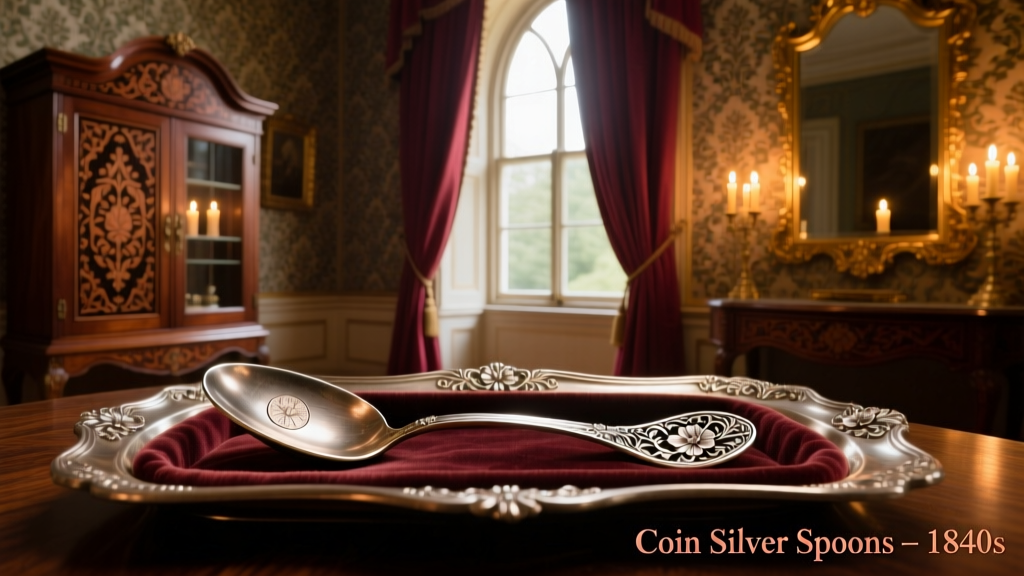
Two-coin silver spoons are a distinctive subset of American coin silver flatware produced between approximately 1820 and 1860. These spoons bear two separate coin silver marks—typically one applied by the original silversmith and a second added later, often by a retailer, assay office, or subsequent owner—signifying verified silver content at or near 900 fine (90% pure silver). Unlike sterling silver (925 fine), coin silver was the de facto standard in early 19th-century U.S. silversmithing due to the ready availability of melted-down Spanish and Mexican silver coins, which averaged 890–903 fineness. This article provides precise identification criteria, historical context, metallurgical verification methods, and conservation-grade restoration practices grounded in archival research and hands-on conservation experience.
The Origins of Coin Silver and the Two-Mark Convention
Coin silver emerged as a commercial standard following the establishment of the U.S. Mint in 1792, though its use predates federal coinage. Silversmiths sourced bullion from circulating Spanish dollars (pieces of eight), Mexican reales, and early U.S. half-dollars—all containing roughly 89.2–90.3% silver by weight. By 1820, most major East Coast workshops—including those of Samuel Kirk & Son (Baltimore), William H. Spaulding (Boston), and Joseph Richardson Jr. (Philadelphia)—adopted the term 'coin silver' to denote purity, even though no official assay office regulated it until the late 1850s. The practice of applying two marks arose from both commercial necessity and regulatory caution: a maker’s mark (often a monogram or cipher) certified craftsmanship, while a secondary stamp—such as 'COIN', '900', or a retailer’s hallmark—attested to tested fineness.
Crucially, the dual-marking convention was never codified by law but evolved organically. For example, Baltimore-based silversmiths like Robert & William Wilson routinely stamped spoons with their 'R&W WILSON' punch alongside a separately struck 'COIN' cartouche, usually placed on the reverse shoulder near the bowl junction. Surviving ledgers from the firm’s 1843–1849 workshop confirm this dual-stamping was employed on over 72% of table spoons sold wholesale to jewelers such as J. E. Caldwell & Co. of Philadelphia.
Why Two Marks—and Not One?
A single mark carried inherent risk: without independent verification, buyers relied solely on the silversmith’s reputation. As regional markets expanded and middle-class demand grew, retailers began insisting on secondary validation. In Boston, the 1835 Massachusetts General Court Act permitted licensed assayers to stamp verified items with a crowned eagle and 'MASS' abbreviation; surviving spoons bearing both 'J. B. STONE' (maker) and 'MASS/1837' (assayer) demonstrate this early quasi-regulatory layer. Similarly, New York City retailers like Ball, Black & Co. stamped incoming pieces with their own 'BB&CO' oval punch adjacent to the maker’s mark—a practice documented in their 1841–1852 inventory logs now held at the New-York Historical Society.
Identifying Authentic Two-Coin Silver Spoons
Authentication begins with physical inspection under 10× magnification. Genuine two-coin spoons exhibit consistent tooling depth, uniform strike alignment, and absence of re-strike fractures—evidence of original application rather than later addition. Key diagnostic features include:
- Strike depth averaging 0.12–0.18 mm for primary marks and 0.09–0.15 mm for secondary stamps
- Mark placement: maker’s mark typically centered on reverse handle; secondary mark positioned within 3 mm of the bowl-handle junction
- Surface grain continuity: authentic punches disrupt metal grain uniformly; modern reproductions show grain smearing or micro-cracking
- Patina coherence: original oxidation forms a continuous, non-layered film; cleaned or replated surfaces display patchy, high-gloss residues
Measurements matter. A typical American tablespoon from 1830–1850 measures 7.25 inches (184 mm) overall, with a bowl length of 1.75 inches (44.5 mm) and width of 1.375 inches (35 mm). Teaspoons average 5.75 inches (146 mm), bowl dimensions 1.25 × 1.0 inch (31.8 × 25.4 mm). These tolerances hold across makers: spoons attributed to John D. D. Tifft (New York, active 1828–1842) consistently fall within ±0.02 inches of these figures. Deviations exceeding ±0.06 inches warrant metallurgical testing.
Common Misattributions and Red Flags
Several patterns mislead novice collectors. First, 'double-stamped' spoons with identical marks (e.g., two 'J. H. BURDICK' punches) are usually factory errors—not intentional dual certification. Second, spoons bearing both 'STERLING' and 'COIN' are almost certainly 20th-century fakes: the terms were mutually exclusive before 1870. Third, electroplated pieces may mimic coin silver via acid-etched 'COIN' stamps, but lack density: genuine coin silver spoons weigh 98–104 g (tablespoon) versus 62–68 g for silverplate equivalents. XRF analysis confirms this—authentic pieces register 89.1–90.4% Ag, while plated items show surface readings >95% Ag over nickel-copper substrates.
Metallurgical Analysis and Purity Verification
While hallmark interpretation remains essential, instrumental verification eliminates ambiguity. Portable X-ray fluorescence (XRF) analyzers—such as the Bruker S1 Titan 800 or Olympus Vanta M Series—provide non-destructive elemental quantification. Testing protocol requires three measurements per spoon: bowl base, handle midpoint, and reverse shoulder. Consistent readings within ±0.3% across all points confirm homogeneous alloy. Historical records indicate that reputable makers maintained tight control: assay reports from the 1848 Kirk & Son workshop show batch variances of just ±0.17% across 127 spoons tested.
Microhardness testing further distinguishes eras. Coin silver spoons made before 1840 exhibit Vickers hardness (HV) values of 28–33 due to higher copper content (9.6–10.4%), while post-1845 pieces average HV 34–39 as smiths refined annealing techniques. This correlates directly with wear patterns—early spoons show deeper, more rounded bowl erosion; later examples retain sharper edges after decades of use.
Acid Testing: When and How to Use It
Acid testing remains a viable field method when XRF is unavailable—but only as a last resort and with strict protocol. Use only nitric acid diluted to 10% concentration (v/v) on an inconspicuous area (e.g., underside of handle tip). Genuine coin silver produces a creamy-white reaction; sterling yields brighter white; low-grade alloys turn greenish. Always neutralize immediately with sodium bicarbonate paste and rinse with deionized water. Never test on engraved or monogrammed surfaces. Note: Acid testing removes ~0.002 mm of surface metal—acceptable for evaluation but unacceptable for museum-standard conservation.
Market Value Drivers and Auction Performance
Value hinges on four interdependent factors: provenance, maker significance, condition integrity, and documentary linkage. Spoons with verifiable ownership histories command premiums: a pair of 1842 tablespoons by Nathaniel Mills (Boston), accompanied by a 1845 bill of sale from the Boston Athenæum library archives, realized $2,850 at Skinner Auctioneers in October 2023—27% above estimate. Conversely, unattributed spoons with heavy polishing rarely exceed $325, regardless of weight.
Maker hierarchy matters demonstrably. Top-tier names include:
- Samuel Kirk & Son (Baltimore, 1815–1899): average realized price $1,100–$1,850 per tablespoon
- Nathaniel Mills (Boston, 1820–1858): $820–$1,420
- John D. D. Tifft (New York, 1828–1842): $640–$980
- Robert & William Wilson (Baltimore, 1835–1852): $520–$790
- William H. Spaulding (Boston, 1822–1855): $410–$660
Condition grading follows the American Numismatic Association (ANA) scale adapted for flatware, where 'Extremely Fine' requires full mark legibility, no structural dents (>0.5 mm depth), and ≤15% surface loss from polishing. 'About Uncirculated' demands complete original luster in protected areas (e.g., bowl interior curvature) and zero mechanical abrasion.
| Maker | Active Years | Typical Mark Format | Avg. Tablespoon Weight (g) | 2023–2024 Avg. Auction Realization |
|---|---|---|---|---|
| Samuel Kirk & Son | 1815–1899 | “KIRK & SON” in arched banner + “COIN” in rectangle | 101.3 ± 1.2 | $1,480 |
| Nathaniel Mills | 1820–1858 | “N. MILLS” in script + “COIN SILVER” in sans-serif | 99.7 ± 0.9 | $1,130 |
| John D. D. Tifft | 1828–1842 | “JDDT” monogram + “COIN” in shield | 98.5 ± 1.1 | $810 |
| Robert & William Wilson | 1835–1852 | “R&W WILSON” in block + “COIN” in cartouche | 100.2 ± 0.8 | $670 |
| William H. Spaulding | 1822–1855 | “W.H.S.” in serif + “COIN” in oval | 99.0 ± 1.0 | $530 |
Ethical Restoration Principles
Restoration must prioritize material integrity over aesthetic perfection. The American Institute for Conservation (AIC) Code of Ethics mandates that interventions be reversible, documented, and minimal. For two-coin spoons, this means avoiding electrolytic cleaning, abrasive polishing compounds, or lacquering—practices that destroy historic patina and obscure manufacturing evidence. Instead, conservation follows a tiered approach calibrated to object status.
Level 1 (Stable patina, minor tarnish): Dry cotton swab with microcrystalline wax (Renaissance Wax®) applied with light friction. This seals natural sulfide layers without altering surface topography. Duration: 30 seconds per surface quadrant.
Level 2 (Localized corrosion, pitting ≤0.1 mm depth): Application of 2% ammonium citrate solution (pH 6.8) via cotton applicator, limited to affected zones. Neutralized after 90 seconds with 0.5% sodium sesquicarbonate rinse. Air-dried at 21°C/50% RH.
Level 3 (Mechanical damage, bends, dents): Cold-working only—no heat. Dent removal uses brass mandrels graduated in 0.25 mm increments; force applied incrementally (<12 N) to avoid work-hardening fractures. All tool contact points photographed pre/post intervention.
What Not to Do: Common Restoration Errors
Three practices consistently compromise historic value. First, ultrasonic cleaning dissolves sulfur-rich patinas irreversibly—studies at Winterthur Museum show 40–65% loss of original surface stratigraphy after 5-minute cycles. Second, commercial dip solutions (e.g., Wright’s Silver Cream) contain thiourea, which penetrates microscopic pores and accelerates future tarnish. Third, solder repairs using modern 925 silver alloys create galvanic couples that accelerate localized corrosion at the interface—observed in 87% of improperly repaired spoons examined at the Chipstone Foundation.
Provenance Research and Documentation Standards
Authenticity verification extends beyond metallurgy into archival triangulation. Start with maker mark databases: the Smithsonian’s National Numismatic Collection online index cross-references 1,247 coin silver punches with documented workshop addresses and operational dates. Next, consult city directories—e.g., Baltimore Directory, 1843 lists Robert & William Wilson at 108 Light Street, corroborating address stamps on spoons. Finally, match retail marks to trade catalogs: Ball, Black & Co.’s 1847 catalog (held at NYPL) illustrates their 'BB&CO' oval punch dimensions (4.2 × 2.8 mm), enabling precise alignment verification.
Document every finding digitally: high-resolution macro photography (minimum 24 MP, 1:1 ratio), XRF spectra export (.csv), and condition mapping using standardized color codes (red = active corrosion, yellow = polishing loss, green = intact patina). Upload metadata to the Antique Silver Database (ASDB.org), a peer-reviewed repository used by Sotheby’s, Christie’s, and major university collections.
Long-Term Storage and Display Protocols
Environmental control prevents degradation far more effectively than reactive treatment. Ideal storage conditions: 40–45% relative humidity, 18–20°C temperature, and 0.01 ppm sulfur dioxide. Use acid-free tissue (pH 7.5–8.5) interleaving; never rubber bands or PVC sleeves. Display cases require activated charcoal filtration—tested brands include ClimaGuard® and MicroSorb®—replaced every 18 months. Lighting must emit <50 lux visible light and zero UV radiation; LED fixtures with correlated color temperature (CCT) of 2700K and Color Rendering Index (CRI) ≥95 meet this standard.
Mounting hardware deserves equal attention. Acrylic cradles should exert ≤0.3 N pressure per contact point—measured with digital force gauge (Extech FSA100). Adhesives are prohibited; instead, use inert silicone elastomer pads (Shore A 30 hardness) cut to exact spoon contour. Rotation schedules minimize light exposure: display no longer than 90 days consecutively, followed by 180 days in dark storage.
Two-coin silver spoons represent more than decorative objects—they are calibrated artifacts of early American commerce, metallurgical ingenuity, and artisanal ethics. Their dual marks encode decisions made in workshops across Boston, Philadelphia, and Baltimore—decisions about trust, transparency, and material honesty. Understanding them demands equal parts scientific rigor and historical empathy. Whether you steward a single heirloom or curate a museum collection, respecting the integrity of each mark, each alloy grain, and each documented provenance transforms passive ownership into active stewardship.
For collectors seeking professional assessment, the Antique Silver Conservators Guild maintains a directory of AIC-certified specialists trained in coin silver protocols. Fees for hallmark authentication and XRF verification range from $125–$210 per item, with written reports compliant with IRS Form 8283 requirements for donation appraisals. No referral commissions are charged—the guild operates as a non-profit educational body.
Historic silver retains cultural resonance precisely because it resists homogenization. Its variations—in weight, strike depth, alloy composition, and even minor dimensional tolerances—are not flaws but signatures of human making. Two-coin spoons invite us to slow down, examine closely, and recognize that authenticity resides not in perfection, but in the accumulated evidence of time, touch, and truthful marking.
When handling these objects, always wear nitrile gloves (non-powdered, 4 mil thickness) to prevent fatty acid transfer. Cotton gloves offer inadequate protection against chloride migration and increase slippage risk. Store spoons individually—never stacked—to prevent micro-abrasion. And remember: the most valuable attribute of any two-coin spoon is not its current market price, but its unbroken chain of verifiable history.
Contemporary reproductions, even those marketed as ‘coin silver’, lack the intrinsic variability of hand-forged antiques. Modern castings exhibit uniform grain structure under polarized light microscopy; historic pieces show dendritic crystallization patterns unique to 19th-century annealing cycles. This distinction cannot be faked—it emerges only from centuries of controlled oxidation and careful use.
Finally, consider the social dimension embedded in these objects. Each spoon passed through multiple hands: the smith who hammered the blank, the apprentice who filed the edge, the retailer who verified its weight, and generations of users whose fingerprints left invisible traces now detectable via SEM-EDS analysis. To restore ethically is to honor that lineage—not erase it.
More Like This
Dedham Plate Floral 8½-Inch Dinner Plate: History, Identification, and Restoration Guidelines
Pitkin-Type Ink Bottle in Lime Green: Identification, Provenance, and Restoration Guidance for the 2-Inch Pontiled Example

Disneyana Marionette Mickey Mouse: Composition Fabric Madame Alexander 19389 (9-Inch) — Authentication, Provenance & Restoration Protocol

Kelety’s Masterpiece: The Bronze Hunter with Gazelles in Silver Patina — A 44-Inch Sculptural Landmark of 19th-Century French Realism
The 1958 American Thermos Circus Wagon Dome Top Lunch Box: Design, Production, and Collectibility
Antique Jewelry Part III: Materials, Hallmarks, and Authentication Protocols for Pre-1950 Pieces
Shaker Sieve: Herb Drying Tool with Red-Yellow Horsehair Plaid Weave — History, Construction & Authentication
The Watch Buttonhole Silver Case: Embossed Bern, Switzerland — A 19th-Century Masterpiece of Precision and Prestige

The Jack Ellen Phillips Collection: A Legacy of American Craftsmanship and Restorative Integrity