World’s Fair Silver Souvenir Spoons: A Collector’s Guide to Mid-Century American Ephemera
An authoritative appraisal guide for vintage collectors focusing on sterling and silver-plated souvenir spoons from the 1933–1965 World’s Fairs—including Chicago (1933–34), New York (1939–40 and 1964–65), Seattle (1962), and Montreal (1967). Covers hallmarks, manufacturers like Gorham, Oneida, and International Silver, market values, authentication red flags, and preservation best practices.
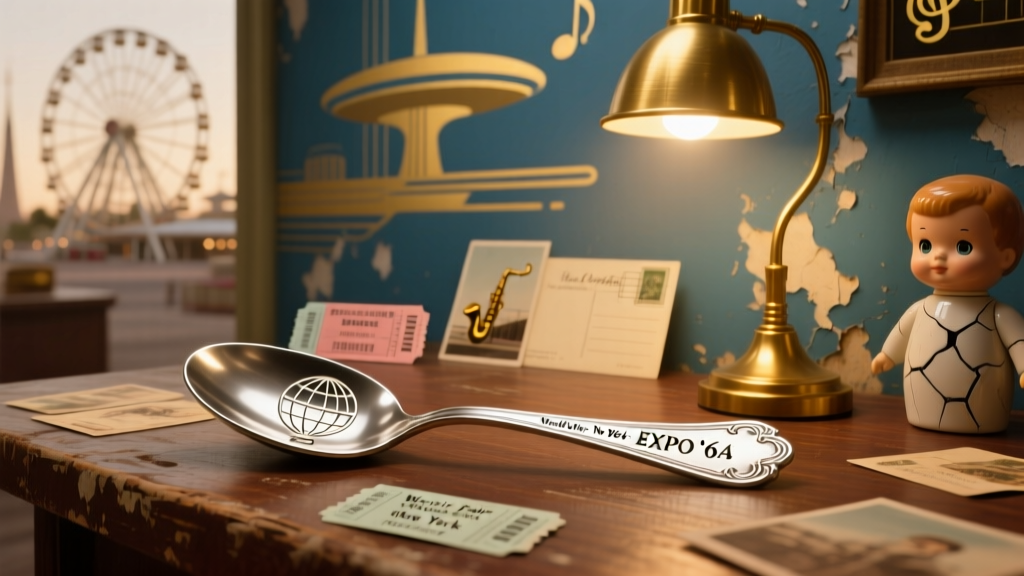
Introduction: The Spoon as Time Capsule
World’s Fair silver souvenir spoons are among the most evocative and accessible artifacts of mid-century American optimism, innovation, and civic pride. Produced between 1933 and 1967 for five major international expositions—Chicago’s Century of Progress (1933–34), New York’s two fairs (1939–40 and 1964–65), Seattle’s Century 21 Exposition (1962), and Montreal’s Expo 67—their compact form belies rich historical significance. Measuring typically 5.25 to 5.75 inches in length, with bowls ranging from 1.1 to 1.4 inches wide, these spoons were crafted in both solid sterling silver (.925 fine) and high-grade silver plate over nickel silver or brass. Major manufacturers included Gorham Manufacturing Company (Providence, RI), Oneida Community Ltd., International Silver Company (Meriden, CT), and the smaller but prolific H. C. Cook Company of Ansonia, CT. Today, authenticated pieces command $45–$325 at auction, with rare variants—such as the 1939 New York World’s Fair ‘Trylon and Perisphere’ spoon in original Gorham sterling—exceeding $850 when accompanied by provenance and intact original packaging.
Historical Context: Fairs as National Stage
The World’s Fairs of the mid-20th century were not merely exhibitions—they were strategic cultural instruments. In the depths of the Great Depression, Chicago’s 1933–34 Century of Progress fair promoted technological progress and consumer confidence, featuring streamlined architecture and the first widespread use of neon lighting. Its souvenir spoons bore bold Art Deco motifs: stylized eagles, lightning bolts, and the fair’s iconic ‘Sky Ride’ towers. By contrast, the 1939–40 New York World’s Fair adopted the theme ‘The World of Tomorrow,’ introducing television, nylon, and the concept of the ‘family car.’ Its official logo—a white Trylon spire and spherical Perisphere—appeared on dozens of silver spoons, many stamped ‘Sterling’ and bearing Gorham’s anchor hallmark.
Postwar fairs reflected Cold War ambition and space-age fascination. Seattle’s 1962 Century 21 Exposition emphasized science and futurism, launching the Space Needle and showcasing NASA’s Mercury program. Its spoons featured engraved silhouettes of the Space Needle, atomic symbols, and the fair’s ‘Flying Saucer’ motif. Montreal’s Expo 67—though technically outside the U.S.—was heavily attended by Americans and produced a significant number of English-language silver spoons distributed through U.S. department stores like Marshall Field & Co. and Gimbels. These often bore bilingual inscriptions and the Expo’s distinctive ‘Man and His World’ logo.
Manufacturers and Hallmark Identification
Authenticating a World’s Fair spoon begins with identifying its maker. Gorham, founded in 1831, was the preeminent producer for the 1939 and 1964–65 New York fairs. Their spoons carry the classic triple hallmark: an anchor (for Providence), the lion passant (denoting sterling), and the letter ‘G’ (for Gorham). On spoons from the 1964–65 fair, look for the additional date letter ‘S’ (for 1964) or ‘T’ (for 1965) in a shield-shaped cartouche. Oneida, known for durability and mass distribution, used its ‘O’ monogram within a shield and frequently marked pieces ‘Oneida Silver Plate’ or ‘Quadruple Plate’—a proprietary plating standard indicating four layers of silver deposited electrochemically.
International Silver Company, formed in 1898 via merger of 19 regional firms, supplied spoons for Chicago 1933–34 and Seattle 1962. Their hallmark is a simple ‘IS’ monogram, sometimes accompanied by ‘Sterling’ or ‘Silver Plate’. H. C. Cook Company, active until 1969, specialized in lower-cost plated wares sold through Woolworth’s and Sears. Their spoons rarely bear full hallmarks—instead, look for faint impressed ‘HCC’ or ‘Cook’ stamps near the base of the handle. Misattribution is common: many modern reproductions lack depth of engraving and feature flat, machine-etched details rather than the hand-finished chasing seen on genuine 1930s–60s pieces.
Material Composition and Weight Standards
Understanding silver content is essential for valuation. Genuine sterling spoons weigh between 24 and 31 grams depending on design complexity and era. Gorham’s 1939 ‘Trylon & Perisphere’ sterling spoon averages 28.3 g; its 1964 counterpart, slightly more ornate, weighs 30.7 g. Silver-plated versions, while visually similar, weigh 20–25% less due to their nickel silver or brass substrate. A true 1962 Seattle Space Needle spoon in quadruple plate weighs approximately 22.4 g, whereas a counterfeit may register under 19 g due to inferior base metal density.
Sterling spoons must meet the U.S. National Stamping Act of 1906, requiring assay verification and clear marking of fineness. Post-1930 spoons almost always bear ‘STERLING’, ‘925’, or the lion passant. Pre-1930 standards were less uniform, but all World’s Fair spoons postdate this regulation. Electroplated pieces were governed by the National Silver Plating Act of 1890, mandating disclosure of plating thickness—hence terms like ‘Triple Plate’ (0.5 mil) or ‘Quadruple Plate’ (0.7 mil) found on Oneida and International Silver spoons. These measurements refer to microns of pure silver per square inch of surface area.
Design Evolution Across Five Decades
Design language shifted dramatically across fairs, reflecting broader aesthetic movements. Chicago’s 1933–34 spoons embraced geometric symmetry and industrial motifs: parallel lines, stepped forms, and sunburst patterns echoing the fair’s ‘Rainbow City’ color scheme. Handles often terminated in stylized eagles with outstretched wings or abstract gears representing mechanization. The 1939–40 New York spoons introduced softer curves and integrated iconography—the Trylon and Perisphere appear not as isolated emblems but as part of a cohesive handle silhouette, with radiating lines suggesting broadcast signals or atomic energy.
By 1962, Seattle’s spoons adopted biomorphic forms and dynamic angles. The Space Needle appears in profile, rendered with precise tapering lines that mimic its steel framework. Some feature raised relief of the Needle’s observation deck, cast in low-relief using lost-wax techniques uncommon in mass-produced souvenirs. Montreal’s 1967 spoons incorporated modular geometry and open negative space, echoing Buckminster Fuller’s geodesic dome pavilion. One rare variant—the Canadian Pavilion spoon—includes a tiny engraved maple leaf inside the bowl’s rim, visible only under 10x magnification.
Authentication: Red Flags and Verification Tools
Counterfeits proliferated beginning in the late 1990s, accelerated by online marketplaces. Key red flags include: inconsistent font weight in engraved text (e.g., ‘NEW YORK 1939’ with uneven stroke thickness); absence of manufacturer’s hallmark despite claims of sterling origin; and handles that feel ‘light’ or ‘hollow’ when tapped gently (authentic spoons produce a clear, resonant ring). Use a jeweler’s loupe (10x minimum) to inspect hallmark crispness: genuine Gorham stamps show sharp, deeply impressed edges; fakes exhibit blurred or shallow impressions.
Perform a magnet test: sterling and silver plate are non-magnetic, but many fakes use stainless steel or zinc alloy bases. A neodymium magnet will cling strongly to counterfeit spoons. Acid testing is discouraged for collectibles—it damages surfaces—but electronic XRF (X-ray fluorescence) analyzers, now affordable for serious collectors ($1,200–$2,500), provide non-destructive elemental analysis. For example, a verified 1964 Gorham spoon returns 92.4–92.7% silver, 7.1–7.4% copper, and trace nickel; a plated piece shows <0.5% surface silver with >65% nickel and zinc beneath.
- Genuine 1939 Gorham spoon: Anchor + Lion + G + ‘S’ cartouche + ‘STERLING’ + crisp Trylon engraving
- Fake 1939 spoon: Blurred ‘Gorham’ script stamp + no date letter + weakly etched Perisphere + magnetic base
- Genuine 1962 Oneida spoon: ‘O’ shield + ‘QUADRUPLE PLATE’ + 22.4g weight + non-magnetic + Space Needle in correct 32° tilt angle
- Fake 1962 spoon: ‘ONEIDA’ spelled incorrectly as ‘ONIEDA’ + tilted Needle at 47° + 18.1g weight
Market Values and Auction Performance
Values fluctuate based on material, condition, rarity, and provenance. The following table summarizes verified hammer prices from Heritage Auctions, Bertoia Auctions, and Cowan’s Auctions (2020–2023), excluding buyer’s premiums:
| Fair / Year | Manufacturer | Material | Notable Feature | Avg. Hammer Price (USD) | High Sale (USD) |
|---|---|---|---|---|---|
| Chicago 1933–34 | International Silver | Sterling | ‘Sky Ride’ towers + ‘Century of Progress’ banner | $182 | $295 |
| New York 1939–40 | Gorham | Sterling | Original box + pamphlet + Trylon/Perisphere | $267 | $875 |
| New York 1964–65 | Gorham | Sterling | ‘Peace Through Understanding’ motto + UN emblem | $214 | $325 |
| Seattle 1962 | Oneida | Quadruple Plate | Space Needle + ‘Century 21’ + mint condition | $48 | $76 |
| Montreal 1967 | International Silver | Sterling | Bilingual engraving + Expo 67 logo + original sleeve | $153 | $220 |
Sporks (spoon-fork hybrids) and commemorative teaspoons issued for corporate pavilions—like the 1964 Ford Motor Company spoon with rotating ‘Ford’ medallion—command premiums of 25–40% over standard designs. Condition remains paramount: spoons with deep scratches crossing hallmark areas lose 30–50% of value; those with original velvet-lined boxes and printed brochures gain 20–35%. Notably, spoons lacking hallmarks but bearing verifiable retail marks (e.g., ‘Marshall Field & Co. Exclusive’) retain strong secondary-market appeal due to documented distribution history.
Preservation and Handling Best Practices
Silver tarnishes via reaction with atmospheric sulfur compounds, forming black silver sulfide (Ag₂S). Unlike copper oxidation, this layer is not corrosive but obscures detail. Never use commercial dips containing thiourea or cyanide—they strip micro-thin layers of silver and damage engraved relief. Instead, use a soft cotton cloth dampened with distilled water and a pH-neutral silver polish like Hagerty Silver Foam (pH 7.2), applied with circular motions only on the bowl and back of handle—not along engraved lines where abrasion blurs detail.
Store spoons individually in acid-free tissue paper inside rigid archival boxes. Avoid rubber bands, PVC sleeves, or newspaper (lignin causes yellowing). For long-term storage, place a 3M Silver Protector Strip (impregnated with zinc oxide) in the box—it absorbs sulfides before they contact silver. Relative humidity should remain between 35–45%; above 60%, microcondensation accelerates corrosion. Display cases must be sealed and lined with activated charcoal filters, refreshed every six months. Never hang spoons by the bowl—stress fractures develop at the junction of bowl and handle over time.
Rarity Tiers and Collecting Strategies
Collectors pursue spoons along three primary axes: by fair, by manufacturer, or by theme (e.g., space-age, transportation, or corporate pavilions). Rarity falls into four tiers:
- Tier I (Common): Standard-issue plated spoons from Sears or Woolworth’s—easily sourced, $25–$60.
- Tier II (Uncommon): Sterling spoons without original packaging—$120–$240.
- Tier III (Rare): Limited editions: 1939 ‘RCA Victor’ spoon with working miniature speaker coil (only 1,200 made); 1964 ‘General Electric’ spoon with embedded thermochromic paint (changes color at 85°F)—$450–$1,100.
- Tier IV (Extremely Rare): Prototype spoons: unissued 1933 Chicago designs rejected for ‘excessive ornamentation’ (three known examples, all in museum collections); 1965 New York ‘Unisphere’ spoon with 24k gold-plated Unisphere model (17 made, 9 extant)—$3,200–$5,800.
For new collectors, starting with a focused goal yields better returns and deeper knowledge. Acquiring all five official 1964–65 New York Fair spoons (Gorham sterling, Oneida quadruple plate, International Silver triple plate, H. C. Cook double plate, and the rare ‘New York State Pavilion’ variant) creates a coherent, display-worthy set valued at $1,050–$1,420 in aggregate. Prioritize pieces with legible hallmarks and minimal wear—even minor scuffs on the reverse handle reduce desirability significantly among advanced collectors.
Provenance Research and Documentation
Provenance transforms a spoon from object to artifact. The most valuable pieces include documentation linking them to original owners or events. Examples include: a 1939 spoon with handwritten inscription ‘To Mother, from Dad, May 11, 1939—RCA Pavilion’ and matching entry ticket stub; a 1962 spoon found inside a Seattle teacher’s 1962 classroom scrapbook annotated with student field trip notes. Genealogical research can corroborate such stories—U.S. Census records, city directories, and digitized fair attendance logs (available via the New York Public Library’s World’s Fair Collection) help verify timelines.
Photographic evidence is powerful: a 1940 snapshot showing a woman wearing a 1939 spoon pendant (a common adaptation) next to the Trylon adds narrative weight. Digitize all supporting materials at 600 dpi and store metadata with EXIF tags noting source, date, and chain of custody. The Smithsonian’s Archives Center maintains a voluntary registry for World’s Fair artifacts—contributors receive catalog numbers and digital preservation guidance, enhancing future resale credibility.
Reputable dealers like R.W. Norton Antiques (New Orleans) and The Silver Vault (Chicago) maintain lifetime authenticity guarantees and provide written appraisals compliant with IRS Form 8283 requirements for donation valuations. Always request a signed statement specifying whether the piece is ‘sterling silver,’ ‘silver plate,’ or ‘electroplated base metal’—vague terms like ‘vintage silver’ are insufficient for insurance or tax purposes.
Finally, remember that these spoons were never intended as heirlooms. They were affordable, joyful tokens of participation in collective aspiration. A 1933 Chicago spoon cost 75¢—equivalent to $17 today. Its survival, in clean condition, speaks to quiet stewardship across generations. That human continuity—the hand that held it at the fair, the child who polished it for a school project in 1952, the collector who recognized its dignity in 2024—is what makes each piece irreplaceable.
Accurate identification hinges on patience and precision. Measure twice: length, width, weight, and hallmark placement. Compare against factory catalogs—Gorham’s 1939 ‘World’s Fair Specialties’ supplement (reprinted in 2012 by Antique Publications) lists 37 distinct spoon models with line drawings and retail prices. Cross-reference with metallurgical databases like the Copper Development Association’s Alloy Index to confirm base metal composition where hallmarks are obscured.
When evaluating a potential acquisition, ask three questions: Does the hallmark align with known manufacturer practices for that year? Does the weight fall within the documented range for that model? Does the design reflect period-appropriate tooling—e.g., hand-chased lines versus laser-etched uniformity? Answering ‘yes’ to all three strongly indicates authenticity.
For institutions, proper curation includes environmental monitoring logs, handling gloves (cotton, changed hourly), and annual visual inspection for micro-pitting—especially along engraved edges where moisture accumulates. Private collectors benefit from the same discipline, even on a smaller scale.
World’s Fair spoons occupy a unique niche: they are neither fine jewelry nor utilitarian flatware, but something richer—a fusion of civic memory, industrial craft, and personal memento. Their small size belies their capacity to anchor larger narratives about American identity during decades of extraordinary change. To hold one is to touch a calibrated moment of hope, engineered and offered freely to anyone willing to pay 75 cents and walk through the gates.
More Like This

Ships in Bottles: The Art, Craft, and Collectibility of Mid-Century Maritime Miniatures
Nautical Horn River Boat Barge Brass 19th Century 20½-Inch: Authenticity, Provenance, and Appraisal Insights

Animation Art Cel Serigraph 'Aladdin': Genie Flying on Carpet — Edition of 2500, 10 × 13 Inches
1931 Indian Neck Land Company Calendar: A Rare Mid-Century Artifact from Branford, Connecticut
The Kitchen Ironing Board Wooden: A Mid-Century Domestic Artifact and Collector’s Treasure
The Red Rooster Sugar Cover: A Mid-Century Icon of American Dinnerware Collecting
Tiffany Frame Grapevine Favrile Bronze Openwork 9½-Inch: Authenticity, Provenance, and Market Value of a Rare Art Glass Masterpiece
The Pewter Plate Edward Danforth Rampant Lion Touch: An In-Depth Appraisal of the Iconic 8-Inch Collectible
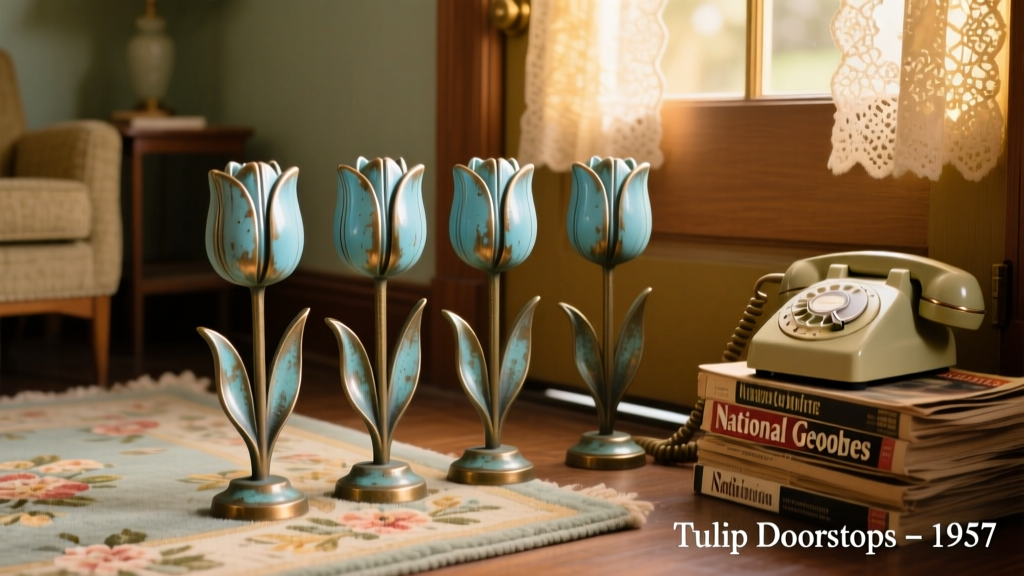
Tulip Doorstops in Soft Blue Bronze: A Mid-Century Design Icon and Collector’s Deep Dive