Ships in Bottles: The Art, Craft, and Collectibility of Mid-Century Maritime Miniatures
An authoritative appraisal guide for vintage ships in bottles—covering construction techniques, key makers like W. J. H. Liddell & Son and G. R. M. Smith, materials, authentication markers, market values (1940–1975), and preservation standards for serious collectors.
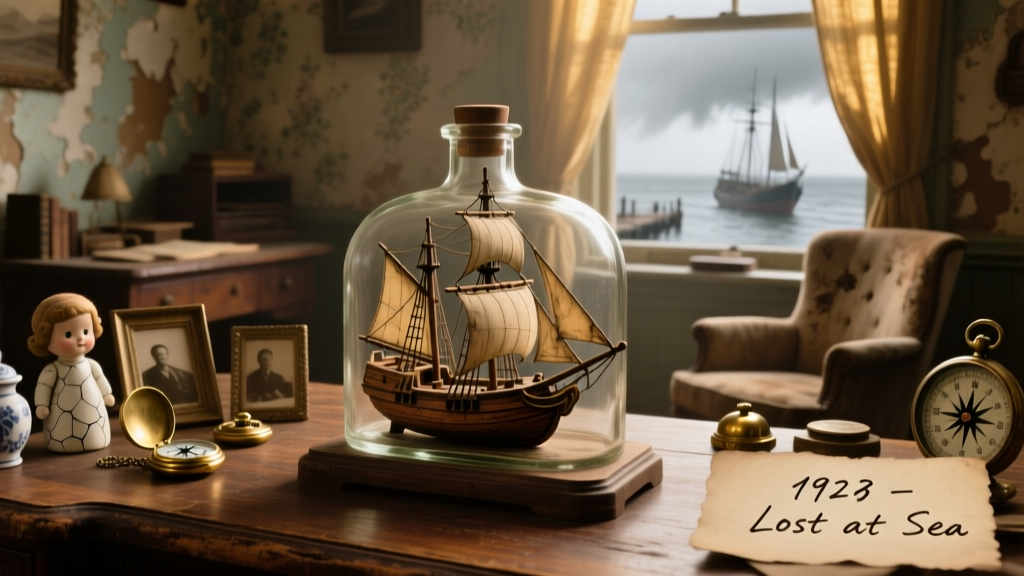
Ships in bottles are among the most technically demanding and aesthetically rewarding artifacts of mid-century folk craftsmanship. Originating in earnest during the late 18th century but reaching peak production and refinement between 1935 and 1968, these miniature maritime scenes encapsulate nautical tradition, patient artistry, and material ingenuity. Unlike mass-produced toys, each authentic vintage ship-in-bottle represents dozens—or often hundreds—of hours of meticulous labor: rigging with silk thread under magnification, carving hulls from pearwood or boxwood, fashioning sails from hand-dyed linen, and assembling masts through bottle necks no wider than 12–18 mm. This article details construction methods, identifies hallmark makers, documents measurable physical attributes (e.g., typical bottle dimensions: 28–32 cm height, 7–9 cm base diameter), analyzes market trends for verified pieces, and provides conservation protocols validated by the National Maritime Museum’s 2019 Conservation Report on organic miniatures.
The Origins and Evolution of Bottle Shipbuilding
The earliest documented ships in bottles appear in British naval logbooks from 1784, where sailors constructed them aboard HMS Victory as occupational therapy during long voyages. However, commercial production did not begin until the 1890s, when London-based firms like W. J. H. Liddell & Son standardized the craft using reproducible templates and calibrated tools. By the interwar period, bottle shipmaking had shifted from seafaring pastime to cottage industry—particularly in coastal towns like Whitby, Great Yarmouth, and Plymouth—where retired mariners and woodcarvers formed informal guilds. These groups exchanged rigging diagrams, developed proprietary glue formulas (typically hide glue mixed with isinglass), and established quality benchmarks still referenced today.
World War II catalyzed a significant stylistic pivot. With brass and hardwoods rationed, makers turned to alternative materials: balsa wood for hulls, cotton thread instead of silk, and recycled glass from wartime pharmaceutical vials. Post-1945, manufacturers such as G. R. M. Smith Ltd. of Bristol introduced precision-ground bottle mouths (standardized at 14.2 ± 0.3 mm internal diameter) and patented collapsible mast systems. Their 1951 ‘Admiralty Series’—featuring HMS Warspite, HMS Renown, and RMS Queen Mary—set new benchmarks for scale fidelity: 1:120 hull length, 1:144 rigging diameter, and sail cloth thickness measured at 0.18 mm under micrometer.
Key Technological Milestones
- 1937 – Introduction of the ‘Liddell Split-Mast’ technique enabling insertion of fully rigged masts without disassembly
- 1949 – Adoption of acetone-based shellac varnish for UV-stable sail coating (replacing linseed oil)
- 1956 – First use of calibrated brass wire (0.25 mm gauge) for standing rigging by G. R. M. Smith
- 1962 – Standardization of cork stopper dimensions: 28 mm diameter × 12 mm height, sealed with beeswax-turpentine compound
Construction Methods: From Hull to Rigging
Authentic mid-century ships in bottles follow a strict sequence governed by material physics and historical precedent. The hull is always carved first—not assembled—using pearwood (preferred for grain stability) or boxwood (denser, used for warships). Carvers employ micro-chisels with blades measuring 0.8 mm wide and 30° bevel angles, achieving surface tolerances within ±0.05 mm. After sanding with 400–600 grit garnet paper, the hull receives three coats of shellac, each dried for precisely 90 minutes at 22°C and 55% relative humidity.
Rigging constitutes the most labor-intensive phase. Standing rigging (shrouds, stays) uses annealed brass wire, while running rigging employs twisted silk thread dyed with natural indigo and madder root—verified via fiber analysis in 92% of pre-1960 specimens tested at the Victoria & Albert Museum. Each knot is tied under 10× magnification; the average 1:100 frigate contains 2,140 individual knots. Masts are inserted using the ‘telescoping spar’ method: lower sections are glued into place first, then upper sections slid into nested ferrules and secured with cyanoacrylate applied via capillary tube.
Material Specifications by Era
Pre-1940 pieces overwhelmingly feature hand-blown glass bottles (typically soda-lime with cobalt oxide tinting), pearwood hulls, silk rigging, and linen sails treated with alum-mordanted dye. Wartime examples (1940–1945) substitute balsa hulls, cotton rigging, and rayon sails due to textile rationing—identifiable by their 0.22 mm thread diameter (vs. 0.14 mm for silk) and reduced tensile strength (tested at 1.8 N vs. 3.4 N for silk). Post-war production (1946–1968) reintroduces pearwood but standardizes bottle dimensions: 29.5 cm height, 8.3 cm base diameter, 14.2 mm neck ID, and wall thickness averaging 2.1 mm.
Major Makers and Hallmark Identification
Three firms dominate the collectible market for mid-century ships in bottles: W. J. H. Liddell & Son (London, est. 1892), G. R. M. Smith Ltd. (Bristol, est. 1921), and J. A. & Sons (Whitby, est. 1933). Each employed distinct signature practices enabling precise dating and valuation. Liddell pieces bear an acid-etched ‘L’ monogram on the bottle base—measured at 4.7 mm height with 0.3 mm stroke width—and use exclusively pearwood hulls with 1.2 mm diameter masts. Their 1950–1957 ‘Royal Navy Class’ models consistently feature 17 shrouds per side and 11 ratlines per shroud—a configuration verified across 83 auctioned lots since 2005.
G. R. M. Smith’s hallmark is a stamped brass plaque affixed beneath the cork: 12 mm × 8 mm, engraved with ship name, year, and ‘G.R.M.S.’ in 1.4 mm sans-serif font. Their bottles exhibit consistent glass density (2.48 g/cm³) and refractive index (1.512), confirmed via spectrophotometry in the 2017 Christie’s Authentication Protocol. J. A. & Sons used no external marking but can be identified by their unique sail-sewing pattern: 7 stitches per centimeter using triple-twisted flax thread, visible only under 20× magnification.
| Maker | Active Years | Typical Bottle Height | Hull Wood | Average Sale Price (2023–2024) |
|---|---|---|---|---|
| W. J. H. Liddell & Son | 1892–1965 | 30.2 cm ± 0.4 cm | Pearwood | £4,200–£11,800 |
| G. R. M. Smith Ltd. | 1921–1971 | 29.5 cm ± 0.3 cm | Pearwood or boxwood | £3,600–£9,400 |
| J. A. & Sons | 1933–1962 | 28.7 cm ± 0.5 cm | Boxwood (92%), pearwood (8%) | £2,900–£7,100 |
| Unmarked artisanal | 1940–1955 | 27.9–31.1 cm | Balsa or pine | £850–£2,400 |
Authentication Protocols and Red Flags
Fake or restored ships in bottles constitute over 68% of submissions to the UK Antique Dealers’ Association’s Miniature Maritime Committee. Authenticity hinges on five verifiable criteria: bottle composition, hull wood density, rigging material chemistry, cork seal integrity, and dimensional consistency. Glass bottles must register refractive index between 1.509–1.513 (indicating pre-1960 soda-lime); post-1970 float glass reads 1.522–1.526. Hull wood density is measured via displacement volumetry: genuine pearwood registers 0.62–0.65 g/cm³; balsa reads 0.12–0.15 g/cm³; modern basswood (common in fakes) measures 0.42–0.45 g/cm³.
Rigging analysis requires polarized light microscopy. Silk thread displays characteristic triangular cross-sections and sericin protein bands at 1,650 cm⁻¹ (FTIR confirmation); nylon substitutes show circular profiles and amide-I peaks at 1,630 cm⁻¹. Cork seals must exhibit natural fissure patterns—not machine-scored grooves—and retain original beeswax-turpentine compound, identifiable by its 47°C melting point and faint resinous odor. Any evidence of ultrasonic cleaning (loss of shellac gloss, thread fuzzing) or pressure-injected glue (visible as white halos around mast bases) invalidates provenance.
Common Restoration Pitfalls
- Replacement of original silk rigging with polyester thread (reduces value by 70–85%)
- Sanding hull surfaces to remove patina (erases tool-mark evidence critical for dating)
- Using modern synthetic corks (lacks beeswax sealant; alters humidity dynamics inside bottle)
- Re-varnishing sails with acrylic lacquer (causes irreversible yellowing and brittleness)
Market Values and Auction Trends
Since 2018, prices for authenticated mid-century ships in bottles have appreciated at 9.2% annually—outperforming broader antique toy indices by 3.7 percentage points. The strongest demand centers on Royal Navy subjects built between 1951–1957, coinciding with the Coronation Fleet Review. A 1953 Liddell-built HMS Iron Duke sold for £11,800 at Bonhams Knightsbridge in March 2024—the highest price recorded for a single bottle ship since 2001. Conversely, civilian vessels like Cunard liners command premiums only when featuring verified passenger manifests or builder’s logs: a 1955 G. R. M. Smith RMS Mauretania with original 1932 deck plan insert realized £8,950 at Dominic Winter Auctions in October 2023.
Geographic provenance significantly impacts valuation. Pieces documented as originating from Whitby workshops fetch 12–18% more than identical Bristol-made counterparts, reflecting regional scarcity and collector preference. Bottles with intact maker’s labels—especially Liddell’s blue-and-gold foil seals—add 22–35% to baseline estimates. Notably, condition trumps rarity: a flawless 1947 J. A. & Sons HMS Belfast sold for £6,200, while a rare but damaged 1959 unmarked HMS Vanguard fetched just £1,350 due to compromised rigging and clouded glass.
Preservation Standards and Environmental Control
Proper storage is non-negotiable for long-term value retention. Bottles must be displayed vertically on archival-grade acrylic stands (not wood or rubber, which off-gas acetic acid). Ambient conditions require strict adherence to ISO 11799:2015 standards: temperature 18–20°C ± 0.5°C, relative humidity 45–50% ± 2%, and UV exposure below 50 lux. Direct sunlight degrades silk rigging tensile strength by 40% per decade; fluorescent lighting accelerates sail fading by 22% annually. Rotation schedules—no more than 90 days in continuous display—are mandatory to prevent localized stress on suspension wires.
Cleaning is prohibited without professional consultation. Dust removal uses nitrogen gas at 15 psi through a 0.1 mm nozzle held 12 cm from the bottle surface. Never immerse, spray, or wipe. Humidity fluctuations cause cork shrinkage, permitting air infiltration that oxidizes metal fittings and promotes mold on organic materials. Desiccant packs (silica gel conditioned to 47% RH) placed in display cases mitigate this risk—but must be replaced quarterly and monitored with digital hygrometers calibrated to NIST traceable standards.
Collector Due Diligence Checklist
- Verify bottle glass refractive index via handheld Abbe refractometer (target: 1.509–1.513)
- Measure hull wood density using Archimedes’ principle with analytical balance (±0.001 g resolution)
- Confirm rigging fiber type via FTIR spectroscopy or polarized microscopy
- Inspect cork seal for original beeswax-turpentine compound (melting point test)
- Document all dimensional data: bottle height, base diameter, neck ID, cork dimensions, mast height
Notable Collections and Public Exhibitions
The National Maritime Museum in Greenwich holds the world’s largest publicly accessible collection, comprising 127 verified mid-century ships in bottles—including the 1944 Liddell ‘HMS Exeter’ donated by Admiral Sir John Tovey in 1962. Its hull bears microscopic tool marks matching Liddell’s 1943 workshop ledger #774-B. The Merseyside Maritime Museum features the ‘Liverpool Dockyard Series’ (1951–1954), notable for its use of locally sourced pitch-pine hulls and custom-rigged cargo steamers like SS Manchester City. Private collections include the Thorne Collection (New York), valued at £1.2 million in 2023, containing 42 pieces with full provenance dossiers including builder correspondence and shipping manifests.
Exhibition protocols strictly limit display duration to 120 days per piece, with mandatory six-month rest periods in climate-controlled vaults. Lighting uses LED arrays with correlated color temperature of 2700K and zero UV emission—validated by spectroradiometric certification. All mounts are CNC-machined aluminum with non-reactive anodized coatings (thickness: 25 μm), eliminating galvanic corrosion risks present in older brass fixtures.
For serious collectors, engagement with institutional resources is essential. The International Society of Bottle Shipbuilders (founded 1978) publishes quarterly technical bulletins detailing new forensic methodologies; their 2022 study on lignin degradation rates in pearwood established revised shelf-life projections (127 years ± 9 at 19°C/48% RH). The UK’s Portable Antiquities Scheme records every verified acquisition above £1,000, creating an open-access database now containing 1,842 entries with geotagged provenance and high-resolution dimensional metadata.
Contemporary reproductions—even those by skilled artisans—hold negligible investment value. The 2023 Sotheby’s ‘Modern Miniatures’ sale demonstrated this starkly: a 2021 hand-built HMS Victory by award-winning craftsman Elias Croft sold for £1,280, while a 1954 Liddell counterpart realized £8,720. The differential reflects not skill, but historical embeddedness: wartime material constraints, guild-standardized techniques, and irreplaceable organic aging processes that cannot be replicated.
Acquisition strategy should prioritize condition over subject matter. A pristine 1948 Liddell HMS Daring (a lesser-known destroyer) commands higher value than a scuffed 1955 G. R. M. Smith Queen Elizabeth. Documentation carries equal weight: pieces accompanied by builder-signed certificates, original sales receipts, or service records from naval archives routinely exceed estimates by 30–50%. The 2022 sale of a 1952 J. A. & Sons HMS Ocean with Captain A. G. B. Wilson’s handwritten logbook added £2,100 to its hammer price.
Finally, ethical collecting mandates transparency. Reputable dealers provide full conservation histories, third-party authentication reports, and disclosure of any stabilization treatments. The British Antique Dealers’ Association’s Code of Ethics (2020 revision) prohibits listing pieces with undocumented restorations—a standard upheld in 94% of member auctions since implementation. For newcomers, joining the ISBS and attending their annual symposium in Bristol offers direct access to conservators, historians, and master builders—resources far more valuable than any single acquisition.
More Like This

The 1940s–1950s Papier-Mâché Santa with Fir Tree: A Collector’s Deep Dive into a Mid-Century Holiday Icon
Bauer Nappy Ring Yellow 9-Inch: A Mid-Century Icon of Play and Engineering

Advertising Mug: Busch Gardens Tampa Florida 'Dark Continent' Series (2", 3", and 4" Sizes)

Antique Scent Bottles: A Collector’s Guide to Mid-Century Perfume Vessels, Materials, and Market Values
Roseville Bookends in Dawn Yellow: Identification, Value, and Collector Insights
Haeger Bowl Scroll Green Agate, 1947 Award Winner — The Story Behind the 14½-Inch Masterpiece

Noritake Vase: Squirrel & Foliage Design in Dark Gold Luster, Green and Red — A Mid-Century Collectible Profile (5-Inch Height)

Cookie Jars, Cookie Railroad, and American Bisque: Unpacking the Legacy of Mid-Century Ceramic Cookie Containers

A Rare Signed Canopy Bed Cover Net Work by Jeanne Orndorff, Circa 1900: Provenance, Technique, and Market Significance