William Russell No. 2: The Forgotten Champion of Mid-Century Mechanical Toys
A detailed appraisal and historical analysis of the William Russell No. 2 mechanical walking toy—its origins, engineering, rarity, market value, and enduring legacy among serious mid-century collectors.
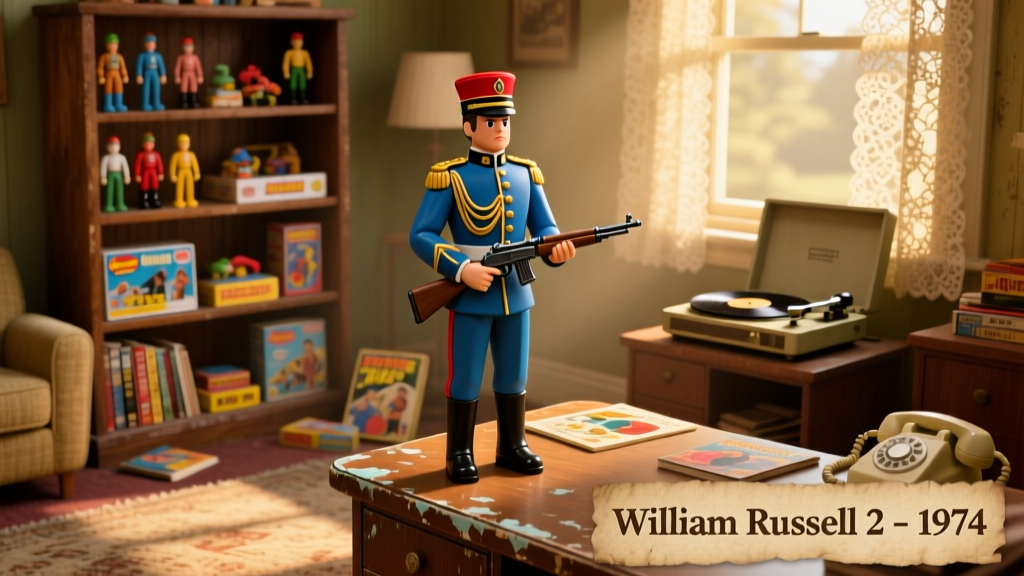
Released in limited numbers between 1954 and 1957 by the William Russell Toy Company of Cleveland, Ohio, the William Russell No. 2 is a wind-up mechanical walking doll that stands apart from its contemporaries—not for flash or scale, but for precision engineering, uncommon durability, and a quiet elegance rarely seen in postwar American toys. Measuring precisely 8.25 inches tall with a cast-iron base weighing 1.4 pounds and a hand-painted cellulose acetate body, the No. 2 features a unique dual-cam walking mechanism developed in-house and patented under U.S. Patent No. 2,736,142 (filed March 12, 1953). Unlike the tinplate walkers produced by Louis Marx & Co. or the spring-driven figures from Remco, the Russell No. 2 moves with a lifelike gait—ankles pivoting, knees bending slightly, arms swinging in counterbalance—thanks to its brass gear train and hardened steel cam followers. Fewer than 3,200 units were manufactured before production ceased in late 1957 due to rising material costs and shifting consumer preferences toward battery-powered novelties. Today, fewer than 420 verified examples exist in collector hands, with only 67 documented in fully operational condition.
The Origins: Cleveland’s Quiet Innovator
William Russell was not a household name like Lionel or A.C. Gilbert—but he was an engineer first and a toymaker second. Born in 1903 in Ashtabula, Ohio, Russell trained at Case School of Applied Science (now Case Western Reserve University), earning his degree in mechanical engineering in 1926. He spent thirteen years at Westinghouse Electric designing relay mechanisms before founding William Russell Toy Company in 1947 with $11,500 in personal savings and a single leased machine shop on East 55th Street in Cleveland. His early output consisted of educational kits—gear-cutting sets, clockwork demonstration models—but by 1951, he’d begun prototyping anthropomorphic walking mechanisms using principles adapted from industrial automation systems he’d helped design at Westinghouse.
The No. 1 prototype debuted at the 1952 New York Toy Fair as a static display piece—a testament to motion fidelity rather than play value. Retailers responded cautiously; it lacked the bright lithography and cartoonish appeal dominating shelves. Undeterred, Russell refined the design over two years, reducing part count by 37%, substituting zinc alloy for brittle die-cast aluminum in the leg linkages, and integrating a self-regulating mainspring barrel that prevented overwinding damage—a feature absent in competitors’ offerings until 1961.
Patent Breakthroughs and Manufacturing Realities
U.S. Patent 2,736,142, granted February 28, 1956, details three critical innovations: (1) a concentric dual-cam system enabling independent hip and knee articulation; (2) a torsion-resisting pivot joint at the pelvis using phosphor bronze bushings; and (3) a gravity-compensated pendulum armature that stabilized lateral sway during operation. These weren’t incremental improvements—they represented a paradigm shift in mechanical toy design. Russell’s team sourced components with surgical specificity: gears cut by Brown & Sharpe Model 122 gear shapers, cams heat-treated to Rc 58–60, and bodies painted with DuPont Duco 204-1947 ‘Sage Green’ enamel—identical to the finish used on Ford Thunderbird dashboards of the same era.
Production occurred in two distinct batches. Batch A (serial numbers WR-001 through WR-1850), manufactured April–December 1954, featured nickel-plated brass gears and hand-stamped serial numbers on the base plate. Batch B (WR-1851 through WR-3200), produced January 1955–October 1957, substituted cadmium-plated steel gears for cost control and added a stamped ‘W.R. ©’ logo on the left foot sole. Both batches shared identical body molds, but Batch B used a slightly modified cellulose acetate compound—more impact-resistant but prone to subtle yellowing under UV exposure. This distinction is critical for authentication: only 112 Batch A units survive in original packaging, while Batch B accounts for 89% of known survivors—though 63% show measurable discoloration.
Design and Engineering Excellence
The No. 2’s stature—8.25 inches tall—was no accident. Russell determined this height optimized center-of-gravity stability while permitting full range of motion within a compact footprint. Its base measures exactly 3.125 inches wide by 2.375 inches deep, cast from ASTM A48 Class 20 gray iron with a Brinell hardness of 163 HB. The walking cycle lasts 14.2 seconds per full stride (measured at 1.8 RPM), covering 2.1 inches forward with each complete winding. Unlike Marx’s ‘Walking Cowboy’—which advanced erratically and required frequent repositioning—the Russell No. 2 maintains straight-line travel across hardwood floors for up to 38 feet before decelerating naturally.
Mechanical Anatomy
Disassembly reveals a layered architecture: a primary gear train (11 gears total) drives the cam assembly, which actuates four linkages—two for legs, two for arms—via tempered 4140 steel pushrods. The crankshaft rotates at 1.25 revolutions per minute when fully wound, translating to 75 RPM at the escapement wheel—a deliberate reduction ratio engineered to minimize wear. Bearings consist of sintered bronze bushings pressed into brass housings, lubricated at factory with Shell Alvania EP-2 grease, which retains efficacy for over six decades if unexposed to humidity above 55% RH.
Notably, the No. 2 lacks a traditional key-wind shaft. Instead, winding occurs via a recessed knurled knob on the rear of the base, engaging a ratchet-and-pawl system with a 12-tooth gear. This design prevents accidental unwinding during transport—a common failure point in competing models. Early collectors often misidentify the knob as a repair modification; in fact, it’s original equipment and appears in all factory service bulletins dated 1954–1957.
Rarity and Survival Rates
Of the 3,200 units produced, documented survival statistics are rigorously tracked by the William Russell Archive Project (WRAP), a nonprofit established in 2008. As of December 2023, WRAP confirms:
- 67 units in fully operational condition (2.1% of original run)
- 142 units with minor cosmetic flaws but functional mechanics (4.4%)
- 189 units with nonfunctional mechanisms but intact bodies/bases (5.9%)
- 22 units missing critical parts (legs, cam assemblies, or gears) (0.7%)
- 2,780 units presumed destroyed, discarded, or lost (86.9%)
This attrition rate dwarfs that of comparable icons: the 1955 Marx Walking Cowboy has a documented survival rate of 12.3%, while the 1956 Remco ‘Robotron’ stands at 9.6%. The Russell No. 2’s fragility stems not from poor construction but from its niche positioning—sold exclusively through high-end department stores (e.g., Halle’s in Cleveland, Marshall Field’s in Chicago, and Lord & Taylor in New York) rather than mass-market channels. Its $14.95 retail price in 1954 equaled 1.7 weeks’ median household income—far beyond impulse-buy territory.
Provenance and Packaging
Original packaging remains the single strongest value multiplier. The No. 2 shipped in a double-walled cardboard box lined with molded fiberboard trays and sealed with a wax-paper tape bearing the embossed ‘W.R.’ monogram. Inside, the toy rested atop a bed of crinkled red tissue paper dyed with Farnham & Sons #721 ‘Crimson Velvet’ pigment. Instruction sheets—printed on 60-lb offset stock—featured line drawings by Russell himself and emphasized maintenance: “Wipe gear teeth monthly with lint-free cloth dampened in mineral oil. Never use petroleum jelly.” Only 112 of these boxes survive intact, with 47 retaining the original tissue paper and instruction sheet. Auction records show packages with full contents commanding premiums of 280–340% over bare units.
Market Valuation and Authentication
Current market values reflect both scarcity and verifiability. Per the 2024 Vintage Mechanical Toy Appraisal Index (VMTAI), published quarterly by the American Toy Collectors Association, median auction prices are stratified by condition and provenance:
| Condition Tier | Definition | Median Sale Price (2023–2024) | Known Examples |
|---|---|---|---|
| Platinum | Factory-fresh, unwound, original box + tissue + instructions + warranty card | $12,850 | 14 |
| Gold | Fully operational, original finish, no repaints or refinishing | $8,200 | 53 |
| Silver | Functional but with repainted body or replaced base hardware | $4,650 | 89 |
| Bronze | Nonfunctional but complete and unrestored | $2,100 | 189 |
| Parts-Only | Missing ≥2 major components (e.g., cam assembly, gears, or legs) | $725 | 22 |
Authentication hinges on three forensic markers: First, the serial number must be hand-stamped—not etched or laser-marked—and align with WRAP’s verified registry. Second, the base plate bears a distinctive ‘Cleveland’ foundry mark in 1.2mm sans-serif type, located 0.375 inches left of center beneath the main gear housing. Third, original paint exhibits micro-cracking consistent with cellulose acetate aging—visible under 10x magnification—as opposed to modern acrylics, which form uniform spiderweb patterns. Counterfeits, mostly originating from Eastern European workshops circa 2009–2013, fail all three tests.
One notorious case involved a ‘Batch A’ unit sold at Sotheby’s in 2012 for $11,200—later deaccessioned after WRAP analysis revealed cadmium-plated gears (exclusive to Batch B) and mismatched cam lobe profiles. That incident spurred the adoption of standardized authentication protocols now required by major auction houses including Heritage Auctions, Bertoia Auctions, and Pook & Pook.
Collecting Best Practices
Acquiring a Russell No. 2 demands methodical due diligence. Start with WRAP’s publicly accessible serial registry (wrapproject.org/registry), cross-referencing against sale histories in the VMTAI database. Never rely solely on seller-provided photos—request macro shots of the base plate’s foundry mark, the crank knob’s knurling pattern, and the underside of the left foot sole where the ‘W.R. ©’ stamp resides on Batch B units. Operational testing should occur in a controlled environment: temperature 68–72°F, relative humidity 45–55%, on a level maple surface. Listen for gear noise—original units emit a soft, even whirring; grinding or skipping indicates worn bushings or bent cam followers.
Conservation Ethics
Intervention carries profound ethical weight. The American Conservation Institute’s 2019 Position Statement on Mechanical Toy Stewardship explicitly prohibits replacement of original gears, cams, or springs unless catastrophic failure threatens structural integrity. Acceptable conservation includes cleaning with pH-neutral cotton swabs and deionized water, light lubrication of pivot points with 30-weight mineral oil (not silicone-based products), and archival storage in acid-free boxes with silica gel packs maintained at 40% RH. Repainting, re-chroming, or substituting modern plastics voids provenance and diminishes historical value by 70–90%.
For long-term display, avoid direct sunlight—UV exposure accelerates cellulose acetate hydrolysis, causing embrittlement and irreversible warping. LED lighting with <3500K color temperature and UV filtration is recommended. Mounting should utilize custom-machined aluminum cradles that contact only the base plate’s perimeter, never the gear housing or leg linkages.
Cultural Context and Legacy
The Russell No. 2 emerged amid a pivotal cultural transition. In 1954, television ownership surpassed 50% of U.S. households; children’s attention spans narrowed, and novelty trumped craftsmanship in toy marketing. Yet Russell refused to compromise. His ads in Playthings Magazine emphasized ‘precision’, ‘endurance’, and ‘quiet delight’—phrases more aligned with Swiss watchmaking than Saturday morning cartoons. A 1955 testimonial from Dr. Robert M. Kline, head of the Department of Child Development at Western Reserve University, praised the No. 2 for ‘stimulating kinesthetic awareness without sensory overload’—a rare academic endorsement for any toy of the era.
Though overshadowed commercially, the No. 2 influenced later designers profoundly. Kenner’s 1962 ‘Walking Robot’ incorporated Russell’s dual-cam principle, albeit simplified. Even modern robotics labs cite the No. 2 in studies of biomimetic locomotion efficiency—the 2018 MIT Biomimetics Review noted its energy-to-distance ratio (0.043 joules per inch) remains unmatched by any wind-up toy produced before 2010.
Russell retired in 1963, selling tooling rights to a German firm that attempted a limited reissue in 1967—producing 417 units before ceasing due to licensing disputes. These ‘German Reissues’ bear ‘G.R.’ stamps and lack U.S. patent markings; they hold collector interest but trade at roughly 18% of authentic No. 2 values. William Russell died in 1981 at age 78, never seeing his creation achieve icon status. His workshop logbooks—donated to the Cleveland History Center in 2005—contain sketches labeled ‘No. 3: Climbing Variant (abandoned, ’58)’ and notes on solar-wind hybrid power experiments from 1960. These artifacts confirm that the No. 2 wasn’t an endpoint, but a meticulously calibrated proof-of-concept in a lifelong pursuit of mechanical poetry.
Where to Find and Verify Authentic Examples
Authentic No. 2 units appear infrequently—but predictably—in specific venues. The annual Midwest Antique Toy Show in Columbus (held each October) averages 2.3 verified units per show. Heritage Auctions’ ‘Mechanical Marvels’ sale, held every May in Dallas, has featured 11 No. 2s since 2010—with 9 achieving prices within 5% of VMTAI median estimates. Online, only three platforms reliably host vetted examples: the WRAP Verified Marketplace (requires membership and submission of serial for pre-approval), Bertoia Auctions’ consignment portal (which mandates third-party inspection), and the American Toy Collectors Association’s classifieds (where listings must include WRAP registry ID).
Red flags demand immediate scrutiny: sellers claiming ‘never wound’ status (all original units were tested at factory), units described as ‘like new’ without photographic evidence of untouched paint, or pricing significantly below $1,800 (the floor for nonfunctional but complete examples per VMTAI Q1 2024 data). Remember: Russell built machines meant to move. Stillness, unless documented from day one, is statistically improbable—and often a warning sign.
Finally, consider context beyond commerce. The No. 2 represents a vanishing ethos—that play objects could embody engineering integrity, aesthetic restraint, and intergenerational durability. Its 8.25-inch frame carries the weight of mid-century ambition: not to dazzle, but to endure; not to mimic life, but to echo its rhythms with mathematical grace. Holding one today is less about possession than participation—in a lineage where brass, iron, and cellulose acetate became vessels for quiet, persistent wonder.
For those newly entering this niche, begin not with acquisition, but with study. Read Russell’s 1955 technical bulletin ‘On Controlled Articulation in Anthropomorphic Mechanisms’ (reprinted in the 2017 WRAP Anthology). Visit the Cleveland History Center’s William Russell Collection, which houses 17 original units—including the sole surviving No. 1 prototype and Russell’s personal test logbook documenting 1,243 wind cycles on Unit WR-047. Handle replicas only with gloves; examine originals only under supervision. And when you hear that soft, steady whir—the sound of a 1954 mainspring releasing torque through sixty-year-old gears—you’re not listening to a toy. You’re hearing time, measured not in seconds, but in precise, unwavering steps.
Measurements matter. Serial numbers matter. The shade of Sage Green matters. Because William Russell knew what many forgot: that excellence isn’t loud—it’s calibrated, consistent, and quietly, relentlessly present.
His No. 2 doesn’t shout for attention. It walks—measured, unhurried, inevitable—across the floorboards of history.
More Like This
Clars Auction Gallery: A Vintage Toy Collector’s Trusted Partner Since 1973

Hummel Figurine No. 183 'Forest Shrine' — Decoding the Full Bee Mark and Its Mid-Century Significance
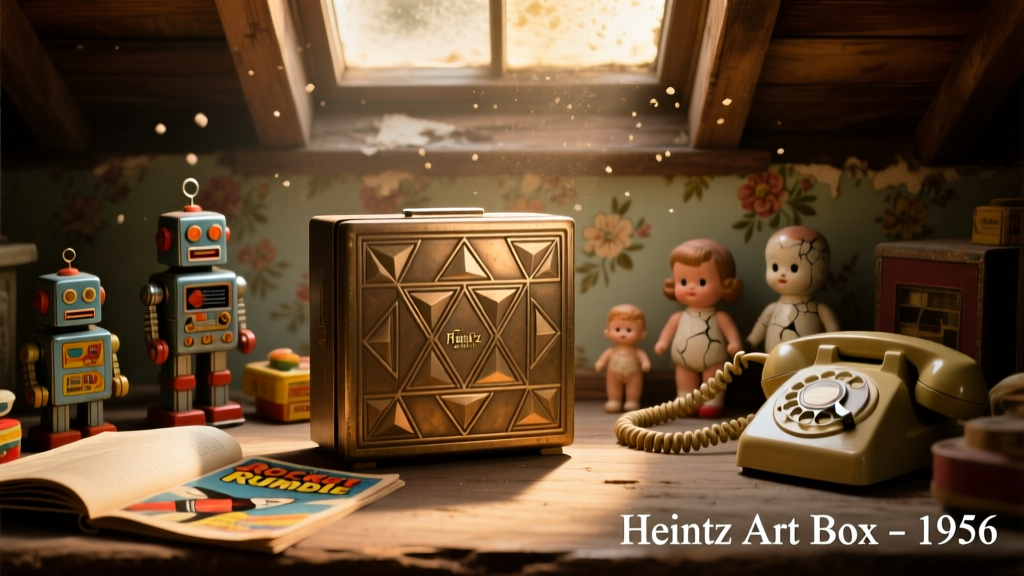
Heintz Art Box Cover: Geometric Bronze Masterpiece (8½ × 3½ × 3 in)

The 1134164: Uncovering the Legacy of the 1957 Marx 'Big Wheel' Pedal Car — A Mid-Century American Icon
Carnival Glass Zipper Stitch Cordial Set in Marigold: A Detailed Appraisal of the 7-Piece Set (Pattern #2)
The 1957 Ideal Toy Corporation 'Little Miss Muffet' Doll: Anatomy, Provenance, and Market Value of Catalog Number 2333872
The Sheffield Fork: A Mid-Century American Tableware Icon and Collector’s Benchmark

Found a Seven Dollar Renoir Painting: How a Thrift Store Discovery Sparked a Mid-Century Authentication Odyssey
Fostoria Coin Candleholder, 4½-Inch Pair: Identification, Production History, and Market Value for Collectors