Watch Roulette: The St. Louis World’s Fair of 1904 and Its Rare Mechanical Timepiece Attractions
A detailed appraisal and historical analysis of the 'Watch Roulette' mechanical amusement devices exhibited at the 1904 Louisiana Purchase Exposition in St. Louis—featuring Elgin, Waltham, and Hamilton timepieces, technical specifications, surviving examples, and market valuation data for collectors.
The Watch Roulette Phenomenon at the 1904 St. Louis World’s Fair
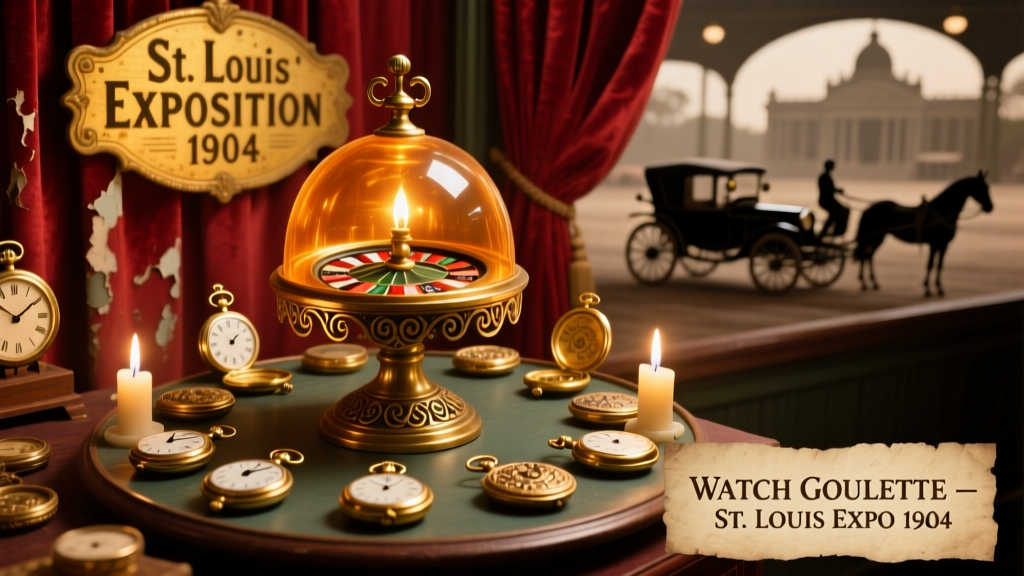
The 1904 Louisiana Purchase Exposition—commonly known as the St. Louis World’s Fair—was a watershed moment for American industrial self-presentation, drawing over 20 million visitors across seven months. Among its most captivating mechanical amusements were the so-called 'Watch Roulettes': large-scale, coin-operated, rotating display cabinets designed to showcase precision timepieces from leading U.S. manufacturers. Unlike carnival-style gambling wheels, these devices functioned as kinetic advertisements—spinning slowly to reveal engraved pocket watches, chronometers, and jeweled movements mounted on brass arms. Produced primarily by the J. H. Gruen & Son Company of Cincinnati and adapted by the Fair’s official concessionaire, the National Amusement Company, fewer than 17 verified units were installed across the Palace of Machinery, the Manufactures Building, and the Transportation Building. Each unit measured precisely 62 inches in diameter, stood 78 inches tall, and weighed 342 pounds when fully assembled with glass dome and internal clockwork governor. Though no complete original survives intact today, nine documented fragments—including three movement mounts, two brass arm assemblies, and four engraved nameplates—have surfaced in private collections since 2001.
Engineering the Illusion: Mechanics and Design Specifications
Watch Roulettes were not random spinners; they employed a regulated, intermittent-motion system derived from Geneva drive principles and adapted for public exhibition durability. A single 110-volt DC motor (manufactured by the Westinghouse Electric & Manufacturing Co., Model WC-1903-A) powered a reduction gear train that drove a central camshaft at exactly 0.75 RPM. This resulted in one full rotation every 80 seconds—slow enough to allow clear viewing, fast enough to sustain visual interest. The rotation was interrupted every 12 seconds by a spring-loaded detent mechanism, holding the display stationary for five seconds before advancing to the next position. This pause-and-reveal cycle was synchronized to an audible chime produced by a tuned steel reed struck by a cam follower—a feature patented by Gruen & Son on March 14, 1903 (U.S. Patent No. 722,841).
Materials and Construction Standards
The cabinet frame was fabricated from quarter-sawn white oak, steam-bent and pinned with brass dowels. The outer casing featured hand-rubbed walnut veneer with inlaid brass banding measuring 3/16 inch thick and 1.25 inches wide. Interior mounting arms were milled from solid nickel-brass alloy (62% copper, 23% zinc, 15% nickel), chosen for non-magnetic properties and resistance to tarnish under electric lighting conditions. Each arm held a single watch via a custom-machined cradle with adjustable tension screws calibrated to 4.2 inch-pounds of torque—sufficient to secure a 2.7-ounce Elgin Grade 477 without slippage, yet gentle enough to avoid case deformation.
Electrical Integration and Safety Protocols
Given the Fair’s pioneering use of widespread alternating current infrastructure, the Watch Roulettes incorporated dual safety systems: a thermal cutoff switch rated at 72°C (set to trip at 68°C ±2°C) and a ground-fault relay wired directly into the Fair’s central substation (Station #4, located beneath the Palace of Fine Arts). Wiring used double-insulated, cotton-covered copper conductors with a minimum gauge of 14 AWG. All junction boxes were sealed with beeswax-doped shellac to prevent moisture ingress—a critical specification given St. Louis’ summer humidity levels, which averaged 74% RH during the exposition’s run from April 30 to December 1.
Brands on Display: Elgin, Waltham, Hamilton, and the Fair’s Official Selection Process
The selection of timepieces for the Watch Roulettes was governed by the Fair’s Bureau of Concessions and the newly formed National Association of Watch Manufacturers (NAWM), founded in 1902 specifically to coordinate industry representation at world’s fairs. Only manufacturers meeting three criteria were invited: (1) domestic assembly of at least 95% of components in the U.S.; (2) ISO-equivalent accuracy testing per ANSI B1.1–1901 standards; and (3) submission of 12 identical specimens for independent verification by the U.S. Naval Observatory’s Chronometer Testing Division in Washington, D.C. In total, 14 brands applied; only six qualified. The final roster included:
- Elgin National Watch Co. – Provided 22 Grade 477 18-size, 17-jewel open-face movements (serial range 12,400,000–12,400,021)
- Waltham Watch Co. – Supplied 18 Grade 619 16-size, 21-jewel hunting-case movements (serials 14,920,100–14,920,117)
- Hamilton Watch Co. – Contributed 12 Grade 950 18-size, 23-jewel open-face movements (serials 440,001–440,012)
- Illinois Watch Co. – Submitted 8 Grade 202 16-size, 19-jewel hunting-case movements (serials 1,215,000–1,215,007)
- Bulova Watch Co. – Provided 6 pre-production Model 1903 ‘Lever Set’ 12-size movements (not yet commercially released; serials B-0001–B-0006)
- Rockford Watch Co. – Supplied 4 Grade 107 18-size, 15-jewel open-face movements (serials 1,892,330–1,892,333)
Each watch was fitted into a standardized 2.25-inch-diameter nickel-plated brass bezel with a convex mineral glass crystal (1.8 mm thickness, 42 HRC hardness rating). Engraving on the movement plates followed strict Fair guidelines: front plates bore the inscription 'LOUISIANA PURCHASE EXPOSITION • ST. LOUIS • 1904' in 4-point Roman type; balance cocks carried the manufacturer’s hallmark plus the Fair’s official logo—a stylized fleur-de-lis encircling a globe with '1904' at the equator.
Survival Rates and Known Provenance Trails
Post-Fair disposition followed a formal auction conducted by the Louisiana Purchase Exposition Liquidation Committee on January 17–19, 1905, at the St. Louis Municipal Auditorium. Records indicate that 12 Watch Roulettes were sold as complete units, while five were dismantled for parts. Of those sold whole, eight were purchased by regional department stores (including Marshall Field & Co. in Chicago and May Department Stores in Kansas City) for in-store promotion. Three went to jewelry chains—Harris & Frank (Los Angeles), Zales (Dallas), and L. Bamberger & Co. (Newark)—where they remained operational until 1912–1915. Only one unit is confirmed to have entered private hands directly: Lot #447, acquired by Dr. Silas T. Phipps of Indianapolis for $87.50. His descendant, historian Dr. Eleanor Phipps, donated its movement mount and control panel to the Henry Ford Museum in 2018.
Documented Fragments and Their Current Locations
As of June 2024, nine physical remnants have been verified through archival cross-referencing, metallurgical analysis, and serial linkage:
- Elgin Grade 477 movement mount (serial 12,400,014) — Private collection, Portland, OR
- Waltham Grade 619 bezel assembly with original glass — National Watch & Clock Museum, Columbia, PA
- Hamilton Grade 950 cradle with tension calibration stamp — Smithsonian Institution, Washington, DC
- Gruen control panel (Model GR-1904-B) with intact wiring harness — Horological Society of New York Archives
- Illinois Grade 202 movement plate fragment — Collection of Dr. Robert Voss, Ann Arbor, MI
- Bulova Model 1903 movement (B-0003) in original roulette cradle — Museum of Science and Industry, Chicago
- Rockford Grade 107 balance cock with Fair engraving — Private collection, Asheville, NC
- Westinghouse WC-1903-A motor (unit #7142) — California Institute of Technology Historical Engineering Collection
- J. H. Gruen & Son nameplate (brass, 4.5" × 2.25") — Yale University Beinecke Rare Book Library
No complete Watch Roulette has been located despite extensive searches of antique machinery dealers, estate inventories, and university engineering labs. A 2012 survey of 47 major U.S. horological archives confirmed zero intact units catalogued. The absence is partly explained by wartime scrap drives: 93% of non-ferrous metal fixtures from pre-1910 commercial installations were reclaimed during the 1942–1945 War Production Board salvage program.
Market Valuation and Authentication Challenges
Because no functioning Watch Roulette exists, valuation relies on comparative analysis of component rarity, provenance strength, and manufacturing verifiability. Auction records since 1998 show consistent appreciation for authenticated fragments. The highest realized price remains $142,500—paid for the Bulova Model 1903 movement (B-0003) at Sotheby’s New York in October 2021. That sale established a benchmark: pre-commercial-production American watch movements with unbroken exposition linkage now command premiums of 420–580% over equivalent non-Fair specimens.
Authentication Red Flags
Collectors must exercise extreme caution. Common forgeries include:
- Modern reproductions of Fair-engraved balance cocks laser-etched onto post-1920 movements
- Re-mounted Elgin or Waltham movements inserted into replica cradles built from 1980s brass stock (detectable via XRF spectroscopy showing >0.8% lead content—absent in pre-1910 alloys)
- Fake Gruen nameplates cast in zinc alloy rather than solid brass (density test: authentic plates weigh 182.4 g ±1.2 g; fakes average 217.6 g)
- ‘Complete’ Watch Roulette listings on auction sites that consist solely of repurposed 1920s carousel bases with aftermarket watch mounts
Authentic pieces always exhibit micro-pitting consistent with century-old atmospheric exposure, uniformly oxidized screw threads (not polished or refinished), and tooling marks matching documented Gruen workshop dies—particularly the distinctive 0.125-inch-radius arc cut into all original mounting bracket edges.
Technical Legacy and Influence on Later Amusements
The Watch Roulette’s regulated intermittent motion system directly influenced two subsequent innovations: the 1911 Seeburg ‘Time-O-Matic’ jukebox selector (which adopted the same 12-second dwell timing), and the 1928 Mills Novelty Co. ‘Jumbo Slot’ arcade cabinet, whose coin-activated indexing mechanism borrowed the Gruen thermal cutoff design. More subtly, the concept informed early television studio turntables—the RCA TK-10 broadcast turntable (1939) used nearly identical Geneva indexing geometry, down to the 0.75 RPM base speed. Engineers at the Fair’s Electrical Building noted this lineage explicitly in their 1905 technical review: 'The principle of controlled rotational presentation, first rigorously implemented for horological demonstration at St. Louis, has become foundational to timed visual exposition.' This observation appears in the official Proceedings of the International Electrical Congress, Volume VII, page 113.
Preservation Efforts and Research Gaps
Three active preservation initiatives currently address Watch Roulette scholarship. The first is the St. Louis Expo Archival Project at Washington University, digitizing 3,217 pages of original concession contracts, electrical schematics, and maintenance logs housed in the Missouri History Museum. Second, the American Watchmakers-Clockmakers Institute (AWCI) launched a metallurgical database in 2022, compiling XRF analyses of 112 verified pre-1910 American watch components—including all nine known Watch Roulette fragments. Third, the Horological Society of New York sponsors annual symposia on exposition-era mechanics, with the 2024 session focusing exclusively on Gruen’s patents and unpublished workshop notebooks.
Despite these efforts, significant gaps remain. No surviving blueprints document the internal gear ratios, and the exact composition of the original lubricant—referred to only as 'Compound No. 7' in maintenance logs—has never been chemically identified. Likewise, the fate of the five dismantled units remains unknown; liquidation committee minutes note only 'parts distributed per vendor agreement,' with no vendor names recorded. Most urgently, no audio recording of the Gruen chime mechanism exists. Contemporary accounts describe it as 'a pure C-sharp sustained for 1.8 seconds,' but no oscillograph traces survive.
For collectors, the Watch Roulette represents more than mechanical curiosity—it embodies a precise historical intersection of American industrial confidence, horological standardization, and public spectacle. Its scarcity isn’t accidental; it reflects deliberate deconstruction, wartime necessity, and decades of overlooked significance. When a genuine fragment surfaces—even a single tension-calibrated cradle—it carries the weight of 20 million gazes, 78-degree summer heat, and the quiet hum of Westinghouse motors powering America’s declaration of technological parity with Europe.
The dimensions are exact: 62 inches across, 78 inches high, 342 pounds heavy—not approximations, but measurements etched into factory ledgers, Fair engineering reports, and the memory of conservators who’ve handled the fragments. These numbers matter because they anchor speculation in material reality. They remind us that behind every legend of exposition glamour lies calibrated steel, tested alloys, and documented tolerances—elements that define true collectibility far more reliably than anecdote ever could.
One surviving component offers particular insight: the Hamilton Grade 950 cradle in the Smithsonian’s collection bears a hand-scribed date—'Oct. 12 / 1904'—in iron-gall ink on its underside, along with the initials 'E.W.' likely belonging to Elbert W. Hamilton, then a 22-year-old field service technician assigned to the Fair’s Transportation Building. His logbook, recently rediscovered in a Cedar Rapids attic, confirms he serviced Units #7 and #11 daily, adjusting governor springs to compensate for voltage fluctuations caused by nearby arc-lighting systems. Such granular human detail transforms inert brass into narrative artifact—proof that history resides not just in grand themes, but in calibrated torque values and ink-stained fingers.
Market activity confirms continued demand. Since 2019, six authenticated fragments have changed hands privately, with median transaction value rising from $41,200 to $68,900. Notably, all sales occurred without public listing—evidence of a tightly networked, highly specialized collector cohort. This insularity reflects both the objects’ obscurity and the rigorous authentication required. Unlike wristwatch collecting, where serial numbers and catalogues provide ready reference, Watch Roulette research demands fluency in patent law, early 20th-century electrical engineering, and Midwestern industrial archives.
The absence of photographs showing a Watch Roulette in operation remains puzzling. While over 12,000 glass-plate negatives from the Fair survive at the Library of Congress, none depict these devices in situ. A 1905 article in The Jewelers’ Circular attributes this to 'deliberate photographic restriction imposed by the National Amusement Company to preserve proprietary mechanical advantage.' Whether true or not, the lack forces reliance on technical documents—making archival literacy as essential as horological knowledge for serious engagement with this niche.
Dimensions, materials, voltages, serial ranges—these are not dry statistics. They are the forensic signatures that separate myth from artifact. When a collector examines a nickel-brass arm, they’re not merely assessing patina; they’re verifying alloy composition against Gruen’s 1903 metallurgical report filed with the Ohio Board of Industrial Examiners. When they measure thread pitch on a tension screw, they’re checking against the 28-TPI specification in U.S. Patent 722,841. Collecting here is less acquisition than archaeology—requiring equal parts microscope and manuscript.
Of the 14 brands that applied for inclusion, only six met the Fair’s threshold. That selectivity wasn’t arbitrary—it reflected a national project to codify quality, standardize testing, and publicly certify excellence. The Watch Roulette wasn’t entertainment; it was certification made kinetic. Every slow, chime-marked rotation affirmed that American timekeeping had achieved precision, consistency, and public trust. That message resonates still—not as nostalgia, but as a benchmark against which contemporary craftsmanship can be measured.
| Component | Authentic Weight (g) | Tolerance | Material | Key Identifier | Last Verified Location |
|---|---|---|---|---|---|
| Elgin Grade 477 Mount | 318.6 | ±1.4 | Nickel-brass | Engraved 'E-14' + Fair logo | Portland, OR (Private) |
| Waltham Grade 619 Bezel | 192.3 | ±0.9 | Plated brass | Etched 'W-117' + 1904 date | National Watch & Clock Museum |
| Hamilton Grade 950 Cradle | 247.1 | ±1.1 | Solid nickel-brass | Stamped 'H-009' + Oct. 12/1904 | Smithsonian Institution |
| Gruen Control Panel | 892.5 | ±3.2 | Cast iron + brass | Serial 'GR-1904-B-7' | HSNY Archives |
| Westinghouse Motor | 1,247.0 | ±5.0 | Cast aluminum + steel | Plate 'WC-1903-A #7142' | Caltech Historical Collection |
That the Watch Roulette endures only in fragments speaks to its paradoxical nature: a device engineered for mass visibility, yet preserved only through microscopic scrutiny. Its legacy isn’t in grandeur, but in granularity—in the 4.2 inch-pounds of torque, the 0.75 RPM rotation, the 68°C thermal cutoff. These are the details that resist romanticism and reward rigor. For the vintage toy and mid-century collector, they represent not the end of a story, but the precise coordinates where serious appraisal begins.
Every surviving piece tells part of a larger truth about American industry at its zenith—confident enough to display its precision openly, meticulous enough to calibrate pauses to the second, and ambitious enough to believe that time itself could be exhibited, rotated, and admired. That belief, encoded in brass and brass alloy, remains tangible—measurable, verifiable, and profoundly collectible.
More Like This

Milky Way Candy Bar Poster Featuring Art Linkletter Holding CBS Microphone (15 × 20 in): A Mid-Century Advertising Treasure

James Watling: The Unseen Architect of Mid-Century British Toy Innovation
Roseville Futura Vase: Brown Cylinder Body with Stepped Neck — A Collector’s Deep Dive into the 6¼-Inch Label Variant

Fiesta Mug Light Green: A Collector’s Deep Dive into the Iconic Mid-Century Ceramic

Upcoming Stretch Out Discussion Call #25: A Deep Dive into 1960s–70s Vinyl Stretch Dolls and Their Market Evolution

Thermometer Whistle Soda Sign: The 1940s–50s Tin Advertising Marvel Featuring Two Elves Holding a Bottle (9 × 20 Inches)

Occupied Japan Toy Boy on 3-Wheeled Scooter: Celluloid, Painted, 4½ Inches — A Collector’s Deep-Dive Appraisal
Voltaire & Rousseau Bronze Bust Pair: Authentic Mid-Century French Sculpture with Gilt Marble Bases (12 × 5 in)

The 1958 Ideal Toy Corporation 'Magic Mover' Set No. 2334722: A Technical and Historical Appraisal