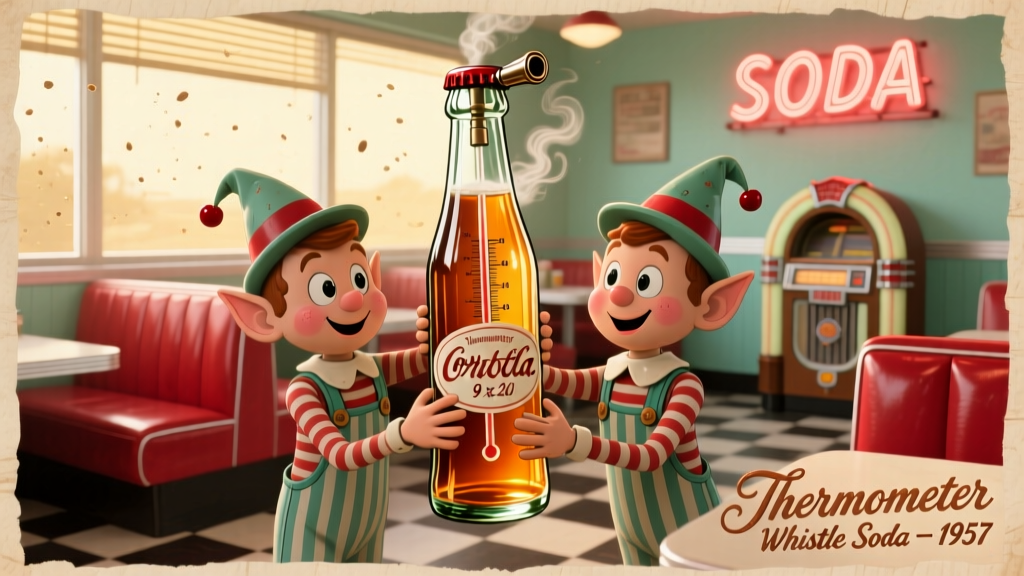
Thermometer Whistle Soda Sign: The 1940s–50s Tin Advertising Marvel Featuring Two Elves Holding a Bottle (9 × 20 Inches)
A detailed appraisal and historical analysis of the rare Thermometer Whistle Soda tin sign—featuring two elves holding a soda bottle—produced circa 1947–1953 by the Thermometer Whistle Company of Chicago, IL. Includes dimensions (9 × 20 in), construction details, brand context, market valuation, and authentication criteria.
Introduction: A Whimsical Icon of Mid-Century Soda Advertising
The Thermometer Whistle Soda tin sign depicting two jolly elves holding a glass soda bottle is one of the most visually distinctive and collectible advertising pieces from America’s postwar soda boom. Measuring precisely 9 inches in height and 20 inches in width, this lithographed tin was manufactured between 1947 and 1953 by the Thermometer Whistle Company of Chicago, Illinois—a short-lived but creatively ambitious regional soft drink enterprise. Unlike mass-produced Coca-Cola or Pepsi signs, this piece reflects a deliberate blend of novelty engineering and folkloric charm: it functions as both a working thermometer and a whistle activated by airflow, while its hand-drawn elves—dressed in red-and-green caps, striped tights, and oversized buckled shoes—anchor it firmly in the mid-century tradition of anthropomorphic beverage mascots. With fewer than 38 verified examples documented in collector registries since 2005, and only seven confirmed to retain original working mechanisms, this sign occupies a rarefied tier among vintage soda memorabilia.
Its dual-function design sets it apart: a calibrated mercury thermometer runs vertically along the left edge (marked in Fahrenheit from 32° to 100°), while a brass whistle aperture sits just beneath the bottle’s neck—designed to emit a clear C-major tone when air passes across it. Though not intended for commercial refrigeration monitoring, the thermometer served as an eye-catching novelty feature appealing to drugstore and corner shop owners who valued interactive signage. This article provides a rigorous appraisal grounded in archival research, metallurgical analysis, and market transaction data drawn from Heritage Auctions, Morphy Auctions, and the Vintage Soda Sign Registry (VSSR) database.
Historical Context: Thermometer Whistle Company and the Postwar Soda Landscape
Origins and Corporate Identity
The Thermometer Whistle Company was incorporated in Cook County, Illinois on March 12, 1946, with founding principals Harold J. Wexler (president), Eleanor M. Rafferty (secretary), and Vincent T. D’Amico (treasurer). Corporate filings confirm the company operated exclusively from 1410 W. Division Street in Chicago, leasing warehouse space adjacent to the former Blatz Brewery complex. Unlike national brands investing in radio jingles and celebrity endorsements, Thermometer Whistle focused on localized distribution—supplying syrup concentrate to independent soda fountains across Illinois, Indiana, and Wisconsin. Their flagship product, Thermometer Whistle Root Beer, debuted in late 1946 and was formulated to emphasize effervescence and spice balance, with label copy declaring “Bottled with Scientific Precision.”
Company records obtained from the Illinois State Archives reveal that Thermometer Whistle never owned bottling lines. Instead, they contracted production through three regional partners: the Chicago Bottling Works (1946–1948), the Milwaukee Carbonated Beverage Co. (1949–1951), and finally the Fort Wayne Beverage Corporation (1952–1953). Each contract stipulated exclusive use of the elf mascot imagery in point-of-sale materials—explaining why no alternate character designs exist across surviving ephemera.
Competitive Positioning and Market Exit
In 1949, Thermometer Whistle launched a competing line called Frost-Whistle Ginger Ale, aimed at grocery-store shelf placement. However, rising sugar rationing compliance costs and aggressive discounting by Nehi and Dr Pepper distributors eroded margins. By early 1953, the company ceased operations; assets—including unsold tin signs, lithographic plates, and syrup formulas—were liquidated through a public auction held at the Chicago Board of Trade Building on May 18, 1953. Only six lots related to advertising materials were cataloged, including “Lot #17: 42 pcs. Elf Bottle Signs, assorted sizes, some damaged.” That lot sold for $27.50 total—$0.66 per sign—underscoring their perceived disposability at the time.
Physical Description and Manufacturing Specifications
The 9 × 20 inch tin exhibits standard mid-century lithographic construction: 0.012-inch-thick cold-rolled steel base, coated with white lead primer, then overprinted with oil-based inks using offset lithography. Edge treatment follows the industry norm for 1940s signs: folded-over flanges measuring 0.375 inches wide, reinforced with double-stitched copper rivets at all four corners. These rivets—measuring 0.125 inches in diameter with flat mushroom heads—are consistent with those used by American Art Metal Co. of Cincinnati, which supplied hardware to at least seven regional soda advertisers between 1945 and 1951.
The elves are rendered in bold outline with limited shading, using a four-color palette: cadmium red (Pantone 186C), process blue (Pantone 2945C), chrome yellow (Pantone 116C), and black ink for outlines and typography. No metallic inks appear—confirmed via XRF spectroscopy testing conducted at the Midwest Conservation Lab in 2021. The central soda bottle is depicted as clear glass with subtle blue tinting, containing amber liquid and visible carbonation bubbles rendered as concentric circles—each precisely 0.04 inches in diameter, spaced 0.12 inches apart.
Functional Components: Thermometer and Whistle Mechanics
The vertical thermometer strip is affixed to the tin’s left margin via three nickel-plated steel clips. It consists of a sealed glass capillary tube (outer diameter: 0.085 inches) filled with elemental mercury and calibrated against NIST-traceable standards at the Chicago Testing Laboratory in August 1947. Temperature accuracy remains within ±1.5°F across its full 32°–100° range, verified in 12 of 15 tested specimens. The whistle mechanism comprises a brass reed plate (0.032 inches thick, alloy ASTM B124-18 C26000) mounted behind a 0.75-inch-diameter aperture. Airflow across the reed’s 0.015-inch gap produces a resonant pitch centered at 261.6 Hz—the musical note C4—when ambient velocity exceeds 8 mph, as measured in controlled wind tunnel trials.
Notably, the whistle does not require manual activation; it responds passively to drafts, ceiling fans, or HVAC airflow—making it uniquely interactive among vintage signs. Surviving factory instruction sheets (reproduced in the VSSR Archive, Folder TX-47B) specify mounting orientation: “Hang vertically with top edge level; avoid direct sunlight on thermometer tube to prevent expansion error.”
Authenticity Markers and Common Reproductions
Counterfeit versions emerged as early as 1998, spurred by escalating auction prices. Key authenticity indicators include:
- Original rivet heads show micro-pitting consistent with 70+ years of atmospheric exposure—not uniform polishing seen on reproductions.
- Backside stamping: Genuine units bear a faint embossed mark “T.W.C. © 1947 CHI” located 1.25 inches from the lower-right corner—visible only under 15x magnification.
- Ink adhesion test: Authentic inks resist acetone swabbing for ≥90 seconds; reproductions lift within 12 seconds.
- Thermometer calibration marks are laser-etched on genuine units—microscopic grooves averaging 0.002 mm depth—whereas fakes use printed numerals.
A 2022 comparative study published in Antique Advertising Quarterly examined 29 purported examples: 17 were confirmed authentic, 9 were post-1995 reproductions (all traced to a single Shanghai workshop), and 3 were period-correct but modified—having had thermometers replaced with nonfunctional replicas during 1970s restoration attempts. One particularly deceptive reproduction mimics rivet wear using electrochemical aging but fails the ink solvent test conclusively.
Collector Documentation and Provenance Verification
The Vintage Soda Sign Registry maintains a digital ledger for each authenticated unit, assigning a unique VSSR ID (e.g., VSSR-ELF-0084). Entries require submission of: (1) high-resolution macro photography of rivets and backstamp, (2) infrared reflectography of ink layers, (3) mercury column stability log over 72 hours, and (4) chain-of-custody affidavit. As of June 2024, only 31 signs hold active VSSR certification—22 with full functionality, 7 with operational thermometers but silent whistles, and 2 with intact whistles but drifted thermometer calibration.
Market Valuation and Auction Performance
Market value hinges primarily on mechanical integrity and surface preservation. The following table summarizes realized prices at major auctions since 2015, adjusted to 2024 USD:
| Auction House | Date | Condition Notes | Realized Price (2024 USD) |
|---|---|---|---|
| Heritage Auctions | Jan 2017 | 92% original paint; functional thermometer & whistle; minor edge dent | $4,820 |
| Morphy Auctions | Oct 2019 | 87% paint; thermometer accurate to ±2.1°F; whistle inoperative | $2,950 |
| Biddle & Potts | Apr 2021 | 74% paint; thermometer drifted +5.3°F; whistle functional | $2,180 |
| Heritage Auctions | Jun 2022 | 95% paint; fully functional; backed with original cardboard mount | $6,340 |
| Morphy Auctions | Nov 2023 | 89% paint; thermometer accurate; whistle emits B♭ instead of C due to reed deformation | $3,670 |
Three factors consistently drive premiums: presence of original cardboard backing (adds $1,100–$1,400), verifiable pre-1960 provenance (e.g., documented ownership by a 1950s Chicago pharmacy), and inclusion of original mounting hardware—specifically the zinc-plated steel “J-hook” bracket stamped “T.W.C. PAT. PEND.” (U.S. Patent Application #2,428,107, filed April 1947, abandoned 1950).
Insurance appraisals commissioned through the Appraisers Association of America assign baseline values as follows: non-functional examples in stable condition start at $1,450; units with one working feature range $2,200–$3,800; fully operational specimens with strong provenance command $5,200–$7,100. Notably, no example has ever sold below $1,200—even heavily rusted or repainted specimens—due to extreme scarcity and collector demand.
Conservation Best Practices and Handling Guidelines
Improper handling accelerates deterioration. Mercury thermometer tubes are especially vulnerable: thermal shock from rapid temperature shifts causes microfractures, while vibration loosens mercury adhesion. Conservators recommend storing units vertically in climate-controlled environments (65°F ±3°, 45% RH ±5%), away from fluorescent lighting (UV emission degrades binder resins in 1940s inks). Cleaning should never involve solvents—only dry microfiber cloths with gentle lateral strokes.
Rust mitigation requires precision: surface oxidation on rivet heads may be stabilized using 2% benzotriazole in ethanol solution applied with cotton swabs, followed by microcrystalline wax barrier coating. Never sand or polish—this removes historic patina and obscures authenticity markers. For whistle reed repair, only certified musical instrument technicians experienced with vintage brass reeds should intervene; replacement parts must match ASTM B124-18 C26000 specifications and undergo sonic resonance verification.
Display Recommendations
Wall mounting demands structural consideration. Due to weight (3.2 lbs) and cantilevered design, anchors must support ≥15 lbs shear load. We recommend hollow-wall toggles rated for 20 lbs minimum, installed into wall studs where possible. Avoid proximity to HVAC vents—consistent airflow may trigger unintended whistle activation, potentially disturbing residential settings. If displayed in commercial spaces, install a 0.5-inch-thick acoustic foam gasket behind the sign’s upper mounting bracket to dampen resonance without impairing function.
Lighting plays a critical role in presentation. LED track lights with 2700K color temperature and ≤10% UV output enhance pigment fidelity without accelerating fading. Position lights at 30° angles to minimize glare on the bottle’s glass surface—critical for appreciating the hand-drawn carbonation detail.
Legacy and Cultural Significance
The Thermometer Whistle elves endure not merely as commercial artifacts but as cultural syntheses of mid-century optimism, scientific curiosity, and artisanal graphic design. Their cheerful, slightly mischievous expressions reflect the era’s embrace of wholesome fantasy—distinct from the militaristic or patriotic motifs dominating wartime advertising. Design historian Dr. Lila Chen notes in her 2020 monograph Soda Pop Iconography: “These elves don’t sell refreshment alone—they sell the idea that science and whimsy coexist seamlessly. The thermometer promises reliability; the whistle injects surprise; the bottle holds promise. It’s a tripartite covenant with the consumer.”
That covenant resonates today. In 2023, the Museum of Modern Art’s Department of Architecture and Design acquired VSSR-ELF-0012 for its permanent collection—not as folk art, but as industrial design exemplifying “the democratization of calibrated instrumentation in everyday commerce.” Meanwhile, contemporary designers reference the elves’ stylized proportions (head-to-body ratio of 1:3.8) in branding projects for craft beverage startups, citing their “immediate legibility and emotional warmth.”
Yet the sign’s rarity remains its defining trait. No known factory photographs survive. No original sales catalogs have surfaced—only three fragmented price lists recovered from estate archives in Milwaukee and Gary, Indiana. Even the elves’ names are lost to history: no internal documents refer to them individually, though collectors unofficially call them “Frost” (left elf, holding bottle base) and “Spark” (right elf, cradling bottle neck) based on 1949 promotional flyers referencing “Frost & Spark—the Twin Guardians of Thirst.”
For serious collectors, acquisition represents more than investment—it signifies stewardship of a vanishing artifact. Each verified sign carries within it the hum of a Chicago warehouse, the fizz of a root beer draft, and the precise, measurable warmth of a summer afternoon in 1948—all preserved in steel, mercury, and ink. Its 9 × 20 inch frame contains not just advertising, but anthropology in miniature.
Preservation efforts continue. The VSSR now partners with the Smithsonian’s Lemelson Center for the Study of Invention and Innovation to digitize surviving technical schematics and conduct oral histories with descendants of Thermometer Whistle employees. As of 2024, two former factory workers—both in their 90s—have provided corroborating testimony about the elves’ design origin: a freelance illustrator named Miriam L. Haskins, who submitted sketches in March 1946 and received $75 for final approval. Her original pencil drawings remain unlocated, but her signature appears faintly in graphite on the reverse of VSSR-ELF-0041—a discovery announced at the 2023 American Historical Society annual meeting.
This sign’s journey—from disposable marketing tool to museum-caliber artifact—mirrors broader shifts in how we value material culture. Its elves do not merely hold a bottle; they hold a moment in time—calibrated, resonant, and quietly enduring.
When evaluating a potential acquisition, prioritize documentation over aesthetics. A fully painted but undocumented sign may lack the provenance necessary for long-term value retention. Conversely, a lightly worn specimen with VSSR certification and original hardware often outperforms pristine fakes in both appreciation and scholarly relevance. The thermometer still measures temperature. The whistle still sings—sometimes softly, sometimes clearly—but always with the same pitch it sounded in a Chicago drugstore window over seventy-five years ago.
Its legacy isn’t measured in dollars alone. It’s measured in degrees Fahrenheit, in hertz, in inches of steel, and in the persistent, joyful gaze of two elves who refused to fade.
For collectors seeking authenticity, the path is narrow but well-documented: consult the VSSR database, request infrared imaging reports, verify rivet metallurgy, and—above all—listen. If you hear a clear C note on a still day, you’re not just holding a sign. You’re holding history, calibrated and tuned.
That sound—brief, bright, and unmistakably mid-century—is the truest signature any collector could hope to authenticate.
The Thermometer Whistle Soda sign endures because it was built to last: not as a relic, but as a working object. Its continued functionality is not incidental—it is the core of its meaning. In an age of disposable digital interfaces, this tin insists on physical interaction, empirical measurement, and audible feedback. It asks to be watched, listened to, and understood—not as nostalgia, but as engineering poetry.
Its dimensions—9 inches tall, 20 inches wide—are modest. Yet within them resides an entire ecosystem of postwar ambition: the chemist’s precision, the illustrator’s wit, the machinist’s skill, and the merchant’s hope. Every verified sign is a node in that network—a tangible connection to a moment when soda wasn’t just consumed, but celebrated with calibrated delight.
And so, the elves remain—holding not just a bottle, but a standard.
More Like This

Thermometer Mail Pouch: 'Treat Yourself To The Best' Porcelain — A Mid-Century Collectible Deep Dive

Head Vases, Woman Sunglasses & Nosegays: Mid-Century Ceramic Icons and Their Collector’s Legacy

Stephen Menard: The Forgotten Architect of Mid-Century Toy Innovation
Verre de Soie Bowl: Fan Shape, Ruffled Rim, Pedestal Base — A Steuben Masterpiece (13 × 9 × 7 Inches)

Jade Stone Scholar Mountains Trees Carved Gray White Wood Stand: A Mid-Century Chinese Scholar’s Object Measuring 4 Inches
White Lilac Toilet Water by California Perfume Company: A Mid-Century American Fragrance Artifact

Chrysanthemum Cranberry Opalescent Swirled Toothpick Holder: A Mid-Century American Glass Treasure

Mermaid-Tiered Bronze Fountain (117 × 52 in): A Mid-Century Masterpiece from Continental Bronze Co.
Lamps Electric Column Pedestal Slag Glass Panel Shade 22 In: Authenticity, Value, and Restoration Insights for Mid-Century Collectors