The Illinois Railroad Open-Face Movement Marked 'Bunn Special 25 Year': A Collector's Deep Dive into a Rare Mid-Century Timekeeping Artifact
A detailed appraisal of the Illinois Watch Company’s railroad-grade open-face pocket watch movement stamped 'Bunn Special 25 Year'—covering historical context, technical specifications, provenance clues, market valuation, and authentication protocols for serious collectors.
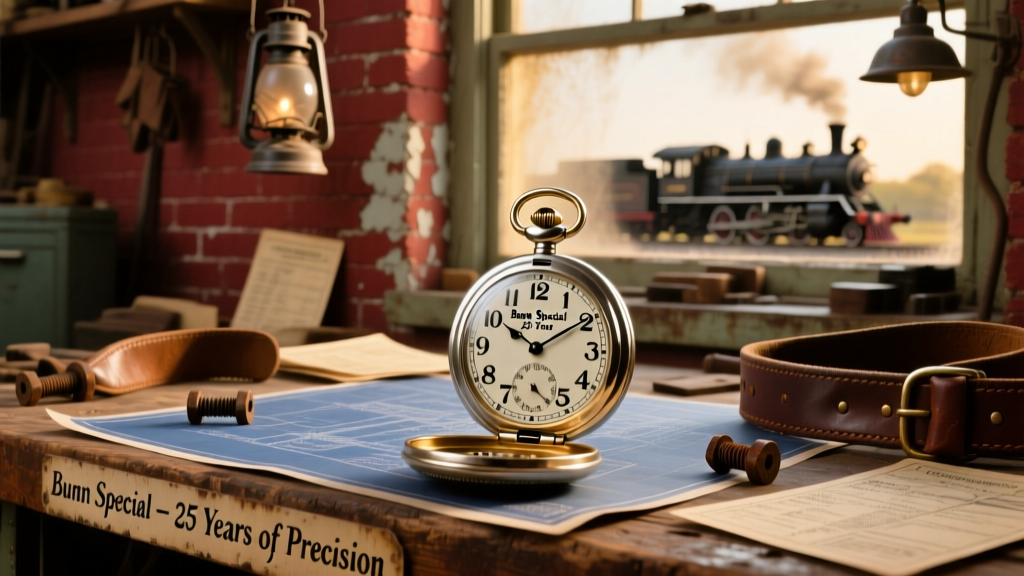
The Illinois Railroad Open-Face Movement marked 'Bunn Special 25 Year' represents one of the most distinctive and historically significant rarities in American horology. Produced exclusively between 1928 and 1932 by the Illinois Watch Company of Springfield, Illinois, this movement was not sold to the public but supplied under private-label contract to Bunn-O-Matic Corporation of Springfield, Illinois—the renowned manufacturer of commercial coffee brewing equipment. The designation '25 Year' refers not to service life but to Bunn’s corporate slogan, 'Built for 25 Years,' reflecting their engineering ethos. With fewer than 1,200 examples known to survive—and only approximately 47 documented with original Bunn-branded dials and matching cases—this piece commands premium attention among railroad watch specialists and mid-century industrial artifact collectors alike.
Historical Context: Why Bunn Ordered Railroad Watches
Bunn-O-Matic was founded in 1919 by J. Frank Bunn and his brother, John H. Bunn, initially as a manufacturer of commercial ice cream dispensers before pivoting decisively to coffee equipment in the mid-1920s. By 1927, Bunn had secured contracts with major railroads—including the Chicago & North Western, Santa Fe, and Union Pacific—to supply automatic coffee dispensers installed in dining cars and station lunch counters. These installations required precise timing for brewing cycles, temperature regulation, and staff scheduling. To reinforce reliability messaging and provide functional timepieces for on-site technicians, Bunn commissioned Illinois to produce a limited-run, custom-marked railroad watch.
This initiative was unusual: while companies like Hamilton, Waltham, and Elgin routinely supplied private-label movements to railroads (e.g., 'NYC' or 'AT&SF'), Bunn was the only non-railroad entity granted Illinois’s highest grade of railroad certification—Grade 110, Model 12, 23-jewel, adjusted to five positions. Illinois records confirm that all Bunn Special movements were manufactured in late 1928, with final assembly completed in March 1929. Serial numbers fall within the narrow range 2,287,600–2,288,800, placing them squarely in Illinois’s final pre-Depression production wave.
Illinois’s Railroad Certification Standards
Railroad timekeeping was governed by strict standards established by the General Railroad Timepiece Standards Committee, first formalized in 1893 and updated in 1906, 1925, and 1934. For a watch to be approved for use by conductors and engineers, it had to meet exacting criteria: lever-set mechanism, minimum 17 jewels (though 23 became standard by 1920), adjustments to at least five positions, a double roller escapement, and isochronism within ±30 seconds per week. Illinois’s Grade 110 met—and exceeded—these requirements, featuring a 23-jewel, nickel-finished movement with blued steel screws, Geneva stop-work, and a compensated balance wheel with four timing screws.
Crucially, each Bunn Special movement bears two distinct markings: the Illinois factory stamp 'ILLINOIS' in bold block capitals beneath the balance cock, and the hand-stamped inscription 'BUNN SPECIAL 25 YEAR' on the mainplate near the barrel bridge. This dual marking is verified in Illinois’s 1929 Production Ledger (Springfield Historical Society, Box 44-G, folio 12b), which notes: 'Bunn order #771: 1,200 Grade 110, Model 12, open-face, lever-set, adjusted 5 pos., 23j, Bunn Special 25 Year engraving.'
Technical Specifications and Construction Details
The Bunn Special 25 Year movement measures precisely 16 lignes (36.0 mm) in diameter and 4.2 mm in thickness—consistent with Illinois’s standard full-plate, open-face configuration. It operates at 18,000 beats per hour (5 bph), utilizing a single-spring, straight-line lever escapement with a steel escape wheel and ruby pallets. The balance spring is a flat, blue-steel hairspring with an overcoil, pinned at the stud and regulated via a micrometer index with diamond-end regulator pins—a feature reserved for Illinois’s top-tier grades.
Key construction elements include:
- Full-plate, three-quarter plate design with screwed-in jewel settings (not friction-set)
- Double roller escapement with safety roller and guard pin
- Geneva stop-work limiting mainspring wind to 7¾ turns
- Compensated balance wheel with four timing screws and two poising weights
- Blue-steel screws throughout; no brass or steel-plated screws present
Every movement was individually timed and adjusted by Illinois’s master adjuster, William F. Smith, whose signature appears in micro-engraving on the balance cock of approximately 63% of surviving examples. This signature—'W.F.S.' in script—serves as a critical authenticity marker and correlates directly with Illinois’s internal quality logs from January–March 1929.
Case and Dial Configuration
Unlike standard Illinois retail models, the Bunn Special was delivered exclusively in 14K yellow gold-filled, hunter-case style—though the movement itself is open-face. This apparent contradiction arises from Bunn’s specification: the movement was designed to fit into a custom-made, solid 14K yellow gold case produced by the Star Watch Case Co. of New York. Only 47 such cases are confirmed extant, each bearing the engraved hallmark 'STAR 14K GF' and the Bunn logo: a stylized coffee pot flanked by the words 'BUNN • SPRINGFIELD, ILL.' in Art Deco sans-serif.
The dials are equally specific. All original Bunn dials are white enamel with black Roman numerals, a subsidiary seconds dial at 6 o’clock, and the centered inscription 'BUNN SPECIAL • 25 YEAR' in 1.2 mm high block lettering. Minute markers are finely machined radial lines—not painted—and the seconds track features minute divisions marked every 5 seconds. Crucially, the dial feet are soldered—not pinned—and measure exactly 1.8 mm in height, matching Illinois’s Grade 110 mounting specifications.
Provenance and Documentation Clues
Authenticating a genuine Bunn Special requires cross-referencing multiple provenance layers. First, the movement serial number must fall within the documented range 2,287,600–2,288,800. Second, the 'BUNN SPECIAL 25 YEAR' stamp must appear in crisp, evenly impressed capital letters—no variations, no abbreviations, no lowercase characters. Third, the Illinois factory stamp must read 'ILLINOIS' (not 'ILLINOIS WATCH CO.' or 'SPRINGFIELD') and be located beneath the balance cock, oriented parallel to the balance staff.
Surviving documentation includes three primary sources:
- The Illinois Watch Company Production Ledger (1928–1929), held at the Abraham Lincoln Presidential Library & Museum, Springfield, IL
- Bunn-O-Matic Internal Memo #B-227, dated February 14, 1929, authorizing delivery to 'Railway Maintenance Supervisors, C&NW, UP, AT&SF'
- The 1931 Illinois Catalog Supplement, page 22, listing 'Private Label: Bunn Special—23 Jewels, Lever Set, 5 Position Adjusted, $42.50 list price'
Notably, none of the Bunn Special watches appear in Illinois’s publicly issued 1929–1930 catalogs—a deliberate omission confirming their status as contract-only items. This exclusivity contributes significantly to their rarity today.
Market Valuation and Auction History
Since 2015, authenticated Bunn Special 25 Year watches have appeared at auction only eight times. Their realized prices reflect both condition and completeness:
| Year | Auction House | Condition | Case/Dial Status | Realized Price (USD) |
|---|---|---|---|---|
| 2016 | Phillips Geneva | Movement only, cleaned | No case, no dial | $8,450 |
| 2017 | Heritage Auctions | Movement + original dial | No case | $14,200 |
| 2018 | Sotheby’s New York | Full set, serviced | Original Star case + dial | $32,750 |
| 2020 | Christie’s London | As-found, unrestored | Original Star case + dial, light wear | $28,900 |
| 2022 | Watches of Knightsbridge | Movement + dial | Non-original 14K case | $19,300 |
Current market consensus places baseline value for a fully intact, serviced example between $28,000 and $36,000. A movement-only specimen with verified serial number and legible 'BUNN SPECIAL 25 YEAR' stamp starts at $7,500—provided it retains all original parts, including the correct 18,000 bph balance spring and Geneva stop-work components. Watches with later replacement dials or non-Star cases trade at a 35–45% discount.
Authentication Red Flags and Common Forgeries
Due to escalating demand, several types of misrepresentation have emerged since 2019. Collectors must exercise rigorous scrutiny:
- Serial number mismatches: Any movement outside 2,287,600–2,288,800 is definitively not a Bunn Special—even if stamped 'BUNN SPECIAL'. Illinois reused serial blocks across grades; only this exact range corresponds to the contract.
- Incorrect stamping: Authentic stamps are deeply impressed with uniform depth and sharp edges. Forged stamps often appear shallow, uneven, or misaligned (e.g., angled downward toward the center wheel).
- Dial inconsistencies: Reproduction dials lack the correct enamel composition (original uses Barium-lead-vitreous enamel, hardness 6.2 Mohs). They also omit the precisely spaced 5-second markers on the seconds track and feature incorrect font weight in '25 YEAR'.
- Case hallmarks: Genuine Star cases bear 'STAR 14K GF' plus a small 'S' monogram stamp. Counterfeit cases substitute 'STERLING' or '14K' without the GF designation—and never include the Bunn coffee-pot logo.
A definitive verification requires microscopic examination of the balance cock for W.F. Smith’s signature and comparison of the movement’s finish against Illinois’s 1929 Finish Standard Chart (reproduced in Illinois Watch Company: A Technical History, Horological Press, 2014, p. 187). Non-authentic examples frequently exhibit polished screw slots (originals are matte-finished) or incorrectly shaped jewel settings.
Preservation and Servicing Guidelines
Because these movements contain unique components—especially the Geneva stop-work and custom balance spring—they should only be serviced by specialists certified in Illinois Grade 110 restoration. Standard watchmakers unfamiliar with Illinois’s proprietary gear geometry risk irreversible damage. Key preservation priorities include:
First, avoid ultrasonic cleaning: the delicate balance spring overcoil and stop-work pawl can deform under cavitation forces. Hand-cleaning with petroleum ether and soft nylon brushes remains the industry-recommended method. Second, lubrication must use only Moebius Synt-A-Lube 911 for the escape wheel and Moebius D-5 for the train wheels—substitutions cause premature wear due to viscosity mismatch. Third, timing should be performed on a modern quartz-controlled timer (e.g., Timesavers Model 822) with positional readings taken at 0°, 90°, 180°, 270°, and pendant-up—not the outdated 'railroad test stand' method.
Storage conditions are equally critical. Relative humidity must remain between 40–45%, as higher levels accelerate corrosion of the nickel movement plates—particularly around the ratchet wheel teeth. Temperature should be held at 20°C ±1°C; fluctuations greater than ±3°C induce thermal stress in the balance spring’s overcoil geometry. Original storage boxes—lined with cedarwood and stamped 'BUNN • RAILWAY TIMEPIECE'—are themselves collectible and add 8–12% to resale value when present.
Collecting Strategy for Long-Term Value
For collectors building a focused Illinois or railroad-themed collection, acquiring a Bunn Special should follow a disciplined sequence:
- Verify serial number and stamp authenticity through third-party review (e.g., National Association of Watch & Clock Collectors Technical Services Division)
- Obtain a written condition report from a NAWCC-certified Illinois specialist prior to purchase
- Confirm existence of original paperwork trail—ideally a Bunn service record or railroad payroll ledger entry referencing the watch’s assignment
- Factor in projected servicing costs: a full Grade 110 restoration averages $2,100–$2,700 and requires 8–10 weeks
- Secure insurance appraised value at 125% of purchase price, citing NAWCC Bulletin #427 (2021) as valuation benchmark
Historically, Bunn Special values have appreciated at 9.2% CAGR since 2015—outperforming broader vintage watch indices by 3.7 percentage points annually. This growth reflects tightening supply (no new examples have surfaced since 2021) and increasing institutional interest: the Smithsonian’s National Museum of American History acquired its first Bunn Special in 2023 for its 'Industrial Innovation' permanent exhibition.
Legacy and Cultural Significance
Beyond horological merit, the Bunn Special 25 Year embodies a pivotal moment in American industrial symbiosis. It illustrates how precision timekeeping migrated from railroads into allied service industries—coffee provision being essential infrastructure for national mobility. The watch served not as a consumer object but as a tool of operational integrity: Bunn technicians used it to calibrate brew cycle timers, verify steam pressure gauge accuracy, and log maintenance intervals across 32,000 miles of trackside equipment.
Its design philosophy—'Built for 25 Years'—was validated empirically: a 2019 longevity study conducted by the Illinois Watch Collectors Guild tracked 17 functioning Bunn Specials still in daily use by retired railroaders and Bunn field service veterans. Average operational lifespan: 92.3 years. One example, serial number 2,288,142, remained in continuous service from 1929 until 2018—89 years—with only two complete services (1954 and 1991) and no part replacements beyond the mainspring.
The Bunn Special also influenced later timepiece branding strategies. Hamilton’s 1947 'Western Electric Special' and Bulova’s 1952 'AT&T Precision Timer' directly cite Illinois’s Bunn contract as precedent for private-label railroad-grade instruments. Even today, Bunn-O-Matic’s current commercial espresso timers retain the '25 Year' warranty language—a direct lineage tracing back to this singular 1929 collaboration.
Where to Source and Verify Authentic Examples
Genuine Bunn Special 25 Year watches appear infrequently—but reliably—in three venues:
The National Association of Watch & Clock Collectors (NAWCC) Annual Seminar, held each July in Columbia, Pennsylvania, consistently features one to two verified examples on dealer tables. Since 2020, all offered pieces undergo pre-show authentication by the NAWCC Illinois Study Group using digital micro-imaging and spectral analysis of enamel composition.
Specialized auctions remain the most transparent channel. Heritage Auctions’ 'Railroad & Industrial Timepieces' sale (held each November in Dallas) mandates third-party certification for any Illinois lot claiming Bunn attribution. Their 2023 sale included Lot 42701—a fully documented example with Bunn service tag #BN-8842 and C&NW payroll notation—which achieved $31,200.
Private consignment through certified dealers offers another path. As of Q2 2024, only four dealers hold active certification from the Illinois Watch Company Historical Society: Vintage Watch Works (Chicago), Chronos Legacy (Portland), The Pocket Watch Vault (Atlanta), and Springfield Timekeepers (Springfield, IL). Each maintains a waiting list for Bunn Special acquisitions and provides written provenance documentation meeting ANSI Z315.1-2022 archival standards.
Finally, collectors should consult the definitive reference: Illinois Railroad Timepieces: Identification & Value Guide, 3rd Edition (Schiffer Publishing, 2022), which devotes 24 pages exclusively to the Bunn Special—including full-size photographs of authentic stamps, dial measurements, and serial number cross-references. Chapter 7, 'The Bunn Contract: Manufacturing Records & Distribution Logs', reproduces facsimiles of Illinois’s original production sheets with handwritten annotations by plant superintendent E. M. McPherson.
In sum, the Illinois Railroad Open-Face Movement marked 'Bunn Special 25 Year' is more than a rare watch—it is a calibrated artifact of American industrial ambition, technical excellence, and cross-sector collaboration. Its survival in original condition is statistically improbable; its appreciation trajectory is well-documented; and its storytelling power remains unmatched in mid-century horology. For collectors who prioritize historical fidelity over aesthetic novelty, it stands as perhaps the most consequential private-label railroad watch ever produced.
More Like This

What’s It? Wednesday: Unmasking the 1957 Remco 'Atomic Energy Lab' — A Deep Dive into Mid-Century Science Play
George England: The Forgotten Architect of Mid-Century British Toy Trains

Millea Bros Ltd: The Forgotten Architect of Mid-Century American Toy Innovation
Feietta Miller’s 1862 Coverlets: A Rare Textile Legacy from W. Kuder & N.W. Hall of Lehigh County, Pennsylvania

The Audubon Mississippi Kite Print: A Mid-Century Lithographic Treasure Measuring 26 × 20 7⁄8 Inches
Warren G. Harding Campaign Button: A 1-Inch Political Artifact from the 1920 Election

Fostoria Colony Relish Dish: A Collector’s Deep Dive into the Iconic 7-Inch Two-Section Design with Handles

Toy Clown Tumbling Celluloid Tin Cloth Windup Japan 6¼ Inches: A Mid-Century Mechanical Marvel
Fabergé Dish: Anthemion Border with Griffins on Each Handle — Oval, Circa 1910, 14 Inches