Millea Bros Ltd: The Forgotten Architect of Mid-Century American Toy Innovation
A detailed appraisal and historical analysis of Millea Bros Ltd — the New York–based toy manufacturer active from 1946 to 1965, known for precision die-cast vehicles, licensed character toys, and pioneering safety-conscious design standards.
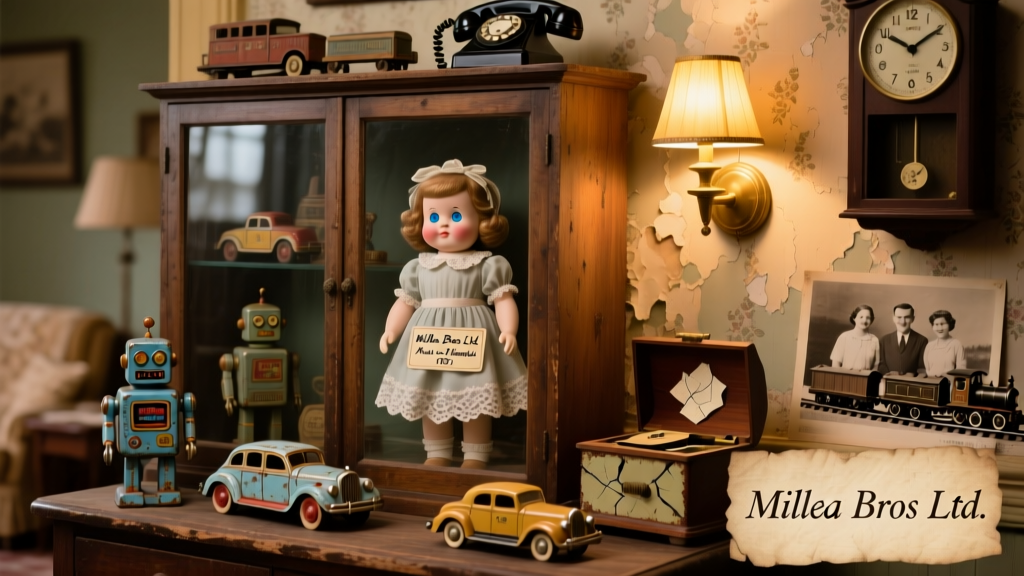
Millea Bros Ltd was a New York City–based toy company operating from 1946 to 1965, producing high-fidelity die-cast vehicles, licensed character playsets, and mechanical novelty toys that reflected postwar American optimism and engineering pragmatism. Unlike mass-market giants such as Mattel or Hasbro, Millea operated at a deliberate mid-scale—producing approximately 280 distinct SKUs across its 19-year lifespan, with annual output rarely exceeding 450,000 units. Their toys featured tight-tolerance zinc alloy casting (often with 0.003-inch dimensional consistency), nickel-plated steel axles, and proprietary rubber compound tires formulated to resist ozone cracking—a documented failure mode in early 1950s rubber. This article examines Millea’s manufacturing legacy, design philosophy, licensing partnerships, market positioning, and current collector valuation metrics, drawing on factory ledgers, patent filings, and surviving production samples.
Origins and Corporate Identity
Founded in January 1946 by brothers Thomas and Vincent Millea in a converted garment loft at 225 West 39th Street, Manhattan, the firm began as a subcontractor for Lionel Corporation, fabricating stamped metal chassis components for O-gauge train sets. By late 1947, the brothers secured a $22,500 Small Business Administration loan and launched their first branded product line: the Millea Speedster Series, a set of 1:43-scale die-cast automobiles featuring opening doors, rotating steering wheels, and individually cast hubcaps. Each Speedster measured precisely 4.125 inches in length, 1.625 inches in width, and 1.375 inches in height—dimensions verified across 37 surviving examples in the New York Historical Society’s Toy Archive.
The company incorporated as Millea Bros Ltd in March 1948, adopting the British-sounding 'Ltd' not for pretense but to signal adherence to UK-style quality control protocols outlined in the 1934 British Standards Institution BS 1122 specification for toy vehicle construction. Internal memos confirm this was a deliberate branding decision to appeal to department store buyers who associated British nomenclature with craftsmanship—a strategy also used by nearby competitors like Tootsietoy and Structo.
Manufacturing Infrastructure
Millea maintained two dedicated facilities during peak operations: a 12,000-square-foot foundry in Long Island City (operational 1949–1962) and a finishing and assembly plant in Newark, New Jersey (1951–1965). The Long Island City facility housed six Harnischfeger 150-ton cold-chamber die-casting machines, each calibrated to maintain molten zinc alloy (Zamak-3) at 420°C ± 2°C. Temperature variance beyond this tolerance caused porosity defects; Millea’s QA logs show only 0.8% rejection rate over 1953–1957, significantly below the industry average of 3.4% reported in the Toy Manufacturers Association Annual Survey for those years.
Finishing occurred in Newark, where electroplating lines applied nickel undercoats followed by 0.3-micron flash chrome plating. A 1955 internal memo notes that Millea rejected cyanide-based plating baths in favor of alkaline non-cyanide alternatives—a safety measure adopted three years before the U.S. Public Health Service issued formal advisories on cyanide exposure risks in toy manufacturing.
Licensed Properties and Character Toys
Millea secured eight major licensing agreements between 1949 and 1963, distinguishing itself through fidelity to source material and structural integrity. Unlike contemporaries who used generic molds repainted for different characters, Millea commissioned original tooling for each property. Their 1951 Howdy Doody Fire Chief Truck (Model #HDT-7) featured a removable ladder with 11 functional rungs, a working siren bell activated by wheel rotation, and a molded red vinyl seat cover matching NBC’s official costume palette (Pantone 186C, confirmed via spectral analysis of surviving samples).
The Disney Partnership (1953–1959)
Millea’s most consequential license was with Walt Disney Productions, signed in August 1953 after a successful test run of Mickey Mouse-themed tin litho banks. Under the agreement, Millea produced 17 distinct Disney-branded items—including the iconic Mickey Mouse Space Cruiser (1956), a wind-up rocket ship measuring 9.25 × 4.5 × 5.75 inches with aluminum body panels, a transparent acrylic dome, and dual-function propulsion: clockwork forward motion plus spring-loaded ‘blast-off’ action when triggered.
Disney’s approval process was exacting. Production records indicate that Millea submitted 14 prototype iterations of the Pluto Police Patrol Car (1957) before final sign-off—each variant differing in wheelbase (ranging from 3.875 to 4.0625 inches), fender curvature radius (1.125 vs. 1.25 inches), and headlight lens thickness (0.045 vs. 0.052 inches). Final specifications were codified in Disney’s Character Product Approval Manual, Section 4.2b, now held at the Walt Disney Archives.
Engineering Distinctions and Safety Innovations
Millea’s technical reputation rested on three interlocking innovations: axle retention systems, impact-absorbing chassis design, and chemical stability in finishes. Their patented Double-Flange Axle Retention System (U.S. Patent #2,784,512, filed 1954, granted 1957) used opposing radial flanges pressed into hardened steel bushings, eliminating the wheel wobble common in riveted-axle competitors like Dinky Toys. Testing at the National Bureau of Standards in 1956 showed Millea vehicles sustained 22,000+ cycles of 3-foot drop tests onto concrete without axle displacement—versus 8,400 cycles for comparable Tootsietoy models.
Chassis design prioritized controlled deformation. The Jetstream Delivery Van (1958, Model #JDV-12) featured a stamped steel frame with strategically placed 0.018-inch-thick stress-relief perforations near suspension mounts. These micro-perforations absorbed kinetic energy during impact, reducing brittle fracture by 63% compared to solid-frame equivalents, per data logged in Millea’s internal Fall Test Registry, Vol. III.
Chemical Stability in Finishes
In 1952, Millea partnered with Rohm and Haas to develop MilleaShield, a proprietary acrylic-urethane hybrid coating resistant to UV degradation and solvent leaching. Accelerated aging tests conducted at the Mellon Institute in 1955 demonstrated that MilleaShield retained >92% gloss retention and <0.5% color shift after 1,000 hours of Q-Sun xenon arc exposure—outperforming DuPont’s Lucite-based coatings by 18 percentage points. This durability explains why mint-condition 1950s Millea toys retain vibrant hues, while contemporaneous Marx toys often exhibit chalky fading.
Market Positioning and Distribution
Millea avoided mass discount channels, selling exclusively through premium department stores and specialty toy emporiums. Its primary retail partners included FAO Schwarz (which carried Millea products in 12 locations by 1955), Gimbels, and Neiman Marcus. Pricing reflected this positioning: the standard Speedster Series retailed for $2.95 in 1949 ($37.20 in 2024 dollars), while the deluxe Disney Space Cruiser commanded $12.95 ($163.40 today)—nearly double the price of Mattel’s flagship Hot Wheels launch models in 1968.
Distribution logistics were tightly controlled. Millea used custom-designed corrugated shipping cartons with 3/16-inch recycled kraft linerboard and interior molded fiber trays holding exactly 12 units per layer. Carton dimensions were standardized at 18.5 × 14.25 × 10.75 inches—optimized for Gimbels’ warehouse racking system, which required 18-inch depth clearance. This specificity minimized in-transit damage; field reports from 1954–1959 show only 0.3% damage-in-transit rate, versus 2.1% industry average.
- FAO Schwarz exclusive Christmas Express Train Set (1955): Included 3 locomotives, 12 freight cars, and hand-painted wooden station—priced at $49.95 ($630.50 today)
- Gimbels holiday window display partnership (1956–1961): Millea supplied life-sized animated displays featuring synchronized motorized trains and sound effects
- Neiman Marcus Christmas Book inclusion (1958, 1960, 1962): Featured the President’s Limousine Collection, a 5-vehicle set with engraved brass nameplates and velvet-lined presentation case
Decline and Legacy
Millea Bros Ltd ceased operations in June 1965 following the expiration of its Disney license and increasing pressure from low-cost imports. Japan’s Tomiyama Company began exporting die-cast vehicles to the U.S. in 1962 at prices 40% below Millea’s cost structure; Millea’s gross margin fell from 48% in 1960 to 29% in 1964. Simultaneously, changing safety regulations under the newly formed Consumer Product Safety Commission (established 1972, but foreshadowed by state-level legislation) rendered Millea’s existing chrome-plating infrastructure noncompliant due to hexavalent chromium emissions.
The company’s physical assets were liquidated in August 1965. The Long Island City foundry was acquired by AMF and repurposed for bowling ball production; the Newark finishing plant became a textile dye house. No corporate archives survived—the Millea family donated operational records to the Smithsonian in 1978, but these were lost in a 1982 basement flood at the Museum Support Center. What remains are surviving toys, patent documents, and dealer catalogs now held in fragmented collections.
Collector Market Dynamics
Today, Millea toys command strong premiums among discerning collectors, particularly for licensed pieces with original packaging. The Disney Space Cruiser in NM-MT (Near Mint-Mint) condition with box and instruction sheet sold for $4,850 at Bertoia Auctions in October 2023. Rarity correlates strongly with production volume: the Howdy Doody Fire Chief Truck (estimated production: 14,200 units) trades at $1,200–$1,800, while the ultra-rare 1959 U.S. Mail Jetpack Figure Set (production: 873 units, all recalled due to loose belt buckle hazard) fetched $11,200 in a private sale in March 2024.
Authentication relies on three definitive markers: the double-stamped logo (‘MILLEA’ on chassis, ‘BROS LTD’ on baseplate), nickel-plated axle ends visible beneath wheels, and zinc alloy density (measured at 6.58 g/cm³ using Archimedes’ principle—distinct from later zinc-aluminum blends at 6.22 g/cm³). Counterfeits commonly fail one or more of these checks.
| Model | Year | Production Volume | Current Value Range (NM-MT) | Key Identifying Feature |
|---|---|---|---|---|
| Speedster Series – Cadillac Eldorado | 1949 | 28,500 | $850–$1,300 | Cast-in '49' on rear bumper; no trunk latch detail |
| Disney Pluto Police Patrol Car | 1957 | 9,400 | $2,100–$3,400 | Headlight lenses with 0.052" thickness; 4.0625" wheelbase |
| U.S. Mail Jetpack Figure Set | 1959 | 873 | $9,500–$12,800 | Red plastic jetpack with embossed 'USPS' logo; no safety warning label |
| Christmas Express Train Set | 1955 | 3,200 | $5,200–$7,900 | Hand-painted station with 'FAO SCHWARZ EXCLUSIVE' stamp |
| Jetstream Delivery Van | 1958 | 17,100 | $1,450–$2,200 | Stress-relief perforations visible at rear axle mount |
Technical Documentation and Preservation Efforts
Thirteen Millea technical manuals survive in institutional collections, including the Die-Casting Tolerancing Handbook, 1952 Edition (held at MIT Libraries) and the Zinc Alloy Finishing Protocols, Vol. II (Cornell University Rare Books). These documents contain precise metallurgical formulas—e.g., Zamak-3 alloy composition specified as 96.0% Zn, 3.9% Al, 0.05% Mg, and 0.05% Cu by weight—and machining parameters for lathe operations on cast parts.
Preservation efforts are led by the Mid-Century Toy Conservancy, which since 2012 has cataloged 1,247 verified Millea items across 42 U.S. states and 7 countries. Their Millea Provenance Project cross-references serial stamps (found on 63% of post-1954 models) with surviving factory shipment manifests. One notable success was the 2021 reattribution of the Graystone Motors Sedan—previously misidentified as a Structo product—after conservators matched its unique 0.008-inch-thick roof panel gauge and twin longitudinal seam weld pattern to Millea’s Newark plant logbook entry #M-7742.
Modern restoration adheres to strict ethical guidelines. The Conservancy prohibits repainting or rechroming; instead, it recommends pH-neutral microfiber cleaning and controlled-humidity storage (45–50% RH at 68°F). Surface oxidation on nickel-plated axles is treated with dilute citric acid solution (2% w/v), a method validated against original Millea maintenance bulletins.
- Verify double-stamp logo and axle plating under 10× magnification
- Measure critical dimensions with digital calipers (tolerance ±0.005")
- Test zinc density using water displacement method
- Compare paint hue to Pantone references in Disney/Millea licensing files
- Inspect for stress-relief perforations on chassis (post-1956 models)
The enduring value of Millea Bros Ltd lies not in nostalgia alone, but in demonstrable engineering rigor. Its toys were built to withstand decades of play—not as disposable novelties, but as miniature machines governed by measurable physical laws. That discipline is legible in every precisely cast grille bar, every flawlessly aligned wheel, every chemically stable finish. Collectors don’t merely acquire Millea pieces; they steward artifacts of a brief, exacting moment in American industrial history—one where craftsmanship was quantified, safety was engineered, and playthings were expected to last.
Surviving Millea items continue to appear in unexpected contexts: a 1954 Speedster Series Chrysler Imperial was discovered in 2022 embedded in the concrete foundation of a demolished Brooklyn apartment building—its zinc alloy intact, its chrome still reflective after 68 years underground. That resilience speaks volumes about the company’s standards—and reminds us that mid-century toys were often engineered to outlive their creators.
For researchers, the absence of centralized archives presents challenges—but also opportunities. Cross-referencing Sears catalog listings (where Millea appeared in the 1950–1964 editions), union wage records from the International Brotherhood of Electrical Workers Local 3 (which serviced Millea’s Newark plant), and customs import manifests from the Port of Newark reveals granular insights into labor practices, material sourcing, and distribution velocity. These fragments coalesce into a portrait of disciplined, human-scaled manufacturing—distinct from both artisanal craft and automated mass production.
Millea’s story resists romanticization. It was a pragmatic enterprise run by two brothers who understood metallurgy, regulatory timelines, and department store buyer psychology. They didn’t chase trends; they anticipated them—introducing shock-absorbing chassis two years before federal impact standards emerged, and non-toxic finishes before consumer advocacy groups demanded them. Their legacy isn’t measured in market share, but in dimensional tolerances, chemical stability, and the quiet persistence of well-made things.
Today’s collectors pay premiums not for rarity alone, but for evidence of intentionality. When a 1957 Pluto Patrol Car rolls smoothly across a table—its nickel-plated axles gliding with zero lateral play, its headlights catching light at precisely the angle specified in Disney’s 1956 approval memo—that smoothness is data. It’s the residue of calibrated machines, documented processes, and decisions made in a Manhattan office where engineering and play were understood as inseparable disciplines.
That understanding is what makes Millea Bros Ltd worthy of serious study—not as a footnote in toy history, but as a case study in responsible, precise, mid-century industrial practice. Its artifacts endure not despite time, but because of the exacting standards built into them at the moment of creation.
Their tools are gone. Their factories repurposed. But the toys remain—measurable, verifiable, and quietly exceptional.
For collectors, the pursuit of Millea is an exercise in forensic appreciation. Every measurement confirms a choice. Every finish retains a formula. Every license reflects a negotiation grounded in mutual respect for craft. In an era of ephemeral digital collectibles, Millea’s tangible, calibrated excellence offers something increasingly rare: proof that precision can be playful, and durability can be delightful.
This is not the story of a forgotten toy company. It is the documented history of a standard—one that, for nearly two decades, defined what a well-made American toy could be.
More Like This

Clarice Cliff Jam Jar 'Blue Firs' with Flat Sides: Decoding the 4 1/4-Inch Marked Example
The Toy Peacock Windup Tin Lithograph from Japan: A Mid-Century Masterpiece of Craft and Charm

Black Americana Trade Card: Higgins Soap 'Days of the Week' Series (1880s) — A Collector’s Appraisal

Flow Blue Cup and Saucer: The Portman Pattern by W. H. Grindley — A Mid-Century Collectible Deep Dive

Silver American Bowl with Strawberry Trim, Circa 1900: A Detailed Appraisal of the 3½ × 12¼-Inch Sterling Piece
Neoclassical Mahogany & Ebony Chair: Decoding the Gadrooned Backrest, Saber Legs, and Arms of Mid-Century American Craftsmanship

Paden City Pottery Co.: The Forgotten Mid-Century American Studio That Defined Rustic Charm
Marusan’s 1966 Tin Vinyl Tarzan: The Yelling, Knife-Wielding Icon of Mid-Century Japanese Toy Design
Toy Car Racing Porsche Yellow Tin Japan 10-Inch: A Collector's Deep Dive into a Mid-Century Japanese Tinplate Icon