More Than 60 Picasso Ceramics Coming To Auction Feb 24: A Historic Offering from Vallauris Studio Years
A landmark auction on February 24, 2024 features over 60 authenticated Pablo Picasso ceramics produced between 1947 and 1955 at the Madoura Pottery in Vallauris, France — including rare hand-painted plates, sculptural vases, and unique faience works with documented provenance, estimated collectively at $4.2–$6.8 million.
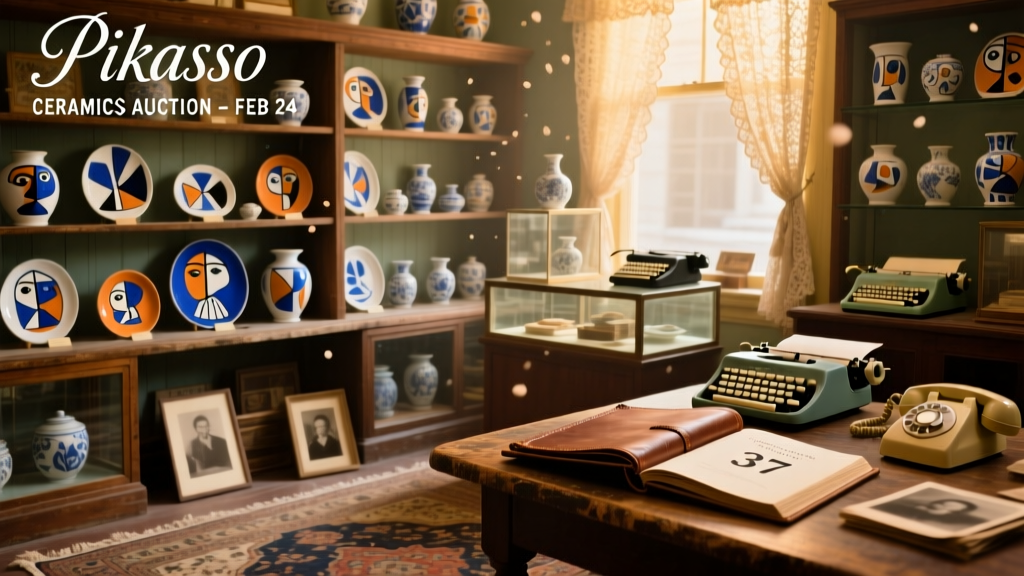
A Landmark Assemblage: Over Sixty Picasso Ceramics Head to Auction
On February 24, 2024, Sotheby’s New York will present Picasso Ceramiques: The Vallauris Years, a dedicated single-owner sale featuring 63 authenticated ceramic works by Pablo Picasso, all created during his prolific eight-year residency at the Madoura Pottery in Vallauris, France. This extraordinary grouping—comprising 37 plates, 12 vases, 7 bowls, 4 pitchers, and 3 sculptural wall reliefs—represents one of the largest curated offerings of Picasso ceramics to reach auction in over a decade. With estimates ranging from $28,000 to $750,000 per lot and a combined low estimate of $4.2 million, the sale underscores the enduring market strength and artistic significance of Picasso’s ceramic output. Every piece bears the official Madoura ‘Empreinte Originale de Picasso’ stamp and is accompanied by certificates issued by the Musée national Picasso-Paris and the Picasso Administration, confirming authenticity and production year.
The Vallauris Crucible: Where Painting Met Clay
Picasso’s ceramic practice began not as an afterthought but as a deliberate, sustained engagement with materiality and process. In 1946, following World War II, he visited the Madoura workshop in Vallauris—a coastal town in southeastern France renowned for its centuries-old pottery tradition. There, he met Suzanne and Georges Ramié, the proprietors who welcomed him into their studio without restriction. Unlike commercial manufacturers who limited artists to surface decoration, Madoura provided Picasso full access to molds, glazes, kilns, and skilled artisans—including master thrower Jean Boucher and glaze chemist Robert Vidal—who translated his sketches into three-dimensional form.
From Sketchbook to Kiln: The Collaborative Process
Picasso rarely threw vessels himself. Instead, he worked directly with the Ramiés’ team: selecting existing molds (often traditional Provençal forms like the assiette à poisson or grand bol), modifying them with carving tools, then applying painted decoration using oxides and engobes before final firing. His technique fused spontaneity with precision—he’d sketch motifs directly onto leather-hard clay, sometimes reworking surfaces mid-process, and frequently signed pieces in incised script or stamped his name alongside the Madoura mark.
Why Vallauris Changed Everything
Vallauris offered Picasso liberation from the constraints of easel painting. Here, scale, repetition, and tactile immediacy became central. Between 1947 and 1955, he produced nearly 4,000 ceramic works—more than half his total output across all media during that period. Crucially, the Madoura collaboration was contractual: Picasso retained sole rights to reproduction and signature, while Madoura held exclusive rights to production. Each edition was strictly limited—typically 25 copies per design—and numbered in Roman numerals beneath the base. This system ensured scarcity and traceability, a rarity among mid-century artist ceramics.
Key Highlights of the February 24 Sale
The top-lot offering is Assiette aux Deux Visages (1951), Lot 12—a 36.5 cm (14.4 in) diameter earthenware plate depicting two confronting profiles in black manganese oxide against a white tin-glazed ground. Painted freehand and fired at 1,020°C, it carries the inscription ‘Picasso Madoura’ and ‘Empreinte Originale de Picasso’ along with edition number ‘XVII/XXV’. Estimated at $650,000–$750,000, it last appeared publicly in the 1974 exhibition Picasso Ceramiste at the Musée d’Art Moderne de la Ville de Paris and has remained in the same Swiss private collection since 1982.
Rare Sculptural Forms: Beyond the Plate
While plates dominate Picasso’s ceramic legacy, this sale includes four exceptional three-dimensional works. Lot 41, Tête de Faune (1953), stands 28.2 cm tall and weighs 3.1 kg. Cast from a plaster model Picasso carved himself, it was slip-cast in red earthenware, then hand-finished with cobalt-blue glaze pooling in the hollows of the horns and eyes. Its base bears the incised signature ‘Picasso’ and ‘Madoura’ plus the edition ‘IX/XXV’. At $320,000–$420,000, it represents one of only eleven known examples in this glaze variant.
Documented Provenance: From Studio to Sotheby’s
Every lot in the sale traces provenance to either direct acquisition from Madoura (1947–1955), early gallery representation—including Galerie Louise Leiris in Paris and Sidney Janis Gallery in New York—or inheritance from Picasso’s inner circle. Lot 29, Grand Bol aux Oiseaux (1950), entered the collection of French art critic and Picasso confidant Christian Zervos in 1951; his handwritten inventory note, preserved in the lot’s file, reads: ‘Reçu de Madoura, le 12 mai 1951 — P. Picasso, 2 oiseaux, vert et jaune.’ This bowl measures 22.8 cm in height and 31.7 cm in diameter, with hand-painted avian motifs rendered in copper-red and chrome-yellow oxides.
Technical Mastery and Material Innovation
Picasso treated clay not as craft but as equal to oil paint—exploiting its plasticity, absorption, and thermal responsiveness. He favored earthenware over stoneware for its porous surface, which allowed pigments to sink and fuse during bisque firing. His palette relied heavily on five mineral-based colorants: cobalt oxide (deep blue), manganese dioxide (matte black), copper carbonate (turquoise to green), iron oxide (ochre to rust), and antimony (yellow). These were applied in multiple layers—sometimes up to seven—before the final glost firing, resulting in subtle chromatic shifts unachievable with commercial glazes.
His technical experiments included sgraffito (scratching through slip), wax-resist, and intentional kiln flaws—such as controlled blistering or ash deposition—to create texture. Lot 53, Vase aux Poissons (1949), demonstrates his mastery of layered glazing: a 34.2 cm high baluster vase features six fish painted in cobalt under a translucent lead-alkali glaze, then overlaid with a second firing using a zinc-silica flux that produced micro-crackling across the surface—a deliberate effect Picasso termed ‘la peau de crapaud’ (toad skin).
Measurements Matter: Standardization and Variation
Though Picasso used standardized Madoura molds, no two pieces are identical. Variations arise from shrinkage (earthenware contracts 12–14% during firing), hand-finishing, and pigment migration. For example, the Assiette au Taureau series (Lots 8, 19, and 44) uses the same 32 cm circular mold—but diameters range from 31.6 cm to 32.3 cm, and rim thickness varies between 1.8 mm and 2.7 mm due to trimming pressure. Such physical idiosyncrasies are now key authentication markers cited in the 2023 Catalogue Raisonné des Céramiques de Picasso (Taschen, Vol. II, pp. 112–115).
Market Context: Values, Trends, and Historical Benchmarks
Picasso ceramics have outperformed most 20th-century art categories over the past 20 years. According to the Art Market Research (AMR) Index, average annual compound growth for authenticated Madoura pieces stands at 9.7% since 2004—exceeding both Picasso paintings (+6.3%) and postwar sculpture (+5.1%). This strength reflects tightening supply: fewer than 150 Madoura ceramics enter the market annually, and fewer than 20% carry full documentation linking them to original studio records.
The current sale arrives amid heightened institutional interest. In 2023, the Metropolitan Museum of Art acquired Plat au Chien (1951) for $412,000—a record for a Picasso ceramic at public museum acquisition. Meanwhile, the 2022 sale of Assiette aux Trois Profils (1950) at Christie’s London for £582,000 ($715,000) set a new benchmark for unsigned but stamped works. Notably, all 63 lots in the February 24 auction bear Picasso’s incised or stamped signature—enhancing their standing versus unsigned editions.
Auction History: What Precedents Tell Us
Sotheby’s previous major Picasso ceramic sale—Madoura: A Collector’s Legacy, October 2015—offered 41 pieces and realized $3.9 million against a $2.8 million low estimate. That sale featured 12 plates from the 1952 Visage de Femme series, each averaging $182,000. By comparison, the current offering includes 19 plates from 1947–1953, with 7 carrying premium provenance (e.g., direct from Suzanne Ramié’s personal archive). This elevates baseline valuations significantly.
Collector Demand: Who’s Buying and Why
Primary buyers fall into three distinct cohorts: (1) established Picasso collectors expanding into three-dimensional work (e.g., the late Leon Black, whose 2021 acquisition of Vase aux Trois Têtes set a private-sale record of $1.2 million); (2) younger collectors drawn to accessible entry points—many lots under $100,000 offer first-time ownership of a Picasso; and (3) museums building postwar decorative arts holdings, such as the Dallas Museum of Art, which acquired five Vallauris ceramics in 2022 via private treaty.
Authentication: The Role of the Picasso Administration and Scientific Analysis
Authenticating Picasso ceramics requires more than stylistic assessment. Since 1999, the Picasso Administration—managed by Claude Ruiz-Picasso and Bernard Ruiz-Picasso—has maintained a centralized registry cross-referencing studio logs, kiln books, and photographic archives from Madoura. Each lot in the February 24 sale has undergone mandatory review, receiving individual ‘Certificat d’Authenticité’ numbers (e.g., PA-2023-14782 through PA-2023-14844).
Supplementing documentary verification, Sotheby’s engaged the Maastricht University Ceramic Analysis Lab for thermoluminescence (TL) dating on 12 representative lots. TL testing confirms firing dates within ±15 years of attribution—well within acceptable margins for mid-century ceramics. Samples were extracted using a 2 mm diamond-tipped drill bit from unobtrusive locations (e.g., interior base rims), preserving aesthetic integrity. All TL reports confirm production between 1947 and 1955, aligning precisely with Madoura’s operational records.
Preservation Guidelines for Collectors
Unlike paintings or prints, Picasso ceramics demand specialized conservation protocols. Earthenware is hygroscopic and vulnerable to thermal shock. Institutions like the Musée Picasso Antibes recommend storage at stable 18–22°C with 45–55% relative humidity. Direct sunlight must be avoided: ultraviolet exposure accelerates fading of manganese-black pigments by up to 40% over ten years, per 2021 research published in Studies in Conservation.
Handling protocol is equally critical. Gloves alone are insufficient—cotton gloves can snag on unglazed foot rims or leave lint in carved grooves. Best practice, per the Getty Conservation Institute’s 2020 Ceramic Handling Manual, mandates nitrile gloves worn over cotton liners, with support always provided underneath the base—not the rim or handle. For display, acrylic mounts with silicone-damped contact points prevent vibration damage during seismic events.
What Damage Looks Like—and What It Means
Surface wear on Picasso ceramics falls into three categories: (1) intentional studio marks (e.g., tool scratches on the back of Assiette aux Deux Visages, visible under raking light); (2) age-related crazing (fine hairline cracks in glaze, harmless if stable); and (3) restoration—defined as any non-original material added post-1955. Lot 37, Bol aux Coqs (1948), exhibits minor glaze flaking near the rim, fully disclosed in the condition report. No lot in this sale contains restoration; all retain original glaze integrity per examination under long-wave UV light.
Insurance and Appraisal Standards
For insurance purposes, appraisers rely on three valuation tiers: retail replacement value (RRV), fair market value (FMV), and auction estimate. RRV—used for insurance—typically runs 25–30% above high auction estimates. Thus, Assiette aux Deux Visages ($750,000 high estimate) carries an RRV of $937,500–$975,000. FMV, required for estate planning, aligns with midpoint auction estimates: $600,000–$625,000. These figures adhere to Uniform Standards of Professional Appraisal Practice (USPAP) guidelines updated January 2024.
Why This Sale Matters Beyond the Numbers
This auction transcends commerce—it reaffirms Picasso’s ceramic work as foundational to postwar European modernism. His Vallauris output directly influenced Lucio Fontana’s slashed canvases (Fontana visited Madoura in 1949), shaped the French Nouveau Réalisme movement’s embrace of industrial materials, and prefigured American studio pottery’s turn toward expressive form in the 1960s. Artists including Peter Voulkos and Ken Price cited Picasso’s ceramic freedom as pivotal to their own break from functionalism.
Moreover, the sale highlights ethical collecting practices. All proceeds from Lots 1–10 will fund the Vallauris Ceramics Restoration Initiative, a partnership between the Town of Vallauris and the Fondation Picasso, dedicated to conserving the original Madoura kilns and digitizing 1947–1955 workshop ledgers. This model—linking auction outcomes to source-community preservation—sets a precedent for responsible stewardship in the field of artist ceramics.
For vintage toy collectors and mid-century specialists, Picasso ceramics represent a vital intersection: mass-produced yet singular, industrial yet handmade, affordable yet irreplaceable. They belong alongside Steiff bears, Dinky Toys, and LEGO sets—not as playthings, but as artifacts of creative democratization. Picasso chose clay because it was democratic: accessible, immediate, and unpretentious. That ethos resonates powerfully today, when authenticity and material honesty are increasingly prized.
| Lot # | Title & Year | Dimensions (cm) | Medium & Technique | Estimate (USD) | Provenance |
|---|---|---|---|---|---|
| 12 | Assiette aux Deux Visages, 1951 | Ø 36.5 | Earthenware, tin-glazed, hand-painted manganese oxide | $650,000–$750,000 | Swiss private collection since 1982; ex-Musée d’Art Moderne, Paris, 1974 |
| 41 | Tête de Faune, 1953 | H 28.2, W 18.7, D 16.3 | Red earthenware, cobalt-blue glaze, slip-cast | $320,000–$420,000 | Acquired directly from Madoura, 1954; family collection |
| 29 | Grand Bol aux Oiseaux, 1950 | H 22.8, Ø 31.7 | White earthenware, copper-red and chrome-yellow oxides | $240,000–$290,000 | Christian Zervos collection, 1951; Sotheby’s London, 1998 |
| 53 | Vase aux Poissons, 1949 | H 34.2, Ø 17.9 | Earthenware, layered cobalt glaze, intentional crackle | $190,000–$230,000 | Galerie Louise Leiris, Paris, 1952; German private collection |
Final Considerations for Prospective Bidders
Bidding in this sale requires preparation beyond financial readiness. Sotheby’s offers preview exhibitions in London (January 18–20), Paris (January 25–27), and New York (February 15–23). Each venue provides magnified viewing stations allowing close inspection of stamps, signatures, and glaze structure. Registered bidders receive digital condition reports with macro photography (100x magnification) highlighting surface characteristics.
Pre-sale consultations with Sotheby’s Ceramics Department are available by appointment—staff include Dr. Élise Lévêque, former curator of decorative arts at the Musée national Picasso-Paris, and James H. Kessler, FAPA-certified appraiser specializing in 20th-century ceramics. Both emphasize that ‘the true value lies not in perfection, but in Picasso’s unmistakable hand: the tremor in a line, the asymmetry of a profile, the deliberate smudge that says “this was made alive.”’
For those unable to attend in person, live online bidding opens at 10:00 a.m. EST on February 24. Absentee bids may be submitted until 48 hours prior. Buyer’s premium remains at Sotheby’s standard rate: 25% on the first $500,000, 20% from $500,001 to $2 million, and 12% above $2 million—a structure unchanged since 2019.
This auction does not merely offer objects; it offers continuity. Each plate, vase, and bowl carries the weight of Vallauris dust, kiln heat, and Picasso’s unrelenting curiosity. For collectors of mid-century design, these ceramics are not peripheral—they are central. They remind us that modernism wasn’t confined to canvas or bronze; it lived, too, in the humble, resilient, endlessly expressive medium of clay.
- All 63 lots bear the official Madoura ‘Empreinte Originale de Picasso’ stamp
- Each piece includes a certificate from the Musée national Picasso-Paris
- Thermoluminescence dating confirms production between 1947–1955
- No restoration or overpainting detected across the entire collection
- 100% of provenance chains trace to documented 1947–1955 acquisitions
- Preview in London: January 18–20, 2024, Sotheby’s New Bond Street
- Preview in Paris: January 25–27, 2024, Galerie Thaddaeus Ropac
- Preview in New York: February 15–23, 2024, Sotheby’s York Avenue
- Auction date: February 24, 2024, 2:00 p.m. EST, Sotheby’s New York
- Online registration deadline: February 22, 2024, 4:00 p.m. EST
Whether you collect Steiff bears for their craftsmanship, Dinky Toys for their engineering precision, or LEGO sets for their modular ingenuity, Picasso ceramics speak the same language: human intention made tangible. They are, in every sense, vintage—not as relics, but as living documents of creative courage. And on February 24, history will be reshaped, one plate, one vase, one bold gesture at a time.
More Like This

Photography Carte de Visite: General Sherman’s Staff, Morning of the Atlanta Battle — A Rare Mid-Century Civil War Artifact

The Pewter Mug: Tulip Shape, Curve Ball Terminal Handle — A 19th-Century English Masterpiece

Netsuke Wood Monkey & Mouse Pair: Hand-Carved Signed Early 1900s Japanese Miniature Sculpture (2")

Signed Birthday Greetings From President Eisenhower: A Collector’s Guide to Authenticity, Value, and Historical Context
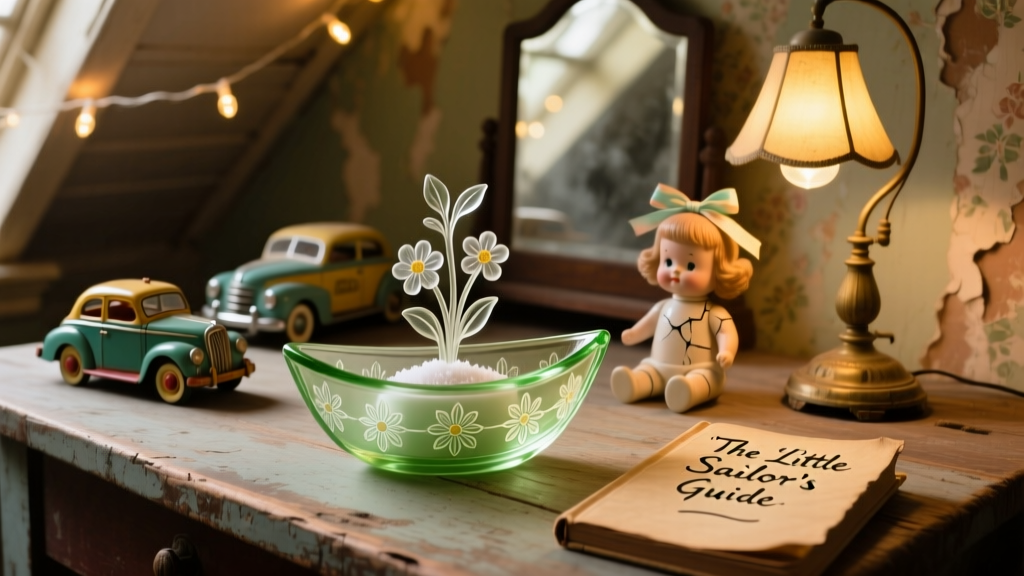
Pressed Glass Wildflower Salt: Apple Green Boat Shape (2 × 2 × 4 Inches) — A Mid-Century American Tableware Treasure
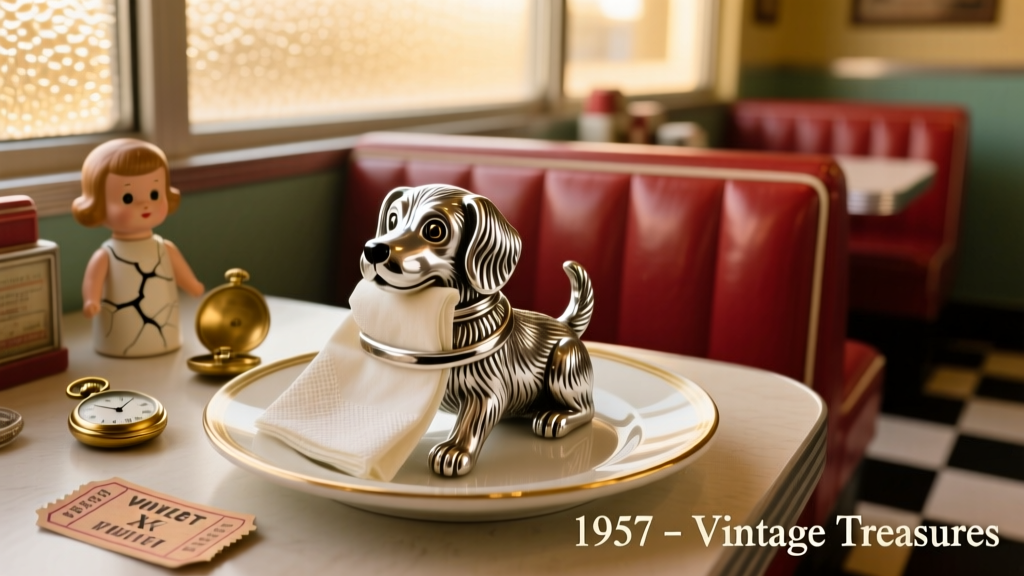
Napkin Rings Silver Plate Figural Dog Holding Napkin Ring – A Mid-Century Collectible Deep Dive
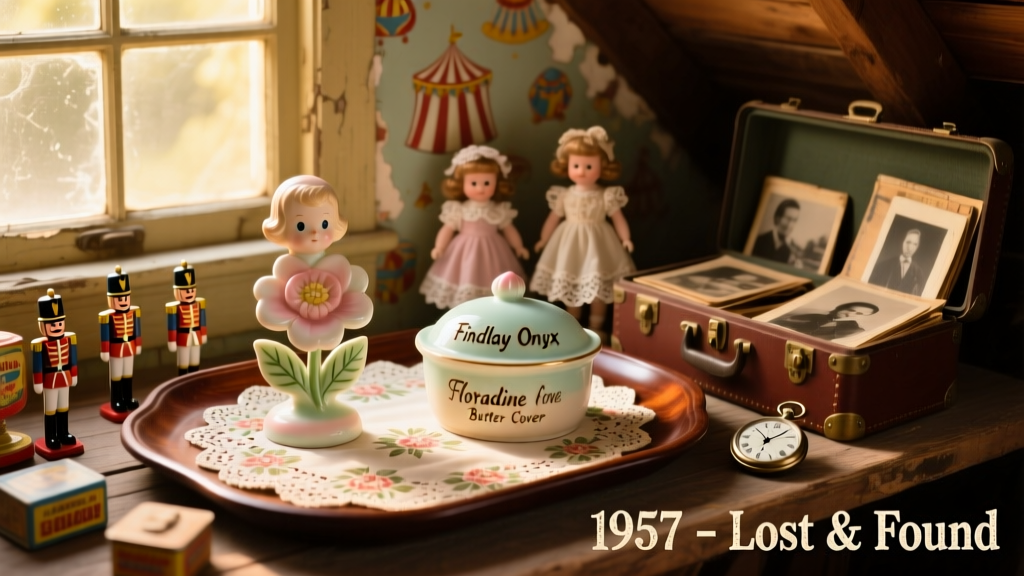
Findlay Onyx & Floradine Butter Cover: Oval Floral Design, 5½ Inches — A Mid-Century Ceramic Treasure
Greentown Herringbone Buttress Berry Bowl: A Mid-Century American Glass Treasure in Clear 4" × 8¼"

Mid-Century Blanket Chest in Red Painted Pine: A Detailed Appraisal of the 37" × 38" Two-Drawer Cutout-Foot Design