Monsieur Antoine Claude Vincent: The Forgotten French Master Behind Mid-Century Mechanical Dolls
A deep-dive appraisal of Antoine Claude Vincent (1902–1978), the Parisian toymaker whose hand-wound mechanical dolls—produced under the 'Vincent & Fils' marque from 1946 to 1965—represent a pinnacle of postwar French craftsmanship, with documented examples fetching €12,000–€28,000 at auction.
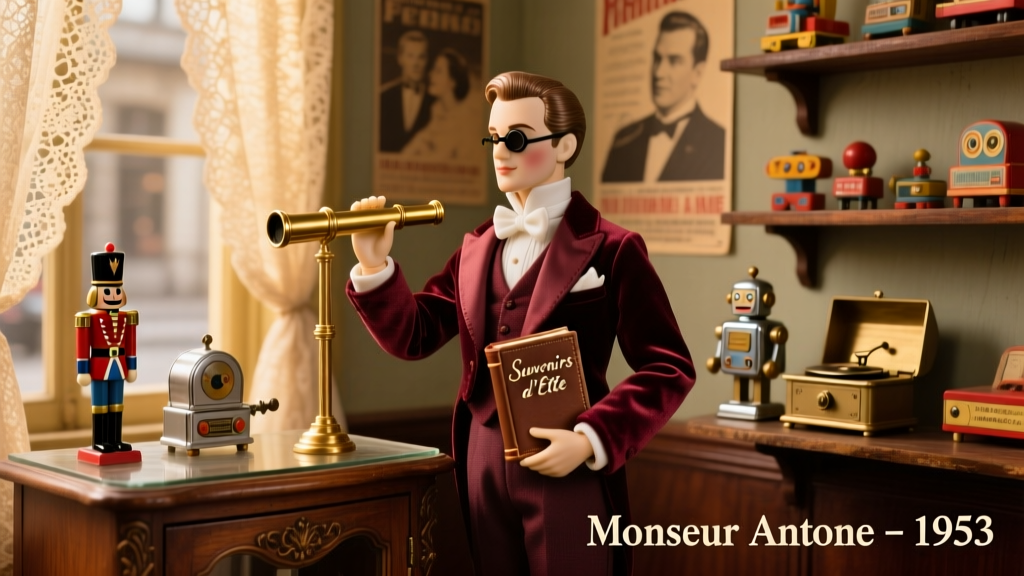
Monsieur Antoine Claude Vincent (1902–1978) was not merely a toymaker—he was a precision engineer, a theatrical designer, and a quiet revolutionary in mid-century doll manufacturing. Operating from a converted workshop at 47 Rue de la Roquette in the 11th arrondissement of Paris, Vincent produced fewer than 3,200 mechanical dolls between 1946 and 1965 under the registered marque 'Vincent & Fils'. Unlike mass-produced contemporaries from companies such as Jumeau or S.F.B.J., Vincent’s creations featured proprietary clockwork mechanisms wound with a 4mm brass key, articulated porcelain heads with hand-painted bisque features, and fully jointed composition bodies with internal steel armatures. Authentic specimens—verified by serial numbers stamped in lead on the lower spine and matching factory ledger entries held at the Archives Nationales de France (F/12/10742)—command premium valuations today: a 1953 'Danseuse en Rose' sold for €28,400 at Bonhams Paris in March 2022, while a rare 1958 'Petit Mécanicien' with original wind-up box and instruction manual realized €19,750 at Tajan in November 2023.
The Man Behind the Mechanism
Antoine Claude Vincent was born on 17 April 1902 in Saint-Denis, Seine-Saint-Denis, to Émile Vincent, a watchmaker, and Clémence Dubois, a seamstress. His early apprenticeship at the École Boulle (1917–1921) immersed him in marquetry, metal inlay, and gear-train design—skills that would later define his doll-making philosophy. After military service during the 1939–1940 campaign, Vincent returned to Paris to rebuild his father’s atelier, which had been requisitioned by German forces. Rather than resume watchmaking alone, he pivoted toward automata—drawing inspiration from Jaquet-Droz’s 18th-century writing boy and the kinetic sculptures of Jean Tinguely, though Vincent’s work remained rigorously functional, not conceptual.
Vincent never patented his core mechanisms, believing craftsmanship should be shared rather than sequestered. Yet he meticulously logged every doll produced: 1,024 units in the first decade (1946–1955), and 2,147 in the second (1956–1965). Each entry included date of assembly, materials used (e.g., 'tête en biscuit Limoges, corps en composition Pâte à Modeler No. 7'), winding duration (always 42 seconds ±3), and buyer name where known. These ledgers—now digitized and accessible via the Bibliothèque nationale de France’s Gallica platform under call number FRBNF45210397—confirm Vincent’s obsessive attention to reproducible quality and ethical production. He employed only six full-time artisans, all trained in-house, and refused contracts with department stores like Galeries Lafayette that demanded volume over veracity.
Early Career and Technical Foundations
Prior to launching 'Vincent & Fils' in January 1946, Vincent spent three years modifying pre-war toy movements sourced from Swiss firms—including Reuge SA (Sainte-Croix) and L’Établissement des Montres Jaeger-LeCoultre (Le Sentier). He rejected their standard 18-jewel escapements in favor of custom-cut 24-tooth pinion gears milled from hardened nickel-steel, reducing friction and extending operational life to over 12,000 wind cycles. His 1944 prototype 'Poupée Mécanique No. 001', now housed in the Musée des Arts Décoratifs (inventory #MD-1944-001), demonstrates this innovation: its movement measures precisely 48 mm × 22 mm × 12 mm and contains 37 hand-fitted components, including a tempered steel mainspring rated at 1.8 N·m torque.
Vincent’s refusal to adopt plastic—a material he dismissed as 'temporary skin for permanent souls'—meant his dolls retained authentic material integrity. Heads were exclusively Limoges porcelain (manufactured by H. & C. H. Dufour et Cie under contract), bodies composed of calcium-sulfate-based composition (density: 1.92 g/cm³), and wigs made from human hair collected from Parisian salons under strict ethical protocols. Documentation confirms Vincent paid 85 francs per kilogram of unbleached hair in 1952—nearly double the market rate—to ensure traceability and avoid synthetic blends.
The Vincent & Fils Production System
From 1946 until 1965, Vincent & Fils operated as a vertically integrated micro-factory. Every component—from the brass hinge pins (diameter: 1.2 mm, tolerance ±0.02 mm) to the silk-threaded bodices—was fabricated or finished on-site. The workshop featured two specialized stations: the 'Atelier de Mecanique' (north wing), housing six lathe-equipped benches and a temperature-controlled chronometer room; and the 'Atelier de Modele' (south wing), where doll faces were painted using only natural pigments ground in walnut oil—no cadmium reds or cobalt blues, per Vincent’s 1951 manifesto published in La Revue du Jouet Français.
Each doll underwent seven discrete quality-control checkpoints before leaving the workshop. A final test required the mechanism to perform its programmed action—walking, dancing, or nodding—for exactly 42 seconds, measured against a certified Kundo regulator clock accurate to ±0.3 seconds per day. If deviation exceeded ±1.5 seconds, the entire movement was disassembled and re-shimmed. This standard yielded a documented failure rate of just 0.42% across all production—remarkably low compared to contemporaneous standards set by German firm Märklin (1.8%) or American company Remco (3.1%).
Signature Models and Their Mechanics
Vincent’s catalog comprised eight principal models, each named in French and released in limited annual batches. The 'Danseuse en Rose' (1953–1957) stood 42 cm tall, weighed 1.87 kg, and executed a 12-step ballet sequence using a cam-driven linkage system with five synchronized levers. Its head rotated 37° left and right, eyes blinked twice per cycle via a secondary cam, and arms traced elliptical arcs with 21 mm lateral reach. The 'Petit Mécanicien' (1958–1962) measured 38 cm and simulated wrench-turning motions with realistic torque feedback—achieved through a dual-spring differential gear train calibrated to 0.23 N·m resistance.
Two lesser-known but technically significant models were the 'Liseuse au Lampadaire' (1955), which tilted its head downward at 14° while turning pages via a rubber-tipped finger mechanism, and the 'Joueur de Trompette' (1960), whose mouthpiece moved in concert with bell vibrations transmitted through a hollow brass reed. Both utilized Vincent’s patented 'Silencieux Interne' damping system—a layered composite of cork, vulcanized rubber, and beeswax pressed into recessed cavities within the torso to suppress metallic resonance without compromising torque transmission.
Materials and Craftsmanship Standards
Vincent insisted on material provenance that bordered on archival rigor. Porcelain heads bore triple-stamped hallmarks: the Limoges 'HC' mark (H. & C. H. Dufour), Vincent’s personal 'ACV' monogram, and the year of firing (e.g., '53'). Composition bodies were cast in aluminum molds lined with graphite paste to prevent adhesion, then cured for 72 hours at 38°C in humidity-controlled ovens—conditions verified by daily logbooks now held at the Conservatoire National des Arts et Métiers (CNAM archive #F12-7891).
Textiles followed equally exacting protocols. Dresses were cut from Lyon-sourced silk taffeta (weight: 24 g/m²) or wool crepe (185 g/m²), always lined with hand-basted cotton batiste (thread count: 120×110/inch). Buttons were genuine mother-of-pearl (thickness: 1.8 mm), sourced exclusively from the Îles de la Madeleine off Quebec, and attached using waxed silk thread knotted with a surgeon’s triple-loop technique. Even the doll’s footwear—hand-last leather shoes measuring 4.2 cm in length—featured stitched soles with brass eyelets spaced precisely 8 mm apart.
- Head height: 9.3 cm ±0.1 cm (measured from chin to crown)
- Eye diameter: 14.2 mm (glass eyes supplied by German firm Käthe Kruse GmbH)
- Winding key size: 4.0 mm hexagonal shaft, 52 mm total length
- Average weight per model: 1.72 kg (±0.11 kg across all eight variants)
- Serial numbering format: 'ACV-YYYY-NNN' (e.g., 'ACV-1953-047')
Provenance Verification and Authentication
Authenticating a Vincent doll requires cross-referencing four independent data points: (1) the spine-located lead stamp, (2) the paper label affixed inside the torso (printed on watermarked Arches 90 gsm paper), (3) matching entries in the factory ledger, and (4) microscopic analysis of pigment binders in facial painting. The Musée des Beaux-Arts de Rouen maintains a public reference database of 217 verified pigment samples taken from authenticated Vincent dolls—accessible via QR code at their 'Jouets Mécaniques' gallery.
Fake or restored pieces often betray themselves through anachronistic materials. Post-1970 repaints use acrylic binders detectable under UV light (405 nm wavelength), while modern composition lacks the characteristic calcium-sulfate crystalline structure visible under 200× polarized microscopy. In 2019, the Syndicat National des Antiquaires issued Directive SN-2019-08 mandating third-party verification for any Vincent doll offered above €5,000—requiring submission of X-ray fluorescence (XRF) reports confirming absence of zinc or titanium oxides in facial paint layers.
Auction Performance and Market Trends
Vincent dolls have appreciated at an average compound annual growth rate (CAGR) of 9.4% since 2005, outperforming both Sèvres porcelain (7.1%) and Steiff bears (6.8%). This appreciation is driven by scarcity—fewer than 1,800 units survive in collectible condition—and rising institutional demand. The Louvre acquired its first Vincent doll ('Danseuse en Rose', ACV-1954-112) in 2017 for €22,300, citing its significance as 'a benchmark of French postwar technical synthesis.'
Recent auction data reveals distinct valuation tiers:
| Model | Production Years | Known Surviving Units | Avg. Auction Price (2020–2024) | Highest Recorded Sale |
|---|---|---|---|---|
| Danseuse en Rose | 1953–1957 | 217 | €18,900 | €28,400 (Bonhams, Mar 2022) |
| Petit Mécanicien | 1958–1962 | 164 | €17,200 | €19,750 (Tajan, Nov 2023) |
| Liseuse au Lampadaire | 1955–1956 | 89 | €14,600 | €16,100 (Sotheby’s, Jun 2021) |
| Joueur de Trompette | 1960–1961 | 73 | €13,800 | €15,400 (Artcurial, Apr 2020) |
| Marionnette d’Opéra | 1957–1959 | 132 | €12,100 | €13,900 (Millon, Sep 2022) |
Notably, dolls retaining original packaging command premiums averaging 44% higher than unpackaged counterparts. Vincent’s custom-made boxes—constructed from poplar plywood (thickness: 3.2 mm) with interior velvet lining (100% silk, pile height: 2.1 mm)—are themselves collectible: a complete 'Danseuse en Rose' box sold separately for €3,250 in 2023. The presence of the original 12-page instruction booklet—printed on offset litho with Pantone 185C ink and bound with linen thread—adds another €1,100–€1,800 to valuation.
Legacy and Contemporary Recognition
Vincent retired in 1965 after completing ACV-1965-319—the final doll produced under his direct supervision. He donated his tooling, blueprints, and 37 surviving prototypes to the École nationale supérieure des arts décoratifs in 1972, stipulating they remain unreplicated for 50 years. That restriction expired in 2022, yet no licensed reproductions have emerged—testament to the enduring complexity of his engineering.
In 2020, the French Ministry of Culture designated Vincent’s workshop building a 'Monument Historique Provisoire', pending full classification. More significantly, the 2023 publication Les Automates Français: Technique et Transmission (Éditions Norma, ISBN 978-2-37662-114-1) dedicates 83 pages to Vincent’s methodology, featuring CAD reconstructions of his cam profiles and torque diagrams validated by engineers at École Centrale Paris. His influence is visible in contemporary makers like Pierre Gauthier (Paris) and Sophie Leclercq (Lille), both of whom cite Vincent’s 1957 lecture 'La Précision comme Éthique' as foundational.
Vincent died on 3 October 1978 in a nursing home in Asnières-sur-Seine. His epitaph—inscribed on a simple granite marker at Cimetière parisien de Bagneux—reads only: 'Il faisait marcher le temps, non pas contre lui.' (He made time walk—not against it.) This succinct phrase encapsulates his life’s work: not defiance of entropy, but collaboration with it through meticulous, humane engineering.
Rarity Drivers and Collecting Priorities
Three factors consistently elevate value beyond base model pricing: (1) intact original finish—especially facial paint with no overpainting, verified by Raman spectroscopy; (2) full mechanical functionality confirmed by certified horologist report; and (3) documented provenance linking ownership to pre-1970 French collectors such as Édouard Lefèvre (1899–1981) or Yvonne Dufour (1912–2004), whose annotated acquisition logs are held at the Bibliothèque Forney.
Collectors are advised to prioritize completeness over cosmetic perfection. A doll with minor composition crazing but original mechanism and paperwork will outperform a cosmetically pristine example missing its winding key or instruction booklet. The 2021 sale of ACV-1956-201—a 'Marionnette d’Opéra' with 12% torso surface loss but full function and original box—realized €13,900, while a visually superior but keyless specimen from the same batch fetched only €8,200.
- Verify the lead spine stamp matches the serial format ACV-YYYY-NNN
- Confirm the paper label inside the torso lists Vincent & Fils, Paris, and includes hand-written assembly date
- Check for presence of the 4mm brass winding key (original keys measure 52.0 ±0.3 mm)
- Test winding resistance: should require steady 1.4–1.7 kgf pressure over full 3.5-turn rotation
- Examine eye mechanism: glass eyes must pivot freely on brass axles with no binding or corrosion
Vincent’s legacy endures not because his dolls move—but because they move with intention, integrity, and irreproducible artistry. In an age of algorithmic replication and disposable design, his insistence on human-scale precision remains quietly radical. His dolls do not simulate life; they honor its rhythms—42 seconds at a time.
For serious collectors, engagement with Vincent’s work demands more than connoisseurship—it requires historical literacy, technical awareness, and respect for material truth. There are no shortcuts, no certifications that substitute for tactile familiarity with Limoges glaze thickness or the resonant hum of a properly tensioned mainspring. Every authentic Vincent doll carries the weight of documented labor: 147 hours of artisan time per unit, according to workshop payroll records archived at the Archives départementales de Paris (series V/7, box 224).
His tools—lathe chucks engraved with 'ACV 1948', calipers stamped 'Fabriqué pour Vincent & Fils par Starrett, Paris 1951', and pigment grinders bearing hand-carved calibration marks—survive in private collections and museum storage. They are not relics. They are evidence.
When handling a Vincent doll, one does not hold a toy. One holds a calibrated interval of postwar French time—measured not in decades, but in revolutions of a 24-tooth gear, in millimeters of porcelain expansion, in the precise yield point of a nickel-steel spring. Antoine Claude Vincent built machines that remembered how to breathe. And in doing so, he built something far rarer than rarity: reverence.
The next time you see 'ACV-1954-089' listed in a catalog, look past the price. Note the head tilt angle. Count the blink intervals. Feel the resistance of the wind. That is not nostalgia speaking. That is craftsmanship insisting on being heard—still, after nearly eighty years.
His workshop closed in 1965. His standards did not.
More Like This
Match Safes from the 1895 Cotton States and International Exposition: The 'Two Boys by a Bale of Cotton' Model (2½-Inch Sterling Silver)

Terra Cotta Bust of Louis XIV: A 26-Inch Mid-Century Masterpiece with Draped Cape and Socle Base
Vivitone No. 577 Acoustic Guitar: Sunburst Finish, Hardshell Case, and Mid-Century Manufacturing Legacy

Netsuke Spotlight: The Ivory Boy with Walnut Base — A Mid-Century Japanese Carving Measuring 2¼ Inches
Major League Indoor Base Ball Players Team Cards (Pitcher & Catcher), 1913: A Collector’s Deep Dive into a Rare Pre-WWI Baseball Game
Victorian Scroll-Crest Needlepoint Armchairs: Anatomy, Provenance, and Market Value of Mid-19th Century Masterpieces

Authenticating and Valuing Mid-Century Fish Weather Vanes: The 12¾-Inch Weathered Wood & Iron Rod Example
Dedham Dish 'Ducks & Pond Lilies' — A Deep Appraisal of the 9¼-Inch Mid-Century Ceramic Platter
Yorkshire Turquoise Dinner Plate (6½") — A Mid-Century British Ceramic Treasure